
Discover how to standardize operations in coffee shop and restaurant branches. Practical guide with SOPs, audits, and technology to scale in LATAM.
Coffee works great in the first branch because the founder is present, corrects every drink, and knows by heart the right way to open, charge, clean, and close. When opening the second unit, that memory is divided among teams, schedules, and cities. An espresso comes out differently, a portion changes, the wait time lengthens, and the customer begins to notice that the brand no longer offers the same experience.
The conclusion is direct: how to standardize operations in branches does not consist of copying a manual, but of building a system that allows repeating what is important, measuring deviations, and adapting what depends on the neighborhood. The practical rule is to standardize the operational core and leave room for local adaptation, with audits, training, and data that maintain control after the opening.
The hidden cost of opening a second unit
Opening a second branch without control systems can destroy the profitability and reputation that made the first one successful. The most common mistake is assuming that the original team will transmit knowledge naturally. In reality, each person interprets verbal instructions according to their experience, shift pressure, and personal judgment.
A coffee shop can maintain a reasonable recipe while the owner weighs the coffee, checks the extraction, and corrects the plating. When that supervision disappears, small variations appear and accumulate: overheated milk, syrups served without measurement, poorly identified cups, discounts applied without authorization, or inventory received without a uniform review.
In Mexico, standardization has a broad institutional base. The Ministry of Economy, through the General Directorate of Standards, coordinates the national standardization system and can formulate, review, issue, modify, and cancel Mexican Official Standards and Mexican Standards. In addition, the country has 49 federal representations distributed across 32 delegations and 17 sub-delegations, a territorial coverage designed to bring homogeneous compliance and supervision criteria at a national level, according to information from the Ministry of Economy on standardization.

Standardizing does not mean freezing the branch
Total rigidity does not work either. A coffee shop in a corporate area may concentrate its operations early, while a unit in a residential neighborhood needs to respond to a different flow. A barbershop can keep its hygiene and payment protocols identical but adjust its promotions according to local demand. A restaurant can protect recipes, portions, and service, even if its hours or neighborhood communication change.
The 80/20 rule offers a point of balance:
Standardized core: recipes, weights, preparation, payment, authorized discounts, cleaning, security, service, visual identity, and cash register closing.
Local adaptation: hours, neighborhood activations, close alliances, promotional messages, and commercial adjustments justified by the flow of each location.
Operational rule: if a variation affects taste, safety, money, or brand perception, it must be approved and documented. If it only adapts the way of attracting local demand, it can be left in the hands of the branch within defined limits.
The need is visible in business data. In Mexican retail, 22.3% of large economic units declared complying with environmental standards in 2018, 26.2% did not know if they complied with any standard, and 51.5% did not comply, according to Data México on retail trade. The data does not describe every business, but it does show the gap that can exist between operating and controlling.
NORMEX reports that it operates as a registered National Standardization Body since 1993 and that it has participated in the elaboration and issuance of NMX in 14 industrial branches covering more than 33 sectors of the national economy, as gathered in the reference from the Ministry of Economy. For an SME with branches, documenting the standard is not additional bureaucracy. It is the way to turn geographical expansion into repeatability, evidence, and corrective capacity.
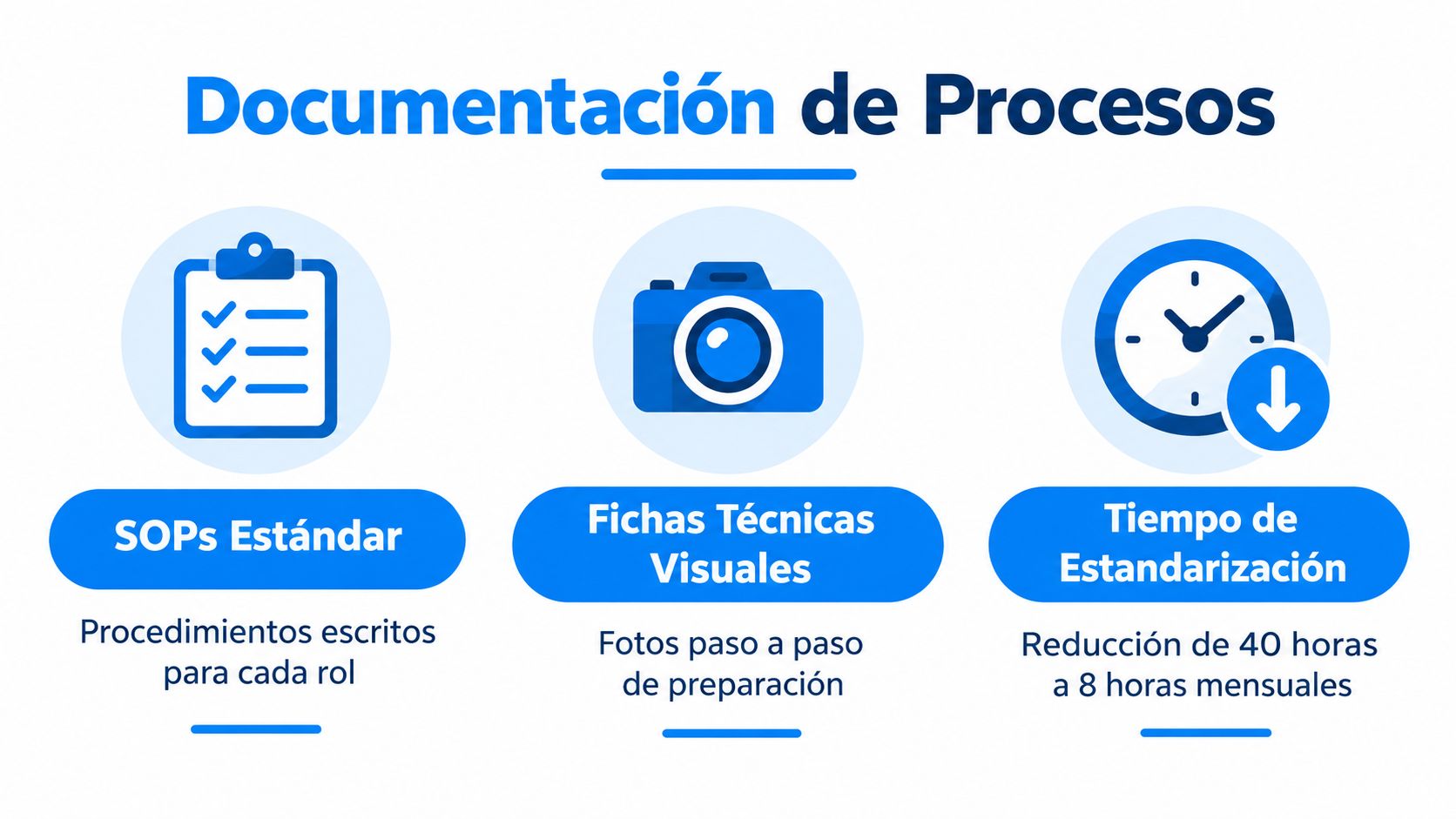
Process documentation and visual technical sheets
A useful SOP answers three questions before the shift begins: what must be done, who does it, and how it is verified. A manual that only describes brand values or general recommendations does not solve execution. The employee needs observable, ordered, and accessible instructions at the point where the task occurs.
Documentation must start with the 80% that cannot vary. In a restaurant, that includes receipt of supplies, storage, mise en place, preparation, plating, payment, cleaning, and closing. In a coffee shop, it is useful to cover calibration, drink recipes, milk handling, labeling, delivery, and waste control. In a barbershop or beauty salon, the core includes disinfection, workstation preparation, customer consultation, payment, and closing.
What a technical sheet should contain
A visual technical sheet does not replace professional judgment. It makes it transferable. For each critical product, the sheet must show the final reference and describe the controls that affect the result.
Expected result: photograph of the finished dish, drink, or service, with approved dinnerware, position, and appearance.
Critical weights: quantities of ingredients whose variation alters taste, cost, or perceived size.
Assembly sequence: maximum of 4 steps, ordered so that the employee can execute them during service.
Visual lines: levels of sauce or topping, height, distribution, and any signal that allows comparison without relying on an oral explanation.
Control points: temperature, texture, dish cleanliness, label, packaging, or presentation before delivery.
Nestlé Professional México recommends documenting dishes with reference photos, critical weights, a quick assembly sequence of maximum 4 steps, and sauce or topping levels as a visual line. It also proposes shift reviews, physical comparison of dishes, and a sensory scale from 1 to 5 to monitor consistency, according to its restaurant administration guide.
The manual must follow the customer's journey
Documentation works best when organized by zone, not as an endless document. The kitchen must have its recipes, preparation, storage, and cleaning. The bar needs its drinks, calibrations, replenishment, and utensil handling. The dining room requires protocols for welcome, delivery, complaints, and cleaning. The register must define opening, payment, cancellations, discounts, returns, and daily closing.
Each SOP must include:
Concrete objective, for example, delivering a drink with the same taste and presentation.
Responsible person, with a clear role and not with the phrase
Related Blogs

Nov 10, 2026
How to manage multiple restaurant locations from a single system?

Nov 9, 2026
Which CRM is best for a small business in Mexico? 2026

Nov 8, 2026
What works better for a small business: WhatsApp promotions or email promotions?

Nov 7, 2026
How do you calculate a business's net purchases? Formula and example in MXN

Nov 6, 2026
How much does a point-of-sale system cost for a small business in Mexico?

Nov 5, 2026
How to Create an Executive Breakfast Menu to Sell to Offices: 2026 Guide