Learn how to train staff in suggestive selling techniques. A guide with real strategies to increase the average ticket and customer loyalty.
Training staff in suggestive selling is a plan, not a motivational speech: product, scripts, role-play, and measurement. The goal is to suggest with utility (not pressure) to increase the ticket without damaging the experience. Long definitions live in what is upselling; here you will build the 4-week training.
4-Week Training Plan
Week | Focus | Manager's Checklist | Team Deliverable |
|---|---|---|---|
1 | Product | Top 10 items + 3 possible combos | Each person explains 5 suggestions without reading |
2 | Scripts | Phrases by industry (coffee, retail, service) | 10-min role-play at opening |
3 | Role-play + objections | “No thanks”, price, “the same thing again” | 1:1 written feedback |
4 | Measurement | Compare ticket or sales per employee in the POS (if the report allows) or keep a simple sheet per shift | Weekly goal of suggestive attempts, not “closing by force” |
Short scripts by industry (examples):
Coffee shop: “Would you like it with [extra] or in size [Y]? It goes well with what you ordered.”
Restaurant: “[Side dish/appetizer] usually works well for sharing; shall we add it?”
Retail: “People who buy X usually need Y; shall we check it out?”
Measurement: in Swirvle you can support sales analysis by period in the POS; if you don't break down by employee yet, record attempts/acceptances by hand per shift. Ticket at the table: increase average ticket in restaurant. Complete process: sales process.
Redefining suggestive selling in your business

There is a misconception that suggestive selling is an aggressive tactic to push products that no one asked for. Nothing could be further from the truth. When done well, it becomes a genuine act of service. It is the art of anticipating a need that the customer had not even expressed and proposing a solution that improves their purchase.
Think about the difference. It is not the same for a cashier to repeat from memory "do you want to upsize your combo?" as it is for a barista in a coffee shop in Puebla to tell you: "I noticed you ordered an Americano, which has an intense roast. Our freshly baked corn cake has a sweetness that balances that flavor perfectly. Would you like to try a slice?". The first is a transaction; the second, a conversation.
The real impact beyond the average ticket
While the most obvious goal is to increase the value of each purchase, the benefits of a well-trained team go much further. A relevant suggestion demonstrates two key things: that your staff deeply knows the product and, more importantly, that they are paying attention.
Imagine this in an ice cream parlor in Yucatan. A customer orders a scoop of mamey. The employee, instead of just serving it, comments: "Excellent choice! That is one of our creamiest ice creams. It pairs incredibly well with a bit of local shredded coconut, giving it a crunchy texture that you will love." That small interaction can not only add a topping to the bill, but it creates a memorable moment that builds loyalty.
Well-implemented suggestive selling is not a monologue by the seller, but the result of actively listening to the customer. It is converting data and observations into valuable recommendations that strengthen trust and the relationship with your brand.
The numbers confirm the potential of this strategy. A good training program in Mexico can increase sales by up to 58% in restaurants and shops. In fact, an analysis revealed that servers trained in active listening and suggestive selling increased the average ticket by 35% during the first three months. If you want to dive deeper into how this drives consumer trust, Zendesk has an excellent article on the subject.
Real impact of suggestive selling training in SMBs
To make it clearer, observe the quantifiable effect that a training program in suggestive selling can have on your business's key indicators.
Key Metric | Average Potential Increase in Mexico | Application Example |
|---|---|---|
Average Ticket | +15% to 35% | Offering a dessert that pairs well with the main dish at a restaurant in Nuevo León. |
Purchase Frequency | +10% to 20% | Recommending a maintenance product for a haircut at a barbershop in Baja California. |
Customer Satisfaction | Significant increase | Suggesting a more suitable option based on the needs expressed by the customer at a pharmacy in Mexico City. |
Sale of High-Margin Products | +20% to 40% | Proposing a premium drink instead of the standard one at a coffee shop in Puebla, explaining its value. |
These data are not just optimistic figures; they are the result of applying a customer-centric strategy, where each suggestion brings real value and strengthens the long-term relationship.
Data, not just instinct
For suggestions to truly hit the mark, they cannot rely solely on the salesperson's intuition. This is where technology becomes your best ally. A point-of-sale (POS) system that integrates a CRM, like Swirvle, gives you the hard data to personalize each recommendation.
Think of your employee at a barbershop in the State of Mexico. He reviews the history of a frequent customer on the tablet and tells him: "What's up, David! I see you always take the strong hold wax. We just got a new formula with argan oil that gives you the same control, but with extra hydration for your hair. Do you want me to show it to you?".
This level of personalization transforms suggestive selling from a simple transaction into an advisory service. In the end, how to train staff in suggestive selling techniques boils down to teaching them to be trusted advisors, not simple order takers.
Getting to work: how to structure your training program
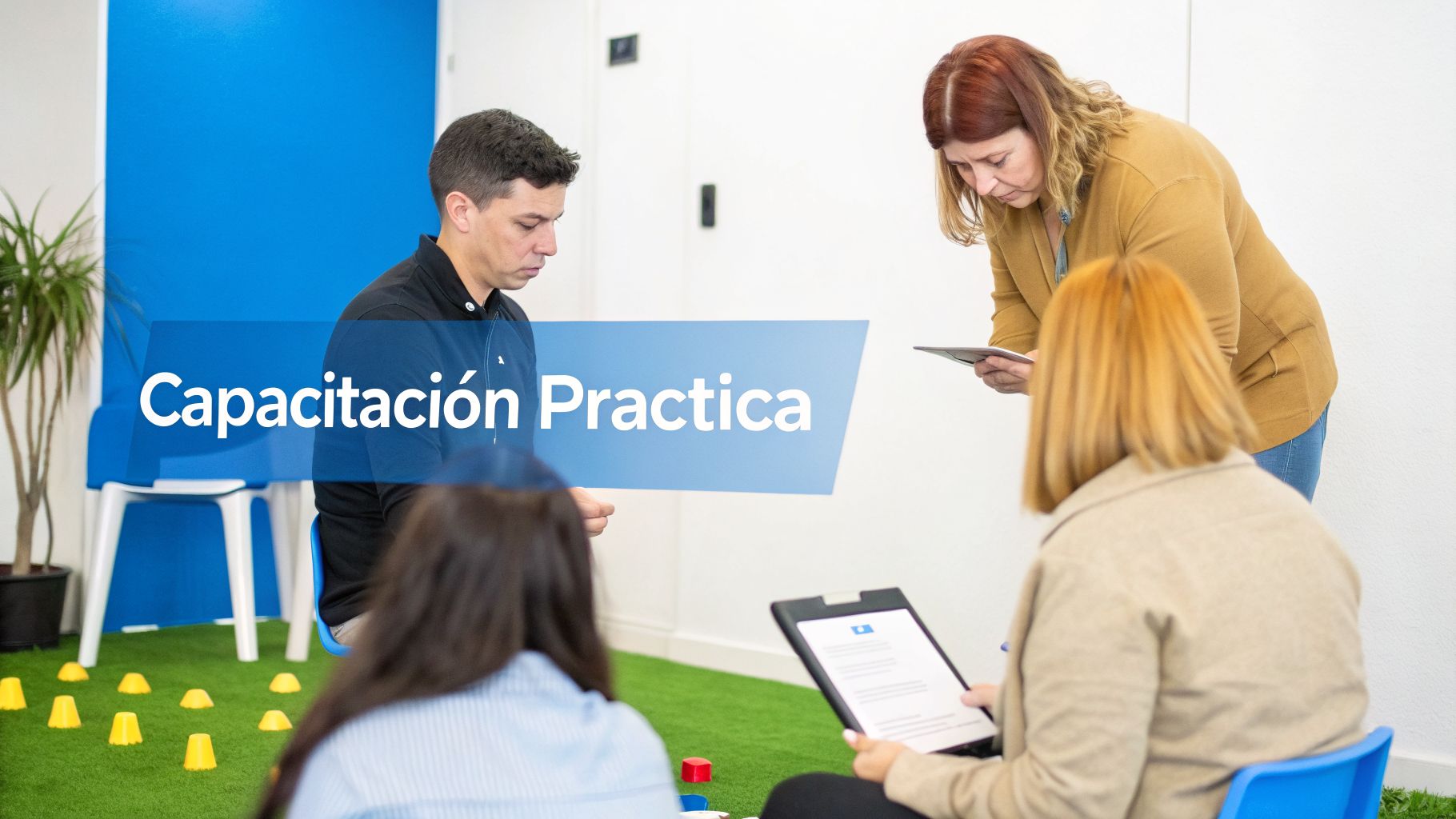
A suggestive selling training program that actually works is not improvised. It requires a solid structure, with modules designed for practice and measurement, not for filling up with theory. The final goal is that your team does not end up repeating phrases like a robot, but rather develops a selling instinct born from a genuine interest in serving the customer.
To put together a plan of this caliber, it is crucial to understand the fundamentals of talent development in any business. It is not just about teaching techniques; it is about motivating and polishing the interpersonal skills your people already have.
The starting point: customer psychology and active listening
Before a salesperson can even think about suggesting something, they have to learn to listen. And I don't mean hearing, but truly listening. This is the foundation of everything. Active listening means decoding the intention, mood, and needs that the customer does not always verbalize.
Let's look at a real case: a coffee shop in Nuevo León. A customer walks in at 4 p.m. and orders a black coffee. An untrained employee simply serves the coffee. One who has been trained detects the opportunity. They know that at that hour, people are looking for a second wind to finish the day. That's why they might ask: “Are you looking for that extra energy for the afternoon? I mention it because our double cold brew has less acidity and a more powerful caffeine kick, ideal for closing the day strong.”
This first training block must be very practical and include exercises to:
Identify non-verbal cues: Does the customer look in a hurry, are they undecided, or are they taking their time? Posture and eye contact say a lot.
Paraphrase to confirm: Repeating the customer's need in other words shows you understood. "So, if I understand correctly, you are looking for something light but that will satisfy your hunger, correct?".
Ask follow-up questions: Instead of assuming, it is better to dig deeper to get more information before making a suggestion.
The pillar of the program: deep product knowledge and strategic combinations
Your team cannot recommend what they do not know inside out. This module goes far beyond memorizing a menu or a catalog; it is about them understanding the "why" behind each product and, above all, how it connects with others to create a memorable experience (and, of course, a higher ticket).
Product knowledge is not knowing what you sell, but knowing why a customer should buy it. Your team must become the experts that customers turn to for advice, not just for a product.
Imagine a barbershop in Baja California. The goal is not just to sell a hair wax. It is for the barber to know how to explain the difference between a matte finish and a shiny finish, which hair type each works best for, and which deep-cleansing shampoo complements it to avoid product buildup. That is advisory, not just selling.
Key actions for this module:
Create a “combo matrix”: Identify your star products (the best sellers) and pair them with complementary products that have a good profit margin.
Organize internal tastings and demonstrations: Your staff must try, touch, and use the products. If you sell food, they must know what each dish tastes like. If you sell cosmetics, they must feel the texture on their own skin.
Focus on value, not features: Instead of saying “this serum has vitamin C,” teach them to communicate the benefit: “This serum will help you even out your skin tone and give it more radiance, it is perfect for recovering after sun exposure.”
The refined technique: the art of questioning and handling objections
A well-executed suggestive sale rarely starts with a statement. It almost always stems from an open-ended question, one that invites dialogue. The challenge is to transform the sales monologue into a genuine advisory conversation.
For example, in a pharmacy in Mexico City, if a customer buys cold medicine, the typical “anything else?” is a missed opportunity. An open-ended question like: “In addition to relieving symptoms, are you looking for something to help speed up recovery?”, opens the door to suggest vitamins, probiotics, or products to strengthen the immune system.
Knowing what to do when faced with a "no, thanks" is just as important. It is not the end of the world or the conversation. The key is to respond naturally and without pressure.
Common Objection | Ineffective Response | Suggestive and Effective Response |
|---|---|---|
“No, thanks, just that.” | “Okay.” | “Understood. Just so you know, many customers like to pair it with [product] because of [key benefit]. Have a great day!” |
“It is too expensive.” | “Yes, that is the price.” | “I understand. The reason for the price is [value feature]. If you are looking for a more affordable option, I can recommend [alternative], although it doesn't have [premium benefit].” |
“I'm not sure.” | “Ok, let me know.” | “What is making you hesitate? Perhaps if I give you more details about [specific aspect] it will help you make the best decision for you.” |
By building your program on these pillars, you are not just teaching how to sell more. You are cultivating a team of true advisors who elevate the perception of your brand. Furthermore, by improving the customer experience with suggestions that add value, you are laying the groundwork for a future loyalty program to be much more effective.
Proven scripts and tactics for different businesses
The theory of suggestive selling is all well and good, but the real game is won on the sales floor. A script should not be a straightjacket for your team, but rather a map with proven routes to reach the same destination: a better customer experience and, of course, a more robust sale.
The secret is not to memorize canned phrases, but to understand the logic behind each recommendation. It is about observing the customer, finding a real connection, and justifying the suggestion. Let's see how this lands in real-world scenarios, with examples you can adapt to your business.
Tactics for coffee shops and restaurants
The food and beverage sector is the ideal ground for suggestive selling. Flavor combinations and experiences are virtually infinite, so the trick is to move past the typical "anything else?" and transition to a recommendation that sounds truly appetizing.
Imagine a coffee shop in Puebla. A customer orders a double espresso, a strongly flavored coffee.
What doesn't work: "Do you want a pastry?" (Too generic).
The expert suggestion: "Excellent choice! For a coffee as intense as espresso, I recommend our dark chocolate cake. Its cocoa notes highlight those of the coffee rather than competing with them. It is the perfect balance, would you like to try a slice?".
See the difference? The suggestion is not random. It connects with the customer's purchase (the espresso), explains the why behind the combination (balance of flavors), and uses language that awakens the senses.
Now, let's think of a seafood restaurant in Baja California. A group of friends is ordering several ceviches to share.
What doesn't work: "Do you want something to drink?"
The strategic suggestion: "I see you are going to share several ceviches, what a great idea! So you can cleanse your palate between each one and not miss any nuances, I recommend our pitcher of clericot. We prepare it with white wine from the Valle de Guadalupe, it is super refreshing and pairs perfectly with the acidity of the seafood".
This recommendation not only shows that the server knows their menu, but it anticipates a need (cleansing the palate) and at the same time promotes a local product with a good profit margin.
Strategies for ice cream parlors and desserts
In businesses where the purchase is pure indulgence, suggestive selling must be fast, visual, and very tempting. The goal is simple: add layers of flavor and texture to the customer's choice.
We are in an artisanal ice cream parlor in Yucatan. A customer orders a scoop of coconut ice cream after hesitating for a moment.
What doesn't work: "Should I add a topping?"
The local and memorable suggestion: "Oh, coconut is one of my favorites! If you want to take it to another level, I suggest a touch of our melipona honey, harvested right here in the region. Its sweetness is very subtle and the combination with the creaminess of the coconut is incredible. Shall we add a little?".
This technique is powerful for several reasons: it validates the customer's choice ("it's one of my favorites"), offers something unique with a local history (melipona honey), and describes the sensory experience. This not only increases the ticket but also creates a cultural connection with the product.
Scripts for pharmacies and specialty stores
Here we must tread more carefully. In a pharmacy, for example, suggestive selling should feel like health advice, not an attempt to sell more. The priority is always the customer's well-being.
A customer walks into a pharmacy in Mexico City and asks for a cold medicine.
What doesn't work: "Do you need cough medicine?"
The empathetic suggestion: "I see you're getting cold medicine. To help your body recover faster and strengthen your defenses so you don't relapse, many of our customers complement it with effervescent Vitamin C. Would you like to add it?".
The difference is key. The second option doesn't just offer a product; it explains the direct benefit ("recover faster") and positions itself as a comprehensive help for the customer's health.
A successful suggestion is never just another option; it is a solution to a problem that the customer might not even have considered. The key is always to give them a logical reason and a clear benefit.
Not training staff in this has a real cost. CANACO estimates that Mexican SMBs lose up to 30% in upselling opportunities by not applying these techniques. On the other hand, businesses that personalize their offers with customer data increase the effectiveness of their suggestions by up to 50%. In restaurants, focusing on high-margin dishes can add up to $3,000 pesos in daily net profit per employee. In fact, after training, 69.4% of businesses report a "very good" attitude from staff, which translates into 43% more positive reviews.
Tactics for barbershops and services
In service businesses, suggestive selling focuses on products that help maintain the result the customer just obtained. The best time is right at the end, when the customer looks and feels refreshed.
Let's think of a modern barbershop in the State of Mexico. The barber finishes the cut and styles the customer with a matte finish wax.
What doesn't work: "Are you going to take any products with you?"
The personalized suggestion: "All set, what do you think of the finish? To give you that matte texture and flexible hold you were looking for, I used this clay wax. If you want to achieve this same look at home every day, I highly recommend it. With the small amount I used, it will easily last you about three months".
This script is pure gold because the customer has already felt the benefit of the product. The barber is not selling a tub of wax; they are selling the ability to replicate that "barbershop look" at home. By connecting the recommendation directly to the result of the service, the sale feels like a natural extension of the experience.
This is how to train staff in suggestive selling techniques that actually work and raise the average ticket. If you want to explore more ideas to achieve this, you might be interested in our article on how to increase the average ticket in a restaurant, whose principles can be applied to almost any type of business.
Measuring the real impact of your training
A sales training plan, no matter how detailed it is on paper, only comes to life when executed with precision and measured consistently. Implementation is not a simple theoretical session; it is an ongoing process that must be integrated into daily operations without interrupting them. And measurement is what will tell you, without beating around the bush, if the investment of time and resources is working.
The launch should not be a single, isolated event. The ideal is to start with an intensive session, perhaps half a day, to lay the foundation: key concepts, scripts, and the first role-playing exercises. But the real secret of success lies in constant reinforcement through weekly micro-trainings of 15 minutes, right before the shift begins.
Imagine a barbershop in the State of Mexico dedicating Tuesdays to practicing the script to sell a new beard oil. Or a coffee shop in Puebla using Wednesdays to review how to suggest the dessert of the day with each coffee. That is the consistency that generates results.
How to launch the program without stopping operations
Implementing training does not have to mean closing your business. The key lies in a gradual rollout tailored to your pace. Here is an approach I have seen work very well:
Initial intensive session: Reserve a morning or afternoon, preferably during a low-traffic time, to cover the main modules. Make sure it is a dynamic session, full of practical examples and participation.
Focused micro-trainings: Establish a routine of very short sessions, 10 to 15 minutes, before each shift or once a week. Each one should focus on a single skill or a specific product.
On-the-job training: Encourage your managers or supervisors to give immediate and constructive feedback. For example, if a server in your Monterrey restaurant does not suggest the local craft beer, the manager can discreetly remind them for the next table.
Gamification and challenges: Organize small weekly competitions. Something like "the employee who sells the most bottles of house wine this week" can receive a bonus, public recognition, or some other incentive.
This continuous process is what transforms suggestive selling from an abstract concept into a practical and well-established skill in your team.
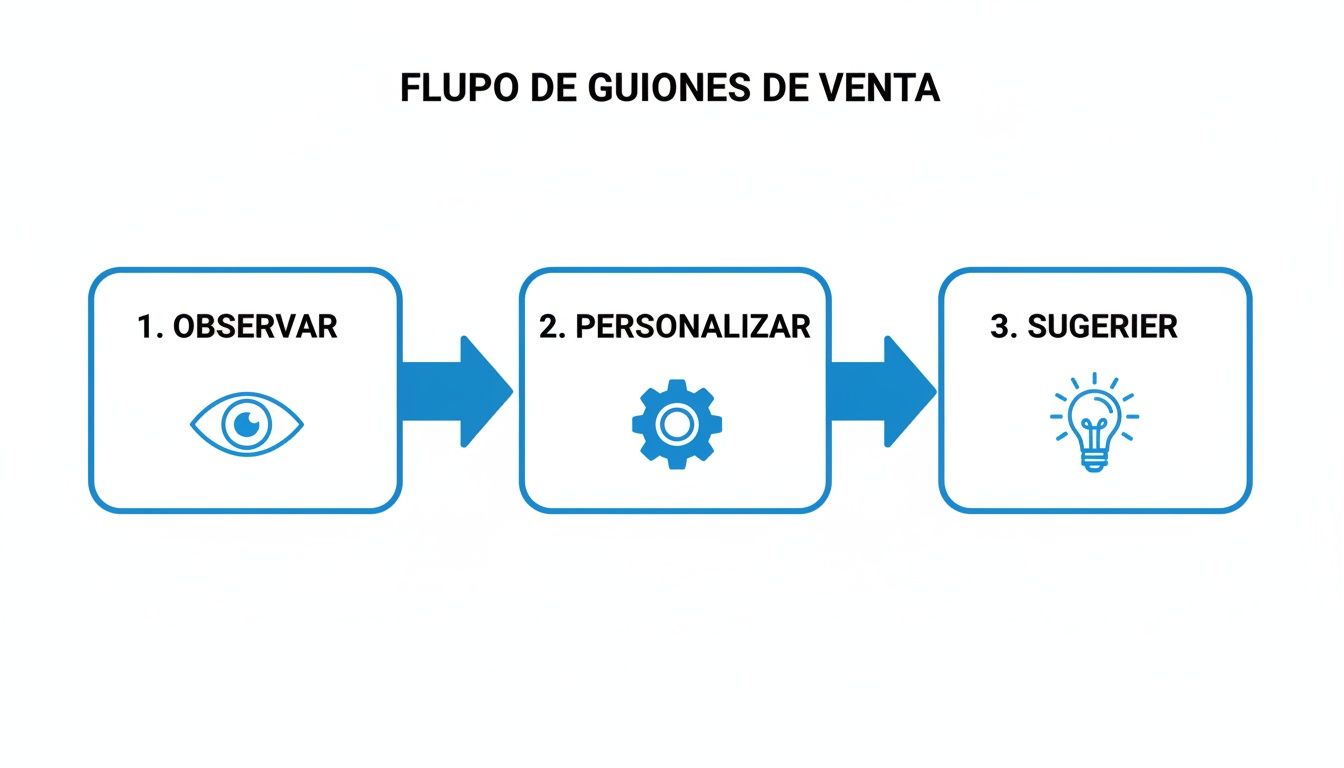
The following diagram visualizes the flow your staff should follow in each interaction. It is a simple but powerful model.
Measuring what really matters: key KPIs
Forget about gut feelings. To know if your training is bearing fruit, you need concrete and actionable metrics. It is not about measuring for the sake of measuring, but about obtaining data that allows you to adjust the strategy and recognize good performance.
Data is the only objective way to evaluate the impact of your training. A good dashboard not only tells you what happened, but helps you understand who made it possible.
These are the KPIs you cannot lose sight of:
Average ticket increase per employee: This is the ultimate metric. It tells you directly how much more each customer is spending thanks to your team's skills.
Suggestion acceptance rate: Of all the times an additional product is offered, how many times do they say yes? A percentage of 20-30% is already an indicator of success.
Sales of promoted products: Measure the units sold of those high-margin products you highlighted in the training. It is the acid test.
Units per transaction (UPT): This indicator shows you if customers are buying more items in each purchase, a clear sign that suggestive selling is working.
Market evidence is compelling. Training staff to focus on the top 20% of most valuable customers (80/20 principle) can reduce acquisition costs by up to 40%. In fact, businesses that use a POS with CRM to segment and train their staff see up to 50% more conversions on their offers. In the restaurant sector, it has been seen that 16-hour workshops raise sales in 72% of cases, achieving a ROI of 150% in the first year.
Tools like the Swirvle sales dashboard allow you to visualize these KPIs clearly and segmented by employee, shift, or branch. With this information, you can see instantly which employee in your Yucatan ice cream parlor is the champion at selling extra toppings, or which barista in your Mexico City coffee shop achieves the highest average ticket. This greatly facilitates the creation of fair and motivating incentive programs, as you are rewarding real performance, based on data, not perceptions.
How the right technology turns suggestive selling into a science
Theoretical training and scripts are an excellent starting point, but let's be honest: on their own, they are not enough. For a suggestive selling strategy to truly work, your team needs the right tool at the precise moment. This is where technology stops being a simple expense to become the brain of a much smarter sales operation.
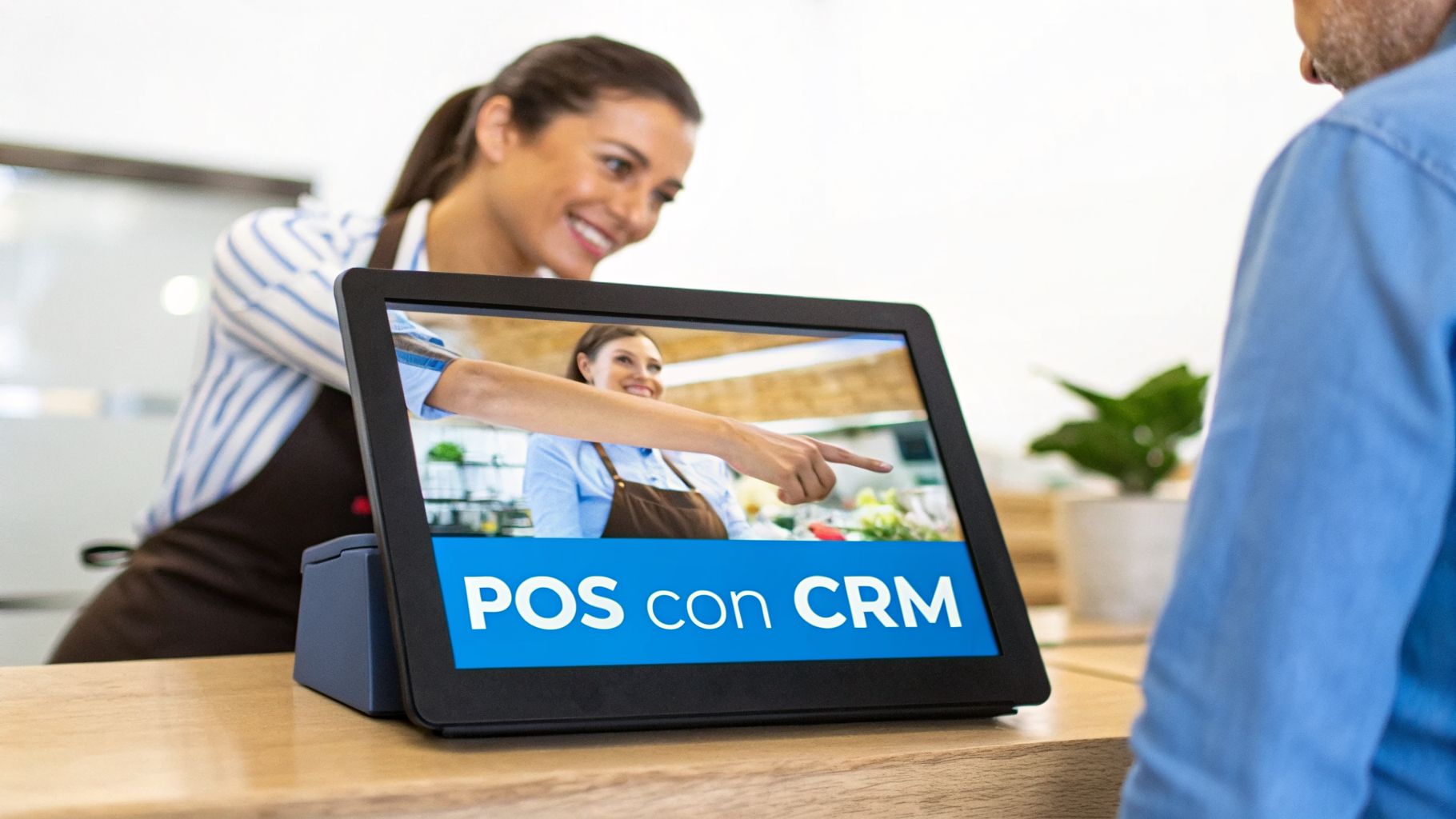
A point-of-sale (POS) system that also includes a CRM, like Swirvle's, is not a luxury. It is the core that connects training with execution. It transforms suggestive selling from a simple guessing game into a precise, data-driven action.
From a generic script to a personal recommendation
The biggest obstacle when training staff in suggestive selling techniques is making the recommendations feel natural and not like a forced pitch. Technology is the bridge that closes that gap, giving your team the context they need to personalize each interaction.
Let's look at a real example. Imagine a barbershop in the State of Mexico. A long-time customer, Carlos, walks in for his usual cut. With a POS like Swirvle, the barber can view his entire history with a couple of taps on the tablet.
What's up, Carlos! Hey, I see last time you took the medium hold wax. We just got a new one with a matte finish that I think would be perfect for your style, would you like me to show it to you?
The difference is massive. This suggestion is powerful because it is specific and relevant to Carlos. It is not born from an assumption, but from his actual purchase history. The system gives your employee the tools to act as a trusted advisor, not an pushy salesperson.
In addition to platforms like Swirvle, it is worth analyzing how other artificial intelligence tools can enrich your business strategy. For example, understanding the potential of ChatGPT for business can open up new ways to generate personalized scripts and responses.
Real-time opportunity detection
Beyond history, a good POS is a co-pilot for your team at the exact moment of the sale. The system can be configured to highlight high-margin products or strategic combinations directly on the checkout screen.
Let's think of a busy coffee shop in Mexico City at breakfast time. When the barista enters an Americano, the system can display a subtle alert: "Suggest: Almond croissant (+35% margin)". This small visual nudge is a constant reminder that guides the team toward the most profitable sales without them having to memorize everything.
Technology can help in very concrete ways:
High-margin products: Visually highlights the items that yield the most profit, encouraging the salesperson to suggest them first.
Smart combos: Facilitates package sales (coffee + dessert, haircut + treatment) that increase the value of each ticket.
Inventory alerts: If a popular product is about to run out, the POS can propose alternatives so as not to lose the sale or disappoint the customer.
This assistance reduces the employee's mental load. It allows them to focus on connecting with the customer, rather than trying to remember all the day's promotions from memory.
Connecting training with measurable results
Finally, technology closes the circle. It allows you to know if the training is working by attributing sales directly to staff actions. With a system like Swirvle, you can monitor each salesperson's performance across key metrics: average ticket, units per transaction, and the sale of specific promoted products.
This visibility allows you to answer crucial business questions:
Who on my team is best applying the techniques we taught?
Are customers accepting product suggestions with higher margins?
Did the average ticket actually go up after the last training session?
Having this data on hand completely changes staff management. You can identify your star salespeople, understand what they do differently, and use that knowledge to level up the rest of the team. It also allows you to create fair and motivating incentive programs, based on clear metrics and not on pure assumptions.
In short, technology is what makes a training program sustainable and scalable. If you want to dive deeper into how a POS with integrated CRM can be the core of your strategy, I suggest exploring the features that allow you to tie the knots between training and numbers on your income statement.
Clearing up the most common doubts about sales training
Investing time and resources in a new initiative always generates questions. I know from experience. When it comes to training your team in suggestive selling, it is completely normal to wonder about the cost, the time it will take, and above all, the results.
Let's address those doubts head-on, with the clarity you need to decide with confidence.
One of the first questions that always arises is: how long will it take to see a return on investment? The answer is more encouraging than you think. The first fruits are seen almost immediately. If you launch clear challenges or incentives, you could notice spikes in the average ticket within weeks. Imagine an ice cream parlor in Yucatan that starts suggesting melipona honey toppings; it is very likely to see a change in sales that very weekend.
However, the real impact, the one that truly transforms the business, consolidates in the medium term. A complete return on investment, which involves not only a sustained increase in sales but also much stronger customer loyalty, usually materializes over a period of 3 to 6 months. Here, consistency is everything.
How do I ensure my team doesn't sound like a robot?
This is perhaps the biggest and most valid fear. No one wants their staff scaring off customers with a forced, unnatural pitch. The solution is not to eliminate scripts, but how we use them. Think of them not as a libretto to be recited word for word, but as a roadmap, a foundation on which to build.
The secret is to empower your people to own the message, adapting it to their personality and, of course, to the customer in front of them. This is where role-playing becomes your best ally. By practicing different scenarios—from the hurried customer in a Mexico City coffee shop to the undecided one in a Nuevo León barbershop—your team gains the ease to improvise with confidence. The goal is for them to understand the logic behind the suggestion, not to memorize a phrase.
Authenticity sells much more than perfection. A salesperson who truly connects with the customer, even if they don't use the exact words from the script, will always be more effective than one who simply recites a text.
What do I do if an employee resists training?
It is a reality of any business: not everyone welcomes change with open arms. If you run into a reluctant employee, direct confrontation is rarely the answer. The smartest strategy combines data and personal motivation.
Numbers don't lie: Use data from your POS system. In a private and constructive talk, show them how their average ticket compares to that of their colleagues who are applying the new techniques. Seeing the tangible impact in figures can be the push they need.
Make it worth their while: What do they gain directly? A clear commission system or bonuses for meeting sales goals of complementary products can change their perspective overnight.
Go for individual coaching: Sometimes resistance comes from insecurity. Dedicate time to a one-on-one session to understand what is holding them back. Maybe they don't feel comfortable with a certain product or don't see the value of the technique. A bit of personalized attention can make all the difference.
In the end, it all comes down to understanding the logic behind each interaction. If you want to delve deeper into how a management system can give you the data you need to personalize these conversations, we recommend our article on what is a CRM system.
Training is the starter motor, but technology is the fuel that multiplies its power. With Swirvle, you don't just have an integrated POS and CRM to measure your team's performance; you can also automate loyalty programs that encourage repeat business and raise the average ticket. Transform your data into sales and grow your business sustainably with Swirvle.
Related Blogs

Nov 10, 2026
How to manage multiple restaurant locations from a single system?

Nov 9, 2026
Which CRM is best for a small business in Mexico? 2026

Nov 8, 2026
What works better for a small business: WhatsApp promotions or email promotions?

Nov 7, 2026
How do you calculate a business's net purchases? Formula and example in MXN

Nov 6, 2026
How much does a point-of-sale system cost for a small business in Mexico?

Nov 5, 2026
How to Create an Executive Breakfast Menu to Sell to Offices: 2026 Guide