Discover why you should offer dessert. Easily increase your average sale with upselling strategies, bundles, and data for your food SMB.
A dessert can add $0.80 to the ticket and drive an additional net profit of $3.70 when the offer is well-managed. In a menu where the average cost of raw materials is around 31% and that of dessert drops to 18%, selling it is not a whim; it is one of the cheapest ways to increase the average sale without looking for more traffic.
Index
What the numbers say about dessert as a sales lever

Dessert is not sold just for a craving; it is sold because it improves the bottom line. In real operations, desserts usually come out with a better gross margin than many savory dishes, and for that reason, it drives profitability without forcing more traffic. When the average ticket is already under pressure, that difference really matters. To land the concept of average ticket without the smoke, it is useful to look at the complete bill and not just the price of an isolated item. More context on average ticket
The economic logic is simple
That is exactly what interests an SME in Mexico, even if they bill in pesos and not in euros. The mechanism does not change by state or format, because the dessert comes at the end of the purchase, when the customer has already decided to pay and has already accepted the main expense. There, the cost of convincing them is low and the margin is usually cleaner than on many main dishes.
Operational rule: if the main dish is already decided, the dessert does not compete against traffic, it competes against inertia. And inertia, at the register, usually loses.
The important data point is not just that the dessert leaves more profit, but that it leaves more with less friction. When the category has a lower raw material cost, the decision to offer it stops being decorative and becomes a profitability decision. In coffee shops, diners, restaurants, or counter-service businesses, that means each well-placed dessert can function as a margin lever.
The correct reading is this: the dessert is not evaluated as a "nice extra," but as a high-margin unit. If the business operates in Mexico City, Nuevo León, Puebla, or Yucatán, the base logic remains alive, even if the average ticket and price sensitivity change. What changes is the execution, not the economic convenience.
How the ticket is reconfigured when dessert is added
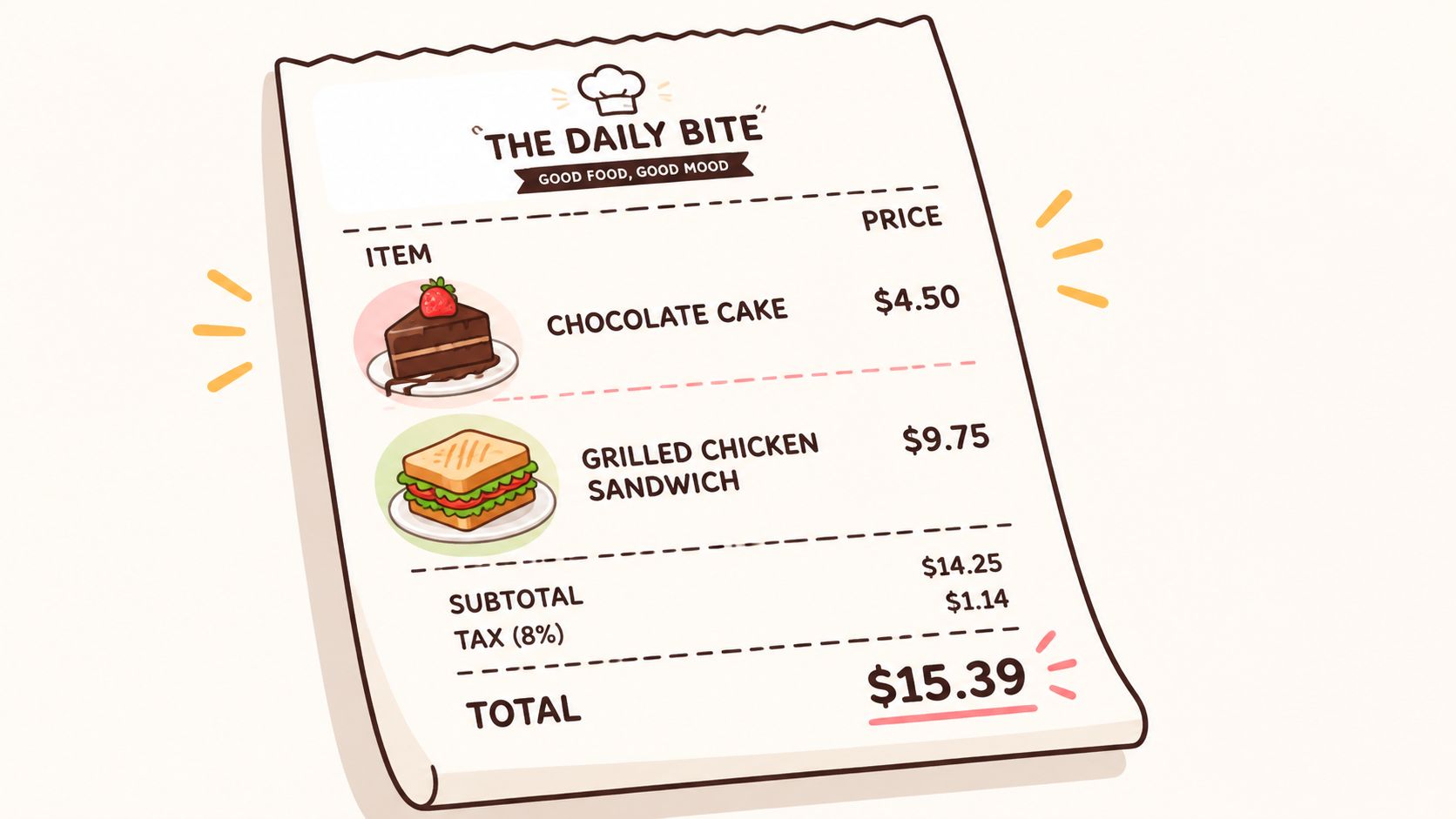
When the dessert enters, the ticket stops being a closed sum of main dish and drink. It becomes a broader basket, with more perceived value and more room to shift spending without pushing the customer out of the purchase. How to increase the average ticket in a restaurant
Upselling and cross-selling are not the same thing
The upselling increases the value of what the customer was already going to buy. The cross-selling adds a complementary item, such as a drink or dessert, so that the final purchase looks more complete. In food service, these techniques usually push the average ticket up between 15% and 30%, and in combination menus with a drink and dessert, the increase can be close to 25% or 30%. When the complete menu is well-put-together, the bill changes visibly, because the dessert not only adds incremental revenue, it also reorders the basket towards a higher-value purchase.
In real operations, that means something very concrete. Dessert is not sold as "something sweet at the end." It is presented as the piece that closes the moment of consumption. If the customer already has coffee, a main dish, or a sandwich, the dessert comes in as a natural finish, not as pressure.
A well-offered dessert does not feel like an extra expense, it feels like rounding out the experience.
The right mix changes the ticket
A menu with well-placed desserts alters the purchasing logic because it expands the variety of the basket. That explains why a customer can accept a mini dessert at the counter, a slice upon sitting, or a combo with a hot drink without perceiving it as a forced sale. On the other hand, a business that insists on pushing dessert at the wrong time usually lowers conversion and ruins brand perception.
The lesson is practical. Dessert is not sold separately from the ticket composition, it is sold within it. If the business has already succeeded in getting the customer to choose a dish, drink, and side, the sweet finish is usually the last profitable move before checkout. In Swirvle, that logic is managed with upsell scripts, habit segmentation, and campaign measurement, because the gross margin of the dessert only matters if the execution is also tuned.
Dessert upsell formats that actually work at the counter
The most expensive mistake is using the same push for all moments. A sit-down restaurant does not sell the same way as an express coffee shop, and a gas station does not have the same attention window as a bakery register. If the format does not match the rhythm of the business, the offer feels awkward and acceptance drops.
Upselling sells best when the staff understands what they are doing. If you want to review the difference between upselling and other sales tactics, it is worth reading what is upselling. That distinction matters because you do not push a dessert that completes the ticket the same way as a support product that only accompanies the main purchase.
The tactic must follow operational saturation
Direct question: works when there is table service and time to read the customer's reaction. It is best in restaurants and cafes with human service, because it allows adjusting tone and speed.
Strategic description on the menu: useful when the sale depends on visual reading. The anchor word, like chocolate, helps trigger desire without staff intervention.
Fixed-price combo: fits best when the operation needs speed and billing clarity. It reduces friction and prevents the customer from feeling like things are being "added on."
Tasting menu: useful for high tickets or long experiences. Here, the dessert is understood as part of a sequence, not as an add-on.
Visual hook in display case: works best in grab-and-go businesses, where the decision is quick and the visible product does much of the work.
Push at the end of the ticket at checkout: ideal when the customer has already decided to buy and there is only a small window left to add something else.
Format | Ideal moment | Type of business | Main KPI |
|---|---|---|---|
Direct question | Table service | Restaurant, coffee shop | Acceptance rate |
Strategic description | Menu reading | Restaurant, coffee shop | Dessert conversion |
Fixed-price combo | Quick checkout | Express coffee shop, to-go | Average ticket |
Tasting menu | Full experience | Medium-high ticket restaurant | Value per diner |
Visual hook | Passing the display case | Bakery, counter, takeaway | Impulse buy by sight |
Push at checkout | Closing the purchase | Gas station, car wash, counter | Upsell |
Tone matters more than the script
There is no need to sound pushy. There is a need to sound confident and helpful. An operator who delivers the suggestion as a natural part of the close sells more than one who recites an awkward script.
Useful practice: if the dessert does not fit into the kitchen workflow, it does not fit into sales either. The best suggestion is the one the operation can fulfill without delays.
The key is to respect the rhythm of the business. In a saturated kitchen, pushing a complex dessert breaks service. At a fast checkout, however, a simple and visible product can add value without slowing down the line.
Real examples by business type and region
At a car wash in Nuevo León, the best moment is not when the customer enters, but when they have already paid for the wash and are waiting for delivery. A short, direct, pressure-free close works there. The phrase that works is: "Shall I also get you a coffee with a brownie for the road?" The meaning is clear, the customer is already in exit mode, and the product adds convenience, not a heavy decision.
Three counter scenes
In a coffee shop in Mexico City, the cleanest play appears during off-peak hours. The operator can say: "With your hot drink, a sweet pastry goes great, shall we bundle it in a combo?" Here, the combo reduces friction because the perception is not of an extra purchase, but of a better finish. The payment must go on the same ticket, without separating accounts or forcing a second decision.
At a gas station in Puebla, weekend sales work best with a quick purchase. The script could be: "Shall we add a mini dessert for the trip?" That phrase has an advantage, it does not force imagining immediate consumption, it just accompanies the journey. The customer accepts more easily when they feel the product resolves a craving without compromising time.
What makes the customer say yes
Right timing: the dessert is proposed when the customer has already completed the main purchase.
Short phrase: the longer the explanation, the more it feels like a sales pitch.
Coherent product: coffee with a brownie, hot drink with a sweet pastry, a trip with a mini dessert.
Simple checkout: everything should go into a single transaction, without complicating the register or delivery.
The same principle changes shape depending on the channel. In Nuevo León, practicality carries weight; in Mexico City, convenience during off-peak hours matters; and in Puebla, the weekend impulse is key. The logic is not universal in tone, but it is in mechanism: capturing a complement when the value is already high.
How to execute the dessert strategy within Swirvle
A well-mounted dessert campaign does not rely on memory or good faith at the register. It depends on sorting customers by branch, separating habits, and triggering messages based on real purchases. In Swirvle, that logic turns the counter into a repeatable operation, with clear segments and rules that do not change every shift.
The database must be organized by habit, not by intuition
First, customers are loaded by branch and simple variables are tagged: average ticket, frequency, day of visit, and purchase channel. From that database, useful segments emerge, such as customers who buy coffee in the afternoon, Friday visitors, or profiles that respond best once they have reached their minimum spend. From there, dynamics like points for combo purchases or smart coupons for minimum spending are activated.
This organization cuts out the noise. The business stops talking to everyone with the same message and starts reaching out to those who have already shown signs of a higher spend. For dessert, that changes everything, because the offer stops sounding generic and lands with more meaning at the right time.
Campaigns that actually work in an SME
Swirvle delivers the campaign via WhatsApp, push, and email according to the customer's routine. In an operation with strong seasons, this combination works to push a specific dessert on high-traffic days without improvising every week. The flow is built by segment, schedule, and previous response, not on a whim by the team.
In a coffee shop in Baja California, for example, the dessert menu can be sent via WhatsApp on hot days with a short message and a clear time window. In a business in Yucatán, seasonal logic helps push desserts that fit the visitation season, always from the correct segment. The point is not to decorate the campaign, it is to make sure the offer arrives with context and that the team does not have to distract from the main operation. Automation works when the offer comes by habit, not on a whim by the operator.
Automation works when the offer arrives by habit, not on a whim.
Minimum flow to avoid wasting time
Load customers by branch and tag ticket and frequency.
Create segments with high propensity, for example, recurring visitors or high tickets.
Define the incentive: combo, points, or smart coupon.
Launch the message through the channel where the customer already responds.
Record the response and adjust the next step according to actual consumption.
This order avoids a pretty but useless campaign. When data guides the offer, the dessert stops depending on the mood at the counter and becomes part of the pattern of return visits.
Measuring the ROI of the dessert strategy in 30 days
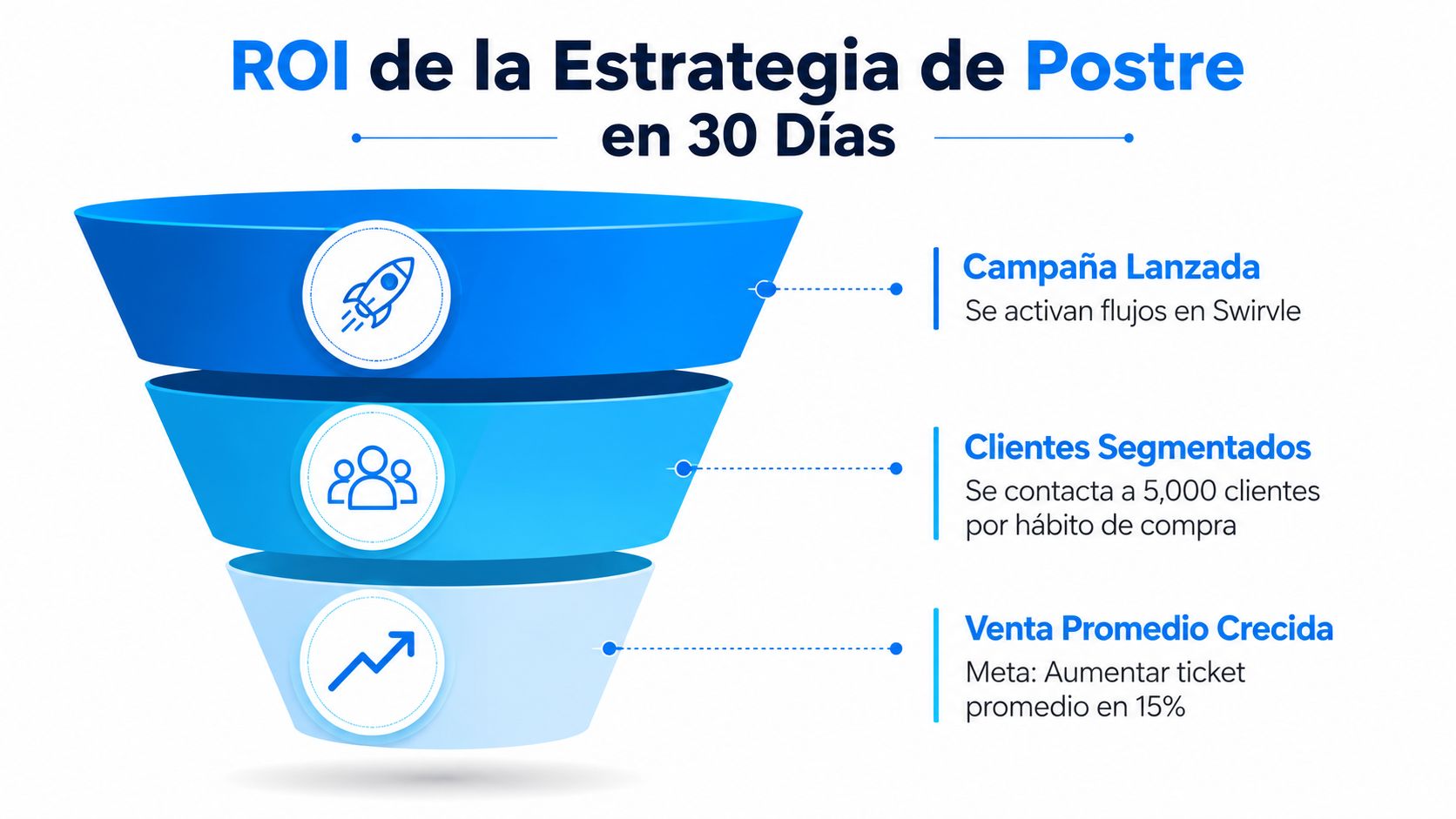
The strategy is not measured by enthusiasm; it is measured by average ticket and attributable incremental revenue. If the dessert campaign does not move those two things, it is useless, even if the menu looks more attractive. The statistics dashboard must compare those who received the campaign against a control group, to separate real effects from operational noise.
The calculation must be net
ROI is not read just with gross sales. You have to subtract the cost of raw materials and the cost of the campaign, because an apparent increase can disappear when the entire operation is accounted for. If the business already has a good dessert base, the next adjustment is not always to sell more, sometimes it is to sell better by segment or timing.
A 30-day plan can look like this: Week 1, load the correct segment and organize the database. Week 2, launch the first campaign with a simple message and a clear incentive. Week 3, compare average ticket, response, and repeat visits against the control group. Week 4, double down on what worked or change the dessert, the channel, or the timing.
Which variable is best to test first
Segment: frequent customers versus high-ticket customers.
Channel: WhatsApp, push, or email, based on prior response.
Offer: combo, coupon, or points.
Timing: day of visit, time of day, or season.
The priority is not to guess; it is to test a single variable per cycle to know what moves the ticket. If too many things are changed at once, the result becomes confusing and the business ends up discussing opinions instead of data.
Decision criteria: if the average ticket goes up but the net margin does not improve, the campaign is poorly designed. If the margin improves and the customer returns, the strategy deserves to be scaled.
The practical goal is simple. In 30 days, the business must know which segment buys the most dessert, which message converts best, and which format yields the most profit. Without that analysis, the dessert offer remains pure guesswork.
Frequent errors and quick answers for food SMEs
When does offering dessert lower instead of raise sales? When it is pushed before the customer completes their main purchase, or when the kitchen cannot keep up with the pace. Dessert must come at the end, not at the beginning.
What if the customer is price-sensitive? It is best to use a short format, a small portion, or a closed combo. The feeling of control matters more than pushing the ticket amount.
How to avoid waste when launching a combo? Start with a few references, sell the simplest thing first, and measure sales by branch. The combo must follow the operation, not force it to overproduce.
What if there is only one branch? The logic is still valid. The difference is that the measurement is made against the historical behavior of that same store, not against another location.
Swirvle helps organize customers, segment by habit, and activate campaigns so that the dessert does not depend on the impulse of the moment. If a food SME wants to raise its average ticket without improvising, it is worth checking out Swirvle and seeing how to convert every sales close into a measurable repeat purchase.
Related Blogs

Aug 5, 2026
10 dessert ideas to sell that actually work in 2026

Aug 3, 2026
Price elasticity: a practical guide for SMEs

Aug 1, 2026
Why offer dessert? Easily increase your average sale

Jul 30, 2026
Resource allocation: a practical guide for SMEs 2026

Jul 28, 2026
Swirvle: better than a digital punch card app

Jul 27, 2026
Consistency in customer service: the secret to selling more without being perfect
Try Swirvle for free
No card required · 30 days free
Start your free trial