
Guía clara sobre los tipos de inventarios que existen: qué significa cada uno, cuándo conviene usarlo y cómo elegirlo según tu negocio.
Master the types of inventory that exist in Mexico. Learn how to manage them in your SMB to optimize your stock, reduce costs, and increase profitability.
Inventory is much more than a simple list of products stored in a warehouse. For any SMB in Mexico, it is working capital in motion, the true financial engine that, if mismanaged, can choke operations.
Poor management translates into very tangible problems: cash tied up in slow-moving stock, frustrated customers who can't find what they are looking for (the famous stockouts), and direct losses from expired or damaged products. Understanding the different types of inventory that exist is, without a doubt, the first step to turning this challenge into a real competitive advantage.
What is inventory and why does it define the success of your SMB
Think of it this way: inventory is like the bloodstream of your business. If the flow becomes slow, blocked, or inefficient, the entire system suffers. In practical terms, inventory encompasses all goods and materials a company owns, whether to sell them directly or to use them in its own production process.
Let's take a coffee shop in Colonia Roma in Mexico City as an example. Its inventory isn't just Chiapas coffee beans. It also includes milk from local producers, disposable cups, lids, sugar packets, and even napkins. Each of these items has an associated cost and a direct impact on day-to-day profitability.
The fundamental classification of inventories
To bring order to this complexity, inventories are usually grouped into two major categories that answer very specific questions: What stage of production is this product in? and What do I strategically need it for?
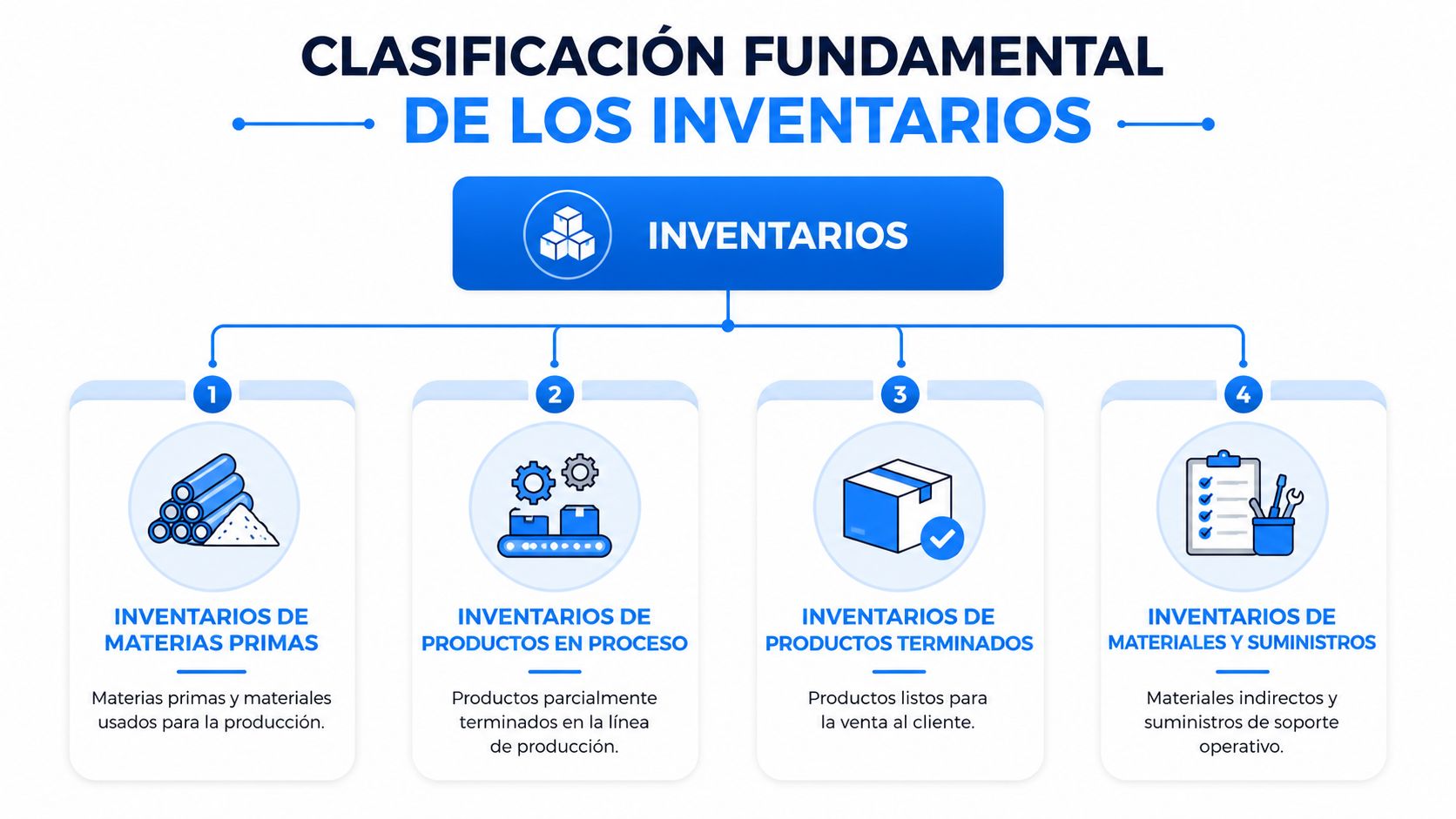
As the diagram shows, inventory is not a uniform mass. The key lies in segmenting it to control and optimize it with precision.
Understanding this division is the starting point for any effective control system. For example, a barbershop in Tijuana, Baja California, needs to manage both its styling waxes and gels for sale (classified by stage) and a safety stock of its most frequently used razor blades (classified by purpose) so it never has to halt a service.
Good inventory control seeks the perfect balance between supply and demand. Managing it correctly not only cuts operating costs but also elevates the customer experience by ensuring they always find what they are looking for.
To help you better visualize these categories, we have prepared a summary table.
Quick classification of inventory types
This is a panoramic view of the main inventory categories according to their stage in the production chain and their strategic purpose. It will help you quickly identify which ones apply to your business model.
Main Category | Inventory Type | Brief Description | Ideal For Businesses Like |
|---|---|---|---|
By Stage | Raw Materials | Basic inputs that will be used in production. | Restaurants, coffee shops, artisanal ice cream parlors. |
By Stage | Work in Process | Goods that have started production but are not finished. | Bakeries, tailor shops, furniture factories. |
By Stage | Finished Goods | Items ready to be sold to the end customer. | Clothing stores, pharmacies, barbershops. |
By Purpose | Safety (or reserve) | Extra stock to cover unexpected events like delays or demand spikes. | Any business that relies on suppliers, like pharmacies or restaurants. |
By Purpose | Seasonal (or anticipation) | Accumulated to meet foreseeable demand in high seasons. | Gift shops, ice cream parlors, stationery stores. |
By Purpose | Obsolete (or dead) | Products that no longer rotate and generate losses. | Tech stores, fashion boutiques, pharmacies. |
This conceptual map gives you the basis to start organizing your assets. If you want to dive deeper into the methods for registering and valuing these goods, we recommend consulting our complete guide on product inventory.
Cómo evaluamos y clasificamos los tipos de inventarios de esta guía
Para que esta guía sea útil y no solo una lista de definiciones, organizamos los inventarios con cuatro criterios prácticos. Primero, por etapa en la cadena de valor: materia prima, trabajo en proceso, producto terminado y suministros MRO. Esta clasificación aparece de forma consistente en referencias empresariales como NetSuite y sirve porque muestra en qué parte de la operación está detenido el capital.
Segundo, por función estratégica: inventario de seguridad, estacional, cíclico, en consignación, justo a tiempo y obsoleto. Aquí lo relevante no es dónde está el producto, sino para qué se mantiene. Tercero, por sistema de control: periódico o perpetuo. Y cuarto, por método de valuación: FIFO, promedio ponderado y, con matices contables, LIFO.
En nuestra revisión editorial vimos un error repetido en muchas guías: mezclar “tipo de inventario” con “forma de contarlo” o con “regla contable para valuarlo”. No son lo mismo. Un negocio puede tener producto terminado como tipo de inventario, controlarlo con sistema perpetuo y valuarlo con promedio ponderado al mismo tiempo. Separar esas capas evita decisiones malas por confusión conceptual.
También dejamos fuera categorías muy específicas que rara vez cambian la operación de una pyme promedio, como inventario en cuarentena farmacéutica o esquemas avanzados por criticidad técnica. Sí los mencionamos cuando ayudan a entender la evolución del tema, porque la logística moderna ya incluye categorías como tránsito, consignación, reserva y ciclo, tal como resume Extensiv, pero el foco aquí está en lo que realmente ayuda a decidir mejor en comercio, manufactura ligera y servicios en México.
Inventories according to their stage in the value chain
One of the most common mistakes I see in SMBs is treating all their inventory as if it were a single thing. Thinking of "the warehouse" as a uniform pile of products is a view that oversimplifies reality and, in the long run, is very expensive. The key to effective control is to start by classifying it according to its phase within the production process.
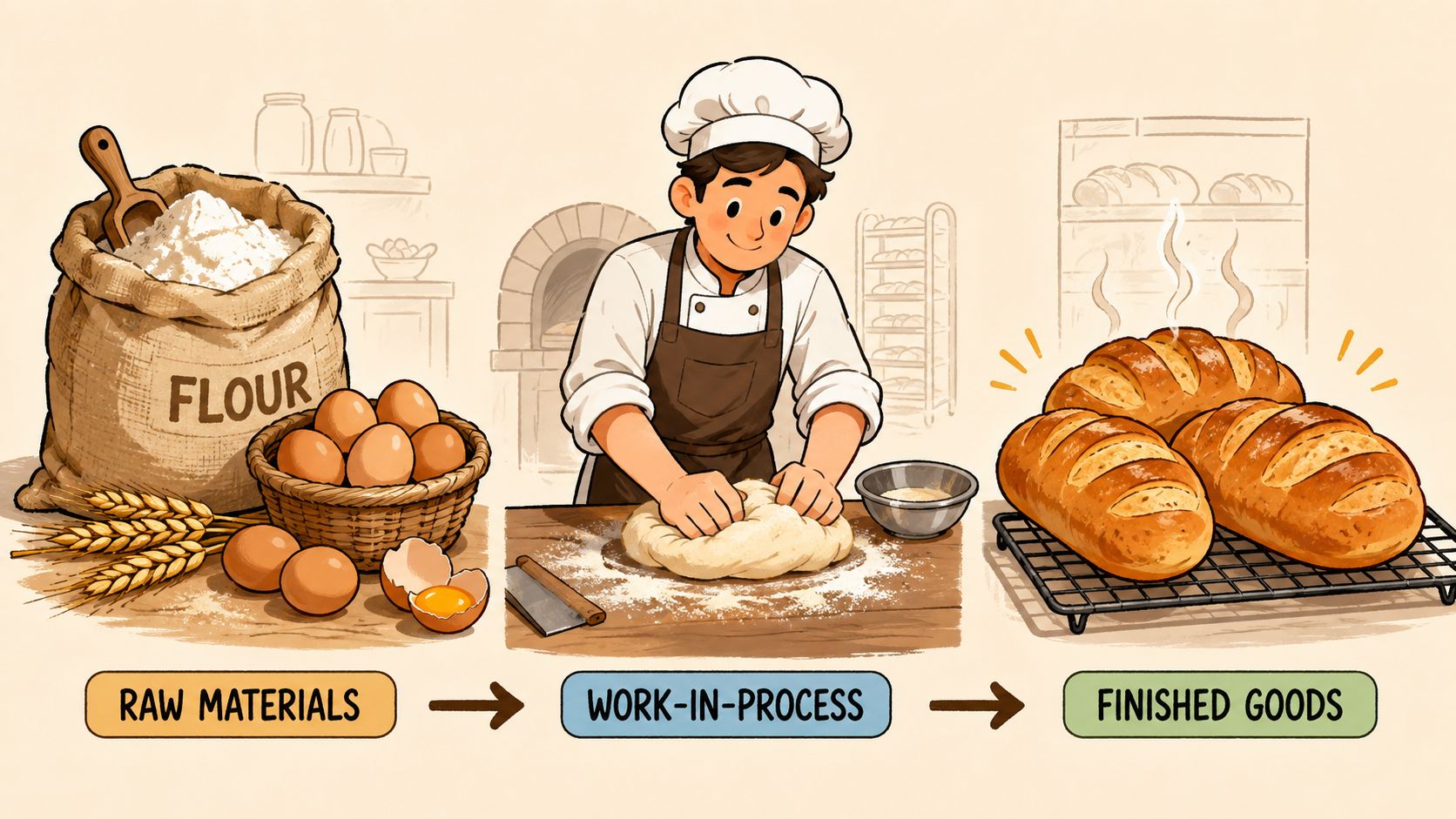
Think of it this way: flour in the sack is not the same as dough fermenting, or bread already baked and ready on the counter. Each stage has its own rules, risks, and opportunities. Understanding this difference gives you tremendous visibility to make much finer decisions, from when to buy inputs to how to adjust your production.
Raw materials inventory
Everything starts, especially if your business manufactures or assembles. Raw materials are the basic inputs you buy to create your products. They are the building blocks of your operation; they don't have their final shape yet, but without them there is nothing to build.
Let's take the case of an artisanal ice cream parlor in Mérida, Yucatán. Its reputation is based on the freshness and quality of its ingredients. Its raw materials inventory would include:
Local seasonal fruits like mango, dragon fruit (pitahaya), or mamey.
Milk and cream from nearby dairy farms.
Sacks of sugar and vanilla beans from Veracruz.
A miscalculation here and production halts. Or worse, it forces you to buy emergency inputs of lower quality, affecting that flavor your customers love. Good control alerts you just in time to reorder and keep the machinery moving.
Work in process inventory (WIP)
Once you take those raw materials and start transforming them, they become work in process inventory, or WIP. These items are no longer raw inputs, but they are not ready for sale either. They are halfway there.
Imagine a bakery chain with several branches in the State of Mexico. Its WIP inventory is the dough that is proofing for the next day's bolillos or the conchas that are already shaped but waiting for their turn to go into the oven. You can't sell a raw concha, but that work-in-process inventory is a valuable asset that represents invested capital and effort.
Having visibility over your WIP is essential for detecting bottlenecks. Is too much dough accumulating before baking? Maybe you need another oven or to adjust times.
Finished goods inventory
This is the inventory we all know, the one on the display shelf, ready for the customer to take home. These are the items that have already gone through the entire production process and their respective quality control. For any retail business, this is the heart of its inventory.
A pharmacy in Cholula, Puebla, lives and dies by its finished goods inventory. Having high-demand medicines in stock, like cold remedies during the rainy season, is the difference between a loyal customer and one who goes to the competition at the first opportunity. Running out of a popular pain reliever over the weekend is not an inconvenience, it is a guaranteed lost sale.
Managing finished product inventory is critical, especially for retail SMBs. In regions like Nuevo León, data from INEGI suggests that for 65% of these companies, this inventory can represent up to 70% of the total value of their stock. This highlights the enormous importance of these inventories and the need for efficient rotation.
It is no wonder that this inventory represents your largest capital investment. That's why mastering its counting and management, as we explain in our guide on how to do a product inventory, directly impacts your cash flow.
Supplies or MRO inventory
There is one final category, often forgotten but just as critical: supplies inventory. It is also known as MRO (Maintenance, Repair, and Operations). These items are not part of the product you sell, but without them, your business paralyzes.
Let's think about a trendy barbershop in the Zona Rosa of Mexico City. The service it sells is a haircut or a beard trim, but to provide it, it needs:
Disposable razor blades.
Shaving creams and after-shave lotions.
Cleaning products to disinfect tools and stations.
None of these supplies are sold directly to the customer, but if you run out of clean blades, the barber cannot work. It's that simple. Managing these supplies well ensures the continuity and quality of the service that sets you apart.
Strategic inventories to protect your operations
Cuando una pyme ya entiende sus inventarios por etapa, el siguiente salto es verlos por función defensiva o táctica. Aquí no basta con saber qué tienes; importa por qué lo conservas, qué riesgo cubre y qué costo oculto introduce. Esa distinción cambia decisiones de compra, de espacio y de flujo de efectivo.
En nuestra revisión, la diferencia más útil fue esta: el inventario de seguridad protege contra la variabilidad, el de consignación reduce capital inmovilizado, el JIT intenta minimizar existencias y el estacional apuesta por demanda previsible. Ninguno es “mejor” en abstracto; cada uno resuelve un problema distinto. Y como el costo de una mala gestión es enorme —distintas compilaciones recientes lo sitúan en alrededor de USD 1.1 billones al año y atribuyen al retail pérdidas cercanas a USD 1.75 billones por faltantes y exceso de stock combinados— conviene elegir modelo con criterio, no por costumbre.
Safety stock: your business's cushion
Safety stock, or reserve inventory, is that extra amount of product you keep "just in case." It is not meant for daily sales. Its sole mission is to be a cushion that protects you from blows: a supplier being late, demand spiking overnight, or a problem on your own production line.
Imagine a successful restaurant in San Pedro Garza García, Nuevo León, famous for its beef cuts. On a weekend, it fills up unexpectedly or a roadblock stops the supplier's truck. Without safety stock—those extra cuts kept frozen—it would run out of its star product, disappointing loyal customers and losing sales.
The goal of safety stock is simple: reduce risks and ensure the business keeps running. It's not there to generate immediate profits, but to prevent losses when things don't go as planned.
This cushion is vital in Mexico, where it is estimated that supplier delays are a reality for nearly 35% of supply chains. For an SMB, especially if it has several branches, this inventory can represent between 15% and 20% of its total stock, with the carrying cost that implies. You can read more about how logistics impacts the handling of different types of inventory to better understand its importance.
Cálculo básico de stock de seguridad
Una fórmula simple y útil para pymes es esta:
Stock de seguridad = (demanda máxima diaria × plazo máximo de entrega en días) − (demanda promedio diaria × plazo promedio de entrega en días)
Ejemplo: una farmacia vende en promedio 18 cajas diarias de un analgésico y su proveedor suele entregar en 3 días, pero en semanas complicadas tarda hasta 6. Si en picos de demanda llega a vender 25 cajas diarias, el cálculo sería:
(25 × 6) − (18 × 3) = 150 − 54 = 96 cajas
Eso no significa que siempre deba almacenar 96 cajas extra sin revisar contexto. En nuestra experiencia editorial, esta fórmula funciona bien como punto de partida, pero luego hay que ajustarla por caducidad, espacio, margen y confiabilidad del proveedor. Si quieres ver otro desglose práctico del cálculo, hay una explicación clara over at Mobel Suministros S.L..
La decisión correcta suele depender de dos tensiones. Si el producto es crítico y el costo de quedarse sin stock es alto, conviene ser conservador. Si es perecedero o caro de almacenar, conviene bajar el colchón y reforzar la frecuencia de reabastecimiento. Ahí es donde el inventario de seguridad deja de ser “más unidades” y se vuelve una política de riesgo.
Inventario de consignación
El inventario de consignación es mercancía que está físicamente en tu negocio, pero sigue siendo propiedad del proveedor hasta que se vende o se consume según lo pactado. Para la pyme, eso cambia el flujo de caja de forma importante: puedes exhibir o usar stock sin comprarlo por adelantado en su totalidad.
¿Cuándo conviene? Sobre todo cuando el producto tiene rotación incierta, valor unitario alto o una marca proveedora con interés en ganar presencia. Un caso típico es retail especializado: una tienda de decoración en Guadalajara puede recibir piezas de una marca emergente en consignación para probar demanda sin inmovilizar capital. Si se venden, liquida al proveedor lo acordado; si no, devuelve parte del stock o renegocia.
Ventajas principales:
Menor inversión inicial en inventario.
Menor riesgo de sobrestock en lanzamientos o categorías nuevas.
Posibilidad de ampliar surtido sin presionar tanto la caja.
Desventajas reales:
Margen a veces menor que en compra directa.
Mayor complejidad en registro, conciliación y devoluciones.
Riesgo de confusión si el sistema no distingue claramente mercancía propia y consignada.
Mi observación aquí es muy concreta: la consignación parece excelente hasta que el negocio la registra mal. Si no separas ubicación, propiedad y regla de pago, terminas creyendo que tienes más inventario disponible del que realmente puedes usar para decisiones financieras. Por eso conviene apoyarse en procesos formales de conteo y en un buen inventory registration system.
Inventario justo a tiempo (JIT)
El enfoque justo a tiempo (JIT) busca operar con el menor inventario posible y recibir materiales o mercancía casi exactamente cuando se necesitan. La promesa es atractiva: menos capital inmovilizado, menos espacio ocupado, menos deterioro y una rotación mucho más limpia.
En negocios con demanda relativamente estable, proveedores cercanos y buena disciplina operativa, JIT puede ser muy eficiente. Piensa en una ensambladora ligera, una cocina de producción con compras diarias confiables o una tienda con resurtido continuo del mismo distribuidor metropolitano. El beneficio principal es reducir el exceso de inventario antes de que se convierta en costo silencioso.
El problema aparece cuando la cadena es inestable. He visto que JIT falla con facilidad en negocios mexicanos que dependen de proveedores informales, rutas largas o surtido irregular: ferreterías que esperan piezas de distintas plazas, restaurantes que compran insumos frescos sin contrato sólido o comercios regionales donde una demora de transporte desacomoda toda la semana. Si la puntualidad del proveedor no es consistente, JIT deja de ser eficiencia y se convierte en fragilidad operativa.
Seasonal inventory: to capitalize on demand
Unlike safety stock, which protects us from the unexpected, seasonal inventory (or anticipation inventory) is planned for demand peaks that we can predict. The strategy here is to build up stock of specific products long before their busy season arrives.
The classic example is a gift shop in downtown Mexico City. It knows perfectly well that Mother's Day, Valentine's Day, or Christmas will trigger the sale of certain items. What does it do? It starts buying chocolates, mugs, and flowers months in advance. This ensures it won't run out and, very often, secures better prices from suppliers by buying early and in larger volumes.
This approach is essential for businesses with cyclical sales:
Ice cream parlors in Progreso, Yucatán: Accumulate bases and popular flavors before the spring and summer heat arrives in full force.
Stationery stores in the State of Mexico: Stock up on notebooks and school supplies months before the back-to-school season.
Barbershops on the Baja California coast: Increase their stock of sun protection products for beards during high tourism months.
The big challenge here is precision. If you buy too much, you are left with merchandise that will be a headache to sell out of season. If you buy too little, you leave money on the table. Analyzing your sales data from previous years becomes your best ally.
Inventario cíclico y conteo cíclico
Conviene distinguir dos ideas que suelen mezclarse. Inventario cíclico puede referirse al stock que una empresa consume o repone de manera regular entre pedidos; y conteo cíclico es la práctica de revisar por partes el inventario físico durante el año, sin detener toda la operación. En la práctica de pymes, el segundo uso es el más accionable porque mejora precisión sin cierres largos.
En lugar de esperar al conteo anual, se revisan categorías pequeñas con una frecuencia definida. Por ejemplo, una refaccionaria puede contar tornillería de alta rotación cada semana, filtros cada mes y accesorios de baja salida cada trimestre. Yo prefiero este enfoque sobre el conteo masivo cuando el negocio ya tiene muchas referencias, porque detecta desviaciones antes de que se vuelvan pérdida acumulada.
Obsolete inventory: the silent enemy
Finally, we come to what keeps any business owner awake at night: obsolete inventory. Also known as dead stock, these are all those products that no longer sell. Whether because they went out of style, their expiration date is near, or the public did not like them as you expected.
This type of inventory is a double problem: not only does it occupy valuable space in your warehouse, but it is also stagnant capital that generates absolutely nothing for you. It's like having bills stored in a box that lose value every day that passes. A pharmacy that didn't sell enough sunscreen at the end of summer in Cancún faces this problem as soon as autumn arrives.
The best defense is prevention. Analyzing your product turnover helps you detect those slow-moving items before they become an unsolvable problem. Good inventory software can alert you to this automatically. But if you already have obsolete stock, the key is to act fast. Run promotions, create bundles, or even donate it; the goal is to recover at least part of the investment and, above all, free up that space for products that do turn over.
Cómo elegir entre los tipos de inventarios que existen según tu negocio
La pregunta útil no es solo “cuáles son”, sino cuáles te convienen. Para responderla rápido, conviene mirar cinco variables: rotación, caducidad, variabilidad de la demanda, confiabilidad del proveedor y capacidad de caja. Con esas cinco, la mayoría de pymes ya puede descartar varios enfoques.
Si vendes perecederos o productos con moda corta, prioriza control fino de producto terminado, stock de seguridad moderado y reposición frecuente. Si fabricas, necesitas distinguir con claridad materia prima, WIP y terminado, porque ahí suelen esconderse cuellos de botella. Si tu proveedor es inestable, JIT rara vez es una buena idea por sí solo. Si tu caja es limitada pero quieres ampliar surtido, la consignación puede ser más razonable que comprar volumen.
Yo suelo resumirlo así después de revisar operaciones pequeñas: cuando el mayor riesgo es quedarte sin vender, necesitas cobertura; cuando el mayor riesgo es quedarte inmovilizado, necesitas ligereza. De esa tensión sale gran parte de la política de inventarios.
Tipo de negocio | Prioridad de inventario | Lo que suele funcionar mejor | Lo que suele fallar |
|---|---|---|---|
Restaurante o cafetería | Materia prima + seguridad en insumos críticos | Reposición frecuente, FIFO, stock de seguridad en básicos | Acumular demasiado perecedero |
Retail de moda o regalos | Producto terminado + estacional | Compras por temporada, ABC, promociones tempranas | Sobrecomprar y liquidar tarde |
Farmacia | Producto terminado + seguridad | Sistema perpetuo, conteos cíclicos, control por caducidad | Confiar solo en conteos mensuales |
Manufactura ligera | Materia prima + WIP | Separar etapas, monitorear cuellos de botella, reorden por consumo | Mezclar WIP con terminado |
Tienda especializada con marcas externas | Consignación + terminado | Acuerdos claros de propiedad, devoluciones y pago | Registrar como stock propio todo lo consignado |
Operación con proveedor muy confiable y demanda estable | JIT parcial | Compras frecuentes, mínimos bajos, monitoreo diario | Aplicar JIT con proveedores inestables |
Un marco adicional ayuda bastante: si tu operación pierde más por faltantes que por almacenamiento, sube cobertura; si pierde más por obsolescencia y caja inmovilizada, baja cobertura y acelera rotación. Ese equilibrio vale más que memorizar una lista larga de categorías.
How to choose the right inventory control method
Antes de decidir un sistema, conviene separar tres decisiones distintas que muchas empresas mezclan:
Tipo de inventario: qué estás clasificando físicamente o estratégicamente.
Sistema de control: cómo registras entradas, salidas y existencias.
Método de valuación: cómo asignas costo a lo vendido y a lo que queda en stock.
Esa distinción ahorra errores. Una farmacia puede tener producto terminado y stock de seguridad como tipos de inventario, usar control perpetuo para registrar movimientos y valuar con FIFO o promedio ponderado. Son decisiones relacionadas, pero no equivalentes. Para ampliar el panorama de prácticas aplicadas en México, también resulta útil esta guía de métodos de control de inventario.
Control systems: periodic vs perpetual
El sistema periódico actualiza las existencias después de conteos físicos programados. Entre un conteo y otro, el negocio opera con estimaciones, ajustes manuales y menos visibilidad. El sistema perpetuo, en cambio, actualiza el stock con cada venta, devolución, recepción o transferencia.
La diferencia no es teórica; cambia la calidad de tus decisiones de compra. En nuestra revisión, el mayor problema del sistema periódico no fue solo la demora, sino la falsa sensación de control: muchos negocios creen que saben lo que tienen porque cuentan al cierre del mes, pero pasan tres semanas comprando a ciegas. El perpetuo exige más disciplina y tecnología, pero reduce mucho mejor quiebres, faltantes no detectados y compras duplicadas.
Criterio | Inventario periódico | Inventario perpetuo |
|---|---|---|
Costo inicial | Bajo | Medio o alto |
Precisión operativa | Media o baja entre conteos | Alta si se registran bien los movimientos |
Frecuencia de conteo físico | Alta dependencia de conteos completos | Conteos de validación y cíclicos |
Tipo de negocio ideal | Muy pequeño, pocas referencias, baja rotación | Retail, farmacia, alimentos, multi-sucursal, catálogos amplios |
Error común | Confiar en estimaciones por semanas | Pensar que el sistema elimina la necesidad de conteo físico |
Riesgo principal | Stockouts o sobrecompra por falta de visibilidad | Datos falsos si el equipo registra mal entradas y salidas |
Si estás empezando con pocas referencias y márgenes simples, el periódico puede ser suficiente por un tiempo. Pero si ya vendes en varios canales, manejas caducidades o tienes cientos de SKUs, yo no esperaría demasiado para migrar a perpetuo. Ahí el costo de no ver el inventario en tiempo real suele ser mayor que el costo de digitalizarlo.
Inventory valuation methods
Now, it doesn't only matter how you count your inventory, but also how you value it. This point is key for your accounting, as it directly affects the cost of goods sold (COGS) and, therefore, your real profit margin. For this, there are three main methods: FIFO, LIFO, and Weighted Average.
These are the most used methods:
FIFO (First In, First Out): This method assumes that the first products that entered your warehouse are the first ones sold. It is perfect for businesses with perishable products. Think of an artisanal ice cream parlor in Yucatán: it has to sell the batches of ice cream it prepared first to guarantee freshness and avoid spoilage.
LIFO (Last In, First Out): Here the logic is reversed: the last products you bought are the first ones you sell. It is less common for food due to expiration risks, but it can be tax-advantageous in times of inflation. By recording the cost of sales at the most recent (and almost always higher) price, reported utility decreases, which can represent a tax benefit.
Weighted Average: With this method, you calculate an average cost for all identical items you have in stock. Every time you buy a new batch at a different price, the average cost updates. A barista in Cholula, Puebla, who buys coffee beans from different producers at constantly changing prices can use this method to simplify accounting and maintain a stable cost for their drinks.
Nota editorial sobre FIFO, promedio ponderado y LIFO
En la práctica, FIFO suele ser la opción más razonable cuando hay caducidad, moda, lotes o necesidad de trazabilidad intuitiva. Promedio ponderado funciona muy bien cuando compras el mismo artículo a precios cambiantes y quieres simplicidad operativa sin rastrear capa por capa cada entrada. LIFO, aunque aparece con frecuencia en explicaciones generales, tiene una limitación importante: bajo las Normas Internacionales de Información Financiera, no se permite como fórmula de costo para inventarios.
Por eso, si tu operación en México reporta bajo NIIF o busca alinearse con ese marco, LIFO no suele ser una salida práctica aunque conceptualmente siga apareciendo en material didáctico. Mi recomendación editorial es simple: para operación diaria, elige el método que puedas sostener con disciplina y que además tenga sentido contable para tu negocio. Si no estás seguro, conviene validarlo con tu contador antes de automatizarlo en sistema. Y si quieres conectar esta decisión con rentabilidad real, revisa también how cost of goods sold is determined.
Optimize your profitability with ABC inventory classification
Not all products in your warehouse carry the same weight. That's a fact. Some are your business's stars, the ones that move the needle of your profits, while others play a supporting role. Treating them all equally is one of the most common and costly mistakes, as it drains resources and diverts attention from what matters.

Exactly to avoid this, there is the ABC classification method, a management technique based on the Pareto principle. The logic is quite straightforward: instead of viewing your inventory as a uniform block, you segment it into three categories (A, B, and C) according to their value and impact on revenue, not just by physical volume. This allows you to focus your energy and control where the return is greatest.
Understanding ABC categories
To make it clearer, let's imagine you run a pharmacy in Puebla. When applying the ABC method, your inventory could be organized as follows:
Class A - The Vital Ones: These are relatively few products, but they represent the heart of your business. We are talking about approximately 20% of your items, which nevertheless generate about 80% of your revenue. In your pharmacy, these would be specialized, high-cost medicines with constant rotation. They demand tight, almost daily control, strategic negotiations with suppliers, and a well-calculated safety stock so you never run out of stock.
Class B - The Important Ones: This is the next level in the hierarchy. They make up around 30% of your items and contribute 15% of your revenue. Here we might find vitamins, popular supplements, or skincare products from recognized brands. While they are important, control can be less intensive; weekly or bi-weekly reviews, supported by a perpetual system, are usually sufficient.
Class C - The Necessary Ones: These products are the vast majority in terms of quantity, occupying about 50% of your inventory, but their contribution to revenue is minimal, just the remaining 5%. Think of cotton, bandages, or hand sanitizer. They are necessary to provide complete service, of course, but they do not justify exhaustive control. With a monthly count and a simple reorder system, their management is more than covered.
ABC classification is not just academic theory; it is an extremely widespread practice in Mexican logistics. In fact, its adoption among SMBs continues to grow, especially in commercial hubs like Monterrey. A recent study revealed that 72% of retail SMBs in LATAM already use this model, optimizing their operational costs by up to 35%.
How to implement ABC classification
The traditional, manual method consists of multiplying the units sold of each item by its unit cost to calculate its annual consumption value. Then, you sort the products from highest to lowest value and group them into categories A, B, and C according to the percentages that best fit your operation.
By applying ABC classification, you stop managing your stock as a homogenous whole and start treating it as an investment portfolio, allocating resources according to the return on each asset.
Fortunately, you no longer have to spend hours on spreadsheets. Modern tools, like POS and CRM systems, automate this analysis entirely. A good system processes your sales and cost data to classify your inventory instantly, eliminating manual labor and potential errors. This analysis is also key to understanding the true profitability of each product, a concept we detail in our guide on how cost of goods sold is determined.
Mastering this technique will not only help you optimize storage costs but also minimize the risk of running out of your star products and free up capital that was previously tied up in slow-moving inventory.
Frequently asked questions about inventory types
¿Qué son los inventarios y tipos de inventarios?
El inventario es el conjunto de bienes, materiales e insumos que una empresa posee para vender, transformar o usar en su operación. No se limita al producto final: también incluye materia prima, trabajo en proceso y suministros que sostienen el servicio o la producción.
Los tipos más básicos suelen agruparse por etapa y por función. Por etapa: materia prima, WIP, producto terminado y MRO. Por función: seguridad, estacional, consignación, cíclico, JIT y obsoleto. Esa separación ayuda a decidir mejor qué contar, qué proteger y qué reducir.
¿Cuáles son los 4 métodos de inventario?
La respuesta corta es que la palabra “métodos” suele mezclar dos cosas distintas. Si hablas de control, los más citados son el conteo periódico y el sistema perpetuo. Si hablas de valuación, los más enseñados son FIFO y promedio ponderado; LIFO también aparece en teoría, aunque no siempre es aplicable contablemente.
Por eso, cuando alguien menciona “4 métodos de inventario”, normalmente está combinando dos métodos de control y dos de valuación. Operativamente, esa combinación tiene sentido siempre que no confundas su función: uno te dice cómo registras el stock y el otro cómo calculas su costo.
¿Puedes darme 5 ejemplos de inventarios?
Sí. Cinco ejemplos claros, por industria, serían estos:
Restaurante: carne, verduras y aceites como materia prima.
Panadería: masa fermentando como trabajo en proceso.
Farmacia: medicamentos en anaquel como producto terminado.
Barbería: navajas, geles y desinfectantes como suministros MRO.
Tienda de decoración: mercancía recibida en consignación de una marca externa.
Lo importante no es solo el ejemplo, sino su implicación. Cada uno exige controles distintos: caducidad en alimentos y farmacia, avance de producción en panadería, consumo indirecto en servicios y conciliación de propiedad en consignación.
Si uso un sistema perpetuo, ¿todavía necesito conteos físicos?
Sí. Un sistema perpetuo mejora la visibilidad, pero no reemplaza la verificación física. Siempre habrá diferencias por mermas, errores de captura, robos, devoluciones mal registradas o daños no reportados.
La práctica más sana es combinar sistema perpetuo con conteos cíclicos. En vez de cerrar toda la operación para contar todo de golpe, revisas categorías por prioridad: A semanal, B mensual, C trimestral. Esa rutina mantiene la base de datos creíble y evita que el software se convierta en una ilusión de exactitud.
¿Qué tipo de inventario conviene más a una pyme con poco flujo de efectivo?
Depende de qué tan predecible sea su demanda y de la estabilidad del proveedor, pero hay una regla útil: con caja limitada conviene evitar exceso de producto terminado lento y explorar esquemas que reduzcan capital inmovilizado, como compras más frecuentes, stock de seguridad selectivo o consignación en categorías nuevas.
En nuestra revisión, el error más común fue comprar “por si acaso” sin distinguir entre productos críticos y productos inciertos. Para una pyme con efectivo ajustado, suele rendir mejor proteger pocos artículos clave y no llenar bodega con referencias de rotación dudosa.
Understanding and mastering the different types of inventory that exist is not just an administrative task, it is a pillar for your business to grow sustainably. With Swirvle, you have the tools to make this control simple and effective. We integrate your point of sale, precise stock control, ABC analysis, and a powerful CRM so your products and your customers are always connected.
Discover how we can help you transform your inventory into your best competitive advantage at https://swirvlehub.com.
Blogs Relacionados

22 oct 2026
¿Cómo evitar el robo hormiga de empleados en mi negocio?

21 oct 2026
¿Cómo controlar las mermas en un restaurante? Guía 2026

20 oct 2026
¿Qué es la factura global al público en general y cuándo se hace? Guía SAT

19 oct 2026
¿Cómo recibir pedidos por WhatsApp en un restaurante sin que se pierdan?

18 oct 2026
¿Cómo crear un catálogo en WhatsApp Business para vender más? Guía 2026

17 oct 2026
¿Cómo configurar respuestas rápidas en WhatsApp Business?