
Understand what a loyalty program is and how to create one: follow 5 steps, avoid common mistakes, and choose rewards that actually improve repeat purchases.
Understanding what a loyalty program is helps you make better decisions on what to offer, how to retain customers, and what to measure to ensure the strategy is profitable.
A loyalty program is a system designed to incentivize repeat purchases and track customer behavior over time. It is not just about "giving prizes": it works when it has a clear goal, easy-to-understand mechanics, a valuable reward, and tracking that allows you to know if it actually improves retention, frequency, or average ticket.
How we evaluate what makes a loyalty program effective
For this guide, we didn't just pick any flashy example. In our review, we prioritized models that an SMB can actually operate without turning loyalty into an administrative burden. We evaluated five concrete criteria: reward clarity, ease of adoption for the customer, measurability, technological integration, and financial sustainability.
We also discarded mechanics that look attractive on a presentation slide but fail on the shop floor: rules that are hard to explain, rewards that are too far out of reach, or schemes that rely on permanent discounts. In practice, we have seen that a simple, well-communicated program usually outperforms a "sophisticated" one that no one understands at the cash register.
To ground our recommendations, we crossed three things: retention fundamentals, examples applicable to real businesses in Mexico, and operational viability for small teams. That's why here you won't just see what a loyalty program is, but how to create one with goals, costs, and metrics that can be defended.
What a loyalty program actually is
A loyalty program is a structured strategy to get a customer to return, buy more frequently, and prefer your business over other options. Unlike a one-off promotion, it doesn't just aim to drive a single week's sales: it creates a continuous incentive to return and, at the same time, provides data to understand what your customers are buying, how often they return, and which rewards actually change their behavior.
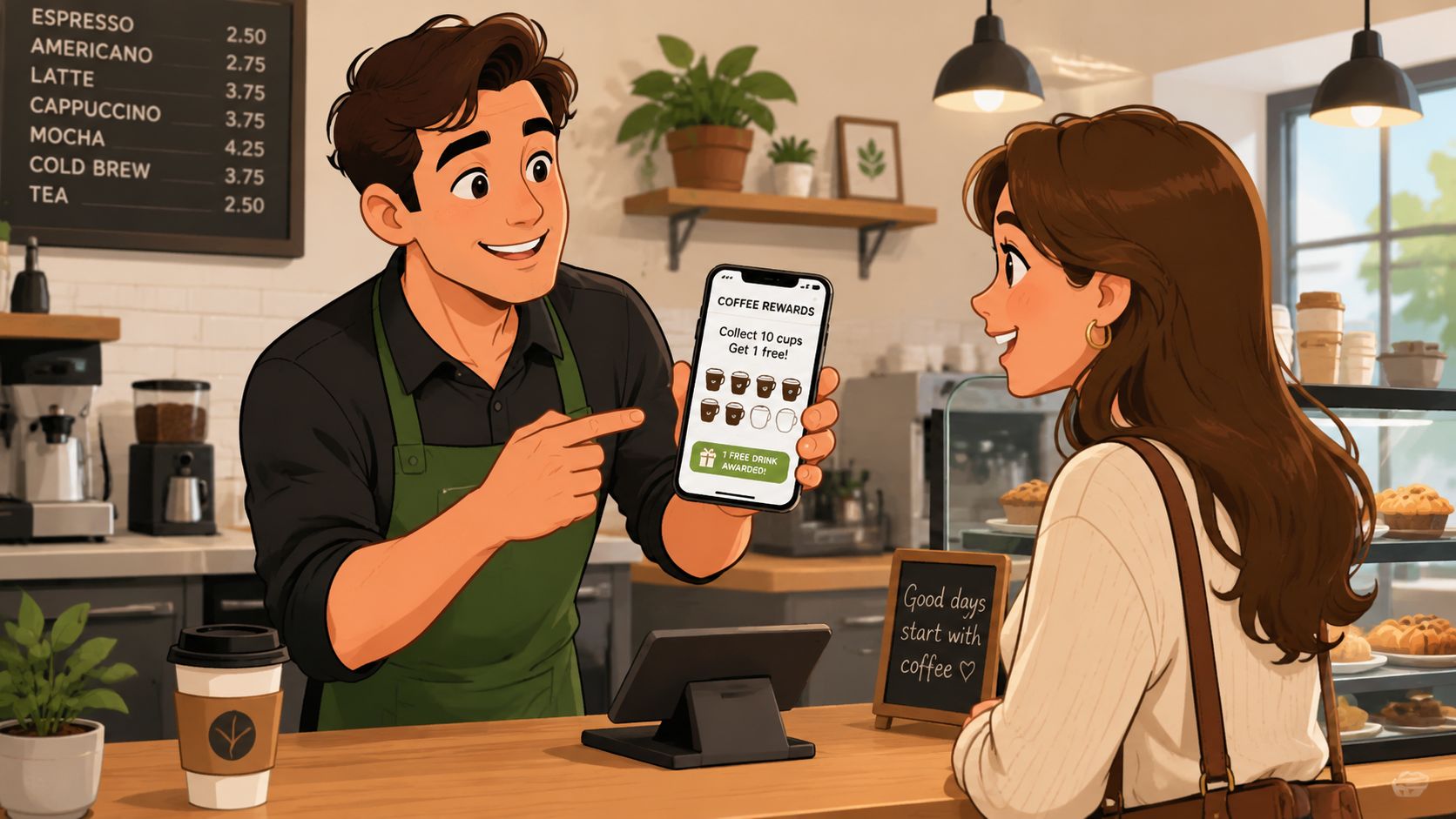
The difference from a promotion is important. A 20% coupon can bring in one-time traffic; a real program creates a repeatable logic: the customer buys, accumulates progress, receives value, and starts over. Therein lies the foundation of customer loyalty. This logic is relevant because improving retention has a cumulative effect on profitability: various analyses cited by Queue-Fair remind us that increasing customer retention by 5% can boost profits by 25% to 95%.
In simple terms, it consists of designing a relationship with clear rules. In our review, a program stops being improvised and becomes serious when it meets at least these four elements:
Criterion | What it must define | Practical question |
|---|---|---|
Objective | What behavior you want to drive | Are you looking for more visits, a higher ticket, or to reactivate customers? |
Mechanics | How the customer accumulates value | Through points, visits, tiers, or purchase rewards? |
Reward | What they receive and when | Is the prize attainable and relevant? |
Data and tracking | What you are going to record and measure | Do you know who buys, when they return, and how much they redeem? |
That framework answers a very common question: what to put in a loyalty program. The default answer is not "discounts." The bare minimum is a business goal, a simple accumulation rule, an easy-to-understand reward, and a system to track results. If one of those components is missing, there is usually no program: there is just a repeated promo.
A classic example still works in coffee shops: buy 9 drinks and the 10th is on the house. But today we also see more powerful models in retail and e-commerce: a store can give points per purchase, early access to launches, or preferred shipping for frequent customers. This type of benefit doesn't just push sales; it also improves brand perception and repeat business. In fact, a regional analysis compiled by Loybox points out that in Latin America, 83% of respondents improve their perception of a brand when a loyalty program exists.
Beyond a simple discount
It is easy to fall into the trap of thinking that a loyalty program is the same as a promotion. It is not. A promotion reduces the price for a moment; a program structures the commercial relationship so that the customer has a concrete reason to return.
The real goal is to increase customer lifetime value. That's why good programs don't limit themselves to giving things away: they use data to make the next purchase more relevant. According to Pretii, in 2025, 97% of surveyed organizations already recognized customer loyalty as a driver of success, and 87% stated that investing in these initiatives yields ROI. In our editorial experience, that figure only becomes believable when the company knows what behavior it wants to change and doesn't launch rewards "just because."
A loyalty program works when the customer understands the benefit in seconds and the business can measure if that benefit generates profitable repeat business, not just redemptions.
Key components of an effective loyalty program
Component | Description | Practical Example |
|---|---|---|
Clear Rewards | The customer must easily understand what they earn and how they earn it. Simplicity is crucial. | “Accumulate 5 car washes and the 6th is free.” Direct and uncomplicated. |
Personalization | Using data to offer rewards and messages that resonate with each customer's habits. | Sending a discount coupon to a barbershop customer for a beard treatment on their birthday. |
Constant Communication | Keeping the customer informed about their progress, new benefits, and exclusive offers. | Push notifications or emails saying: “You only need 2 more visits to our coffee shop for your free drink!”. |
Exclusive Experience | Offering benefits that are not just discounts, such as early access to products or VIP events. | Invitation to an exclusive coffee tasting for program members of your coffee shop. |
Component | Description | Practical Example |
|---|---|---|
Clear Rewards | The customer must easily understand what they earn and how they earn it. Simplicity is crucial. | "Accumulate 5 car washes and the 6th is free." Direct and uncomplicated. |
Personalization | Using data to offer rewards and messages that resonate with each customer's habits. | Sending a discount coupon to a barbershop customer for a beard treatment on their birthday. |
Constant Communication | Keeping the customer informed about their progress, new benefits, and exclusive offers. | Push notifications or emails saying: "You only need 2 more visits to our coffee shop for your free drink!". |
Exclusive Experience | Offering benefits that are not just discounts, such as early access to products or VIP events. | Invitation to an exclusive coffee tasting for program members of your coffee shop. |
The key lies in the data
Modern loyalty programs are a direct source of business intelligence. Every time a customer identifies themselves to earn points or register a visit, the business gains context: what they buy, how often they return, which reward they redeem, and which segment responds best. This allows you to move from "I think this works" to much more concrete decisions.
For example, with this information you can:
Identify your star customers: Those who buy the most or spend the most at your coffee shop or barbershop.
Segment your messages: Offer something relevant based on actual habits, not generic campaigns.
Win back lost customers: Detect who stopped coming and trigger a timely offer or reminder.
All-in-one platforms like Swirvle bring these tools within reach of SMBs, connecting the point of sale with the customer database and marketing campaigns. If you want to dive deeper into this topic, you can learn more about the synergy between a CRM and a loyalty program and how it drives growth. This allows businesses like coffee shops, barbershops, or local stores to implement strategies that previously only large chains could afford, turning every sale into an opportunity to strengthen the relationship with their customers.
Why does your business need a loyalty program?
Implementing a loyalty program is not just a trend to give away things to your customers. It is, in reality, one of the smartest moves you can make to grow your business, especially when competition is fierce. For an SMB, every customer is a treasure, and it takes much less work and money to keep the ones you already have than to go out and look for new ones.
The key to everything lies in how it influences people's behavior. When you offer rewards—points, discounts, a free product—you give your customers a clear, tangible reason to choose you instead of the business next door. This simple preference gradually turns into real and stable profits.
Increases purchase frequency and average ticket
Think about this: a customer who knows that every purchase brings them closer to a prize has a very powerful reason to return. Imagine a barbershop that gives a free haircut after five visits. That customer is going to schedule their appointments with you to keep the streak going. Or a car wash where every service adds points for a free wax; suddenly, the decision to wash the car again accelerates.
And not only that. Loyalty programs also encourage customers to spend a little more on each visit to reach their reward faster.
In a coffee shop: It is highly likely that a customer will add a pastry to their coffee just to gather the points they need for their next free drink.
In a car wash: A driver might choose a more expensive cleaning package because it gives them double points.
The logic is simple: when customers feel they are investing in a future prize, their spending in the present increases. This is essential for your business to be more profitable without relying all the time on finding new people.
The numbers don't lie. A recent study by EY found that 83% of Mexicans look for and prefer brands that have loyalty programs. What's more, these programs can make recurring consumption grow between 15% and 25%, because 82% of customers admit they directly influence the amount of money they spend. If you want to see more details, you can consult the impact of these programs on the Mexican market here.
Turn data into your secret weapon
But here comes the best part: beyond the prizes, the real power of a digital loyalty program lies in the information it gives you. Every time a customer identifies themselves to accumulate points, they are telling you exactly what they like, when they buy, and how much they spend. That information is pure gold for making smart decisions.
Platforms like Swirvle don't just gather all that data, they present it to you in a way you can actually use. At a glance, you can know who your most loyal customers are, which products are your members' favorites, or even detect customers who haven't visited you in months. With that information in hand, you can launch targeted and personal marketing campaigns that actually work.
For example, you could send a discount coupon for their favorite drink to all customers who haven't stopped by your coffee shop in 30 days. It is a simple and automated action that turns data into real money. Understanding this is the first step to mastering one of the best tools to increase sales in your business.
How to choose the ideal type of loyalty program
There is no single formula that works for everyone. The loyalty program needed by a coffee shop with daily customers is totally different from the one required by a luxury boutique. The key lies in understanding your objectives, your business model, and, above all, how your customers behave.
Choosing the right model is like picking the right tool for a job. Are you looking to have people visit you more often? Do you want them to spend more on each purchase? Or do you prefer to create an exclusive circle for your best customers? Let's look at the most common models so you can identify which one aligns best with your business.
Points programs
This is the classic system we all know. The logic is simple: for every peso a customer spends, they accumulate points that they can later redeem for products, discounts, or other rewards. It is an excellent strategy to motivate higher spending on each visit.
Its greatest appeal is flexibility. Customers feel they are in control, deciding when and on what to use their points.
Ideal for: Businesses with frequent purchases and variable purchase tickets, such as coffee shops, convenience stores, or restaurants.
Practical example: A coffee shop can give 1 point for every $10 pesos of consumption. Upon gathering 100 points, the customer redeems them for their favorite drink.
This mechanism is very good for getting people to add an extra product to their purchase just to reach the goal faster, which directly raises your average ticket.
The following diagram explains it very well. Every loyalty program seeks to strengthen three pillars: having people visit you more often (frequency), spend more (average ticket), and not leave for the competition (retention).

Each type of program targets these objectives differently. Understanding this is essential to align the strategy with what your business actually needs.
Programs by visits or digital stamps
Here, what is rewarded is consistency. Instead of focusing on how much the customer spends, this model celebrates how many times they return. It is, basically, the modern and digital version of the classic cardboard punch card.
The beauty of this system is its simplicity and the very clear sense of progress. The customer sees very visually how close they are to their reward.
Ideal for: Businesses where the price of the service is more or less fixed, such as car washes, barbershops, beauty salons, or taco shops.
Practical example: A car wash can give a digital stamp for each wash. After 5 stamps, the sixth service is on the house.
This type of program is incredibly effective for creating a habit. The customer knows that every visit counts and is much less likely to go to the competition so as not to “lose their streak.”
VIP tier programs
Tier programs appeal directly to the desire for status and recognition. They work by creating a hierarchy (think bronze, silver, gold) where customers move up levels as they buy more, unlocking increasingly better benefits.
This model is perfect for identifying and pampering your most valuable customers, making them feel part of an exclusive club.
Ideal for: Businesses looking to build a long-term relationship and a sense of community, such as fashion boutiques, signature restaurants, or specialty stores.
Practical example: A specialty coffee shop can create a “Coffee Lover” tier for customers who spend more than $1,000 pesos per month. In return, it offers them access to exclusive bean tastings or priority to buy limited editions.
Platforms like Swirvle allow you not only to choose one of these models but to combine them. You can start with a simple points system and, later on, add VIP tiers to reward your top customers, adapting your strategy as your business evolves.
To help you better visualize which one might be right for you, here is a comparison table.
Comparison of loyalty program types
This table compares the most common loyalty program models, highlighting what type of business they are ideal for.
Program Type | Ideal for | Main Advantage | Potential Disadvantage |
|---|---|---|---|
Points | Businesses with frequent purchases and variable tickets (coffee shops, retail). | Flexible and encourages higher spending per transaction. | Can be complex if rewards are not clear or attractive. |
Visits or Stamps | Services with fixed pricing (barbershops, car washes, beauty salons). | Simple, visual, and generates very strong consumption habits. | Does not incentivize higher spending, only repeat visits. |
VIP by Tiers | Businesses looking for exclusivity and long-term value (boutiques, restaurants). | Creates a strong sense of belonging and rewards the best customers. | May discourage new customers who see high tiers as too far away. |
Coupons and Discounts | Virtually any business looking to generate immediate traffic. | Very effective for attracting customers and moving inventory quickly. | If overused, it can accustom customers to buying only with a discount. |
As you can see, there is no single answer. The best strategy is one that feels like a natural extension of the experience you already offer, bringing genuine value that your customers can feel with every visit.
The steps to successfully implement your loyalty program
Implementing a well-designed loyalty program involves more than choosing an attractive prize. You need a measurable goal, mechanics aligned with your purchase type, a profitable reward, and a launch process that doesn't rely on improvisation. This is where many SMBs fail: they launch something easy to understand for marketing, but hard to operate for the cash register or impossible to measure for management.
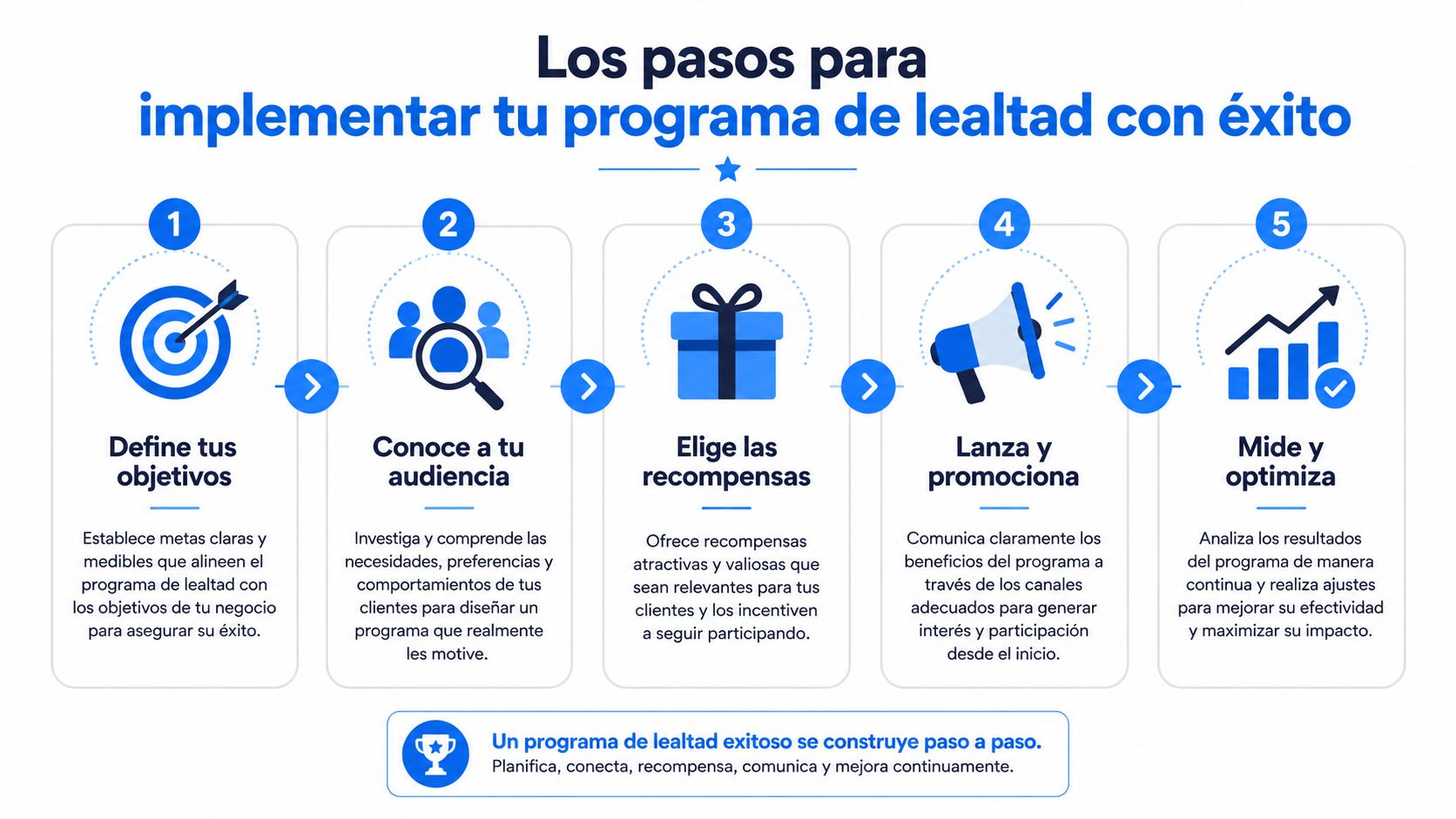
1. Define your objectives (what do you want it for?)
Before deciding whether to use points or visits, define a baseline goal with current numbers. If you don't know your starting point, you won't be able to prove later if the program improved anything. Your baseline can include four simple metrics: monthly frequency, average ticket, percentage of customers returning in 30-60 days, and expected redemption rate.
Useful examples:
In a barbershop, moving from one visit every 5 weeks to one every 4.
In a coffee shop, raising the average ticket of enrolled customers from $85 to $95.
In retail, increasing the percentage of customers who buy again within 60 days.
In a car wash, reactivating inactive customers with more than 90 days without a visit.
If you need an additional reference to structure your retention focus, it's worth reviewing the practices on Salescaling’s site, because they help connect business goals with concrete loyalty actions. In our review, the most common mistake in this step is setting vague goals like "having more loyal customers"; that doesn't guide design or budget.
2. Calculate if the reward is profitable
The reward must excite the customer without eating away at your margin. To evaluate it, calculate three things before launching: the actual cost of the prize, the expected incremental revenue, and the frequency with which it will be redeemed.
A practical formula is this: if you give away a product whose internal cost is low but has high perceived value, the program is usually much more sustainable than one based on direct discounts. For example, in a coffee shop, it may be better to give away a medium drink with a good margin than to offer a general 20% discount. In retail, early access, free shipping, or a low-cost gift can work better than recurring discounts.
We tend to be suspicious of programs that promise "big" prizes too soon. They sound good at first, but often hurt margins or train customers to buy only when there is an immediate financial benefit.
3. Choose the mechanics based on purchase frequency
Not all mechanics work for all businesses.
Very frequent purchases: points or stamps are best.
Stable price services: visits or digital stamps are usually clearer.
High tickets or less frequent purchases: tiers, VIP benefits, or quarterly accumulated rewards may work better.
Retail or e-commerce with diverse categories: points with simple rules and non-monetary benefits usually provide more flexibility.
The rule of thumb is this: the more frequent and predictable the purchase, the simpler the mechanics can be. If the purchase is more spaced out, the reward must feel relevant enough so the customer doesn't perceive it as too far off. In our review, many SMBs overcomplicate the structure too soon; it is almost always better to start with a basic version and improve it later.
4. Ask only for the minimum necessary data
A good program is also designed by minimizing registration friction. If a customer has to fill out too many fields to join, adoption drops. The reasonable minimum to start with is usually name, phone or WhatsApp, and, if applicable, email address. With that, you can already identify purchases, send reminders, and build a useful customer database.
Later, you can enrich the profile with birthdays, favorite categories, or purchase frequency, but not all of it from the first contact. Asking for too much at the register is one of the reasons many programs launch with low enrollment.
5. Choose wisely between manual implementation and software
A manual version can help validate the idea, but it has clear limits: poor traceability, risk of error, almost no automation, and difficulty in measuring actual impact. Specialized software, on the other hand, allows you to record purchases, trigger messages, and compare the results of members vs. non-members.
Manual implementation
Lower initial cost.
Useful for very simple tests.
Weak for measurement, control, and scalability.
Loyalty software
Better tracking of purchases and redemptions.
Automations for onboarding, reactivation, and follow-up.
Reports to know if loyalty actually drives frequency, ticket size, or retention.
Less reliance on staff for repetitive tasks.
If you are going to evaluate tools, check at least these criteria: integration with POS and CRM, available automations, quality of reports, ease of registration for the customer, and actual operating cost. That last point matters: a cheap tool that requires manual processes ends up costing more time and errors.
Tools and software to manage a loyalty program
The right technology doesn't replace a bad strategy, but it does prevent a good idea from breaking down in daily operations. For an SMB, the best software is not the one with the most features, but the one that makes it easiest to register customers, add benefits, measure results, and trigger campaigns without relying on spreadsheets.
What a good tool should solve
A useful loyalty system should help you cover five fronts:
Quick registration at POS: immediate signup, without long forms.
POS or CRM integration: so that purchases, profiles, and rewards live in the same flow.
Basic automations: welcome, reminders, birthdays, reactivation.
Actionable reports: active members, redemptions, frequency, ticket, and repeat business.
Simple operation for the team: if the cashier doesn't understand it, neither will the customer.
In our editorial review, the clearest sign of a weak tool is that it forces the business to export data to understand something as basic as who bought again this month. The tool should shorten decisions, not create parallel work.
When an SMB can start manually and when it's no longer convenient
A physical card or a control sheet can serve to validate initial acceptance in very small businesses. But they are no longer enough when you want to segment, compare periods, or automate messages. That is when the hidden cost appears: more staff time, more recording errors, and less visibility on ROI.
Platforms like Swirvle aim precisely to solve that transition: connecting the program, POS, and CRM so that registration and communication don't live separately. If you want to evaluate options, you can also check out Swirvle's main platform to compare implementation approaches. We suggest doing a simple test: can the customer join in less than a minute? Does the team understand how to operate it in a shift? And can you see results without building manual reports?
How is the actual success of your program measured?

Launching a loyalty program without measuring its results is like sailing without a compass. You know you are moving, but you have no idea if you are heading in the right direction. For your strategy to be a smart investment and not a simple expense, it is crucial that you understand its true return on investment (ROI).
The good news is that you don't need a PhD in finance to achieve this. With the right tools and a focus on the metrics that actually matter, you can get a clear snapshot of the impact your program is having on the health of your business.
The metrics that actually tell the story
To know if your loyalty program is working, you have to go far beyond counting how many people have signed up. True success is measured by the change in your customers' behavior. These are the four key metrics you should always keep on your radar.
Customer Retention Rate: What percentage of your customers returns over and over again? A successful program makes this number grow, proving that you are building a solid and loyal customer base.
Purchase Frequency: How often do program members buy compared to non-members? If your barbershop members are now coming every three weeks instead of every five, there's your answer!
Average Ticket: When a program member visits you, do they spend more than the rest? This metric is key. An increase here means that rewards are motivating them to add that extra product or try a more comprehensive service.
Customer Lifetime Value (LTV): This is the king of metrics, the one that encompasses it all. It calculates how much money a customer generates for you during their entire relationship with you. If the LTV of your program members is significantly higher, you have definitive proof that your strategy is profitable.
A practical example in a taco shop
Let's take the case of "Tacos El Campeón". Before their program, the average customer spent $150 pesos per visit and came twice a month. After implementing a digital stamp system, they noticed something interesting: members now spent $180 pesos and visited three times a month.
Let's do the math. The LTV of a non-member customer was $3,600 pesos a year ($150 x 2 visits x 12 months). In contrast, a member's LTV soared to $6,480 pesos ($180 x 3 visits x 12 months). The difference is not small; it is convincing proof of the program's profitability. If you want to go deeper, I recommend understanding what ROI in marketing is and how to apply it.
The reason many loyalty programs fail is not a lack of good intentions, but a total absence of measurement. Without data, you are flying blind, not knowing what works, what doesn't, and where to adjust course.
This is precisely where technology becomes your best ally. Platforms like Swirvle tackle this problem at its root. Instead of you having to rack your brain with spreadsheets, they show you these metrics in visual dashboards, simple to interpret and updated in real-time.
With just a couple of clicks, you can compare the behavior of your loyal customers against occasional ones, discover which rewards are the most popular, and, most importantly, make decisions based on real data to grow your business.
Examples of loyalty programs that actually work in Mexico
Useful examples are not just the biggest ones; they are those that help you decide what is worth copying and what is not. Therefore, instead of getting stuck on figures from national chains, it is worth translating those models into three real-world SMB contexts. Even so, the size of the market confirms that loyalty is no longer marginal: an analysis cited by Milenio shows the massive adoption of these schemes in Mexico, and the regional growth reported by Loybox reinforces that loyalty is already driving investment, brand perception, and recurring revenue in LatAm.
Coffee Shop: high frequency, simple reward
Objective: increase weekly visits and slightly raise the average ticket.
Chosen mechanics: digital stamps per visit or points per consumption.
Reward: free drink or size upgrade after a certain number of purchases.
Metric to watch: purchase frequency per enrolled customer.
Main risk: requiring too many purchases to reach the prize.
Why does it work? Because the category has high repeat business and the customer immediately understands the progress. In our review, this is one of those cases where simplicity wins: if the reward is reached relatively quickly, a habit is formed. When is it not convenient? When the prize margin is low or the coffee shop relies on general discounts instead of specific benefits.
Barbershop: consistency and reactivation
Objective: shorten the time between cuts and win back inactive customers.
Chosen mechanics: one registered visit per main service.
Reward: free cut, discount on premium service, or birthday benefit.
Metric to watch: average days between visits.
Main risk: confusing rules between services that do and do not qualify.
Why does it work? Because a barbershop usually operates on a relatively predictable schedule. A visit-based system reminds the customer that returning with the same frequency has a reward. It is not as suitable if the business has services that are very disparate in price and duration; there, a hybrid logic with points or benefits by category might be better.
Store or Retail: accumulated value and actionable data
Objective: boost repeat purchases, identify frequent customers, and launch segmented campaigns.
Chosen mechanics: points per spend, sometimes combined with tiers.
Reward: store credit for future purchases, early access, or exclusive benefits.
Metric to watch: repeat purchase rate at 30-60 days.
Main risk: inflating discounts and eroding margins.
Why does it work? Because retail needs flexibility for different categories and ticket sizes. Points allow you to recognize purchases of different sizes without punishing the customer who spends less. Where it does not work is in stores with margins that are too tight if all the value of the program depends on discounts. There, benefits of access, personalization, or service tend to be healthier.
What cases that actually work have in common
The three examples share something: the reward is quickly understood, progress is visible, and the business can measure if behavior has changed. This seems obvious, but in practice, this is where a program is most likely to break down. We reviewed many cases where the idea was attractive, but the customer didn't know how many purchases they had made or the team didn't know how to explain it at the counter.
Frequently asked questions about loyalty programs
What should I put in a loyalty program?
The essential part is defining four pieces: objective, mechanics, reward, and measurement. If you don't know what behavior you want to drive, what the customer wins, and how you are going to record results, the program becomes a promotion without direction.
What type of loyalty program is right for my business?
It depends mostly on purchase frequency and ticket size. If your customers return often and spend similar amounts, visits or stamps usually work best; if there are variable tickets or many categories, points provide more flexibility; if you want to reward your best customers, tiers may be more appropriate.
How much does it cost to implement a loyalty program?
It can range from a very low-cost manual test to an integrated platform with POS and CRM. The real difference is not just in the initial price, but in what you can measure, automate, and operate without errors; that is why it is best to compare operating costs, not just the monthly fee.
How long does it take to see results?
The first learnings come from registration and data capture, but visible changes in frequency, repeat purchases, or ticket size are usually better evaluated between 3 and 6 months. That timeframe allows you to observe if enrolled customers return more, redeem, and respond to communication.
Will my customers actually use it?
Yes, if sign-up is easy and the reward is immediately understood. When the benefit is confusing, distant, or requires too many steps, adoption drops even if the idea is good. That is why simplicity is usually a competitive advantage, not a limitation.
Is it better to start manually or with software?
Manual can work to validate very simple mechanics, but it falls short in measurement and automation. If you already need to segment campaigns, integrate purchases, or compare results between members and non-members, software is usually the most solid option.
Now that you have a clear understanding of what a loyalty program is and how it can give your business a boost, the next step is choosing the right tool. Swirvle offers you an all-in-one platform that integrates POS, CRM, and loyalty so that every sale turns into a long-term relationship. Discover how Swirvle can help you grow.
Related Blogs

Nov 10, 2026
How to manage multiple restaurant locations from a single system?

Nov 9, 2026
Which CRM is best for a small business in Mexico? 2026

Nov 8, 2026
What works better for a small business: WhatsApp promotions or email promotions?

Nov 7, 2026
How do you calculate a business's net purchases? Formula and example in MXN

Nov 6, 2026
How much does a point-of-sale system cost for a small business in Mexico?

Nov 5, 2026
How to Create an Executive Breakfast Menu to Sell to Offices: 2026 Guide