Learn what 1st party data is, why it is vital for your SMB or physical store in Mexico, and how to use it to increase sales and build customer loyalty with Swirvle.
A coffee shop owner in Puebla sees the same customers go by every week. A car wash manager in Monterrey recognizes faces, cars, and schedules. A manager of a small retail chain in the State of Mexico knows that there are branches that sell certain products better, but cannot explain why. All of them have valuable information right in front of them. Almost none of them are turning it into decisions.
That is the real problem. There is no lack of customers. There is a lack of business memory.
In many Mexican SMBs, data exists, but it is scattered among the cash register, the manager's WhatsApp, a layaway notebook, loose receipts, and the staff's heads. That is why it is not surprising that recent studies on e-commerce in Mexico indicate that only 25–30% of Mexican retail SMBs systematically measure purchasing behavior by branch, while 45% state they do not have the capacity to analyze their own data. That is where the silent leak of sales is.
1st party data solves exactly that. It is not about becoming a corporation. It is about stopping operating blindly and starting to recognize patterns that are already occurring in the business.
Table of Contents
The Gold Mine Hidden in Your Business
What happens today in most branches
The opportunity that is almost always right in front of you
What Is 1st Party Data and Why It Is Your Best Ingredient
Your own data is worth more because it is born at your counter
The difference between sowing and buying blindly
The Real Impact on Mexican SMBs with Physical Stores
When data becomes recurrence
What changes in daily operations
How to Collect Customer Data Ethically and Effectively
How to ask for data correctly from the register
Clear privacy without complications
What works and what does not
From Data to Money with Smart Segmentation Examples
Car wash in Nuevo León
Coffee shop in Mexico City
Gas station in Yucatán
Concrete Activation in Swirvle: Your Action Plan
Order first, campaigns later
Automating without losing control
The Future of Your Business Is in Your Own Data
h2 id="35">The Gold Mine Hidden in Your Business
Most physical businesses in Mexico already have a gold mine. The problem is that they treat it as if it were common dirt. Every purchase leaves a clue. Every repeated visit marks a habit. Every customer who agrees to receive promotions is giving permission to build a more profitable relationship.
A coffee shop in Baja California does not need a data lab to detect who buys coffee on their way to work and who comes in for dessert in the afternoon. A bakery in Puebla does not need a complex strategy either to notice which families buy on weekends and which ones only show up on birthdays or special dates. Those patterns already live in daily operations.
A business without a customer record repeats the same sales effort over and over again with the same person.
The problem appears when no one pieces them together. Then all customers seem the same. Mass promotions are sent out, discounts are given to those who would have bought anyway, and margins are lost without knowing which campaign actually worked.
What happens today in most branches
There are clear signs of disorder that are repeated in Nuevo León, CDMX, State of Mexico, and other areas:
Unidentified frequent customers: they return often, but the business does not know their name or history.
General promotions: the same is offered to new, loyal, and about-to-churn customers.
Isolated data: cash register, WhatsApp, coupons, and loyalty programs live separately.
Decisions by intuition: the manager "feels" that something works, but cannot measure it.
The opportunity that is almost always right in front of you
1st party data turns familiar faces into useful profiles. It is no longer about "that gentleman who always comes in for a double Americano." It is about a customer with a clear frequency, average ticket, favorite schedule, and authorized contact channel.
That changes the conversation. Instead of spending to attract anyone, the business can sell better to those who have already walked through the door.
What Is 1st Party Data and Why It Is Your Best Ingredient
1st party data is the data that the business itself obtains directly from its customers. It does not come from a third party. It is not bought. It is not guessed. It is born at the counter, in the loyalty program, in a digital registry, in an identified purchase, or in a survey answered with permission.
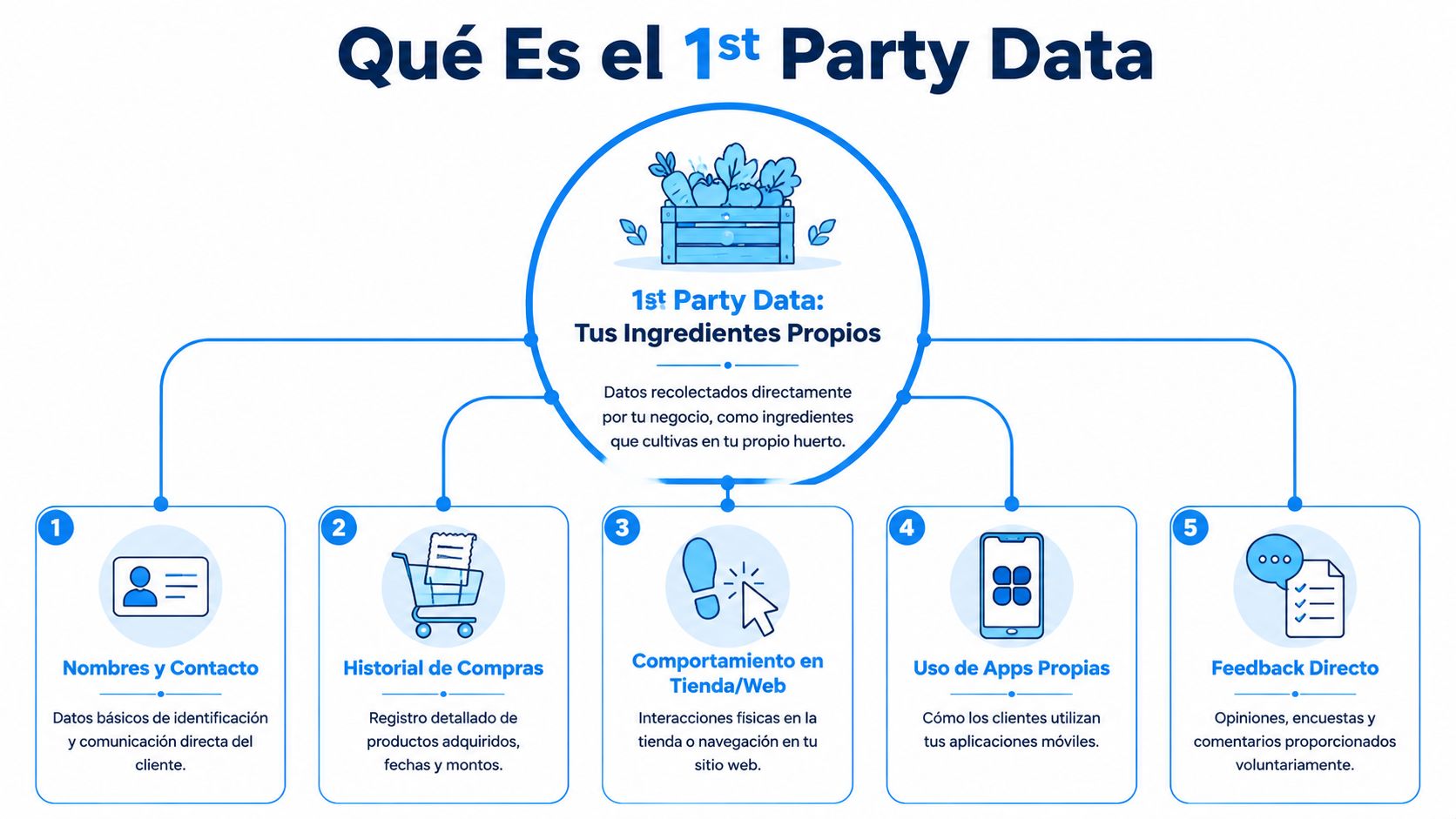
Your own data is worth more because it is born at your counter
The easiest way to understand it is to think of a kitchen.
If a coffee shop grows its own ingredients, it knows their quality, origin, and availability. The same goes for data. When a customer leaves their name, cell phone, birthday, purchase history, or preferences within the business ecosystem, that information is more useful because it has real context.
A car wash can know which customer usually gets a premium wash and how often they return. A gas station can detect who only fills up on fuel and who also buys in the store. A bakery can identify which customers buy on a whim and which ones buy for a special occasion.
The difference between sowing and buying blindly
It is useful to separate three concepts to avoid confusing terms:
Data Type | Where It Comes From | What It Implies for an SMB |
|---|---|---|
1st party data | From the business itself | More control, more accuracy, and better operational use |
2nd party data | From a partner sharing their data | Can be useful, but depends on agreements and compatibility |
3rd party data | From aggregated external sources | Less control and less direct relationship with the customer |
In an SMB with a physical store, the data that is most useful is almost always the first one. It is the one that can be activated quickly. It is also the one that best connects with the reality of the sales floor.
Rule of thumb: if the business cannot explain where a piece of data came from and with what permission it was obtained, that data should not be the basis of a campaign.
The most useful examples of 1st party data are very everyday:
Contact information: name, cell phone, email, and birthday.
Purchase history: what they bought, when, at which branch, and for how much.
Behavioral signals: visit frequency, schedules, redemptions, and response to messages.
Declared preferences: favorite flavors, type of service, or categories of interest.
Direct feedback: complaints, comments, ratings, and survey responses.
The best ingredient is not the most sophisticated. It is the one that can be used well. In physical SMBs, that almost always starts with simple, well-captured, and well-organized data.
The Real Impact on Mexican SMBs with Physical Stores
When a business organizes and activates its own data, the effect does not stop at a pretty presentation. It is noticed at the cash register. It is noticed in the frequency of visits. It is noticed in the ability to stop sending the same promotions to everyone.
When data becomes recurrence
The most useful results for an SMB are those that directly hit retention, ticket, and return. Companies that use first-party data from CRMs and loyalty programs achieve 35% more retention. In Nuevo León, a 2023 study showed a 28% increase in average ticket size and a 4.5x ROI on personalized loyalty campaigns.
Translated to real operations, this means something very concrete. If a coffee shop in CDMX identifies those who already buy several times a week, it can stop attracting them with discounts and start pushing them toward higher-value consumption. If a car wash in Monterrey detects customers who have not returned in a while, it can reactivate them with a timely incentive before losing them completely.
Physical businesses do not grow just with more traffic. They grow when they convert known visits into repeated habits.
What changes in daily operations
These impacts do not come from technological magic. They come from better decisions. For example:
Valuable customers are recognized: frequent customers are no longer mixed with occasional ones.
Promotions are adjusted by behavior: less waste on discounts.
It is measured which campaign actually brought in sales: not just opens or clicks.
Each branch is managed better: real habits are compared by location.
This also matters in businesses where purchases have a family or routine logic. A pharmacy with a follow-up program, for example, can leverage contact information to remind customers of recurring purchases or relevant services. Timely and clear communication does change user behavior. Those who receive a useful message at the right time respond better.
The point is not to accumulate data. The point is to use it so that the customer returns, buys better, and stays longer.
How to Collect Customer Data Ethically and Effectively
Collecting data well has nothing to do with invading privacy. It has to do with asking for useful information, with clear permission, and with a visible benefit for the customer. When done well, the capture stops feeling like a chore and starts functioning as a natural part of the experience.
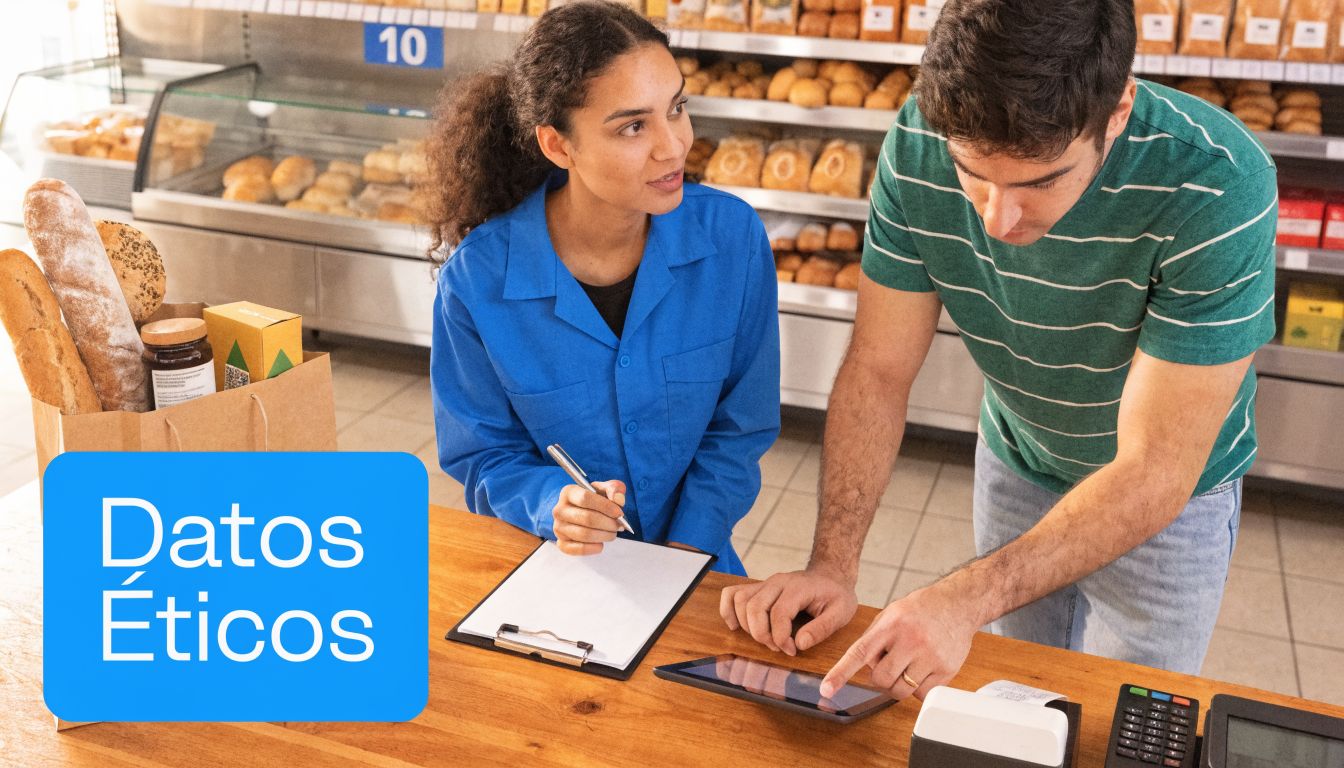
How to ask for data correctly from the register
The best capture usually starts at a simple point. The purchase. Right there, a coffee shop, a bakery, or a retail store can invite the customer to sign up for a loyalty program with a direct promise: accumulate points, receive rewards, access exclusive promotions, or save benefit history.
It works best when the process is short. Name, cell phone, and consent. Later, the profile can be enriched with more data as the relationship grows.
Some practical ways for a physical SMB are these:
Digital loyalty program: the most natural method to record purchases and recurrence.
Registration at the counter or tablet: useful when staff explains the benefit in less than a minute.
Post-purchase survey: good for getting preferences and feedback without friction.
Wi-Fi with voluntary registration: works if the business actually offers value in return.
Form on site or own networks: convenient for pre-orders, orders, or promotions.
For businesses that still have scattered information, it is best to start by organizing a single database rather than five separate lists. This guide on how to structure a customer database helps ground that step without making it more complicated than necessary.
Clear privacy without complications
Here many SMBs hold back because they think the law requires impossible documents. It is not like that. What it does require is clarity. The business must explain what data it asks for, what it will use it for, and how the customer can withdraw their consent.
According to a cited survey on SMB alignment with LFPDPP in Mexico, only 18% of SMBs say they are fully aligned with this law. That gap does not just imply risk. It also opens a clear opportunity to build trust.
A simple notice can say, in normal language:
“Your data will be used to manage your registration, accumulate benefits, and send you promotions related to your activity with the brand. You can unsubscribe whenever you want.”
What does not work is asking for too much data, hiding consent, or using the information for something the customer never authorized.
What works and what does not
Practice | Works | Does not work |
|---|---|---|
Store capture | Asking for little data with a clear benefit | Long forms at the end of the line |
Consent | Clear checkbox and simple language | Fine print and ambiguous messages |
Subsequent use | Sending offers related to real purchases | Bombarding with generic messages |
Internal management | A single organized database | Loose files per branch |
Ethics here is not an ornament. It is an operational advantage. When the customer understands what they win and how their data will be used, they share better information and respond better to campaigns.
From Data to Money with Smart Segmentation Examples
Having an organized customer database is just the start. The money appears when that base becomes actionable segments. Segmentation means stopping talking to everyone in the same way. In a physical SMB, that avoids unnecessary discounts and improves the timing of the message.

Car wash in Nuevo León
A car wash can divide its base into very clear groups. Weekend customers, frequent customers, dormant customers, and customers who buy premium services.
With that, the conversation changes:
Weekend customers: they are invited to go during the week with a benefit that helps distribute demand.
Frequent customers: they are rewarded without immediately lowering the price of each visit.
Dormant customers: they receive a reactivation message with a short validity period.
Premium customers: they are offered a complementary service, not a generic discount.
Here the point is not to send more messages. It is to send fewer, but better chosen ones.
Coffee shop in Mexico City
In restaurants and coffee shops, segmentation by consumption habit usually gives a lot of play. It is possible to separate those who buy coffee daily, those who consume pastries, those who show up only on weekends, or those who approach seasonal promotions.
First-party data collected via loyalty programs enables personalization that increases sales by 41% annually in the analyzed universe of 850 physical SMBs with CRM.
If a coffee shop knows a customer's purchase pattern, it stops selling coffee. It starts selling routine, craving, and occasion.
To ground the value of these segments, it is useful to measure how much a customer is worth over time. This explanation on how to calculate customer lifetime value helps decide how much to invest in retention and when a reward makes sense.
Gas station in Yucatán
A service station can work with very concrete segments without getting complicated:
Only fill up on fuel: it is best to push them to the store with a cross-reward.
Buy in store and fill up: ticket size can be raised with combos or cumulative benefits.
Always visit the same branch: useful for local campaigns by time or inventory.
Have not appeared in a while: they deserve reactivation before they change brands out of habit.
This also applies to small chains in Puebla or the State of Mexico. When the branch understands who buys what, it no longer depends so much on the manager's intuition. It starts operating with useful signals.
Concrete Activation in Swirvle: Your Action Plan
The critical part is not gathering data. It is turning it into campaigns that are repeatable, measurable, and easy for the team to operate. That is where it is convenient to move from loose files to a tool that connects registration, history, segments, and messages.
Order first, campaigns later
A reasonable flow for an SMB with multiple branches follows this order:
Centralize customer registration
Each sign-up must be in one place, linked to purchases, visits, and redemptions.Define useful fields
No need to capture everything. Just data that helps sell better, such as contact, branch, registration date, and purchase behavior.Build simple segments
Newly registered, frequent, at risk, high ticket, low ticket, no recent visit.Assign an action per segment
Welcome, reward, reactivation, cross-sale, or reminder.
At this point, POS software with an integrated loyalty program helps because it prevents sales and marketing from working as separate worlds.
Automating without losing control
Activation works best when the business decides on clear rules. A CRM with a loyalty program like Swirvle can centralize customer profiles, segment by consumption habits and branch, and run campaigns via WhatsApp, push notifications, or email with performance measurement.
The practical logic looks like this:
Segment | Simple Rule | Suggested Action |
|---|---|---|
New customer | First registered purchase | Welcome message with second-visit benefit |
Frequent with low ticket | Visits often, spends little | Complementary offer or upgrade |
Customer at risk | Prolonged time without returning | Reactivation coupon with short validity |
Loyal high-value | Constant purchases and high ticket | Exclusive reward without aggressive discount |
According to AMVO benchmarks on dynamic segmentation in CRM and WhatsApp campaigns, this type of segmentation can reduce churn by 28%, raise average ticket by 22%, and generate a 2.9x higher ROI compared to non-segmented campaigns.
Useful automation does not replace judgment. It repeats with discipline what the business already knows makes sense.
What does not work is automating chaos. If the base is poorly captured, the segments are born wrong. If the messages do not respond to real behavior, the customer perceives them as noise. That is why it is better to start with few segments, measure response, and adjust.
In a chain of coffee shops in CDMX or a group of car washes in Nuevo León, that change is already big. You stop sending promotions on a whim and start operating with rules.
The Future of Your Business Is in Your Own Data
SMBs with physical stores in Mexico do not need to chase trends or set up giant projects to take advantage of 1st party data. They need commercial discipline. Register better. Order better. Segment better. Activate better.
That changes the business from the inside. The customer stops being an isolated sale and becomes a measurable relationship. The branch stops operating with partial memory and starts working with history. Marketing stops spending blindly and starts driving recurrence, ticket, and loyalty.
For a coffee shop in Puebla, a gas station in Yucatán, a car wash in Monterrey, or a store chain in the State of Mexico, the advantage is not in having millions of records. It is in making good use of the data that is already born every day at the register.
Every customer who buys without registering is an opportunity walking out the door. Every identified purchase, on the other hand, can turn into the next visit.
If the goal is to go from loose receipts to identified customers, and from generic campaigns to attributable sales, Swirvle offers a practical way to centralize data, activate loyalty, and run personalized communication for physical businesses in Mexico and LATAM.
Related Blogs

Oct 4, 2026
How to organize my client information if I have a small business? Guide
Oct 3, 2026
What message should I send on WhatsApp to win back a customer who is no longer returning?

Oct 2, 2026
Grocery Store Software: 2026 Comparative Guide

Oct 1, 2026
Omnichannel CRM for Physical Businesses in 2026

Sep 30, 2026
7 sales report templates for SMBs

Sep 29, 2026
Business POS and payment system: complete guide 2026
Try Swirvle for free
No card required · 30 days free
Start your free trial