Learn how to apply the AIDA marketing model in your brick-and-mortar business. Use tactics for WhatsApp or email and grow with Swirvle this 2026.
One Monday, the cafeteria of a branch in Puebla wakes up full. On Wednesday, the same bar stays quiet until mid-afternoon. Something similar happens at a car wash in Nuevo León. There are days with lines and days with empty bays. Many owners attribute it to the season, the weather, or luck. It is almost never just that.
What is usually missing is a process. Not an isolated promotion or "more posts" on social media. A process that connects what the customer sees on their cell phone with what they end up doing at the point of sale. That is where aida in marketing is still useful for brick-and-mortar businesses in Mexico. Not as textbook theory, but as an orderly way to take a person from a first impact to a visit, a purchase, and then another purchase.
The problem is that many guides on AIDA are designed for pure e-commerce or generic ads. They do not help much when the real goal is to fill a branch in Estado de México, trigger repeat visits in Yucatán, or move customers between various locations in CDMX. That context demands another reading of the model: one where WhatsApp, email, and push notifications work to trigger a measurable offline action.
The disconnect remains large. In Mexico, 68% of retail SMEs do not yet integrate WhatsApp and push notifications into their marketing strategies, which generates a loss of up to 45% in conversion rates due to a lack of continuity between physical and digital branches, according to the AMVO in 2025, cited in this explanation of the AIDA model. Put simply: many businesses already do some digital marketing, but they do not connect it with the store visit.
That same order that a business needs to sell also serves to protect cash flow and prioritize investment. When an owner reviews operating expenses, promotions, and cash flow, it is also beneficial for them to learn how to optimize the budget for international remittances if that topic is part of their personal or family finances. The logic is the same. Less improvisation, more control.
Table of Contents
Introduction: The Challenge of Attracting Customers to Your Physical Business
When the problem is not traffic, but continuity
The bridge between digital marketing and in-branch sales
What is the AIDA Model and Why It Remains Relevant in 2026
The four stages without beating around the bush
Why it still works in Mexican brick-and-mortar businesses
AIDA for Brick-and-Mortar Businesses: From Theory to the Street
What each stage looks like in a branch
What does work and what usually fails
Omnichannel AIDA Campaigns: Messages That Convert by Channel
What message goes in each stage
AIDA message templates by channel and business
Implementing AIDA with Swirvle: Your Practical Roadmap
The correct order of implementation
Segmentation, automation, and loyalty without complicating it
Measuring the Success of Your AIDA Strategy with Swirvle
The KPIs that actually matter by stage
How to read ROI without deceiving yourself
Introduction: The Challenge of Attracting Customers to Your Physical Business
A brick-and-mortar business does not live on likes. It lives on visits, tickets, and recurrence. But many Mexican SMEs continue to operate with disconnected campaigns: a promo in stories, a digital flyer on WhatsApp, a coupon that no one ever sees again, and an email that goes out without segmentation.
That creates a very common pattern. The business manages to get attention one day, but does not know how to sustain interest or convert it into a purchase. Worse still, when the person does buy, no one triggers a second contact to bring them back. The result is not just irregular sales. It is also dependency on increasingly aggressive promotions.
When the problem is not traffic, but continuity
A coffee shop in CDMX can have good pedestrian flow and still sell below expectations. A car wash in Nuevo León can have enough clientele in the area and still struggle with slow days. In both cases, the failure usually lies in the continuity of the message.
If someone saw a promotion on their cell phone, arrived at the branch, bought, and then disappeared, the business did not have a complete strategy. It only had an initial impact.
Rule of thumb: if the customer remembers the offer but does not remember why to return, the campaign stopped mid-funnel.
The bridge between digital marketing and in-branch sales
AIDA solves that because it forces you to think in sequence. First, attention is captured. Then, interest is sparked. Next, desire is built. Finally, a clear action is requested. In a brick-and-mortar business, that action is almost always a visit, a redemption, a repurchase, or a registration for a loyalty program.
That changes the way campaigns are planned. You no longer send "a promo for everyone." You design a path.
Real attention: a message that interrupts with relevance, not with noise.
Useful interest: content that explains why that branch or service is worth it.
Concrete desire: an emotional or economic reason to prefer that business.
Easy action: a simple instruction that can be executed on the spot.
Businesses that land that process stop depending so much on improvisation. They start moving customers with intent.
What is the AIDA Model and Why It Remains Relevant in 2026
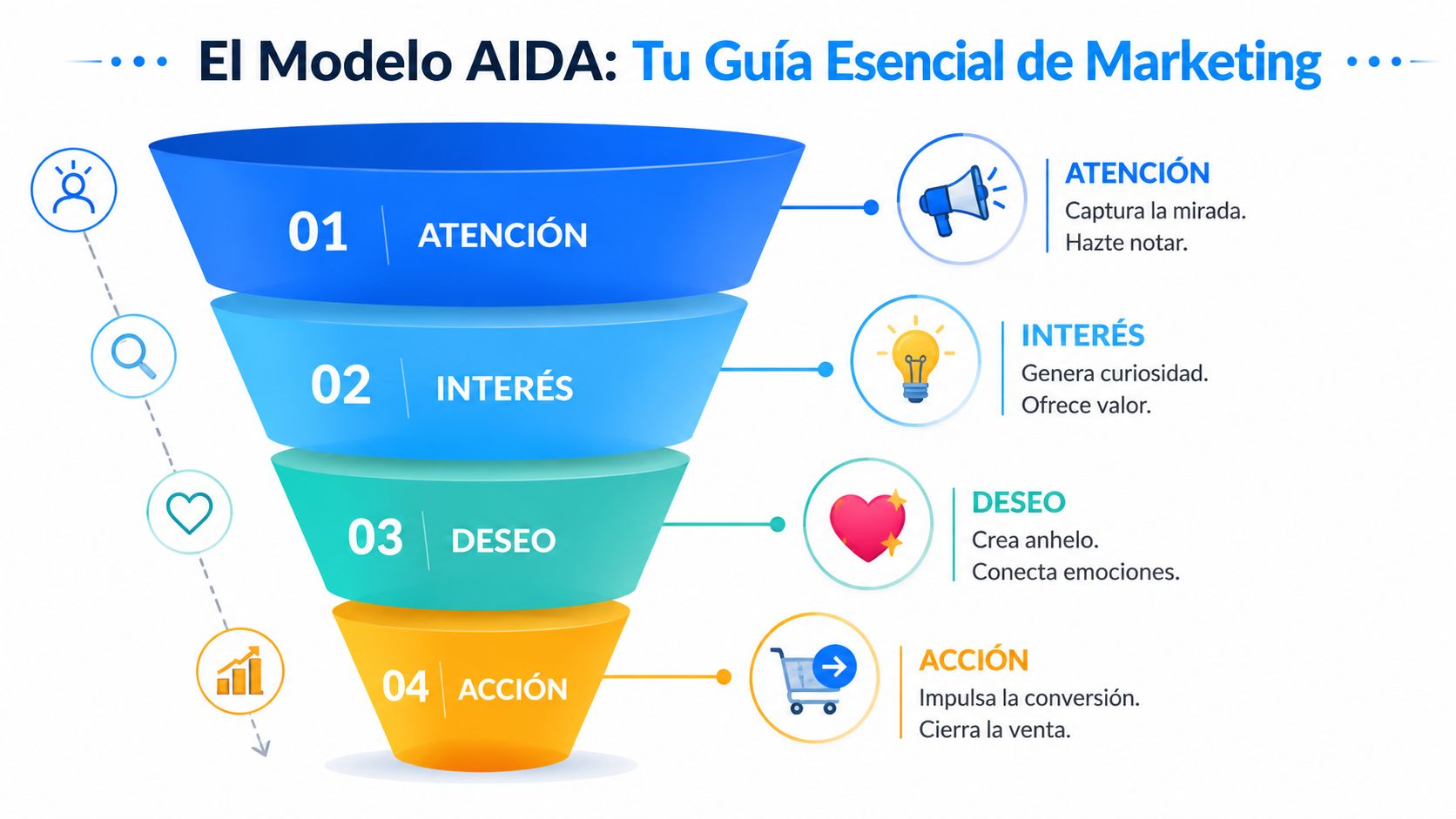
AIDA stands for Attention, Interest, Desire, and Action. The model was developed by E. St. Elmo Lewis in 1898, and remains relevant because it describes something that has not changed: people do not buy automatically. First they notice something, then they evaluate it, then they want it, and finally they act.
A simple analogy helps. Making a new friend does not start by asking for a favor. First, that person notices your presence. Then, they find something interesting in the conversation. After that, a connection appears. Only then is there enough trust to move forward. The same thing happens in marketing.
The four stages without beating around the bush
Attention is the first stop to the scroll, to routine, or to indifference. In a gas station, it can be a visible promotion when pumping fuel. In a coffee shop, it can be a notification with a seasonal drink. Without attention, the rest does not start.
Interest appears when the business answers an implicit question from the customer: "and why does this benefit me?". Here, messages that explain value work best. For example, speed, quality, benefit per visit, or an advantage per branch.
Desire no longer just informs. It makes the customer want to choose that business. It is not based solely on discounts. It can also come from convenience, exclusivity, personalization, or accumulative rewards.
Action is the concrete instruction. Visit today. Show this coupon. Reply to this message. Return this week. If the call is ambiguous, the campaign gets diluted.
Why it still works in Mexican brick-and-mortar businesses
The validity is not nostalgia. It has results in the local context. The AIDA method, developed in 1898, is used by 78% of SMEs with physical stores in Mexico. A study by AMAP in 2024 revealed that it increased the conversion rate in email and WhatsApp campaigns by 42%, and in Monterrey, 65% of retail chains reported a 35% increase in the average ticket when applying it to loyalty programs, as summarized in this analysis on the AIDA method.
That matters because many brick-and-mortar businesses believe that AIDA is only for ads. No. It also works for loyalty, repurchase, and visit frequency.
A similar example is well understood outside of marketing. When someone reviews steps to buy safe used cars, they do not make the decision based on a single stimulus. First, something catches their attention, then they compare, then they develop a preference, and finally they act. Human logic follows the same pattern.
It is also useful to connect AIDA with the upper part of the funnel. For that, it helps to better understand the concept of awareness in marketing for physical businesses. Without that first layer of visibility, not even the best offer ends up producing visits.
AIDA works because it organizes communication according to how a person decides, not according to how the business wants to sell.
AIDA for Brick-and-Mortar Businesses: From Theory to the Street
In a brick-and-mortar business, AIDA does not live in a presentation. It lives on the sidewalk, on the cell phone screen, at the register, and in the decision to return or not return. That is why it is useful to look at it with concrete examples.
A coffee shop in Puebla does not compete just for coffee. It competes for habit. A car wash in Nuevo León does not sell just a service. It sells convenience, trust, and recall. A bakery in Estado de México does not just place products. It places cravings, urgency, and occasion.
What each stage looks like in a branch
In Attention, the important thing is to be noticeable without being generic. In a coffee shop, that can be a clear storefront, a visible promo of the day, and a well-targeted mobile message. In a gas station, it can be an activation related to points or immediate rewards upon pumping.
In Interest, the customer has already stopped for a bit. Here, details that explain value carry weight. Estimated service time, benefits per visit, relevant combos for that hour, or advantages of that branch compared to another. If everything sounds the same, interest drops quickly.
In Desire, the business must drive preference. It is not enough to say "we have a promotion." It works better to present a specific reason to act. A premium wash with an accumulative reward. A coffee and pastry at a special price for those who have already visited before. A points reload for buying at a high-traffic branch.
In Action, the customer needs ease. If to redeem an offer they have to ask, scan something confusing, or meet unclear conditions, the momentum is lost. The close must be natural for the staff and obvious to the customer.
What does work and what usually fails
Four patterns are observed that successfully land AIDA on the street:
Message linked to context: the promotion changes according to time, branch, or habit. A breakfast customer is not spoken to the same way as an afternoon customer.
Visible benefit at the register: staff can explain the reward in one sentence.
Correct channel for the moment: WhatsApp serves to reactivate. Push serves for closeness and opportunity. Email serves to develop value.
Simple reward: visits, points, or an easy-to-understand coupon.
What usually fails is the opposite.
Too many identical promos: if everything is discounted, nothing stands out.
Messages without segmentation: sending the same thing to someone who visits every week and someone who has not purchased in a long time weakens the result.
Campaigns without branch connection: the customer receives something digital that is not well reflected in-store.
Actions difficult to execute: complex coupons, uninformed staff, or confusing redemption.
When the branch operation does not understand the campaign, AIDA breaks right in the last step.
In Baja California, a campaign focused on speed and convenience can work. In Yucatán, one centered on experience and scheduled return. The model is the same. What changes is the trigger that moves each customer. That is the part that generic guides almost never land.
Omnichannel AIDA Campaigns: Messages That Convert by Channel
The most common mistake in omnichannel campaigns is using the same message everywhere. AIDA helps avoid that because it forces you to ask what the customer needs on each channel and at each stage.
Not all media do the same job. WhatsApp pushes fast response. Email gives space to explain value. Push works well when the moment matters more than the detail. If all three channels repeat the same thing, they are wasted.
According to AMVO, campaigns segmented by consumption habits in branches in Interest and Desire stages increase recurrence by 28% in retailers. The CTR on WhatsApp can reach 12-18% compared to a generic 5% and reward redemption 42%, with a 22% increase in the average ticket when using these tactics, as described in this guide on applying AIDA to digital marketing.
What message goes in each stage
For Attention, keep it short. The goal is not to explain everything. It is to trigger a look or an initial click. A coffee shop in CDMX can send a push with a seasonal drink and an immediate benefit. A bakery in Puebla can use WhatsApp to announce a newly available product.
For Interest, the context already comes in. Here, explaining what makes the offer different is useful. A car wash can highlight estimated duration, type of wash, or additional benefit for frequent visits. A restaurant in Baja California can show a promotion by hour or a combo designed for the office.
For Desire, personalization works. "Your reward is ready" converts better than "We have promotions." If the person has already visited before, the message must recognize that history. Desire is built when the offer feels relevant, not mass-produced.
For Action, the instruction has to be simple and close to the moment of purchase. "Show this message today" is better than a long text with several conditions. If, in addition, the channel allows replying or saving the offer, the final step becomes more natural.
AIDA message templates by channel and business
Before designing more elaborate creatives, it is useful to review simple examples. For visual messages, it helps a lot to understand how to structure messages with images for loyalty campaigns, especially when the business wants to improve attention without saturating text.
AIDA Stage | Channel | Type of Business | Example Message |
|---|---|---|---|
Attention | Push | Coffee Shop | “Your break for the day is ready. Today there is a special drink at your nearest branch.” |
Interest | Coffee Shop | “This week, the coffee and pastry combo applies during morning hours. Ideal for a quick visit before the office.” | |
Desire | Coffee Shop | “You have already accumulated visits. Today you can take advantage of a reward on your next purchase.” | |
Action | Coffee Shop | “Stop by today before 6 pm and show this message at the register.” | |
Attention | Push | Car Wash | “Your car can be ready today without waiting so long. Check the benefit available at your branch.” |
Interest | Car Wash | “Learn the difference between express and detailed wash, and which suits you best according to your weekly use.” | |
Desire | Car Wash | “Your next visit can trigger a frequency benefit. It is available at your usual branch.” | |
Action | Push | Car Wash | “Come today. Your reward is active and is applied directly at the counter.” |
Attention | Gas Station | “Today there is a benefit for fueling at your usual station.” | |
Interest | Gas Station | “These are the rewards you can activate based on your recent consumption.” | |
Desire | Gas Station | “You are just a few purchases away from unlocking a useful prize on your next visit.” | |
Action | Gas Station | “Fuel up today and ask to apply your benefit at the register.” |
The best message is not the most creative. It is the one that corresponds to the correct stage and reduces the customer's next doubt.
Implementing AIDA with Swirvle: Your Practical Roadmap
Implementation fails when the business tries to automate too much from day one. AIDA works best when assembled as a simple, measurable chain. First segment. Then message. Next activation. Finally optimization.
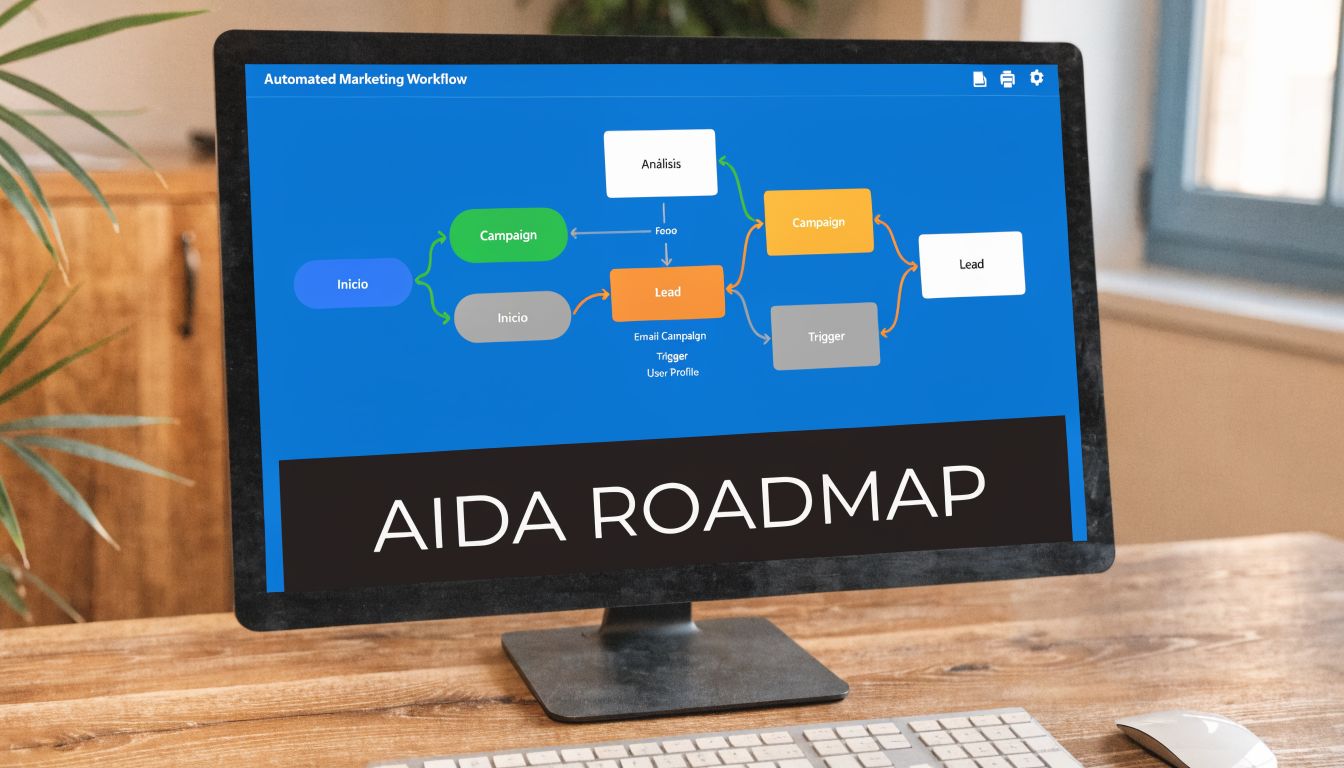
In Mexican franchises and retail chains, AIDA-based loyalty programs increase purchase frequency 3.2x in sectors like restaurants and car washes. Segmenting by branch in the Desire stage can reduce CAC by 41%, from $450 MXN to $265 MXN, according to this analysis on AIDA and digital marketing. That explains why the order of implementation matters so much in businesses with multiple locations.
The correct order of implementation
The first step is not sending campaigns. It is organizing the customer database by behavior. A useful structure separates at least these groups:
Frequent customers: visit regularly and respond best to habit-based rewards.
Recent customers: have already purchased, but have not yet formed a routine.
Dormant customers: stopped visiting and need a strong reason to return.
Customers by branch: react differently according to location, time, and context.
With that base, each stage of AIDA can operate logically.
Attention is activated with brief and timely messages. In a coffee shop chain, that can be a campaign by branch linked to the time of day. In a car wash, it can be an alert associated with the time of greatest likelihood of a visit.
Interest uses value content. No grand speeches. Just clear reasons to keep moving forward: service difference, accumulative benefits, or more convenient experience.
Desire is where personalization is worth the most. A generic coupon attracts. An incentive linked to history convinces better. If the person usually visits a specific branch, the message should reflect that.
Action closes with a simple and measurable instruction. Redeem today, visit this location, show the message, or activate a reward.
Segmentation, automation, and loyalty without complicating it
A practical roadmap for operating AIDA with discipline looks like this:
Define useful events
Record visit, purchase, frequency, and branch. Without that data, automation triggers messages blindly.Create audiences with intent
"All customers" is not enough. It is necessary to distinguish between those who are ready for a repurchase and those who still require interest or desire.Design short flows
A brief sequence usually performs better than a long chain. One attention message, one interest, one desire, and a concrete close.Use smart coupons
The coupon must be connected to a real condition. Previous visit, favorite product, frequent hours, or usual branch.Try small variations
Change an offer, a schedule, or the text of the call to action. Not all at once.Measure by branch
What works in Monterrey may not behave the same in Puebla or Estado de México.
A similar framework is observed in other sectors that depend on behavior-based automation. For example, in automate real estate marketing processes, the useful logic is not bombarding contacts, but activating messages according to signals and stages. In physical retail, the same thing happens.
It is also useful to think in customer value, not just immediate sales. If the business wants to better evaluate which strategy yields the most profit over time, it can go deeper with a platform focused on Mexico by reviewing how a modern alternative for loyalty and CRM in physical businesses works.
A loyalty program does not replace AIDA. It gives it continuity after the first action so that the customer re-enters the cycle.
When implemented well, the business stops chasing sales one by one. It starts building a system that attracts, converts, and reactivates with less operational effort.
Measuring the Success of Your AIDA Strategy with Swirvle
Many owners believe their campaign "worked" because there was more movement at the register. That criterion is not enough. If attention, interest, desire, and action cannot be separated, the business does not know which part worked and which is being wasted.
57% of retail marketing managers in Mexico report difficulty attributing sales to AIDA stages. AI platforms like Swirvle solve this, showing KPIs like 73% attention rates via notifications in gas stations, a 35% increase in desire with points dynamics, and a 4.2x ROAS in restaurants, according to this analysis on AIDA measurement.
The KPIs that actually matter by stage
The practical reading of the panel must be done by function, not just by volume.
Attention: notification opens, initial views, and early response to the first impact.
Interest: clicks, reads, interaction with content, and progression to the next piece of the flow.
Desire: saved rewards, coupon activation, visit intent, and participation in points dynamics.
Action: redemption, attributed purchase, repurchase, and return on the campaign.
How to read ROI without deceiving yourself
A good analysis does not just reward the campaign with the most opens. It rewards the one that generates visits and attributable sales consistently. That is why it is useful to look at results by branch, by segment, and by type of offer.
If a campaign gets a lot of attention but barely redeems, the problem is before the action. If there is redemption but low repurchase, the business needs to reinforce satisfaction and continuity. The advantage of measuring by stages is that it stops being a guessing game.
What is not properly attributed ends up receiving budget based on intuition, not on results.
If the business wants to turn AIDA into a measurable system of attraction, repurchase, and loyalty for physical branches, Swirvle offers CRM, automations, WhatsApp, push, and email campaigns, plus dashboards to attribute sales and understand which messages are actually taking customers from the screen to the register.
Related Blogs

Sep 19, 2026
Effective promotions to increase sales during low-traffic hours: 2026 guide

Sep 18, 2026
Examples of coffee shop loyalty programs (physical and digital)

Sep 17, 2026
Pros and cons of the "free coffee for the first 100 customers" promotion

Sep 16, 2026
How to organize a private coffee tasting: a practical guide

Sep 14, 2026
How to optimize Google Business Profile for barber shops

Sep 13, 2026
The best customer retention software for coffee shops
Try Swirvle for free
No card required · 30 days free
Start your free trial