
Discover effective promotions to increase sales during low-traffic hours, with examples, automation, KPIs, and strategies for coffee shops and businesses
An empty hour is not fixed with random discounts. A profitable promotion responds to three variables at the same time: available capacity, the right customer, and the precise moment. If a coffee shop has free tables in the mid-afternoon, a restaurant drops off after lunch, a barbershop cools down during the week, or a beauty salon has gaps in the morning, the problem is not always a lack of interest. Many times it is a poor allocation of the incentive.
That changes the conversation about effective promotions to increase sales during low-traffic hours. Lowering prices is not enough. It is advisable to choose between hourly discounts, loyalty, urgency, personalization, combos, referrals, memberships, and experiences according to the real goal: filling the calendar, increasing the ticket size, moving inventory, reactivating customers, or bringing in new visits without destroying margin.
In Mexico, physical traffic has proven to be volatile. Evidence from Getin indicates that in the first half of 2023, foot traffic to shopping centers fell by 10.81%, while the attraction of physical stores within those same centers rose by 17.10% (consumer and retail analysis in Mexico). The useful takeaway for off-peak hours is clear. When fewer people arrive, the one who converts the present audience best wins.
Swirvle fits naturally into this operational point. The platform allows you to centralize customers, segment by habits and location, automate campaigns via WhatsApp, push, and email, and measure attributed sales to know if a promotion filled capacity or just gave away margin. The important thing is not to launch eight ideas at once. The important thing is to choose one, configure it well, and measure it with discipline.
1. Time-specific promotions
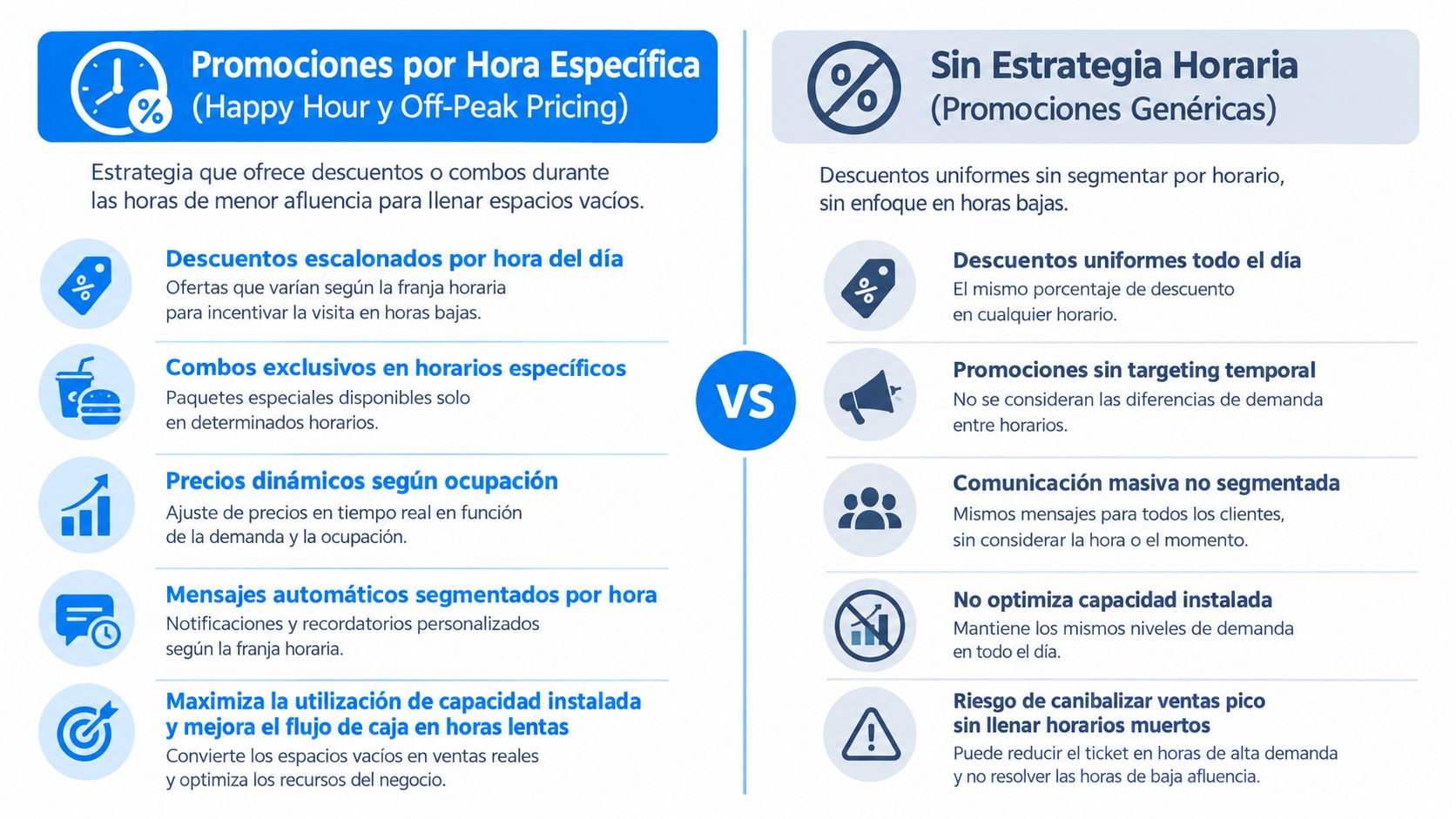
Hourly promotion remains the most direct tactic for shifting demand to a slow slot. It is also the most misused. If a coffee shop runs a discount all day, it trains the customer to expect a low price. If it limits the offer to a specific window, it better protects the peak and makes the change in behavior measurable.
In Mexican restaurants and coffee shops, a useful practice is to limit the promotion to blocks like 3:00 to 6:00 p.m. or even 10:00 to 11:30 a.m. to fill dead periods without touching the strong hours. This also works for barbershops and salons. A Tuesday morning promotion competes less with natural demand than a Saturday promotion.
How to set it up without giving away margin
A coffee shop can activate an "afternoon combo" between 2:00 and 4:00 p.m. only for customers who have not visited in the last week. A restaurant can offer an executive menu on business days between 3:00 and 5:00 p.m. with a minimum consumption. A barbershop can reserve a block with a benefit for Monday through Wednesday mornings. A salon can push manicures and pedicures during the hours where there are usually more cancellations.
Rule of thumb: the slot is defined by actual idle capacity, not by the owner's intuition.
With Swirvle, the flow is simple: identify the slot with the lowest traffic, create a dynamic coupon valid only during that time, limit it by location and recurrence, and trigger automated messages 30 minutes before via push or WhatsApp. For restaurants, it also helps to review the logic of high and low season in restaurants, because the slow hour is not always repeated the same way each month.
Risks and correct use
The main risk is cannibalizing visits that would have happened anyway. Therefore, it is advisable to require a minimum ticket, exclude anchor products, or reserve the promotion for specific segments. Another useful protection is to rotate the schedule every month so that the incentive remains tactical.
The hook of a limited window works only if the audience can act at that moment. In physical businesses with frequent consumption, the difference compared to a generic clearance sale is that the time slot must connect with real visiting habits—proximity, day of the week, and purchase reason—and not just with price.
2. Loyalty program for frequent purchases
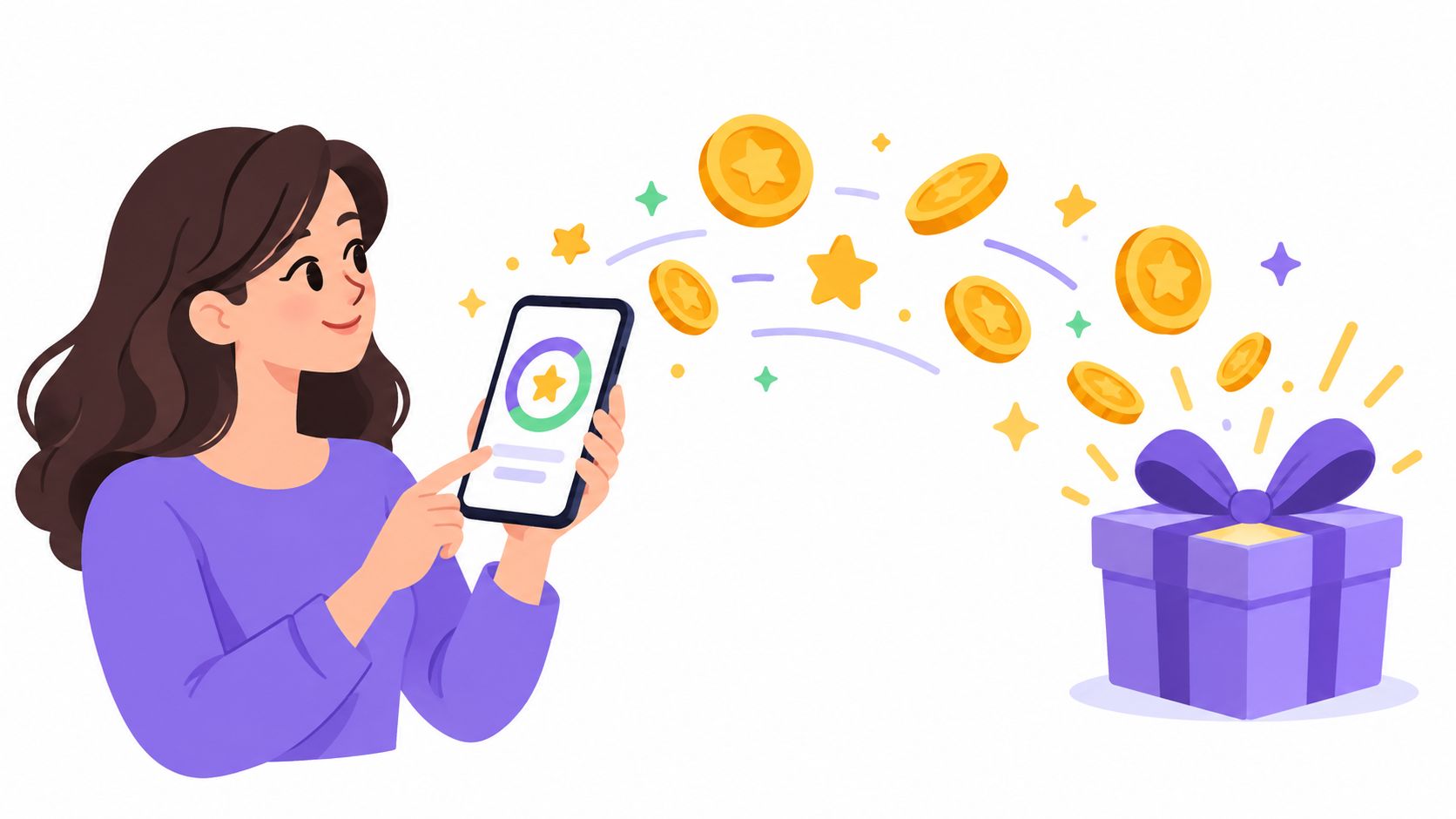
When the slow hour is repeated every week, the direct discount stops being the best tool. Loyalty usually works better because it rewards behavior without turning the off-peak slot into a permanent clearance sale. For a coffee shop, that can mean points for purchases between 2:00 and 4:00 p.m. For a beauty salon, accumulative visits on slow mornings with a reward redeemable later.
The Mexican context supports this bet. The loyalty program market in Mexico is projected at US$1.55 billion by 2025, with an annual growth of 16.8%, and more than 70 million people have at least one registration in a loyalty program; additionally, OXXO/Spin reports around 53 million registered users and 24.6 million active users (market intelligence on loyalty in Mexico). For off-peak hours, this suggests that the base already exists. The challenge is to activate it well.
Where it wins against the simple discount
A barbershop can offer a benefit for each visit on Tuesday and Wednesday mornings, instead of discounting every haircut. A restaurant can give double points during a slow slot and allow the reward to be used later on higher-margin products. A coffee shop can show on the receipt or app how close the customer is to the reward, converting that anticipation into an additional visit.
Operational benchmarks from the same market suggest active participation rates of 25% to 30% in retail and 40% to 45% in restaurants, with healthy redemption rates of 50% to 70% (participation and redemption analysis in loyalty). This makes the campaign measurable, but also forces tight control over eligibility, frequency, and reward cost.
Suggested automation flow
Swirvle allows you to set up a points or visits dynamic with rules for hours, location, and customer type. The recommended logic is to show progress, trigger reminders when only a few purchases are needed for the reward, and set expiration dates. A useful guide to bring ideas to life in coffee shops can be found in loyalty program examples for coffee shops.
The best reward for off-peak hours is not always "more discount." Many times, an experience, an upgrade, or a complementary product works better.
3. Flash sales and surprise offers
Flash sales are useful when the business needs an immediate reaction. They do not build habits on their own, but they do create quick peaks in very specific windows. A coffee shop can announce a limited-time afternoon offer on cold drinks. A beauty salon can release canceled slots with an incentive valid only that day. A barbershop can fill last-minute calendar gaps with a promotion for VIP clients.
Their strength is in urgency. Their weakness is in abuse. If the customer learns that an aggressive surprise appears every Thursday, it stops being a surprise and starts cannibalizing normal purchases.
When they are actually useful
In Mexico, the strongest promotional moments are concentrated in seasonal campaigns. HKTDC documents that Hot Sale 2024, organized by AMVO, lasted 8 days and generated nearly US$230 million in revenue, a 15.3% increase compared to the previous year; furthermore, consumer spending tends to concentrate on key events like Hot Sale, Buen Fin, and Christmas (report on retail foods and promotional behavior). The lesson for small physical businesses is useful. Temporary promotions work best when perceived as measurable micro-events rather than permanent markdowns.
In restaurants, there are also well-defined hourly windows, with Monday being the weakest, Friday the strongest, and dinner between 5:30 and 8:30 p.m. in the Mexican market, according to the same reference. This supports off-peak flash offers, not during the already strong stretch.

Tactical setup
A useful sequence with Swirvle would be: segment nearby or recent customers, create a coupon expiring in hours, limit units per location, and launch the message at most two hours in advance. The message must include the timeframe, benefit, and restriction. "Today from 3:00 to 4:00 p.m., only 8 spots for express manicure with special benefit" works better than an open and ambiguous promotion.
Segment priority: frequent customers receive the notice before occasional customers.
Clear inventory: if spots are limited, it is best to reflect that on the coupon or in the calendar.
Clean attribution: each redemption must be tied to a campaign, location, and time slot.
4. Personalized offers based on behavior
Personalization changes the focus. Instead of asking "what promotion should we send today," the right question is "which customer is most likely to respond today and with what incentive." This difference reduces promotional costs and increases relevance.
In Mexico, it is no longer always best to chase traffic above all else. In the first half of 2026, store attraction fell by 6.4%, visits by 5.2%, and items sold by 7.1%, but the average value of each purchase rose by 3.0%, while sales only dropped by 2.5% (coverage on consumption and value per purchase). This data changes the logic of off-peak hours. If the consumer visits less often but buys more per occasion, the personalized promotion should aim to increase the ticket size and mix, not just put more people in the store.
Cases where it beats mass promotions
A coffee shop can detect who usually buys coffee and sweet bread in the mid-afternoon and send them an add-on combo instead of a general discount. A restaurant can identify customers who return every certain number of weeks and offer a complimentary appetizer or drink only during a low-occupancy slot. A beauty salon can alternate incentives between manicure, hydration, and upgrades based on actual history.
Personalizing is not chasing the customer. It is tailoring the promotion to those who already show a similar intent.
Flow with Swirvle
The recommended sequence is to register preferences, group by purchasing habits and location, and automate mailings 24 hours before the historical visit pattern. The channel also matters. WhatsApp usually works best for active users and urgency. Email can serve occasional customers or more detailed messages. Push works well when the app already has frequent use.
Automation wins when tied to a specific behavior: absence of visit, partial purchase, regular hours, or proximity to a reward. For these types of messages, it is worth reviewing personalized notifications, because the difference between a "promo for everyone" and a "relevant message" usually defines whether the off-peak hour improves or just gets filled with noise.
5. Bundling and strategic combos
Bundles are the best option when the problem is not just traffic, but a low ticket size. They sell more without relying on a steep discount on each item. This makes them especially useful in coffee shops, restaurants, and salons where the business can combine products or services of different margins.
A coffee shop can create an "Office Afternoon Combo" with a large coffee, pastry, and water. A restaurant can package a main dish, drink, and small dessert. A barbershop can group a haircut, beard trim, and oil. A salon can join a manicure, pedicure, and hand massage. The name of the combo is not important. What matters is that it makes sense to the customer and preserves profitability.
What the contextual data says
In June 2026, ANTAD reported a 1.6% drop in same-store sales, attributing part of the effect to the 2026 World Cup, which modified consumption habits; in parallel, Walmart de México reported lower store traffic of 1.1%, while the average ticket rose between 2.2% and 2.9% (analysis of demand diversion and ticket size). The relevant reading is contrary to typical advice. When traffic falls due to context, the best promotion is not always a flat discount. Many times it is better to capture intent with bundles and contextual promotions.
How to build bundles that actually sustain themselves
Consumption logic: a coffee shop sells an afternoon combo better than an arbitrary mix of products.
Mixed margin: the bundle must include at least one component that helps sustain contribution.
Tiered versions: basic, premium, and "to share" allow raising the ticket without forcing a single option.
A useful setup with Swirvle consists of creating coupons by bundle, restricting them to slow hours, and measuring not just redemption, but average ticket size compared to visits without the promotion. If the combo increases the ticket, even if traffic does not rise as much, it can be a better business than a general markdown.
6. Referral and incentivized word-of-mouth
Referrals work best when the business needs local visibility and social proof, not just immediate volume. For a neighborhood coffee shop, a "bring a friend" on Tuesday or Wednesday afternoon can fill the place more than an open discount. For a barbershop, a recommendation among acquaintances reduces the trial barrier. For a salon, referred clients usually arrive with clearer intent than a cold lead.
The key is not to overpay for acquisition. If the benefit for the referrer and the referee is excessive, the business swaps CAC for lost margin. If the benefit is well-calibrated, it becomes an efficient way to occupy idle capacity.
Where it becomes most useful
A restaurant that drops off at the beginning of the week can push referrals only for weekday lunch. A barbershop can give an incentive for the first online booking during slow hours. A salon can reward a client who brings another person during a morning slot that is normally underutilized.
For barbershops in Mexico, a specialized guide recommends discounts of 15% to 20% for customers booking their first appointment via the online system and suggests focusing offers on slow days and hours, such as Tuesday and Wednesday mornings. This criterion fits well with referrals. The entry incentive can be reserved for the first appointment and limited to a timeframe where the business indeed needs to move the schedule.
Recommended flow
Swirvle can generate unique coupons or codes per customer to track who referred, when it was used, and at which location. The message should be short, easy to share, and with an expiration date. "Share this benefit to book Tuesday or Wednesday morning" works better than a long process.
A referral program for off-peak hours must reward the visit during the slow slot, not just any visit.
7. Membership and automatic subscription
Membership works when the business already knows a repetitive demand and wants to make it predictable. It does not fill gaps from one day to the next, but it stabilizes the calendar and improves planning. For a coffee shop, it can mean recurring afternoon benefits. For a barbershop, a flat rate or benefit during weekdays. For a salon, scheduled services on specific mornings.
The main advantage is financial and operational. The customer perceives continuous value. The business gains greater visibility on expected recurrence. The disadvantage is clear: if the offer is poorly designed, the customer only uses high-cost benefits and does not build incremental margin.
When does it make sense
It works best in categories with natural repetition. Coffee, lunch, haircuts, manicures, pedicures, and personal maintenance services fit better than highly sporadic experiences. It also requires communication discipline. If the customer forgets benefits or does not understand time constraints, the membership is perceived as an empty promise.
Swirvle allows you to set up memberships with rules by day, hour, location, and reward type, as well as automating usage reminders. This helps push the visit into the desired slot instead of letting the benefit be consumed at any time.
Best practices to avoid margin leak
Clear window: restrict benefits to off-peak hours.
Simple tiers: basic, premium, and VIP are usually enough.
Visible usage: reminders via WhatsApp or push before a benefit expires.
The most common mistake is selling a subscription when the real problem is still the commercial offer. If the business does not yet know what offer moves the slow slot, it is best to first test with a specific promotion before encapsulating it in a monthly model.
8. Exclusive experiences and events
Not all off-peak hours are corrected with price. Some are corrected with a reason. Experiences work when the business needs conversation, community, and visits with a greater willingness to buy more than one product or service. A coffee shop can organize a tasting or thematic talk. A restaurant can set up a wine and tapas window. A salon can turn a slow morning into a skincare workshop. A barbershop can activate a social gathering with reservation.
The strong point of this dynamic is that it changes the nature of the visit. The customer does not enter just to save money, but to participate. This reduces reliance on discounts, although it raises operational demands.
When does it justify the effort
In restaurants, a guide applied to the market suggests happy hour promotions with discounts of up to 50% on drinks between 5:00 and 7:00 p.m., along with combos like coffee with cake, BOGO, and late-night deals. That type of structure can serve as a foundation for a broader experience, but the real value appears when the brand adds pre-registration, a coupon for the next visit, and cross-selling of higher-margin products.
In Mexican coffee shops, a recent journalistic example identified actual lower-traffic windows by location: between 2:00 and 3:00 p.m. at one store, between 9:00 a.m. and closing at another, and before 9:00 a.m. at yet another (coverage on off-peak hours in coffee shops). The implication is powerful. The event should not be designed for the entire brand, but by location.
How to make an experience measurable
Swirvle can centralize registration, send reminders, generate post-event coupons, and attribute derived sales. If a coffee shop organizes a "Coffee Talk" at one location, the KPI should not just be attendance. It must also measure consumption at the event, subsequent repurchase, and conversion into recurring customers in that slot.
Comparison of 8 promotions for off-peak hours
Strategy | Implementation Complexity | Required Resources | Expected Results | Ideal Use Cases | Key Advantages |
|---|---|---|---|---|---|
Time-Specific Promotions (Happy Hour and Off-Peak Pricing) | Low-moderate: simple hourly rules | Marketing, automated communication, price adjustments | Increases occupancy in slow hours and improves cash flow | Restaurants, coffee shops, salons with defined peak hours | Fills idle capacity; easy to measure |
Loyalty Program for Frequent Purchases (Points & Rewards) | Moderate-high: points system and tracking | Points/CRM platform, incentives, communication | Greater frequency and average ticket; better retention | Businesses with recurrence (coffee shops, barbershops) | Increases retention and generates valuable data |
Flash Sales and Surprise Offers (Scarcity & Urgency) | Low-moderate: requires specific coordination | Stock control, instant notifications, logistics | Immediate traffic spikes and high conversion | Moving inventory or filling specific windows | Generates urgency and high CTR; low operational cost |
Personalized Offers Based on Behavior (Behavioral Targeting) | High: data analysis and AI | Advanced CRM, historical data, automation | Very high conversions and relevance; less marketing waste | Customers with sufficient history; VIP programs | Maximum personalization and marketing efficiency |
Bundling and Strategic Combos (Product Bundling) | Moderate: planning combos and pricing | Inventory management, packaging/promotion, POS | Increases average ticket and moves slow products | Cross-selling in coffee shops, restaurants, salons | Improves margin and simplifies the purchase decision |
Referral and Incentivized Word-of-Mouth (Viral Loop) | Moderate: tracking and reward rules | Unique codes/links, tracking, incentives | New customers with reduced CAC; higher retention | Businesses with satisfied customers and active social networks | Lower CAC, organic acquisition, and increased loyalty |
Membership and Automatic Subscription (Subscription Model) | High: recurring billing and tier management | Subscription platform, exclusive benefits | Recurring revenue and guaranteed frequency | Businesses with habitual consumption (coffee shops, barbershops) | Cash flow predictability and higher CLV |
Exclusive Experiences and Events (Experiential Marketing) | High: event coordination and talent | Event logistics, promotion, staff | Engagement, community, and additional sales during the event | Brand differentiation and content generation | Emotional loyalty and social media amplification |
Convert slow hours into a measurable growth system
The best decision is not to choose the most eye-catching promotion. It is to choose the most appropriate one for the business constraint. If the problem is immediate idle capacity, an hourly promotion or a flash sale can work. If the problem is recurrence, loyalty or membership is appropriate. If the problem is ticket size, bundling and personalization usually better protect the margin. If local social proof is lacking, referrals and experiences can yield more.
A useful implementation starts with a single low-traffic slot. Identify a window where there is available capacity and insufficient demand, but without touching the peak. Then choose a promotion with a single goal: filling the calendar, increasing the ticket, reactivating dormant customers, or acquiring new customers. Mixing all goals into the same campaign complicates reading the result.
Next, define the segment and channel. Not all customers should receive the same incentive. A frequent customer may respond to points or early access. An inactive customer may require urgency. A new customer may need a trial offer. At that point, set up a coupon or reward with clear rules: hours, location, eligibility, expiration, usage limit, and included or excluded products.
Automation comes after, not before. First, decide the logic. Then program the delivery via WhatsApp, push, or email according to the segment's behavior. In Mexican brick-and-mortar businesses, WhatsApp has an especially strong weight: a 94.3% penetration is reported in the country, open rates near 98%, campaigns that usually convert between 5% and 15%, customer-initiated messages that can exceed 45% conversion, and an estimated cost of marketing conversation in Mexico near US$0.03 (databook on loyalty market growth and channels). This makes testing micro-campaigns by location and time viable without relying on generalized discounts.
Measurement should be compared against a baseline, not intuition. The minimum template includes incremental sales, cost of incentives, margin, average ticket, visits, redemptions, frequency, retention, CAC, and ROI. If a campaign increases visits but destroys the ticket and margin, it solved nothing. If a promo moves less traffic but raises the ticket and repurchase, it might be a better decision.
The strongest recommendation is to start with a controlled test in a single location or a single time slot. Review results every week, adjust the schedule, audience, message, incentive, and channel, and scale only when attribution shows real improvement. Swirvle fits into this process because it centralizes customers, automates campaigns, and shows dashboards to read attributed sales without relying on scattered spreadsheets.
Swirvle brings together CRM, loyalty, coupons, and automations so that coffee shops, restaurants, barbershops, and salons can turn their slow hours into measurable campaigns by location, segment, and channel. For those looking to execute effective promotions to increase sales during low-traffic hours without losing visibility of margin and ROI, it is worth checking out how Swirvle works.
Related Blogs

Oct 6, 2026
Which campaigns work to fill a restaurant during the week?

Oct 5, 2026
Does Excel work as a CRM for a small business, or is it better to use a software?

Oct 4, 2026
How to organize my client information if I have a small business? Guide
Oct 3, 2026
What message should I send on WhatsApp to win back a customer who is no longer returning?

Oct 2, 2026
Grocery Store Software: 2026 Comparative Guide

Oct 1, 2026
Omnichannel CRM for Physical Businesses in 2026
Try Swirvle for free
No card required · 30 days free
Start your free trial