Choose the best grocery store software in 2026. We compare pros, pricing, and key CRM, POS, and inventory features for LATAM businesses.
For a grocery store in Mexico, the right software must prioritize fast checkout and inventory control before adding loyalty and analytics. POS adoption was linked to an 18% increase, while sales grew 6% and profits grew 19% in the traditional channel.
The problem is usually not a lack of effort. The owner opens early, receives suppliers, works the counter, logs informal credit, and closes the register when they are already exhausted. The problem appears when they need to answer how much was sold, which product ran out, which merchandise is about to expire, or why the cash does not match the registered sales.
The selection of grocery store software must follow a layered adoption logic. First, the transaction is organized. Then inventory, purchases, and the cash drawer are controlled. Only when the team uses those processes every day does it make sense to add campaigns, rewards, segmentation, and automations.
Operational need | Feature that must resolve it | Priority |
|---|---|---|
Check out without stopping the line | Fast POS, product search, and multiple payment methods | Immediate |
Avoid stockouts and overbuying | Inventory, purchases, stock levels, and alerts | Immediate |
Operate with irregular connectivity | Offline mode and subsequent synchronization | Immediate |
Control informal credit and shifts | Credits, cash flow movements, and shift closures | High |
Retain customers | Points, coupons, visits, and rewards | Later |
Understand performance | Reports, segmentation, and campaign attribution | Later |
Scale to more locations | Centralized dashboard, permissions, and mobile operation | According to growth |
Why grocery stores need structured software
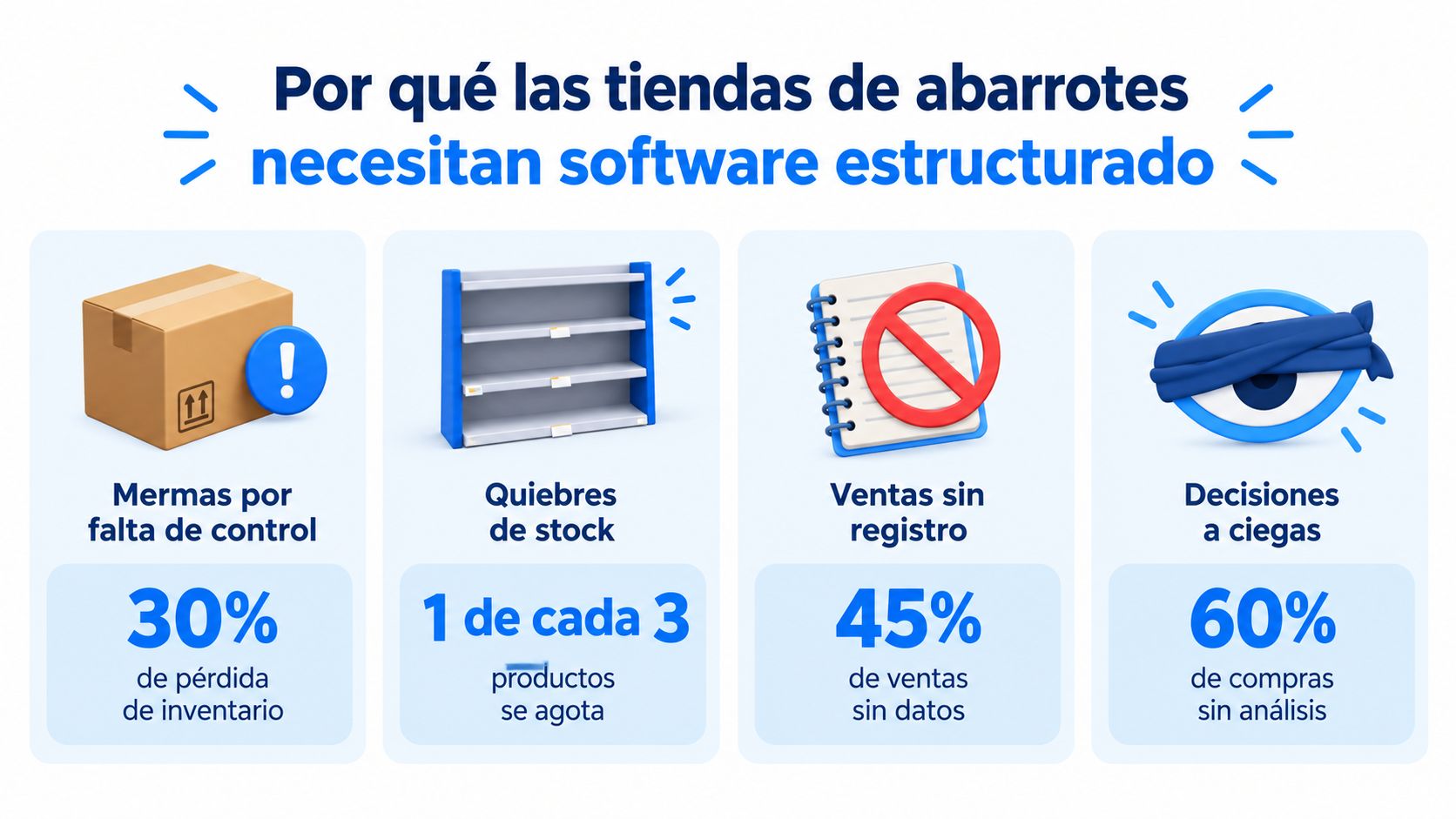
A store can sell all day long and still lose money. It is enough for a high-turnover product to run out, for an exit to be poorly registered, for slow-moving merchandise to be bought, or for business cash to be mixed with personal expenses. When control depends on a notebook, the operation lacks a reliable memory.
Operational informality also hides the cost of perishables. An expired product does not always show up as a loss at the time of purchase. It becomes waste weeks later, after it has taken up space, tied up money, and could no longer be sold. Software does not eliminate waste on its own, but it allows registering entries, exits, turnover, and adjustments so the owner can act beforehand.
The cost of working with incomplete information
The 2024 Economic Censuses from INEGI show that 95.5% of economic units in Mexico are micro-enterprises, concentrating 41.5% of the employed personnel, and only 5.5% of the units made online sales, according to the results released by INEGI. For this type of business, the priority is not to acquire a complex suite. It is to have a tool that staff can use during an actual sale, even with little digital experience.
The store needs to know what happened, not what seems to have happened. A structured daily close must link sales, cash, transfers, cards, informal credit, and returns. Inventory must reflect purchases and sales. Products with expiration dates must receive different treatment than non-perishable merchandise. If the system does not help solve those tasks, its advanced reports hold little value.
Rule of thumb: if registering a sale in the system takes longer than writing it in a notebook, adoption will fail at the counter.
Available evidence supports starting with the basic operation. In a study by the Poverty Action Lab on neighborhood stores, locations where debit card use was introduced earlier recorded, after two years, 18% higher POS adoption, plus 6% sales growth and 19% profit growth compared to locations with later implementation, according to the IPA (Poverty Action Lab) evaluation on POS adoption in corner stores. The lesson is concrete: digitizing checkouts and control can serve an economic function, not just an administrative one.
The three functional layers of retail technology
The most common mistake is buying features before building habits. A store does not need to activate the full potential of a platform from day one. It needs to progress from the layer that reduces daily errors to the one that allows making better commercial decisions.
First layer, transaction and control
The transactional layer includes the POS, product catalog, pricing, inventory, shift closures, and purchasing control. It must also address common situations in a Mexican store, such as informal credit, split payments, and operating without stable internet.
This layer answers immediate questions:
What was sold: each transaction is associated with products, quantities, and payment methods.
What remains available: sales reduce stock and make shortages visible.
What must be purchased: the person in charge can review turnover, suppliers, and stock levels.
What happened at the register: the shift close compares recorded movements with cash and payments received.
Managing perishables deserves specific attention. INEGI reported that real retail revenues grew 0.6% monthly in August 2025, a variation that keeps pressure on turnover and margins, according to retail trade results published by INEGI. A useful system must allow registering expiration dates, purchases by supplier, adjustments, transfers, and waste. "Real-time inventory" is not enough if the business cannot identify which batch must leave first.
Second layer, customers and recurrence
The analytics and loyalty layer transforms purchase history into commercial actions. It includes customer profiles, segmentation, points, coupons, rewards, and campaigns. In a neighborhood store, it can help distinguish the customer who buys daily from the one who only visits on payday, without turning every promotion into an indiscriminate discount.
This layer must come after sales are correctly registered. A campaign based on incomplete data segments poorly, attributes results incorrectly, and can reward behaviors the business does not want to encourage.
Third layer, automation and intelligence
The intelligence layer incorporates automations, recommendations, and predictive analysis. It can help detect demand patterns, suggest actions, or trigger communications based on customer behavior. Its value depends on the quality of the operational record.
The correct sequence is simple: charge well, measure well, act with data. The owner who jumps straight to artificial intelligence without controlling inventory and cash only automates disorder.
In-depth evaluation of Swirvle and alternative approaches
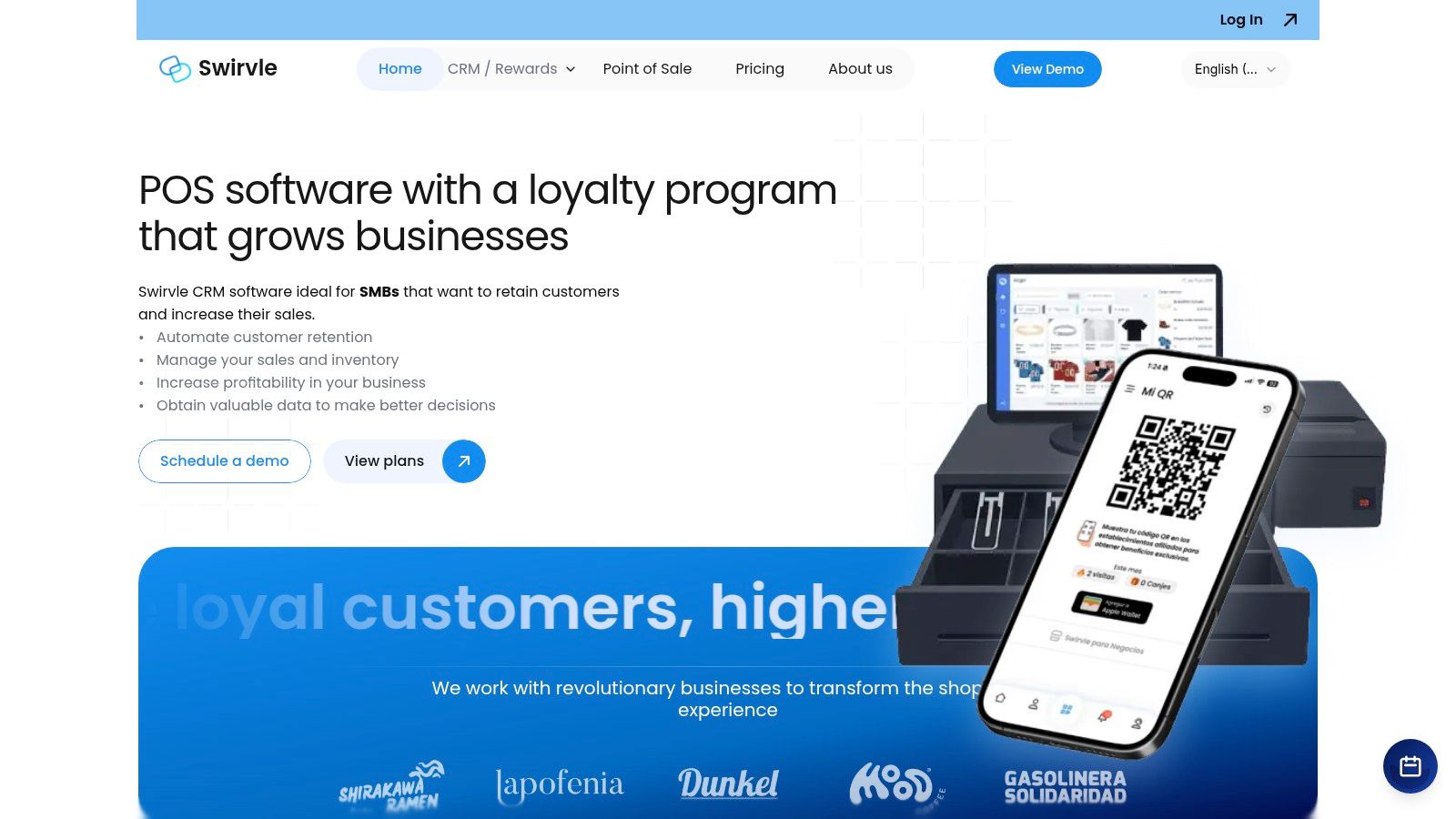
Swirvle fits into the second layer and can connect with the first when an SMB needs to bring together sales, inventory, customers, and retention actions. Its value proposition combines POS, CRM, loyalty program, automated campaigns, and analytics dashboards in a cloud platform. It also incorporates AI agents and communication via WhatsApp, push notifications, and email.
The correct comparison is not "modern platform versus legacy system." It is isolated basic operation versus connected operation. An independent POS can handle checkouts and inventory clearly. However, it typically leaves customer information separate, so the owner needs to export data, hire another tool, or run campaigns manually.
What an integrated approach solves
A store with more than one location needs to check sales and inventory from a single dashboard. It must also distinguish customers by purchasing habits, location, and frequency. Swirvle offers those capabilities along with coupons, visit dynamics, points, configurable rewards, and campaign sales attribution.
That approach is most relevant for businesses that already have a minimum data foundation. A coffee shop can trigger a reward after several visits. A barbershop can send a message to customers who stopped booking. A restaurant can segment those who buy specific products. In a grocery store, the logic can apply to recurring purchases, seasonal promotions, or customers who combine grocery shopping with immediate consumption products.
The decision must consider the maturity level. If the team is still skipping sales, not registering adjustments, and does not know the inventory, a CRM should not be the first investment. If the operation is already organized and the business needs to increase recurrence, integration avoids keeping a customer database separate from the POS. To delve deeper into operational criteria, you can consult this guide on POS software.
Where it wins and where it demands discipline
Swirvle's advantage lies in centralizing data and campaigns. The limitation is that no automation compensates for a poorly configured catalog, outdated prices, or staff registering sales outside the system. The platform can reduce fragmentation, but it requires the business to define segments, rewards, and measurable goals.
The market context favors this evolution. One report projects that the Mexican loyalty market will reach $2.63 billion by 2029, while another summary places it at $1.55 billion by 2025, with an annual growth of 14%, according to market information on loyalty programs in Mexico. This is a sign of opportunity, not a reason to activate rewards before controlling the cash drawer.
Real applications for businesses with different needs
The same technology should not be configured the same way for a grocery store, a coffee shop, a restaurant, or a barbershop. Each business has a different bottleneck. Selection must start from the operation that generates losses, lines, cancellations, or lost customers.
The grocery store needs continuity
For a neighborhood store, the main test occurs when the connection fails. The POS must allow registering sales, updating stock locally, and syncing data when service returns. It also needs fast searches, cash drawer control, informal credit, purchases, and a clear way to review out-of-stock or near-expiry products.
Cash dependency remains central. A BFA Global study reported that 24% of micro and small enterprises accepted transfers and only 10% accepted debit or credit cards; furthermore, 59% of micro-enterprise sales were in cash, compared to 29% in small, 18% in medium, and 6% in large businesses, according to the analysis on digital payments adoption in Mexico. Therefore, the system must work well with cash before trying to turn every transaction into a marketing campaign.
To go deeper into daily controls, purchases, and stock, it is useful to review this guide on how to manage a grocery store.
The coffee shop needs speed and personalization
A coffee shop faces another kind of friction. The system must handle sizes, ingredients, modifiers, dine-in, and takeout. The priority is for the cashier to capture a complex order without causing errors or delaying the line.
Afterward, the coffee shop can use purchase history to promote a beverage, a repeat visit, or a specific reward. Loyalty works best when connected to observable behavior, not when offering general discounts to the entire base.
The restaurant needs costing and waste control
In a restaurant, selling a dish does not equal deducting a single unit. The recipe consumes ingredients, portions, and preparations. The software must help link sales to inventory, review costs, and detect waste in the kitchen.
The owner needs to compare what should have been used with what actually left the storage room. If the system only registers tickets but does not connect recipes and stock levels, the restaurant keeps a major part of the manual problem.
The barbershop and salon need customer memory
A barbershop or beauty salon depends on schedules, history, preferences, and follow-ups. The POS can register payments, but the CRM adds context: service performed, frequency, chosen professional, and the right time for a new communication.
In these businesses, a return campaign can be more valuable than a price reduction. The tool must show which customers stopped coming and allow segmented communication without forcing the team to dig through scattered conversations.
Cost analysis and measuring real return
The monthly price is only part of the cost. The decision must include setup, catalog migration, training, support, devices, counting time, and the cost of continuing to operate with errors. A cheap solution that staff does not use ends up being more expensive than a simple tool used in every sale.
The return must be measured against an operational baseline. Before implementing, the owner must record for a reasonable period their sales, stockouts, inventory adjustments, returns, outstanding informal credit, closing time, and purchase frequency. There is no need to invent precision. It is about comparing the prior state with the subsequent behavior using the same criteria.
Which revenues and savings should be observed
A POS can generate a return in several ways:
Recovered sales: products available when they used to run out.
Less waste: purchases and turnover better aligned with demand.
More reliable cash closes: fewer differences between registered sales and cash.
Higher recurrence: customers returning after relevant communication.
Better staff utilization: less time spent adding up notebooks and correcting entries.
Digital payments can also expand the financial case for quick-service businesses. An analysis by BFA Global found increases of 31% to 39% in sales in treated businesses after implementing card readers and a mobile checkout app, as documented in the analysis on the power of digital payments. This data should not promise the same result for every store, but it does show that digital checkout can be part of a growth hypothesis in coffee shops, restaurants, and barbershops.
How to avoid a misleading calculation
The owner should not count as return a sale that would have happened anyway. A loyalty campaign needs an attribution rule. An inventory saving needs to compare purchases, adjustments, and waste. A better daily close needs to observe differences before and after, not just the manager's impression.
The calculation must separate recurring benefits from one-time benefits. The initial setup might happen only once, while purchasing control and customer recovery are reviewed every period. To establish a calculation methodology, you can consult how to calculate ROI.
Financial criterion: software is worth the investment when it turns a recurring loss into a controllable and measurable action.
Strategic roadmap for small business owners
Implementation must occur while the store remains open. Trying to configure all features in a single day creates resistance and leaves staff without a clear routine. Adoption should progress in phases, with a designated lead who reviews daily use and corrects data from the start.
Initial phase, clean and configure
The first step is to clean up the catalog. Each product needs a recognizable name, unit of sale, price, supplier, and initial stock. Users, permissions, payment methods, return rules, and the procedure for informal credit must also be defined.
Migration deserves more care than the dashboard's appearance. A catalog with duplicates generates fake inventory. An incorrect price damages cashier trust. A poorly captured initial stock invalidates any subsequent report.
Operational phase, register everything
During the first stage of use, the team must focus on registering sales and closing the register. It is not wise to demand campaigns, segmentations, and advanced reports while staff are still searching for products or mixing up payments.
The person in charge must observe the counter, not just send instructions. Practical questions are more useful than extensive training:
Can a sale be registered without help?
Is cash distinguished from cards and transfers?
Does the cash close match the logged movements?
Is it clear which product needs restocking?
Does the system continue working if the internet goes down?
Control phase, buy and correct
When sales are consistently registered, the business can activate purchases, reorder points, expirations, adjustments, and waste reviews. The owner must set aside a fixed time to review stock levels and suppliers, because a report that nobody checks does not change the operation.
The POS market in Mexico shows an expansion toward mobile solutions and digital payments. IHL Group projected that it will grow from $1.0 billion in 2025 to $1.4 billion in 2030, with a compound annual growth rate of 5.8%, driven by mPOS and digital adoption in self-service and modern retail, according to the projection of the Mexican POS terminals market. For a small store, the practical implication is to choose a solution that allows starting with minimal hardware and expanding control as the operation grows.
Growth phase, activate loyalty
Loyalty must begin when the business has reliable data and a clear offering. The team can test a simple reward, measure associated visits or purchases, and check if the action generates profitable recurrence. Afterward, they can add segmentation, coupons, and automations.
Discipline matters more than the number of features. A business that correctly uses the basic POS, reviews inventory, and measures its campaigns has a solid foundation for growth. One that buys a complex platform but goes back to the notebook keeps the same risk with an additional subscription.
Swirvle offers POS with integrated CRM to centralize sales, inventory, invoicing, customers, loyalty, campaigns, and statistics—a suitable combination for physical SMBs looking to move from operational control to measurable recurrence. To evaluate how it can fit into a grocery store, coffee shop, restaurant, or barbershop, visit Swirvle.
Related Blogs

Oct 6, 2026
Which campaigns work to fill a restaurant during the week?

Oct 5, 2026
Does Excel work as a CRM for a small business, or is it better to use a software?

Oct 4, 2026
How to organize my client information if I have a small business? Guide
Oct 3, 2026
What message should I send on WhatsApp to win back a customer who is no longer returning?

Oct 2, 2026
Grocery Store Software: 2026 Comparative Guide

Oct 1, 2026
Omnichannel CRM for Physical Businesses in 2026
Try Swirvle for free
No card required · 30 days free
Start your free trial