Learn how to create a loyalty program for your SMB in 2026. Practical strategies, examples, and CRM tools for recurring sales.
How to create a loyalty program in practice: choose an objective, mechanics, reward, rules, counter launch, and measurement — ideally in an afternoon of focused work. If you need the definition or benefits, go to what is a loyalty program and benefits of a loyalty program. Here is the worksheet.
Build your program in an afternoon: 6 steps (coffee shop example with stamp cards)
Step | What you decide | Filled example (coffee shop) |
|---|---|---|
1. Objective | Recurrence, ticket, or referrals | “Have the new customer return in X days” |
2. Mechanics | Points, visits, or tiers | Visits: benefit after N visits |
3. Reward | What you redeem and at what cost | Drink/product with a healthy margin |
4. Rules | Validity, exclusions, stacking | Cannot be combined with another promo on the same ticket |
5. Counter launch | Cashier's phrase + material | “Shall we add this to your program?” + QR |
6. Measurement | 1–2 indicators in 30 days | % of sales with customer ID; redemptions; member visits |
Configure rewards in rewards. Ideas by type: loyalty program examples. Coffee shop business: coffee shop loyalty program.
The true impact of loyalty in today's Mexican market
In an environment as competitive as the Mexican one, where every customer has a world of options at their fingertips, not having a loyalty program is, frankly, leaving money on the table. And no, this is no longer a luxury exclusive to big chains. It has become a fundamental tool for the survival and growth of any SMB, from a neighborhood barbershop in Guadalajara to an expanding restaurant chain in Nuevo León.
Let's think for a moment about today's consumer behavior. There are studies showing that nearly 78% of shoppers are willing to switch brands if they find a better offer or, even more importantly, a better experience. This fact, which at first glance might seem like a threat, is actually a golden opportunity. A well-designed loyalty program becomes your best defense to shield your customer base and, at the same time, your most effective weapon to attract those dissatisfied customers from your competition.
Demystifying loyalty for SMBs
There is still the idea that implementing a loyalty system is a costly and complex project, but that is a myth of the past. Today's technology has democratized access to these tools, allowing any business, regardless of size, to launch a solid and automated program.
I have seen how it works in practice:
Ice cream shops in Yucatán: Imagine a small chain of ice cream shops that sees its sales drop drastically after the high season. By implementing a simple digital stamp program, where the tenth ice cream is free, they not only manage to incentivize visits throughout the year, but they also transform one-time tourists into returning customers.
Barbershops in the State of Mexico: A barbershop can go beyond the simple haircut and create a membership program. Offering benefits like a priority monthly haircut and discounts on grooming products generates recurring and predictable revenue, turning an isolated transaction into a long-term relationship.
These real examples prove that the goal is not simply to give product away, but to build an ecosystem where the customer feels genuinely valued and has a tangible reason to choose you over and over again. To better understand how these dynamics strengthen the business relationship, it is useful to explore various customer loyalty strategies that guarantee repeated and sustainable purchases.
A loyalty program is not an expense, it is a direct investment in your cash flow. Each point you grant is like a seed that, if you care for it well, turns into a future sale and a customer who acts as an ambassador for your brand.
Learning from the giants to apply it at your scale
We can even take valuable lessons from the major market players. Think of OXXO, whose Spin Premia program generates up to 35.1% of its revenue. Obviously, you don't need their budget, but you can apply their logic: they use their customers' data to reward consumption habits and, fundamentally, to keep them within their ecosystem.
That same logic is now accessible to any business. Modern platforms completely simplify customer management and loyalty.
Tools like Swirvle, for example, allow a pharmacy in Puebla or a coffee shop in Mexico City to segment its customers and send personalized offers that actually work, without needing a team of data analysts.
The numbers confirm it. A recent study reveals that 83% of Mexicans actively choose brands that offer loyalty programs, and these can influence up to 62% of purchasing decisions. With projections estimating that the loyalty market in Mexico will reach 4.11 billion dollars by 2028, staying out is simply not an option. If you want to dive deeper, you can explore in detail the benefits of a loyalty program and how they translate into tangible growth for your business.
Define your goals before offering the first reward
Before even thinking about card designs or what rewards you are going to give, you need to take a strategic pause. The key question you must answer is: what specific business problem do I want to solve? Many get carried away by the excitement of launching something new and skip this step, ending up with a program that gives away discounts but doesn't generate a real return.
Without a clear objective, your loyalty program is not an investment, it is an expense. It's like starting to buy inventory without knowing what sells the most. You might get it right by pure luck, but you will most likely end up with tight margins and customers who only look for you for the discount, without that translating into greater profitability for your business.
To make it easier for you to decide, here is a small diagram that can help you visualize if this is the right time to implement a loyalty program.
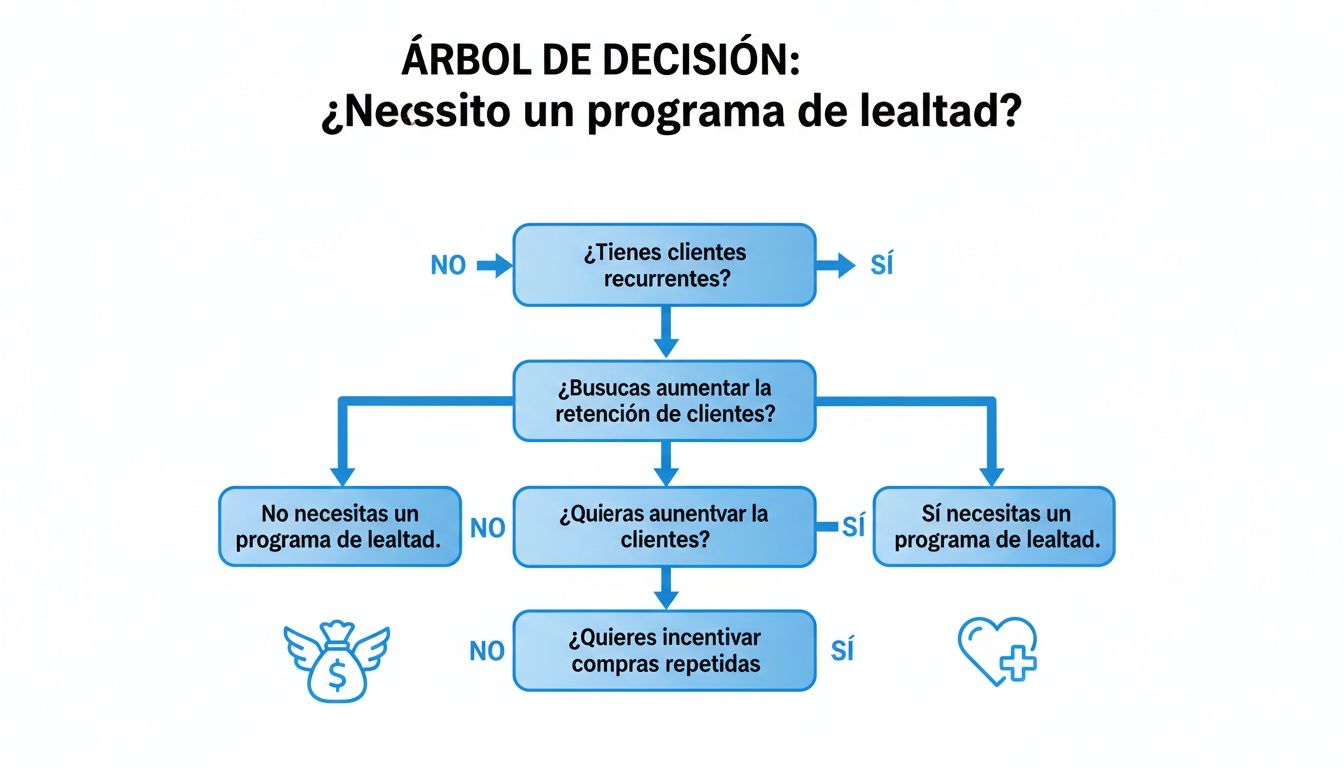
As you can see, the decision becomes much simpler when you manage to identify a real need, such as increasing the frequency of visits or the average ticket. That's when the investment justifies itself.
SMART goals for your loyalty program
To avoid leaving anything to chance, it is best to use the SMART methodology. This forces your objectives to be Specific, Measurable, Achievable, Relevant, and Time-bound. Thus, a vague idea like "I want my customers to come back more" becomes a real and actionable business goal.
Let's see how this plays out in ordinary businesses in Mexico:
For a coffee shop in the Roma neighborhood (CDMX): Instead of a generic desire, the goal would be: "Increase the visit frequency of loyalty program members from 1.5 to 3 times per month in the next 6 months." It is specific, measurable, and has a deadline.
For a pharmacy in Puebla: Its goal could focus on sales: "Increase cross-selling of store-brand products by 15% among program members during the first quarter of the year."
For a barbershop in Monterrey, Nuevo León: It could focus on retention: "Reduce customer churn rate by 20% in 12 months, by encouraging them to book their next appointment before leaving the shop."
These are not just examples; they are the map that will guide every decision of your program. They tell you exactly what you need to measure to know if it is working or not.
Align your loyalty program with your business goals
Once you are clear about your main goal, choosing the program's mechanics becomes much more intuitive. It is not the same to want a customer to visit you more often as it is to want them to spend more on each visit.
This table helps you visualize which loyalty mechanic best fits your business goal, with practical examples for SMBs in Mexico.
Main Goal | Recommended Loyalty Mechanic | Practical Example (Business Type) | Key Metric to Measure Success (KPI) |
|---|---|---|---|
Increase purchase frequency | Stamps per visit or purchase | Coffee shop in Puebla: "Your 6th coffee is free" | Purchase frequency (visits per month) |
Increase average ticket | Points for every peso spent | Restaurant in Nuevo León: Accumulate points to get a discount on your next purchase | Average Order Value (AOV) |
Encourage repeat purchases | Discount coupons for the next visit | Ice cream shop in Yucatán: "20% off your next visit from Monday to Thursday" | Repeat purchase rate |
Build a community | Tiered program (e.g., Bronze, Silver, Gold) | Barbershop in CDMX: Access to exclusive events or advance booking for Gold members | Customer retention rate |
As you can see, each goal has a tool that works best. It is not about choosing the most popular mechanic, but the one that will help you move the numbers that matter to you.
Understanding the profitability behind the reward
Now let's talk about money. Offering an attractive reward is only half the job. The other half, the one that really matters, is making sure it is profitable. This is where two financial concepts that every business owner must master come in: Customer Acquisition Cost (CAC) and Customer Lifetime Value (CLV).
CAC is what it costs you to bring a new customer to your door. CLV is an estimate of all the money that customer will spend with you throughout their relationship with you.
A well-executed loyalty program should cost much less than your CAC and, at the same time, should be responsible for skyrocketing your CLV.
Think about it this way: if it costs you $200 pesos to get a new customer for your barbershop, isn't it worth investing $50 pesos in a reward that secures their sixth visit and turns them into a regular customer? Of course it is.
To define rewards that actually work, you need to understand your customers at a deeper level. A good exercise is to create customer profiles, as it helps you design incentives that connect with what truly motivates them.
When you master these metrics, you stop giving away products and start investing intelligently in your best customers. This, in turn, allows you to segment them better. If you want to dive deeper into this, you can read more here about what customer segmentation is and how to apply it. With this strategic and financial foundation well established, you are ready for the next step: designing your program's mechanics.
Choose the mechanics and rewards that will make your customers fall in love
Once you are clear about your business goals, the moment of truth arrives: defining how you are going to reward your customers. This is where programs that generate indifference separate from those that become true growth engines.
There is no single answer. The ideal mechanic for your loyalty program will always depend on the nature of your business, the average ticket, and, above all, the behavior you want to incentivize in your customers. Think of it like the difference between a custom-tailored suit and a generic one; the former fits perfectly, the latter rarely does.
Points per peso: the ultimate flexible strategy
The point accumulation system is, by far, the most versatile. It is the best option when your customers' purchase amounts vary greatly from one visit to another. The logic is simple and direct: the more you spend, the greater the reward. This directly addresses one of the most important KPIs: increasing average ticket.
Imagine an à la carte restaurant in an area like Polanco in CDMX. A customer might spend $700 MXN on a business lunch and $3,000 MXN on a weekend dinner. A stamp-per-visit system would not fairly reward that larger spend. Instead, a clear rule like “1 peso spent = 1 point” is transparent, fair, and subtly encourages the customer to order that dessert or that second bottle of wine to accumulate points faster.
This model works wonderfully in:
À la carte restaurants: Where bills are highly variable.
Clothing and retail stores: Encourages customers to buy more items in a single visit.
Pharmacies: Promotes the purchase of personal care products or vitamins along with prescription medications. A pharmacy in Monterrey could use it so customers accumulate points and redeem them for discounts on their store-brand products.
Digital stamps per visit: the driver of recurrence
When your main battle is getting customers to return more often, and your business is built on repeat purchases of a similar cost, the digital stamp card is unbeatable. It is a highly visual mechanic, easy to understand, and offers clear, achievable gratification. People love seeing their card fill up.
Let's think about a specialty coffee shop in the Roma neighborhood (CDMX). Most of their customers buy a coffee and perhaps a pastry, a fairly stable purchase. A points-per-peso system would be too slow and unmotivating. However, a powerful message like "Collect 9 stamps and your 10th coffee is on us" creates a habit cycle. The customer can visualize their progress, and the reward is something they already want.
This approach is ideal for:
Coffee shops: The classic "your sixth coffee is free" remains one of the most effective tactics to convert an occasional visitor into a daily customer.
Barbershops or salons: "Your fifth haircut has a 50% discount" is a compelling reason not to look for another option next month.
Ice cream and yogurt shops: An ice cream shop in Mérida, Yucatán, can build loyalty among locals and tourists with a stamp promotion for each visit, ensuring they return during their stay.
Tiered programs: the game of status and exclusivity
If your goal is to cultivate a long-term relationship and reward not just purchases, but engagement and preference, tiered programs are the most sophisticated strategy. This model, which borrows elements from video games (gamification), creates a powerful feeling of status and exclusivity.
By segmenting your customers into tiers like Bronze, Silver, and Gold, you not only reward their cumulative spend, but you also grant them a status they will want to maintain or exceed. The relationship stops being merely transactional and becomes a sense of belonging.
A high-end barbershop in San Pedro Garza García, Nuevo León, could design a program like this:
Bronze Level (Upon signing up): Accumulate points with each haircut.
Silver Level (Upon spending $5,000 MXN in 6 months): Accumulate points 1.5 times faster, receive priority access to appointments, and a free grooming product on their birthday.
Gold Level (Upon spending $15,000 MXN in 6 months): Earn double points, get a complimentary premium drink on each visit, invitations to exclusive whiskey tastings, and a free facial treatment once a year.
This system is perfect for businesses with high-value customers (HVCs), such as spas, luxury salons, exclusive boutiques, or even gourmet restaurants. The real incentive is not just the discount, but access to benefits that money alone cannot buy.
The good news is that you don't have to settle for just one idea. Flexible platforms allow you to combine these dynamics, adjusting the strategy along the way. You can start with a points system and, as you understand your customers better, introduce tiers to segment and reward your most loyal clientele, thereby successfully increasing your customer loyalty in a much smarter way.
Choose the right technology for a frictionless experience
A brilliant loyalty strategy on paper is useless if the in-store execution is clumsy and complicated. It is here, in the day-to-day, where your program comes to life, and technology becomes the engine that guarantees a smooth experience for both the customer and your team. A successful program should be almost invisible to the customer and completely automated for the business.
The most common mistake I see in SMBs is treating loyalty as a manual task. Using paper stamp cards or keeping track in Excel is not only inefficient, but it also deprives you of the most valuable asset of all: your customers' data. The key to making this work at scale and generating a real return is integration.
Centralize everything with an integrated POS and CRM
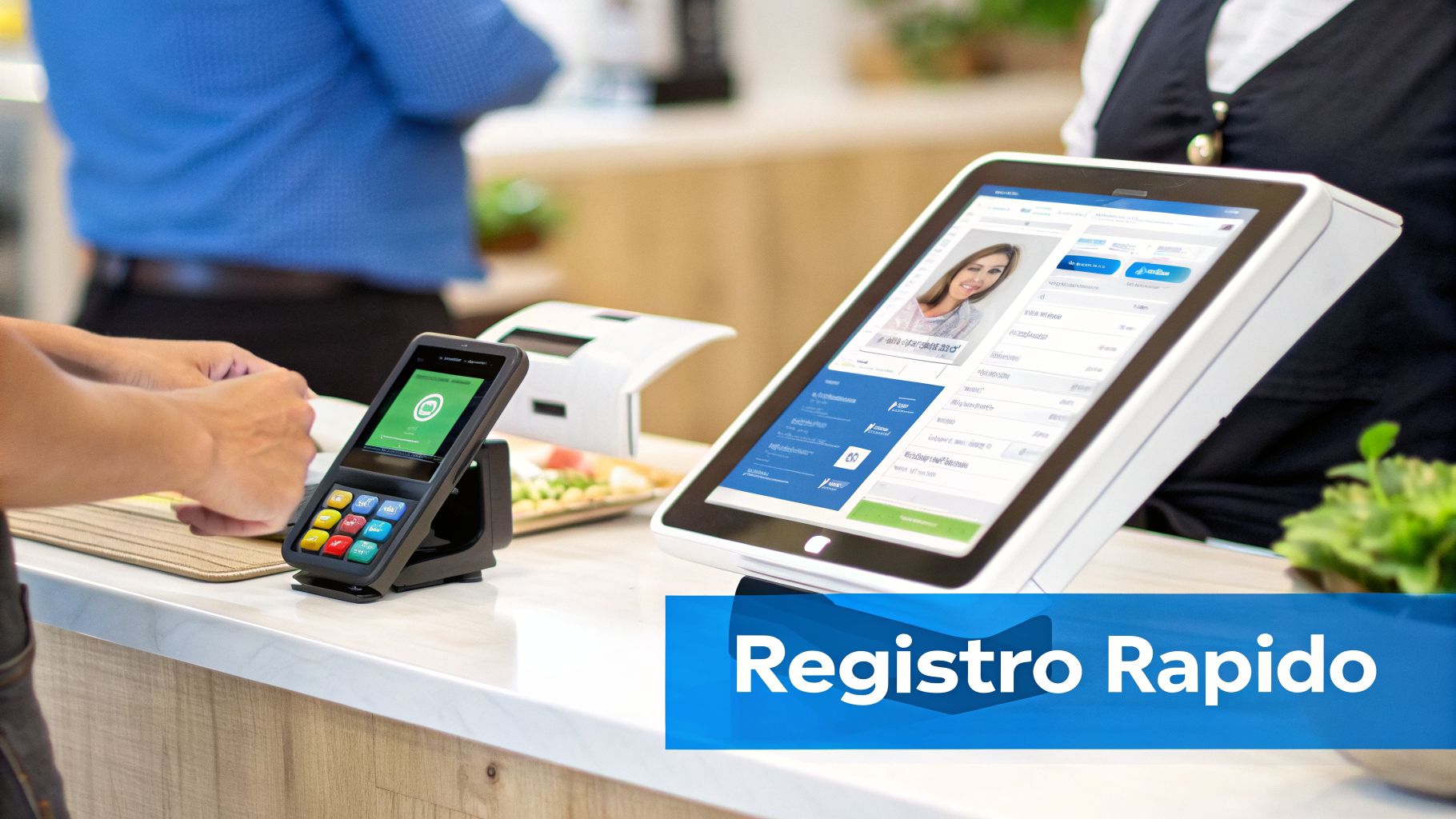
The backbone of any modern loyalty program is native integration between your Point of Sale (POS) and your customer relationship management (CRM) system. When these two tools don't talk to each other, you create friction and double work. The cashier has to handle the sale on one side and the points on the other, the customer has to wait, and you completely lose track of the transaction's history.
"All-in-one" solutions, like Swirvle, eliminate this headache completely. Being integrated, every sale you record in the POS automatically updates the customer's profile in the CRM. Simple.
This allows you to achieve three fundamental things:
Centralize data: All customer information —their purchase history, accumulated points, and available rewards— lives in a single profile.
Swift operations: Point accumulation and redemption are done directly on the checkout screen, without switching systems or interrupting the checkout flow.
360° view: You finally understand what your loyal customers buy, how often, and how much they spend. These are crucial data points to optimize your offers.
Even the registration process, which is often a major hurdle, can be reduced to seconds. Right at checkout, your staff can register a new customer using only their WhatsApp number. Zero forms, zero friction.
Automate communication to personalize the customer journey
Once you have centralized data, the next step is to use it to communicate intelligently and automatically. A customer feels truly valued when they receive relevant messages at the right time, not generic advertising that they immediately ignore.
This is where automations through channels like SMS, email, and push notifications come into play.
Imagine these sequences working for you:
An immediate welcome. A customer registers at your barbershop in Mexico City. Seconds later, they receive a welcome SMS with a coupon for 100 free bonus points to use on their next visit. The value is felt instantly.
A birthday greeting. A pharmacy in Puebla has its loyal customers' birthdates. Automatically, on the first day of their birthday month, they receive an email with a coupon for 15% off personal care products. It's a personal touch that encourages a visit.
An expiring points reminder. A customer of your coffee shop in Yucatán accumulated points that are about to expire. A week before, a push notification warns them: "Don't let your 450 points go to waste! Redeem them for your favorite drink." This fights inactivity and recovers sales that would otherwise be lost.
Technology doesn't replace the human touch, it scales it. It allows you to have personalized conversations with thousands of customers at once, which would be impossible to do manually.
These automations transform your program from something passive into an active marketing tool that works for you 24/7. If you want to see how a loyalty program app can manage these communications for you, there are highly complete solutions on the market that already do this.
Segment and conquer with local campaigns
The true power of an integrated CRM is unlocked when you start segmenting. Not all of your customers are the same, nor do they respond to the same incentives. Segmentation allows you to group them by purchase behavior, preferred branch, or loyalty level to send them ultra-relevant offers.
Let's look at a practical case: a restaurant with several branches in the State of Mexico. While analyzing their data, the owner noticed that customers at the Toluca branch ordered more vegetarian dishes, while in Naucalpan they preferred steaks.
Using this information, the team created segmented campaigns:
Toluca Campaign: An SMS that read: "This week, get double points on all our vegetarian dishes."
Naucalpan Campaign: An email with the subject line: "Grill Thursday: 20% off selected steaks for loyalty members."
The result was a direct return on investment, with a measurable increase in sales of those categories directly attributed to each campaign. In Mexico, these strategies are pillars of success; up to 40% of sales in many businesses are linked to initiatives of this type. OXXO, with its Spin Premia program, generated 35.1% of its total revenue in 2023 thanks to similar segmentation and personalization, proving its power at scale.
Choosing the right technology is not a luxury, it is the foundation for executing a loyalty strategy that is profitable and sustainable in the long run.
Measure, analyze, and optimize: turn your program into a profitability machine
Launching a loyalty program is just the beginning. The real strategy starts now, in the constant cycle of measuring, analyzing, and optimizing. Believe me, a program that is not measured is just an expense that gives away discounts for no reason; but one that is analyzed becomes an investment with a very clear return.
To know if your effort is actually working, you have to look far beyond the vanity metric of "number of registered members." That figure alone says nothing about profitability. The key lies in obsessing over Key Performance Indicators (KPIs) that show a real impact on your business.
The metrics that actually matter to measure ROI
To evaluate if your program is a success, forget about superficial data. Concentrate on actionable metrics that reflect real changes in your customers' behavior. These are the ones that will truly tell you if you are on the right track:
Customer Retention Rate: This is the master indicator. It measures what percentage of your customers return to buy within a given period. What you need to do is compare the retention of program members against non-members. If your members return 25% more, congratulations! Your program is working.
Purchase Frequency: Do program members visit you more often? Think of it this way: a barbershop in Baja California might discover that its loyal customers now come every 3 weeks instead of every 5. That increase in frequency is pure profit, directly attributable to your strategy.
Increase in Average Order Value (AOV): The question here is simple: do program customers spend more on each visit? A restaurant in the State of Mexico could use its data to see if members order more desserts or appetizers just to collect points and reach the next reward.
Redemption Rate: This metric is a thermometer of how attractive your rewards are. If the rate is low, your rewards might be unreachable or uninteresting. But a high rate is a very clear sign that customers are engaged and see the value of your program.
Visualize your success with a smart dashboard
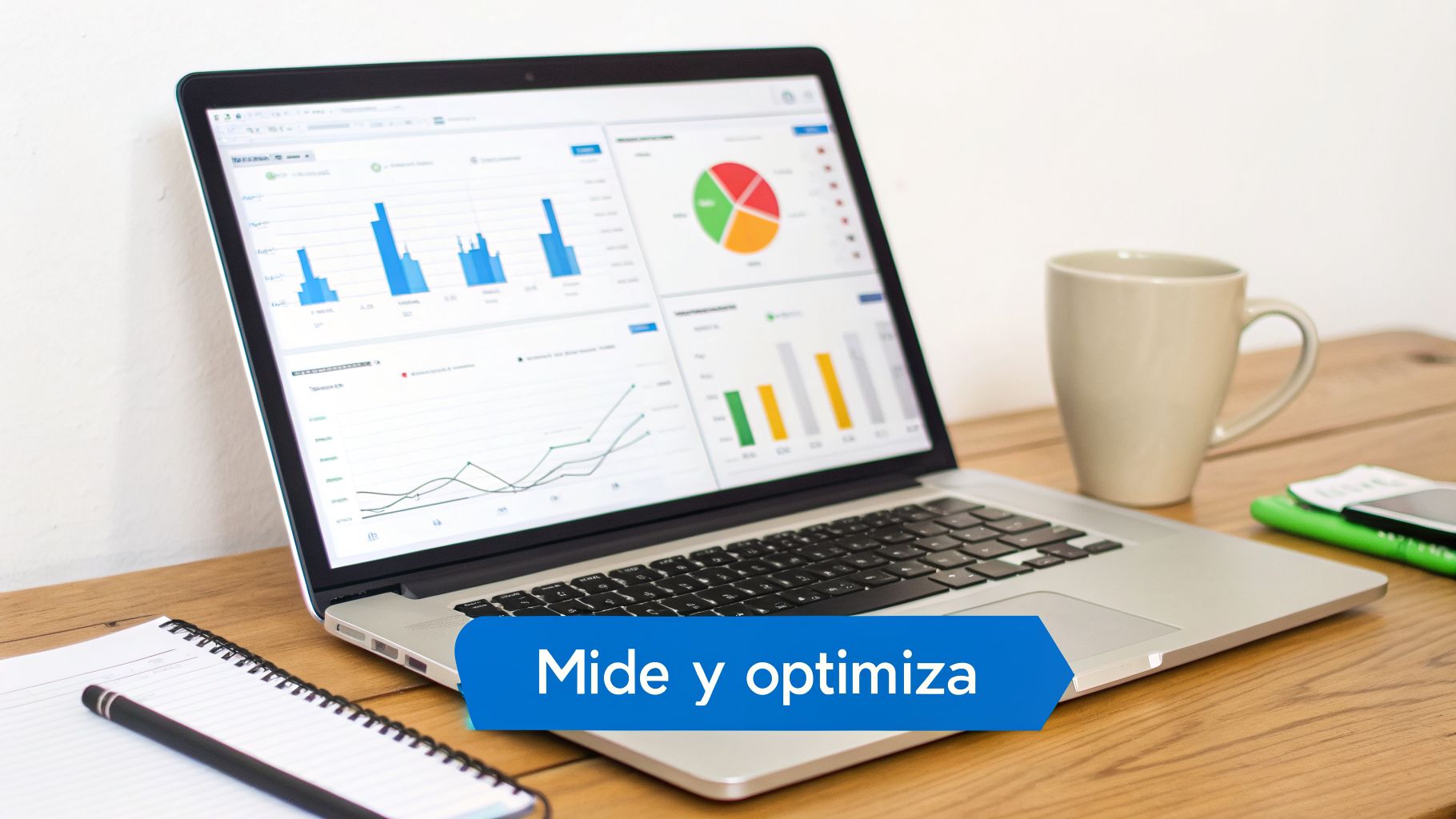
Let's be honest: analyzing these metrics by hand in a spreadsheet is a nightmare and a waste of time. This is exactly where a modern platform with an integrated dashboard becomes indispensable. Tools like Swirvle, often powered by AI, allow you to see the impact of your program virtually in real time.
A good dashboard goes beyond showing pretty charts. It allows you to attribute sales directly to specific campaigns. That way, you will know with absolute certainty that the "double points" coupon you sent via WhatsApp generated $15,000 MXN in sales over the weekend.
This visibility is crucial for making decisions based on data, not hunches. You will be able to identify which rewards are the most redeemed and which ones no one cares about, allowing you to adjust your strategy on the go. If you want to dive deeper into this, explore how a well-structured sales dashboard can give you total control of your data.
Adapt or die in the Mexican market
In today's environment, data analysis is not a luxury, it is a necessity for survival. Although a 2023 Statista study indicates that only 22% of Mexicans consider themselves loyal to a brand, this is not bad news. On the contrary, it reveals a massive opportunity. The remaining 78% are willing to switch if they find a better experience or greater value. A well-analyzed loyalty program is your secret weapon to capture and retain that undecided majority.
Imagine a pharmacy chain with branches in Puebla and Yucatán. By using a CRM that analyzes habits by location, they might discover that more vitamin rewards are redeemed in Puebla, while in Yucatán they prefer discounts on sunscreen. This golden information allows them to customize communications and offers by region, making the program much more relevant.
Ignoring this data is a mistake that can cost you dearly. Constant analysis gives you the keys to adjust your rewards, refine your communications, and ensure your program evolves with your customers. At the end of the day, it is about giving them a compelling reason to choose you and not the competition.
We solve your doubts about loyalty programs for SMBs
We know that taking the leap to a loyalty program raises many questions. Here we have gathered the most common concerns we hear from business owners in Mexico, with direct answers tailored to the reality of an SMB.
How much is it going to cost me to implement a loyalty program?
That is the million-dollar question, and the honest answer is: it depends. You could start tomorrow with paper stamp cards, which is practically free. But let's be honest, those cards get lost, they don't give you a single piece of data about your customers, and they project a somewhat outdated image.
On the other hand, a digital platform involves a monthly investment. The key is to see it not as an expense, but as a tool to generate a measurable return. Think about the cost of not having it. It is estimated that up to 40% of sales in many businesses come from customers who already know you. Losing them because you didn't give them a good reason to return can be much more expensive than the monthly fee for a system designed to look after them.
Isn't my business too small for something like this?
Quite the opposite. For an SMB, every returning customer is pure gold. A digital loyalty program gives you access to the same strategies that major chains use to build loyalty, allowing you to compete head-to-head. More than a luxury, it is a key tool to grow and protect yourself.
Imagine an ice cream shop in Tijuana or an artisanal coffee shop in Oaxaca. With a loyalty program, they can build a solid community of local customers. This not only increases their sales, but it also protects them when a large competitor moves into the area.
What kind of rewards work best?
The ideal reward is a perfect balance between something your customer truly values and something that is profitable for you. And no, it is not always about giving away big discounts.
For a coffee shop in Mexico City, the classic "free coffee" after several purchases is still foolproof because of its simplicity and low cost.
In a restaurant in Nuevo León, offering a "complimentary appetizer on your next visit" can be smarter than a discount, as it ensures the customer returns.
For a pharmacy in Puebla or a barbershop in the State of Mexico, a "15% discount during your birthday month" is a personal touch that builds an emotional connection and provides an excellent excuse to visit you.
A key tip: Use your CRM data to see which rewards are the most redeemed. This will tell you exactly what your clientele values most and allow you to stop offering rewards that simply don't generate interest.
And how do I get my customers and my team to use it?
Here, simplicity is queen. The secret is for the benefit to be immediate and the process incredibly easy. Train your team to offer the program with every sale, but with a clear, fast hook. Something like: “Sign up with your WhatsApp and get 100 welcome points right now.”
Make sure you have highly visible QR codes at the counter, on tables, and even on the receipt. The goal is for the customer to register on their own, without help. With a good platform, registering a customer takes less than 30 seconds. When it is that fast, neither your cashier nor your customer will raise objections; on the contrary, they will see it as something useful and uncomplicated.
At Swirvle, we understand that knowing how to create a loyalty program that works is essential for any business wanting to grow. That is why we designed an all-in-one platform with POS, CRM, and loyalty automation, created especially for SMBs like yours to turn their data into loyal customers and recurring sales. Discover how Swirvle can help you make your customers fall in love with you.
Related Blogs

Nov 10, 2026
How to manage multiple restaurant locations from a single system?

Nov 9, 2026
Which CRM is best for a small business in Mexico? 2026

Nov 8, 2026
What works better for a small business: WhatsApp promotions or email promotions?

Nov 7, 2026
How do you calculate a business's net purchases? Formula and example in MXN

Nov 6, 2026
How much does a point-of-sale system cost for a small business in Mexico?

Nov 5, 2026
How to Create an Executive Breakfast Menu to Sell to Offices: 2026 Guide