How to manage a coffee shop's daily inventory? Counting routine, par sheet, waste, and recipes to wrap up each day with everything accounted for.
Buying more coffee can hide an inventory problem, not solve it. With fluctuating food and beverage prices, as documented by INEGI in its CPI report, restocking without reviewing consumption and cost can leave a business with sufficient stock, but lower margins. A shortage also doesn't prove that more was sold: it can stem from oversized portions, improperly configured modifiers, or unrecorded waste.
The answer to how to manage daily coffee shop inventory control consists of reconciling purchases, recipe-based sales, and physical counts before deciding on the next order. For a brick-and-mortar owner, having a sophisticated spreadsheet matters less than being able to explain what came in, what should have been consumed, and what actually remained.
Daily and Weekly Counting Routine
A coffee shop can organize its control into four daily stages and one weekly review. The following proposed routine assigns responsible parties so that closing doesn't rely on the team's memory.
Daily and Weekly Count Stages
Stage | What Is Recorded | Responsible Party |
|---|---|---|
Opening | Starting balance of high-turnover supplies and visible expiration dates | Shift supervisor |
Receiving Purchases | Incoming goods by supplier, quantity, cost, and expiration date | Person receiving the goods |
During the Shift | Spills, returns, and remade drinks | Barista or kitchen staff |
Closing | Physical count, theoretical consumption based on sales, and waste by cause | Shift supervisor |
Weekly | Full count, replacement cost, and reorder point | Manager or owner |
Opening should focus on whole bean coffee, milk, ice, sugar, cups, and pastries. The supervisor confirms that the received balance matches the previous closing and notes any subsequent activity, such as an early delivery or a transfer from another branch.
During receiving, the person accepting deliveries counts and logs items before storing them. Logging items later, once boxes are already distributed between the bar, storage room, and refrigerator, forces staff to reconstruct quantities and makes duplicate entries more likely.
A Routine That Survives Shift Changes
The barista or kitchen staff needs an accessible log to record spills, returns, and remade drinks as they happen. A printed sheet at the bar works better than a comprehensive form filed away where no one checks it.
Designated responsible party: Each stage is assigned to a specific person, with a designated backup when shifts change.
Consistent timing: The count occurs at the same operational cutoff, without mixing in later sales.
Documented handover: The person ending their shift notes any incidents for the person taking over.
In a shop with split shifts, a single person does not need to be present all day. What is necessary is for everyone to use the same units of measurement and for the supervisor to review discrepancies before accepting the final balance.
The weekly count also covers less visible items: lids, napkins, packaging, and back-stock outside the bar area. The owner reviews costs and purchasing, while another person verifies significant adjustments; assigning a consistent lead does not mean leaving them with total, unchecked control.
Par Sheet to Reconcile Theoretical vs. Physical Counts
Expected inventory is a calculation; physical inventory is a measurement. The par sheet must display both, along with target stock levels, without adjusting the results just to make them match.
NOM-251-SSA1-2009 requires storing supplies according to their nature and labeling them so a FIFO (first in, first out) system can be applied. A daily sheet helps organize this task, although on its own it does not replace other mandatory food safety practices.
The Closing Formula
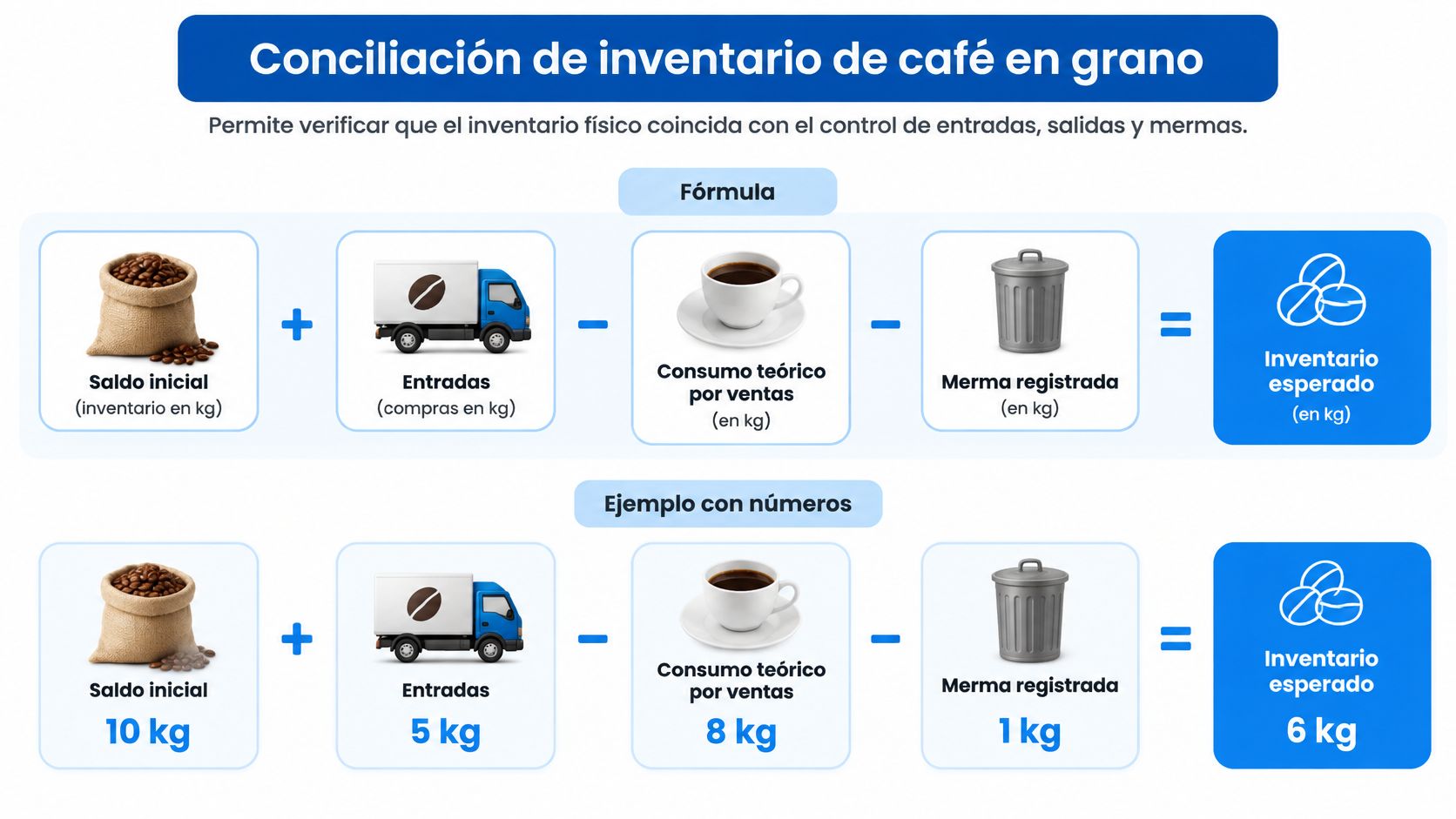
Expected inventory = starting balance + received stock − theoretical consumption from sales − recorded waste.
The following scenario is illustrative, not a recommended yield standard for all coffee shops.
Example of a Par Sheet for Whole Bean Coffee
Item | Quantity (kg) | Source |
|---|---|---|
Starting balance | 5 | Opening count |
Received stock | 3 | Purchase receiving |
Theoretical consumption from sales | 4.2 | Sales multiplied by recipe portions |
Recorded waste | 0.3 | Closing log |
Expected inventory | 3.5 | 5 + 3 − 4.2 − 0.3 |
Physical count | 3.2 | Closing scale weight |
Variance | -0.3 | Physical count minus expected; investigate before ordering |
In this example, there is a shortage of 0.3 kg compared to the expected balance. It should not automatically be written off as waste: first, reweigh the item, verify received deliveries, and check for unrecorded non-sale stock movements.
The infographic illustrates another scenario using the same mathematical formula.
What to Check Before Making Adjustments
Open bags should be weighed by taring the container. In addition, conversion rates between purchasing units and recipe units must be clearly defined: purchasing coffee by the kilogram and consuming it by the gram is no excuse for maintaining incompatible records.
Reconciliation Rule: An adjustment corrects the balance; only a documented root cause allows you to correct operations.
If a shortage recurs, examine portioning, spills, complimentary items, and sales entry accuracy. A recurring issue guides the investigation, but on its own does not prove the underlying cause.
In a taco shop, the same sheet can track tortillas, meat, and salsas. In a bakery, it helps to distinguish between items produced, sold, and discarded, avoiding counting ingredients twice once they have already been converted into finished goods.
Recipes and Modifiers That Deplete Each Ingredient
A sale does not equal a fixed amount of inventory if the customer modifies the drink. Every size requires a defined recipe specifying coffee, milk, syrup, and paper goods; modifications that alter that consumption are then factored in.
The INEGI CPI report tracks price fluctuations across restaurants and similar establishments. For the operator, the practical response is to cost what is actually served, rather than simply sticking to the recipe established when the business first opened.

The Cost of Over-Portioning
In an illustrative example, pouring an extra 15 ml of syrup into each of 40 drinks adds up to 600 ml per day. At an assumed cost of 180 MXN per liter, that excess represents 108 MXN per day that corresponds to no additional sales.
A bottle doesn't need to be dropped and broken to lose product. It is enough for the recipe to specify one measurement while staff uses another, particularly when each barista interprets a portion size differently.
Modifiers require explicit rules:
Extra shot of espresso: Deducts the corresponding dose in addition to the base drink.
Milk substitute: Replaces the original ingredient; it must not deplete both milks in the system.
Extra syrup: Adds its specific portion using a standardized measurement.
To-go order: Deducts the cup, lid, and other designated packaging supplies for that format.
The Bar Test
The test involves preparing a drink strictly following the recipe card, weighing or measuring its components, and comparing the result against the recorded inventory deduction. This procedure should also be repeated with modified versions, not just standard builds.
The guide to standardizing restaurant recipes helps organize ingredients, yields, and quantities. Every recipe change requires an effective implementation date to prevent the bar from using one version while management calculates costs with another.
When a variance occurs, break it down by shift, serving size, and sales channel before attributing it to an individual. In a taco shop, the same principle applies to guacamole per order; in a bakery, to pastry fillings per item.
Waste by Cause and How to Measure Its Cost
Waste must be categorized by cause, not lumped into a generic adjustment. On-site, the value of tracking waste depends on identifying what the team can actually correct.
Categories for an Actionable Log
Expiration. Record the product, quantity, unit of measure, and expiration date. It is also advisable to record the lot number.
Over-prep. The log should compare the amount prepared against what was left over at closing, not just the discarded weight.
Damaged product. A photo or note helps distinguish between receiving, storage, or handling issues.
Recipe error. Remade drinks should be linked to the receipt and the reason; customer returns can be logged as an associated incident.
Internal consumption. Documented separately with manager approval. This is not necessarily waste, but it does represent an unbilled inventory reduction.
Count discrepancy. Left open for investigation until an explanation is found, without prematurely assuming theft.
Every entry requires an assigned staff member and a unit cost. The guide on how to control waste in a restaurant provides further strategies for tracking losses across operational processes.
Turning Quantities into Decisions
Waste cost = quantity lost × purchase cost per unit. Total costs for the period are then calculated and divided by the cost of goods sold (COGS) for the same timeframe.
In an illustrative example, waste of 600 MXN against a cost of goods sold of 6,000 MXN equals 10%. This figure merely illustrates the scenario and does not represent an industry benchmark.
The root cause with the highest addressable cost warrants attention before the one that simply generates the most log entries.
If a taco shop throws out excess prepared ingredients in the afternoon, the manager must review batch prep sizes. If a coffee shop discards expired milk and pastries, purchasing and shelf organization need to be addressed.
The weekly review should conclude with a concrete action item and an assigned owner. Focusing on a single root cause over the course of a month makes it easier to measure improvement; a food safety violation, by contrast, demands immediate correction and cannot wait for the regular review schedule.
Ordering, Receiving, and FEFO Rotation
Orders should be triggered by actual consumption and lead times, not by a visual impression that stock looks low. The operational formula is: reorder point = average daily consumption × lead time in days + safety stock.
In an illustrative scenario, a coffee shop uses 2 kg of coffee per day, has a 3-day supplier lead time, and maintains a 1 kg safety stock. Its reorder point would be 7 kg; reaching this balance triggers a purchase order, though it does not dictate the total order quantity on its own.
Inspect Before Storing
Packaging inspection. The receiver inspects boxes, seals, and expiration dates before signing the delivery slip.
Temperature verification. Dairy and chilled goods are checked with a thermometer against the storage requirements for that product.
Documented receipt. Quantity, cost, supplier, and lot numbers are logged, including any rejected goods.
Stocking by expiration date. Products that expire sooner are placed front and center, even if they arrived in a more recent shipment.
The infographic illustrates another safety stock scenario. Operationally, FEFO means First Expired, First Out, not first in, first out.

Expiration Dates Take Precedence Over Arrival Dates
Profeco distinguishes between expiration dates and best-by dates: past the former, prepackaged food must not be sold or consumed; past the latter, it may be kept under certain conditions, though quality may decline. These labels are not interchangeable.
Every opened container must be labeled with its opening date and the manufacturer's maximum usage period. In an illustrative example with bottles expiring on May 8, 10, and 12, the May 8 bottle goes to the front; an instruction to consume within three days of opening must be followed, not replaced with an improvised timeline.
Tracking warehouse stock entries and exits helps connect receiving with actual consumption. If a stockout occurs, evaluate when the order was placed and how long the supplier actually took to deliver; if products are expiring, ordering extra as a buffer can worsen the problem.
Key Metrics to Review Each Week
The weekly dashboard must drive concrete decisions. The following table outlines internal warning signs to monitor, not universal standards or industry-wide performance benchmarks.
Coffee Shop Inventory Metrics
Metric | Calculation | Warning Sign |
|---|---|---|
Waste as a percentage of COGS | (Waste cost / COGS) × 100 | Increases two weeks in a row |
Count discrepancy | Physical count minus expected inventory | Recurs for the same ingredient |
Days of inventory on hand | Current stock / average daily consumption | Fewer days than supplier lead time |
Replacement cost | Current price / price used in recipe costing | Sustained price increases for coffee or milk |
FEFO turnover | Expired items / total received items | Frequent expirations among high-turnover goods |
Interpreting Trends in Context
Owners must compare equivalent timeframes and note unusual occurrences: a promotion, an incomplete delivery, or a refrigerator breakdown. An isolated variation warrants an explanation; a recurring trend requires a process review.
When calculating inventory coverage, count only usable product. Expired, damaged, or reserved stock cannot be used to fulfill daily customer demand.
Tracking replacement costs reveals issues beyond physical shortages. Even if the team portions ingredients accurately, profit margins can shrink if management continues using outdated ingredient prices in recipe costing.
Unit consistency: Compare kilograms to kilograms, units to units, and costs from the same period.
Item-by-item analysis: Dividing expired units by received units is useful on an individual product basis, but meaningless if liters and individual units are combined into a single sum.
Documented actions: Every warning sign requires a probable cause, an assigned owner, and a follow-up review date.
The FEFO row serves as an internal indicator for expired stock, not a full audit of rotation compliance. It is also important to monitor lots nearing their expiration dates, since waiting until products are discarded leaves managers with no chance to prevent the loss.
Schedule a Demo to Validate Your Inventory Routine
Automation pays off when the business already understands what it needs to reconcile. An effective preparatory step is to run this routine on paper for one week: log starting balances, purchases, waste, and physical counts, along with investigating any variances.

To integrate these daily operations with real-time coffee shop inventory management, Swirvle POS handles checkouts, inventory control, recipe and modifier tracking, live sales reporting, and supplier purchase orders. Every sale automatically deducts the ingredients defined in the recipe and its modifiers.
A Demo Using Your Actual Menu
The walkthrough should feature one of your actual menu drinks, an ingredient substitution, and a typical purchase order. This lets you evaluate the full workflow using the exact units and packaging your staff works with every day.
Standardized recipe: Ingredients, portion sizes, and packaging materials included.
Common modifier: Alternative milks, flavored syrups, or an extra shot of espresso.
Recent purchase: Supplier packaging unit, quantity received, and invoiced cost.
Investigated discrepancy: A real-world example to compare recorded system balances against a physical count.
Swirvle is not a payment processing terminal, does not operate offline, and does not include a kitchen display system (KDS) or table layout map. These limitations should be evaluated before signing up, especially if your shop depends on any of these features.
The goal is not to eliminate physical counts altogether. It is to eliminate redundant manual data entry and provide a reliable theoretical balance that managers can verify.
Swirvle provides a cloud-based point-of-sale system that connects sales, recipes, modifiers, and purchasing to streamline daily inventory reconciliation. After testing the routine on paper for a week, shop owners can visit Swirvle and select Schedule a 15-min demo to see how their real recipes and automated ingredient deductions work with every sale.
Related Blogs

Nov 16, 2026
How to manage a coffee shop's inventory day by day?

Nov 15, 2026
Clip vs Mercado Pago: Which terminal is best for your restaurant or coffee shop in 2026?

Nov 14, 2026
Checklist: Your Coffee Shop POS Features (9 Essentials)

Nov 13, 2026
What rewards should you offer in a restaurant loyalty program? 2026

Nov 12, 2026
How to manage clothing store inventory without losing sales? 2026 Guide

Nov 11, 2026
How to Use a CRM with WhatsApp to Keep Customers Coming Back: 2026 Guide