
Discover how an omnichannel CRM transforms physical businesses. A practical guide with real examples of restaurants, barbershops, and coffee shops for SMEs in Mexico.
A customer writes on WhatsApp to ask if there is a table available. The restaurant responds, but the conversation remains on the phone of a single team member. Later, the customer calls to confirm, arrives at a branch, and pays at the register. Days later, they receive a generic promotion because no one linked their messages to their visit or their actual spending.
This scenario is repeated in coffee shops, barbershops, salons, and food businesses. The problem is usually not a lack of conversations, but the inability to turn them into operational data: which customer contacted the business, which branch they visited, what they bought, when they returned, and how much they spent. An omnichannel CRM serves to connect that story and measure whether customer service drives repeat visits and a higher average ticket, not just faster response times.
How a customer can get lost without an omnichannel CRM
A restaurant receives an inquiry on WhatsApp about the daily menu. The person in charge responds quickly, but does not record the name, the branch of interest, or the intent to visit. Later, the customer calls to confirm a table, and another staff member takes the call without access to the chat history. When the customer finally arrives at the venue, the team treats them like a brand-new visitor.
The company did have multiple points of contact, but it did not have an identifiable relationship. The customer had to repeat information, and the business missed the opportunity to recognize their preferences, link the conversation to the sale, and send a relevant invitation to return. The same issue arises when someone inquires about a barber service, books over the phone, and pays at the branch without anyone logging the source of the appointment.
In Mexico, 71% of online adults consider messaging to be the fastest and simplest way to deal with a business, according to a Kantar survey cited by Expansión. WhatsApp concentrates a large portion of that daily conversation. The operational conclusion is not to send more mindless messages. It is to capture the intent on the channel where the customer already is and preserve that context when they transition to a call, a visit, or a purchase.
The cost of working in silos
A multichannel system can bring WhatsApp, email, and notifications together into a single operation, but that does not guarantee a unified profile. If each channel keeps its own separate contacts, the team has no way of knowing if three conversations belong to the same person, or if any of them resulted in a sale.
A well-configured CRM system must associate identity, branch, conversation history, visits, and transactions. This way, a win-back campaign can target customers who stopped visiting a specific location, rather than sending the same discount to the entire database and eroding margins without knowing what happened next.
Operational rule: a conversation only has business value when it can be linked to a subsequent action, such as a reservation, a visit, a purchase, or a new referral.
What is an omnichannel CRM for businesses with physical stores
An omnichannel CRM acts as a control center for the customer relationship. It gathers contacts coming through messaging, email, notifications, social networks, calls, or forms and connects them to business events, such as a reservation, a branch visit, a purchase, or a reward redemption.
The difference compared to having several open channels is continuity. In an isolated setup, a coffee shop posts a promotion, receives responses on WhatsApp, and records sales at the register without any connection between the two data points. In an omnichannel setup, the campaign identifies the customer, saves the interaction, logs the associated branch, and allows verifying if the person actually bought something afterward.
Mexico already has a buyer who combines physical and digital spaces. 71% of consumers mix physical and digital channels when buying, according to the findings of the 2026 Online Sales Study by AMVO. Therefore, the business should not automatically attribute a sale to the last point of contact. It needs a unified identity and an event log that preserves the entire journey.
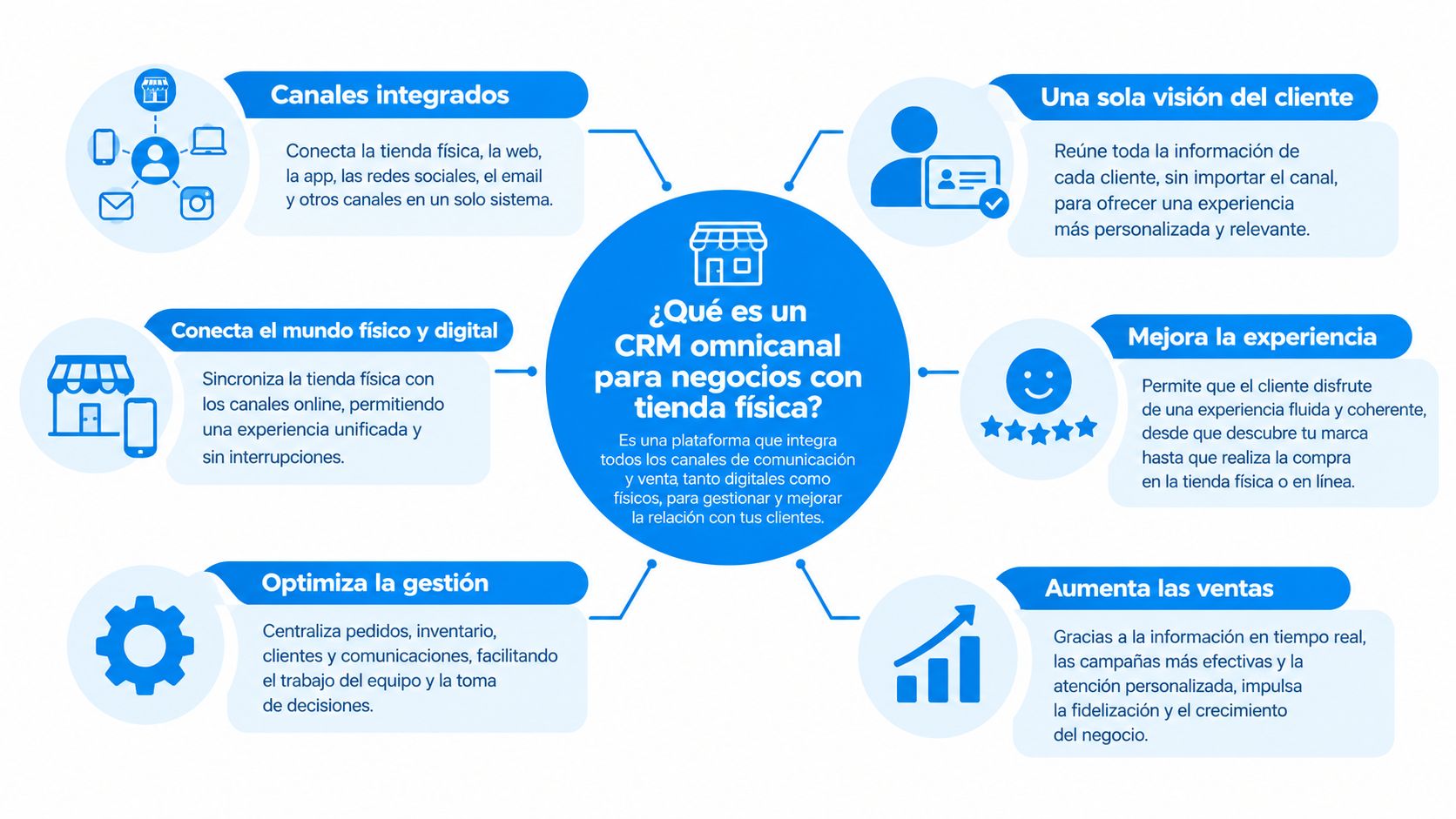
The difference between presence and connection
Simply having WhatsApp, email, and a customer database does not make an operation omnichannel on its own. The connection happens when a staff member can look up previous context and when marketing can link a campaign to a specific sale.
For a physical SMB, that connection must answer simple questions:
Who the customer is: name, contact details, consent, and preferred branch.
What they did: messages, reservations, visits, purchases, coupons, and rewards.
What they need next: a re-engagement, a recommendation, a booking, or a specific offer.
What the campaign generated: response, visit, transaction, repeat purchase, or change in average ticket.
The expected outcome is not just a tidier inbox. It is an operation where the team understands the same story and makes decisions based on data that can be cross-referenced with sales.
Key features that actually measure results
The first indispensable feature is a single customer identity. The CRM must prevent the same contact from appearing as separate records because they used WhatsApp, email, and phone. It must also log the branch associated with each interaction, because a campaign might work in one location and fail in another due to differences in audience, hours, offerings, or capacity.
The second is behavioral segmentation. A coffee shop can distinguish between morning visitors, take-out customers, and those who stopped coming. A salon can separate those who booked a haircut, those who purchased an additional service, and those who inquired about availability without booking. Segmentation must be based on recorded facts, not general demographic assumptions.
The third is coordinated execution. WhatsApp can capture intent, email can preserve useful information, and a notification can trigger a visit when there is a concrete reason. The CRM must control the sequence to avoid sending repetitive messages or offering an incentive to someone who has already purchased.
Attribution must reach all the way to the register
Coverage of omnichannel CRM in Mexico often focuses on integrating WhatsApp, sharing inboxes, and automating responses, but leaves the decisive question largely unanswered: whether omnichannel communication increased repeat visits and the average ticket in-store, and not just response speed. This same logic applies to an omnichannel marketing strategy for SMBs with brick-and-mortar stores.
The business needs a record that connects the campaign, customer, branch, and sale. You do not need to build a complex model to get started. Defining consistent events is enough:
Captured contact, with channel and reason.
Offer or message sent, with segment and branch.
Response or interaction, with date and action type.
Visit or purchase, with amount and location.
Repeat purchase, with the period elapsed since the previous transaction.
CRM automations gain value when they execute actions based on those events. A rule can send a reminder after an inquiry without a reservation, stop a promotion when the customer has already made a purchase, or trigger a reward after a visit. Without a connection to the sales ledger, automation only produces activity. With a connection, it helps prove which conversations end up as actual business.
Where to prioritize the customer's first contact
The initial priority should be the channel that the customer uses with the least friction. In Mexico, messaging offers a clear advantage for capturing intent because it is integrated into the daily behavior of consumers and SMBs. Email and push notifications serve different functions, so they are best used to nurture, remind, and reactivate, rather than replacing the first contact in every scenario.
According to Mobile Time, quoting Meta in Mexico, 92% of MSMEs in Mexico use WhatsApp Business to reach consumers and 88% state that the tool helped them generate new business opportunities.
Channels and their effectiveness for SMBs in Mexico
Channel | Penetration or adoption | Relevant use for SMBs |
|---|---|---|
Messaging | Widespread use among consumers and businesses | Capturing questions, confirming availability, recovering intent, and coordinating visits |
Follow-up channel within a connected strategy | Sending detailed information, receipts, useful content, and loyalty communications | |
Push notifications | Direct medium for identified customers in a proprietary database | Reminding of reservations, activating rewards, and communicating branch updates |
The recommended sequence is simple: first capture intent via messaging, then request the necessary data to identify the customer, and finally continue on the most appropriate channel. A person asking about the menu does not need to receive a whole chain of promotions. They need a helpful response, a clear action, and a record that makes it possible to measure whether they visited the restaurant.
Email works best when the business has information the customer will want to keep, such as reservation details, accumulated benefits, or recommendations based on past purchases. Push notifications are useful for already identified customers, but lose effectiveness if they turn into indiscriminate alerts. The central metric should not be the volume of messages sent, but the relationship between contact, visit, and attributed purchase.
How to implement an omnichannel CRM in an SMB
Implementation should start with the actual flow of the business, not with an extensive list of features. An SMB can make progress without integrating all its systems from day one by defining what data it needs to measure repeat visits, average ticket, and sales by branch.
Step 1, organize existing sources
The team must identify where the data currently lives: point-of-sale system, WhatsApp, spreadsheets, email, appointment book, points program, and visit records. Then, they should remove duplicates, define basic fields, and assign each transaction to a branch.
The minimum data includes contact, branch, interaction date, purchase date, amount, category, and related campaign. If the register does not keep an identifier that can be associated with the customer, attribution will remain partial.
Step 2, choose a priority journey
It is not advisable to automate the entire operation at once. A restaurant can start with menu inquiries and reservations. A barbershop can prioritize reminders and reactivating inactive customers. A coffee shop can link reward campaigns with visits to a specific branch.
Omnichannel loyalty management remains difficult for small and medium-sized physical businesses because data is usually fragmented across POS, WhatsApp, email, and in-store visits. Furthermore, a large part of the available coverage does not address which segments trigger repeat purchases by branch or which incentive works by category, as noted in the analysis on CRM and WhatsApp for businesses in Mexico.
Step 3, test a controlled campaign
The first campaign must have a defined segment, an associated branch, a concrete offer, and a success condition. If the business sends a promotion to the entire database, it won't be able to tell if it worked because of the offer, the channel, or just a coincidence with a purchase that would have happened anyway.
An exit rule must also be established. When a person makes a purchase, they should stop receiving the win-back message and enter a subsequent sequence, such as an invitation related to their consumption category. The company must weekly review responses, visits, attributed sales, purchase frequency, and average ticket, and adjust the flow before opening new channels.
Use cases for restaurants, coffee shops, and barbershops
In a restaurant, the journey can start with an inquiry on WhatsApp about the menu or availability. The CRM identifies the customer, logs the branch, and allows sending a confirmation related to the inquiry. If the customer visits the establishment and the sale is linked to their profile, the company can measure if that conversation ended in a transaction and, later on, trigger an invitation based on their history.
Segmentation prevents everyone from receiving the same incentive. A customer who usually orders takeout can receive a recommendation for that format. Someone who books for groups can receive information about availability and menu options. The restaurant must compare each campaign against attributed sales and observe if the average ticket changes, instead of evaluating the result solely by responses received.
A coffee shop can run a more frequent flow. The business registers the branch visited, identifies usual products or categories, and uses a reward to encourage a new visit. Communication can start on messaging and continue via email or notifications, provided the customer has accepted those channels. The goal is for the promotion to have a concrete reason and for the register to confirm if it produced an additional visit.
Barbershops and salons
A barbershop can distinguish between customers who come in for a haircut, beard trim, or combined services. Instead of sending a general promotion, the team can trigger a reminder based on history and their usual branch. The registered visit makes it possible to measure if the contact recovered an inactive customer and if the additional service increased the purchase value.
The sector has a wide base for working with geographic segmentation. In Mexico, beauty salons, clinics, and hair salons accounted for 71,883 economic units in the 2024 Economic Censuses, equivalent to 6.2% of the national total of the personal services sector, according to the results presented by INEGI. A CRM for restaurants can apply a similar logic to food businesses, with segments by branch, frequency, category, and campaign response.
What every business can expect before investing is clarity, not an automatic promise of growth. A well-connected CRM makes it possible to know which customers return, which campaigns generate purchases, and which incentives consume margin without producing repeat visits.
Next steps to convert attention into recurring sales
The operation must start with three decisions. First, define how repeat visits by branch will be measured. Second, establish which campaigns can increase the average ticket without indiscriminately giving away margin. Third, eliminate generic messages that mix new, frequent, and inactive customers into a single audience.
The dashboard must focus on indicators that the team can use to take action:
Purchase frequency: how many times each segment returns and at which branch.
Average ticket: how much a purchase attributed to a campaign represents compared to the segment's usual behavior.
Attributable sales: which transactions can be linked to a conversation, promotion, reward, or automation.
Response by channel: which medium generates a useful action, not just superficial interaction.
Reactivation: how many inactive customers return after receiving a relevant communication.
Discipline after launch
A common mistake is declaring success just because responses on WhatsApp increased. A response may indicate interest, but it does not prove a sale or a repeat visit. The team must review each campaign alongside register data and categorize results by branch, category, and segment.
It is also helpful to document what is not working. A promotion that drives visits but reduces the average ticket may need a product, audience, or condition adjustment. A message that gets few responses might have a timing, proposal, or channel issue, but it should not be discarded without checking if it produced sales through another route.
Decision criterion: a campaign deserves continuity when the business can explain who it contacted, what action was expected, which branch received the visit, and which sale was attributed.
An omnichannel CRM does not replace business discipline. It organizes information so that the team can stop operating on intuition and start correcting the journey based on evidence. The goal is not just to be present on all channels, but to build a continuous relationship where every contact contributes to a subsequent visit and every visit fuels a better decision.
To turn this approach into action, Swirvle centralizes customers, segmentation by habits and branch, WhatsApp campaigns, push notifications, email, automations, loyalty, and dashboards to attribute sales and measure ROI. Visit Swirvle to evaluate how to connect conversations, rewards, and recurring sales all in one place.
Related Blogs

Nov 22, 2026
How to identify frequent customers in a physical store?

Nov 21, 2026
How to Connect Your POS System with Restaurant Email Marketing: A Guide

Nov 20, 2026
How much does a small restaurant make per month in Mexico?

Nov 19, 2026
How to Run a Small Coffee Shop Step by Step? 2026

Nov 18, 2026
How can you check out customers faster in a coffee shop during peak hours?

Nov 17, 2026
How to create a loyalty program for a clothing store or boutique?