
Swirvle: restaurant point-of-sale software with CRM that combines cash register, loyalty, coupons, and automated campaigns to grow sales in SMEs.
Mariana has a full register early on, the coffee flows quickly, the line moves, and the workday looks good in numbers. The problem appears at closing, when she cannot clearly tell who came back out of habit, who returned because of a coupon, and who only bought once because they were just passing by. That is where the profitable business breaks down, because ringing up sales is not the same as recognizing the customer and building repeat business.
Swirvle: food service point-of-sale software with CRM targets precisely that operational gap. The logic is simple: every sale must leave a useful trail to sell better the next time, not just to balance the books. In Mexico, that conversation makes sense because the business landscape is dominated by micro-businesses and SMEs, with 7,093,631 establishments reported by INEGI, and 95.5% of the economic units being micro-businesses, so efficiency is not a luxury—it is the difference between surviving and growing (INEGI Economic Censuses 2024).
The register that doesn't know who returns
Mariana, owner of a specialty coffee shop in CDMX, sees good ticket sizes, busy shifts, and satisfied customers. But when she asks why some people stop by every week and others vanish after two visits, her register has no answer. The problem is not selling; the problem is that the register rings up sales quickly but leaves information gaps.
What is lost when POS and CRM are separated
When the point of sale lives in isolation, the business sees transactions, not people. This leads to generic promotions, contact lists without context, and campaigns fired blindly because they do not distinguish between an occasional buyer and a profitable repeat customer.
In a coffee shop, this translates into discounts for everyone even though only a few need reactivation. In a restaurant, it means the waiter recommends the same thing to someone who comes every Friday as to someone who is barely trying the place out. And in a barbershop or salon, the mistake is even costlier, because a missed appointment not only lowers sales but also leaves an empty chair and a poorly filled schedule.
Rule of thumb: if the register does not record who bought, what they bought, and when they returned, loyalty ends up being an expensive intuition.
The solution does not start with more campaigns; it starts with unifying sales and customer profiles. In a correct model, every receipt feeds the database with signals of spending, frequency, and preferences. That database then allows segmentation by real behavior, not hunches. To see how that database should be structured, it is worth reviewing the logic of a well-connected customer database.
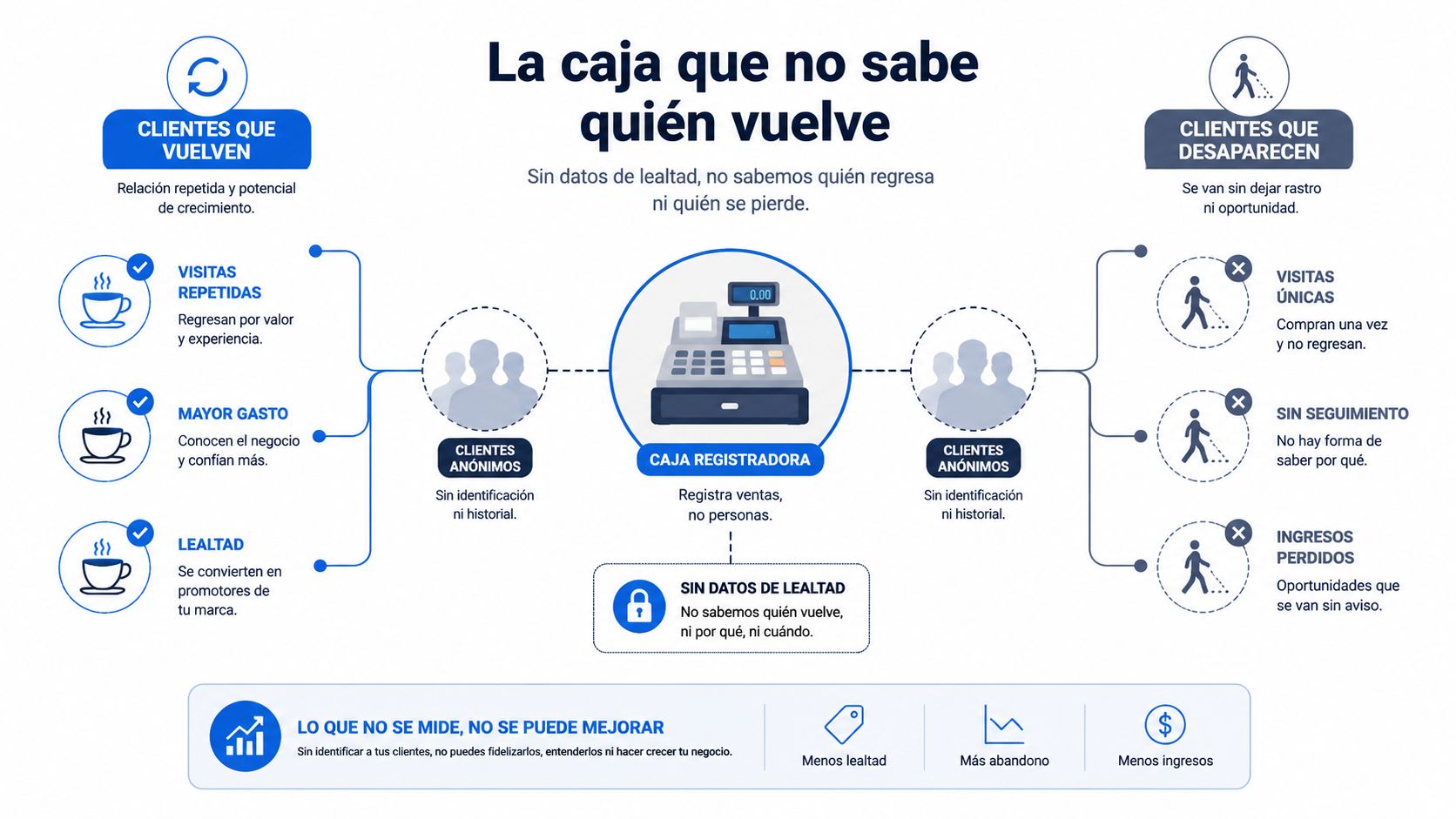
How to think about the correct operation
The fast register serves to collect payments. The CRM serves to decide who to speak to again, with what offer, and when. If both do not share the same flow, the business ends up working double—first at the register and then in spreadsheets.
The point is not to accumulate names. The point is to know which customer is worth repeating, what habit rewards an additional visit, and which branch needs a different campaign. That is what turns daily operations into a repeatability engine.
What Swirvle is as a food service POS with CRM
Swirvle is a platform that brings together the register, CRM, and loyalty into a single flow for businesses with physical locations. In practice, this means that a coffee shop, restaurant, barbershop, or salon can ring up sales, register, segment, and reactivate customers without jumping between systems.
What the POS layer does and what the CRM layer does
The POS layer handles what is visible at the counter: catalog, orders, payments, inventory, and multiple cash registers. The CRM layer handles what happens next: customer profile, history, points, coupons, campaigns, and segmentation. When both layers work together, each sale stops being an isolated receipt and becomes an operational signal.
POS Layer | CRM Layer |
|---|---|
Catalog, orders, and payments | Customer profile and history |
Inventory control | Points, coupons, and rewards |
Multiple registers | Segmentation by frequency and ticket size |
Closing sales at the branch | Campaigns and reactivation |
This union matters because it prevents manual data entry. It also reduces registration errors and ensures that loyalty is born from the transaction, not from a later data upload. The result is a cleaner operation, with purchase traceability and better inputs for subsequent campaigns.
What changes in business incentives
The difference between charging a subscription and charging a commission per sale is not minor. When the software does not penalize every ticket with a percentage, the business logic focuses on using the tool more, not limiting its use due to variable costs.
This detail carries a lot of weight for food service and service SMEs. A small operation does not want to feel that every active promotion, campaign, or new reward makes growth more expensive. It wants to control fixed expenses and decide internally which lever to pull.
The right software not only processes sales, but also prevents the business from paying twice for the same customer relationship.
Swirvle also fits the Mexican reality because the structure of the loyalty market is already familiar to the consumer. Reward programs have built habits in frequent consumption categories, so the mechanics of points, benefits, and repeat visits do not sound foreign to the Mexican customer.
What to check before implementing it
Register and catalog: these must be standardized before thinking about campaigns.
Purchase history: must be migrated clean to avoid starting with noise.
Segmentation: needs to reflect frequency, branch, and type of consumption.
Loyalty: should be set up to reward useful behavior, not just volume.
To see the relationship between both layers in more detail, it is useful to review the CRM and loyalty program approach. Without that foundation, the business is just digitalizing payments. With that foundation, it turns every visit into an actionable piece of information.
Key capabilities that change operations
A feature does not matter on its own. It matters because of the operational pain it solves. A business does not buy "automation" because of a trend; it buys it because it wants less manual work, clearer decisions, and campaigns that actually drive returns. Swirvle stops looking like a pretty register and starts acting like an operational tool.
Unified CRM, loyalty, and smart coupons
The unified CRM gathers customers from the physical store and digital channels into a single profile. This prevents duplicates, split profiles, and campaigns that talk to the same customer twice as if they were different people. In a coffee shop with WhatsApp orders and counter purchases, this union is not a luxury, it is the foundation for operating well.
The configurable loyalty allows rewarding amount, frequency, or product. Not all categories should use the same rule. A restaurant can reward high ticket sizes, a coffee shop can reward repeat visits, and a barbershop can reward the return to the schedule.
Smart coupons work better than a general discount. They can be activated by day, time, category, or branch. This way, you do not give away margin to customers who would have bought anyway, and you concentrate the incentive where you actually need to move the needle. In table-service restaurants, it helps push slow hours. In a barbershop or salon, it is more useful for reactivating the schedule than for cutting prices indiscriminately.
Automations, AI agents, and ROI dashboards
Message automations work for anniversaries, inactivity, and reactivations. Therein lies the difference between chasing customers by hand and operating with rules. A business cannot rely on someone remembering to send a greeting or chasing after those who have not returned.
AI agents can suggest combos, reply via WhatsApp, and draft campaign copy. In practice, they help ensure that the register and marketing are not left waiting for texts, ideas, or basic responses. They do not replace operational criteria, but they do remove friction from repetitive tasks.
ROI dashboards separate intuition from management. If a campaign cannot attribute sales to a branch, segment, or channel, it only generates noise. The business needs to know which message reactivated, which coupon raised the ticket size, and which point of sale converted best.
Operational criterion: a feature is truly valuable when it saves time for the register staff or improves the reading of the return.
In restaurant environments and SMEs with physical locations, the POS+CRM combination allows feeding loyalty programs directly from the transaction, without additional manual entry. Swirvle connects sales with customer activation, transforming every receipt into a signal that feeds future campaigns.
Capability | Problem it solves |
|---|---|
Unified CRM | Avoids duplicate profiles and loose data |
Configurable loyalty | Rewards useful behavior, not blind discounts |
Smart coupons | Protects margin and segments better |
Automations | Reduces manual follow-up work |
AI agents | Speed up responses and operational copy |
ROI dashboards | Attribute sales to campaigns and branches |
How it applies in restaurants, coffee shops, barbershops, and salons
The same tool is not used the same way in all sectors. The typical mistake is copying a loyalty mechanic from a coffee shop into a table-service restaurant or forcing bulk reminders on a barbershop with a compact schedule. The correct configuration depends on the type of visit, frequency, and how consumption takes place.
Restaurant and coffee shop
In a table-service restaurant, the useful lever is customer history combined with average ticket size. The register can suggest desserts, drinks, or extras at the moment of payment, and then activate promotions during low-turnover hours to fill tables again. The business does not need more messages; it needs more meaningful moments.
In a high-frequency coffee shop, the logic changes. Here, a program of points per visit and a visible stamp in the customer experience carry more weight, because the purchase is more frequent and shorter. A smart coupon can reward the customer coming in for their fifth coffee of the week, not the one who is just starting to try the place.
Barbershop and beauty salon
In a barbershop, the priority is chair occupancy and calendar returns. Appointment reminders and reactivations of inactive clients work better than any general discount. If the client stopped going, the correct message is usually about returning, not about a discount.
In a beauty salon, service history carries more weight than an isolated ticket. A well-configured CRM allows speaking again to someone who already got color, treatment, or a haircut with a coherent proposal, not with a generic promotion. This takes upselling off the counter and connects it to real history.
The CRM for restaurants makes sense when the operation uses that information to drive turnover, repeat purchases, and ticket size, not when it just stores names. The difference lies in the rules. If each branch can read frequency, ticket size, and context, then the campaign stops being mass-market and becomes profitable.
Type of Business | Main Mechanic | Typical Coupon | Automatic Message |
|---|---|---|---|
Restaurant | History + average ticket | Extra or dessert during slow hours | Post-visit recommendation |
Coffee shop | Points per visit | Stamp or reward for frequency | Habit-based reactivation |
Barbershop | Schedule + frequency | Benefit for returning appointment | Reminder for next visit |
Salon | Service history | Incentive for maintenance | Upsell based on previous service |
Phased implementation without breaking operations
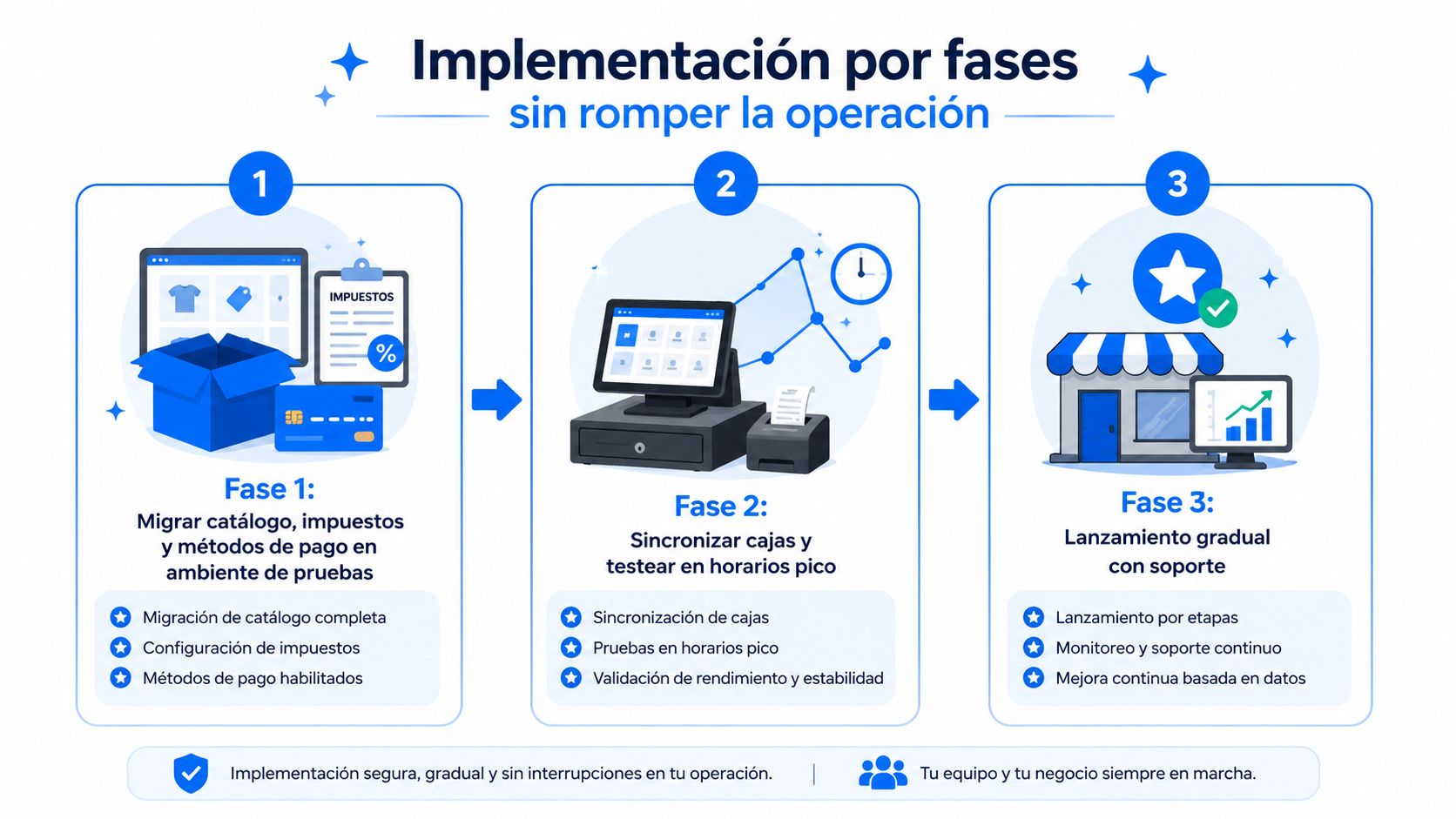
The worst way to debut a POS with CRM is running it live with a messy catalog, out-of-sync registers, and duplicate customers. This turns a useful tool into a source of errors and internal arguments. The correct implementation is done in phases, with clear deliverables and real verification.
Phase 1 and Phase 2
First, the catalog, taxes, and payment methods are migrated into a test environment. Then, tickets are reconciled against the previous system for at least a week, because the operation must not move blindly. If the totals do not match, we do not move forward.
Next, the existing customer base is loaded, duplicates are cleaned up, and purchase history is mapped. This step is what allows the CRM to start with reliable attribution from day one. If this part is done poorly, the rest of the system inherits noise.
Starting best practices: data integrity first, then automation, then campaign.
Phase 3, Phase 4, and Phase 5
The pilot should be run in a single branch, with a simple rule. One point for every one hundred pesos spent is enough to validate behavior, friction at the register, and customer response. Introducing complex coupons from day one only complicates the diagnostic.
Automations, smart coupons, and birthday reminders come later, when the base and inventory are already responding well. Launching segmented campaigns without that validation is an elegant way to multiply errors. The business needs operational confidence before scaling messages.
At the end, dashboards are opened per branch with targets for reactivation and average ticket size. The question is not whether the software "works," the question is whether each phase left a verifiable data point. If there is no verification, there is no rollout.
Success metrics and ROI by campaign and branch
Accumulating contacts without measuring return is a bad habit. In Mexico, the loyalty market already has scale and history, with an estimated value of US$2.54 billion in 2023 and a projection of US$4.11 billion in 2028, with a compound annual growth rate of 9.8% between 2024 and 2028 according to Research and Markets (Mexico loyalty market source). This does not mean every business should imitate mass programs; it means the logic of repeat business is already mature and must be measured properly.
What a manager should look at
The first useful indicator is the cohort repeat rate. This reading shows whether a group that entered through a campaign actually returned because of value or if they only hunted for the discount. The difference between the two cases defines whether the promotion built a habit or just subsidized a visit.
The second indicator is the change in average ticket size between customers with coupons and without coupons. If the coupon attracts visits but destroys margin, it is of no use. If it raises the ticket size or drives a second purchase, then it has operational logic.
The third indicator is the attributed ROI by channel and branch. The business needs to know which message, which channel, and which point of sale drove the sale. Without that attribution, there is no way to decide where to repeat the campaign and where to cut it.
A monthly report does not correct a bad campaign. A weekly decision does.
How to read the data without getting lost
A monthly cohort serves to separate new customers from reactivated customers. If a promotion brings visits, but the cohort cools down immediately, the offer was tactical. If the cohort maintains repeat business, then the perceived value was real.
In operations, it is useful to monitor three simple signals: how many in the group return within thirty days, how many visits repeat customers make, and how much it costs to reactivate a dormant customer. If the business cannot answer those three questions, it is not measuring ROI yet—it is only looking at activity.
Metric | What it measures | Useful reference | Decision it triggers |
|---|---|---|---|
Cohort repeat rate | Real repeat purchases | Monthly reading by segment | Maintain or cut a campaign |
Average ticket with coupon | Additional value from incentive | Compare against no coupon | Adjust discount or combo |
ROI by branch | Profitability per point of sale | Weekly evaluation | Replicate, correct, or stop |
Reactivation | Customers returning after inactivity | Dormant segments | Activate reminder or coupon |
Frequency | Purchase rhythm per customer | Habit by category | Change loyalty mechanics |
When Swirvle makes sense for your business
Swirvle makes sense when the business depends on repeat business and not just foot traffic. A restaurant with more than one location, a coffee shop with high repeat business, a barbershop with a schedule, or a salon with service history wins more if it connects register, customer, and campaign than if it continues operating with loose lists. The tool is not justified by trend; it is justified by operational complexity.
When it does and when it doesn't
If the business has multiple branches, it already needs traceability per point of sale. If it depends on repeat customers, it needs segmentation by habit. If it lives on appointments or repeat services, it needs reminders and reactivation.
Conversely, it is not advisable to force a complete CRM when the volume is too low to sustain it. Nor is it the correct answer if the business actually needs an industrial ERP and not a commercial layer of loyalty and sales. The software must match the size and pace of the operation.
What to do before deciding
First, audit the register and see if the sales data is already clean. Second, map out current customer segments, even if they are few. Third, choose a priority metric—reactivation, ticket size, or frequency—and run a 30-day pilot campaign.
In businesses where repeat visits matter, the criterion is straightforward. If the average ticket size already demands care for every visit and the customer has the potential to return, the decision is pretty much made. What is missing is not more intuition, but a structure that connects purchases, habits, and returns.
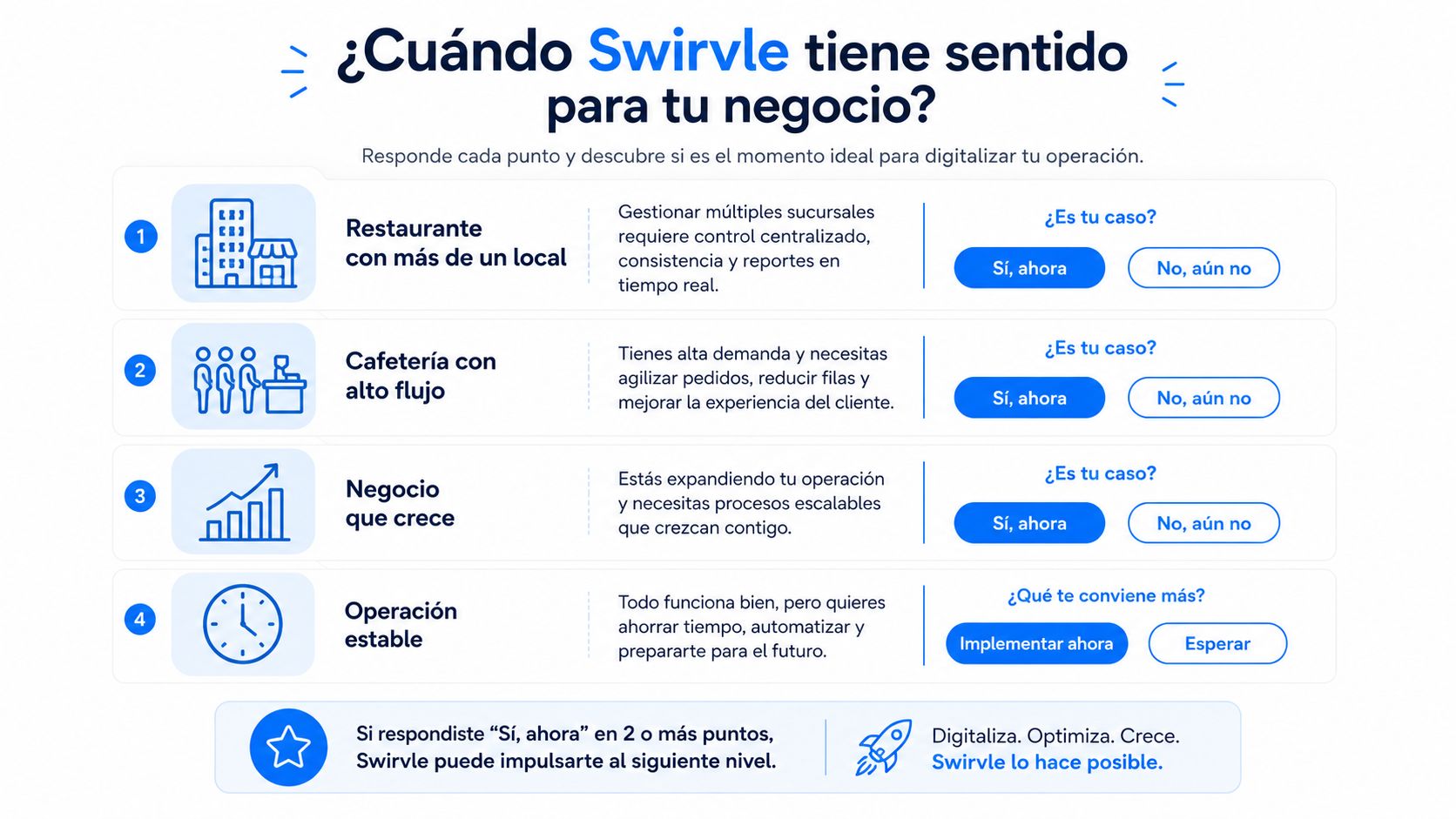
Swirvle helps unite the register, CRM, and loyalty so that every sale leaves useful information and not just a payment. If a coffee shop, restaurant, barbershop, or salon needs to measure repeat business, segment by branch, and automate campaigns orderly, it is worth checking out how it works on Swirvle and deciding if that operation is already asking for a more serious structure.
Related Blogs

Nov 24, 2026
What is inventory turnover and how is it calculated in a store?

Nov 23, 2026
How to calculate the selling price of a cup of coffee?

Nov 22, 2026
How to identify frequent customers in a physical store?

Nov 21, 2026
How to Connect Your POS System with Restaurant Email Marketing: A Guide

Nov 20, 2026
How much does a small restaurant make per month in Mexico?

Nov 19, 2026
How to Run a Small Coffee Shop Step by Step? 2026