
Pros and cons of the "free coffee for the first 100 customers" promotion: ROI, KPIs, risks, and how to execute it with Swirvle.
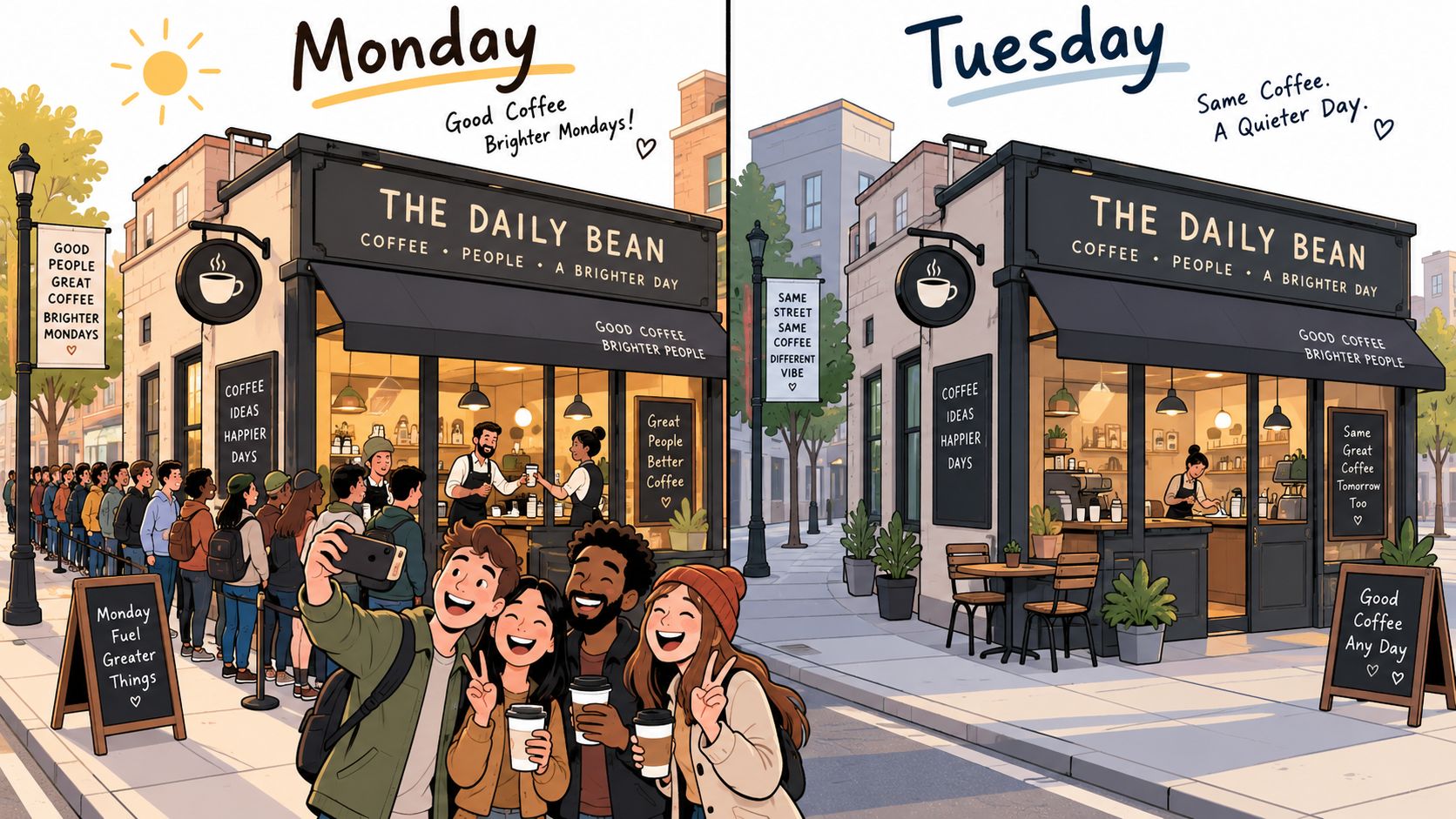
On Monday at eight in the morning, there is a line in front of the coffee shop. The post offering "free coffee to the first 100 customers" is already circulating in local groups, the team is preparing cups at top speed, and the owner feels the campaign has taken off. The problem appears the next day: the line disappears, the regulars occupy the same tables, and the cash register records practically the same ticket amount.
The dynamic can generate traffic, buzz, and product trial. It can also consume budget, overwhelm the counter, and attract people who do not return. The advantages and disadvantages of the "free coffee to the first 100 customers" dynamic are not decided by the number of cups handed out, but by what happens next: data captured, attributed second visits, and verifiable recurrence.
Why Nobody Returned the Following Monday
By noon on Monday, 80 cappuccinos had been handed out. A group selfie in front of the store boosted social media reach and several people tagged the coffee shop. The scene looked like a victory, but on Tuesday the same regulars arrived, the average ticket remained the same, and no follow-up message produced an identifiable purchase.
This result is not uncommon. In Mexico, the USDA/FAS projects domestic consumption of 3.1 million 60kg bags for 2024/25 and 3.15 million for 2025/26, a projected growth of 1.6% year-on-year. The source also places per capita consumption between 1.3 and 1.7 kg per year, while soluble coffee accounts for around 60% of the market. The category has mass appeal, but that appeal does not automatically convert someone attracted by a freebie into a frequent customer. The USDA/FAS projection on coffee consumption in Mexico helps explain why initial traffic can be so intense.
The line demonstrates interest in the offer, not loyalty to the coffee shop.
An owner who only counts cups handed out is measuring activity, not return. The correct question is how many attendees left authorized data, how many received a concrete reason to return, and how many purchased later without another giveaway. Without that chain, the giveaway is a local-reach activation with a short window of impact.
The most useful explanation for Tuesday lies in the complete experience. If the person received the coffee, did not learn about other products, did not receive a subsequent benefit, and was not identified in any system, the coffee shop has no way to contact them again or attribute a future purchase. To review other reasons for abandonment, you should consult this analysis on why customers do not return even when the experience was good.
What This Dynamic Really Means
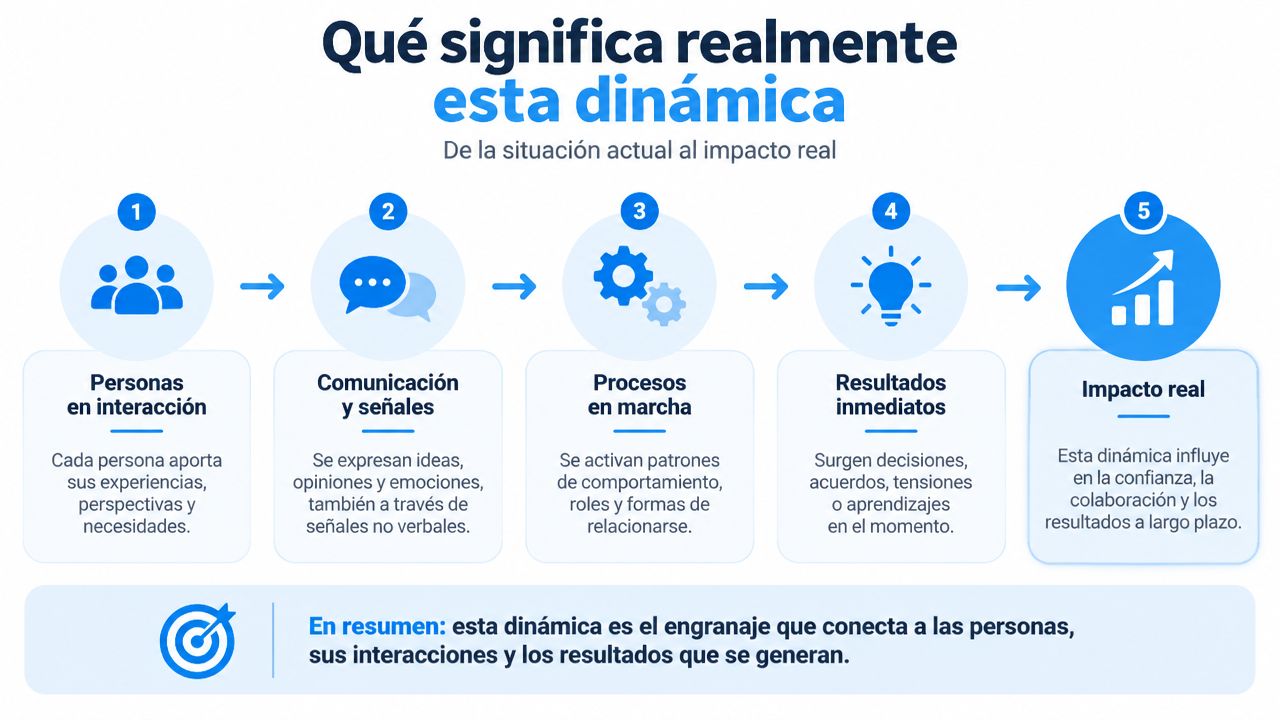
The mechanics are simple: a coffee shop provides a free drink, such as drip coffee or a cappuccino, to the first 100 people who arrive at the venue within a defined date and time window. The business must establish beforehand whether there is a limit per person, if the benefit is non-transferable, and which drinks participate. If those rules are not visible, the line becomes an operational dispute.
The result depends on three gears.
The Incentive Sets the Cost
The type of beverage determines the consumption of ingredients, preparation time, and counter capacity. Giving away a drip coffee does not pose the same challenge as giving away a drink with milk, syrups, and modifications. The benefit must be attractive, yet controllable enough for the team to deliver a consistent experience.
Capacity Creates Urgency
The 100 slots function as a bottleneck. Scarcity generates quick decisions, but it concentrates customer arrivals into a few minutes and can displace those who intended to buy normally. A small shop should not announce the campaign without reserving inventory, setting up a separate line, and communicating what happens when the spots are filled.
The Window Concentrates Demand
The day and time change behavior. An activation before work can fill the branch, while a quiet slot can be used to test capacity without blocking the entire operation. The business is not offering a coupon for a future visit or a 2-for-1. It is absorbing the cost in the moment and, therefore, data capture must occur during that same contact.
The Federal Consumer Protection Law considers offering additional goods or services for free, at a reduced price, or through incentives as a commercial promotion. In general terms, it does not require authorization or prior notice, except in cases foreseen by official standards or situations that could harm the consumer, as explained in the text of the Federal Consumer Protection Law published by PROFECO. If the campaign incorporates sweepstakes, contests, or collectible items, the conditions may change and must be reviewed in accordance with NOM-028-SCFI-2007 and applicable notices or permits, according to this legal guide on commercial promotions in Mexico.
Advantages That Are Actually Worth Leveraging
The main advantage is speed. A limited promotion can fill a specific time slot and test the team's capacity without compromising the entire week. The operational benefit only exists if the coffee shop keeps paying customers' service separate and prevents the line from ruining the experience of those who are already regulars.
Mexico offers a broad base for this type of boost. The domestic coffee consumption projected by the USDA/FAS and the weight of soluble coffee in the market suggest a familiar, frequently purchased category with a low trial threshold. This favors coffee shops, restaurants serving breakfast, and businesses wanting to introduce a new drink, but it does not guarantee that the visitor will choose the venue for their next purchase.
Operations
The campaign helps detect how many drinks the counter can prepare in a short window, which ingredient runs out first, and where bottlenecks appear. It can also justify additional staff when the goal is to open a branch, activate a new area, or test a low-demand time slot.
The rule is to protect the paying customer. If the promotion causes long waits, alters recipes without control, or leaves tables occupied by people who only picked up the freebie, the business is buying reach at the expense of its regular operation.
Financials
The cost is budgetable because the number of drinks is limited. Add-ons can generate additional sales if the menu is presented clearly, although the team should avoid pressuring the visitor. The offer works best when the free coffee opens the door to a complementary purchase, rather than replacing consumption that would have occurred anyway.
Data from Kantar shows that 96% of Mexican families purchased consumer goods with discounts, with an average expenditure of $1,969 pesos per household and a frequency of 21 times a year. The analysis published by Merca20 reported that 89.7% of Mexicans bought with some promotion in the last year, while 58.4% said they take advantage of them frequently and 32.4% mainly on special occasions. These figures show a strong promotional response, but also an audience accustomed to chasing incentives. Kantar's data on the Mexican consumer and promotions supports the need to design a second action.
Brand and Data
A visible line communicates popularity. A shared photo can put the location into neighborhood conversations and help introduce a new branch. The value grows if, when handing over the coffee, the business asks for permission to send a subsequent reward via WhatsApp or email.
Dimension | Advantage | Fulfilled only if... |
|---|---|---|
Operational | Tests counter capacity | The paying customers' experience remains stable |
Financial | Allows control over promotional spending | There is an upsell or a conversion plan |
Brand | Generates local visibility and content | Data is captured and follow-up is sent |
CRM | Identifies new contacts | The registration includes consent and campaign source |
The promotion must close with a thank-you message, a second-visit reward, and a purchase measurement. Without that thread, the photo of the line will be more valuable than the customer database created, and that does not pay payroll.
Disadvantages and How to Protect Yourself Before Launching
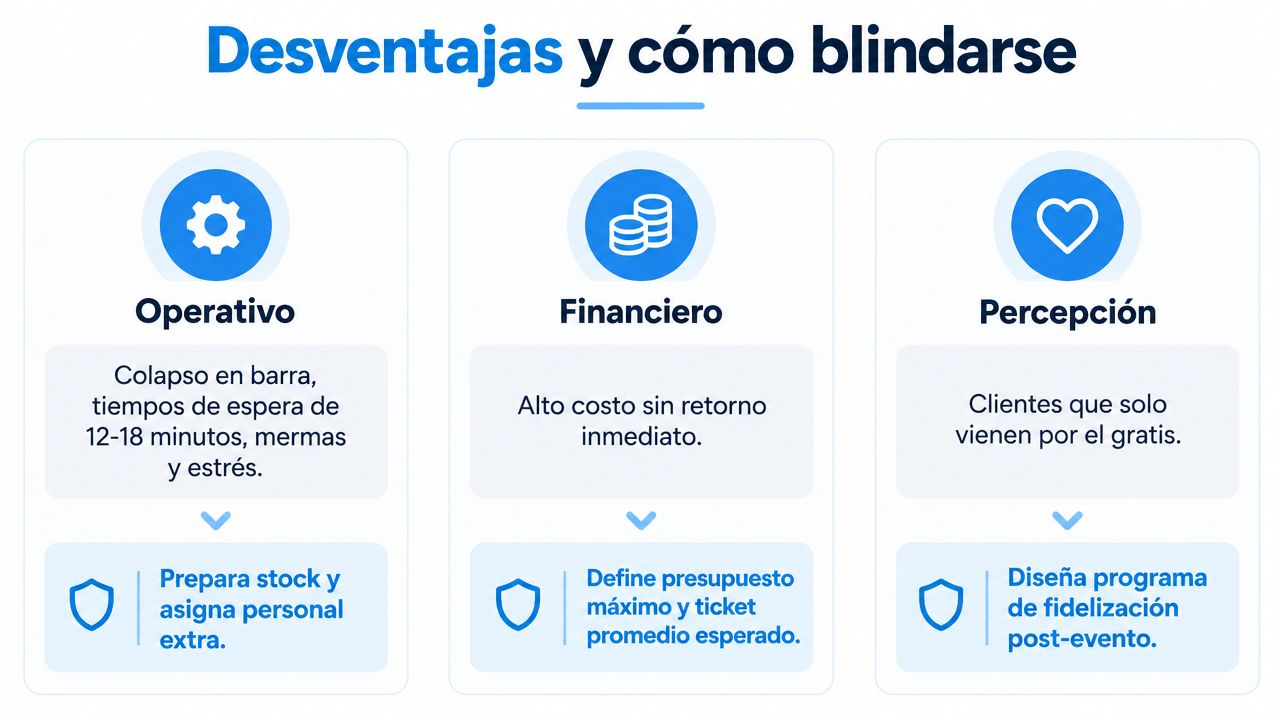
A morning with a line can drain budget, inventory, and patience before generating a second purchase. The owner must set the maximum loss, the recurrence goal, and the evidence that will decide whether to repeat the dynamic. Without those limits, the giveaway fills the shop one morning and leaves the CRM empty.
Operations Under Pressure
The bottleneck appears at the counter. A poorly organized activation can push wait times to 12 to 18 minutes, increase waste, and stress the team, especially if every customer modifies their drink. The solution is to reduce decisions during the peak, not to demand that baristas work faster.
The operation must be documented and reviewed at closing:
Reserve stock: separate ingredients for the promotional drinks and record surpluses.
Assign extra staff: one person hands over while another produces. The barista should not be charging, preparing, and explaining rules simultaneously.
Separate flows: set up one line for the promotion and another for paying customers.
Control orders: limit modifications and communicate the eligible menu before anyone joins the line.
The offer also needs a closing time, a person responsible for counting, and a visible message when the cups run out. This clarity avoids arguments and protects the experience of those who arrived later.
Money That Doesn't Return
The sunk cost of a gifted cup can range between $25 and $35, depending on the campaign's operational assumptions. If the visitor does not add food, does not buy later, and does not leave a consented contact, the business paid for acquisition without creating a relationship. The cost per cup is only justified if it produces an additional margin or a measurable visit.
There is another risk: cannibalization. A regular customer might wait for the giveaway and substitute a normal purchase for a free product. That is why it is advisable to choose a beverage with a controlled margin, set a spending cap, and require a complementary sale under an internal 70/30 average ticket rule. Record it as a control criterion, not as a promise of results.
Brand Perception
An audience attracted solely by the freebie may leave upset if the wait is uncomfortable or if the 100 customers are reached without a clear explanation. A national promotion by a coffee shop chain in 2024 offered free coffee to voters and limited delivery to the first 140 customers per store, with exclusions by branch type, according to their official statement on the voter promotion. The operational lesson is concrete: publish eligibility, hours, inventory, and limits before opening.
If most people are left out, transparency is worth more than an ambiguous promise.
Afterwards, review complaints, wait times, rejected drinks, lost regular sales, and contacts obtained. Connect each registration to a second-visit reward and measure if they buy. If the service failed, repair that experience before launching another activation. The CRM must demonstrate recurrence, not just count people in line.
Comparison with Coupons, Points, and Segmentation
The giveaway wins when the goal is to concentrate attention. It loses when the goal is to understand habits, trigger a second purchase, and increase each customer's value. A coupon for a future visit, a points program, and a segmented campaign distribute the incentive differently, with more traceability and less pressure on a single morning.
Mechanics | Relative CPA | 60-Day Recurrence | Operational Effort | Data Generated | Best For |
|---|---|---|---|---|---|
Free coffee to the first 100 | High in a short window | Low if there is no follow-up | High during the event | Basic contact, if captured | Awareness and opening |
Discount coupon | Medium | Medium | Medium | Redemption, date, and branch | Second visit |
Points program | Medium at start | High potential | Medium and constant | Purchase history | Recurrence |
Segmentation by habits | Variable, controllable | High when message is relevant | Medium | Preferences, frequency, and branch | Ticket and retention |
The 60-day recurrence rate should not be assumed. The giveaway starts with a weak signal because the benefit is consumed immediately. Points take longer to prove value, but they create a repeatable reason to buy. Segmentation can be more efficient because it separates the breakfast customer from the weekend visitor, the coffee buyer from the food consumer, and the customer of one branch from another.
To organize audiences by behavior, frequency, and context, it is best to segment by purchasing habit and by branch. The practical rule is not to send the same reward to the entire database: each segment should receive an offer related to their habit and with a clear expiration date.
The giveaway is good for filling the shop for a day. Points and segmentation win 3 to 1 in amortized CAC when the core problem is building a relationship, according to the operational rule set for this type of campaign. To design coupons with limits and validity, you can review this guide on how to create smart coupons for a store.
Calculating ROI and KPIs to Avoid Going Blind
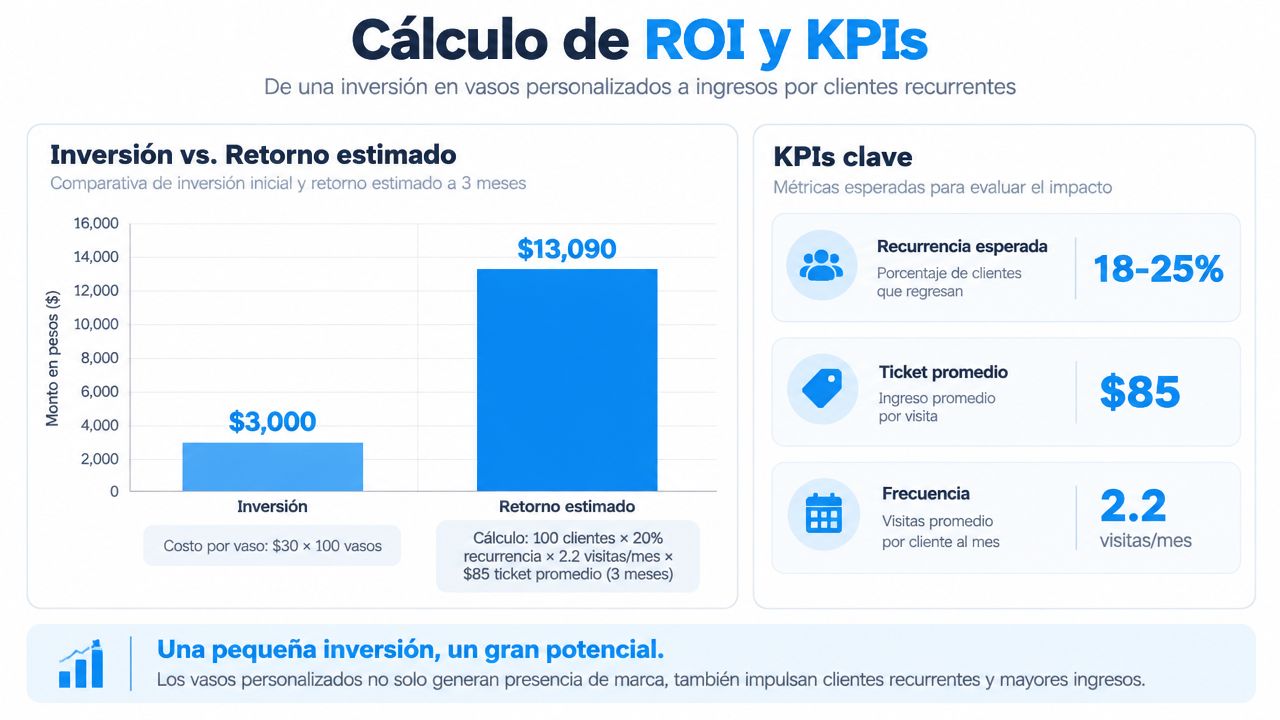
The calculation must start with explicit assumptions, not with enthusiasm for the line. If the cost per cup is set at $30, giving away 100 drinks represents $3,000 in direct investment. With an expected recurrence of 18% to 25%, an average ticket of $85, and a frequency of 2.2 visits per month, the proposed break-even point requires each recurring customer to spend at least $1,360 over 90 days.
The illustrative math should be reviewed before budget approval. With a baseline recurrence of 20%, 100 potential customers, 2.2 monthly visits, an $85 ticket, and a three-month period, the modeled gross return reaches $13,090, against the $3,000 investment. This figure is a working estimate, not a guaranteed sale. It does not include margin, extra staff, waste, rent, or the cost of capturing and recontacting data.
Measure Before Declaring Victory
The indicators must have a source and an associated decision:
CPA: divide the total cost of the campaign by the identified new customers. If registrations are missing, the actual CPA is underestimated.
Return at 7, 30, 60, and 90 days: consult the CRM and separate promotional purchases from subsequent purchases.
Subsequent ticket versus prior ticket: compare equivalent groups by branch and period.
NPS: send a short survey after the visit and record comments on the line, taste, and service.
Coupons redeemed: attribute each second visit to the code used.
Program registrations: measure sign-ups with consent, not just written down phone numbers.
User-generated content: count posts related to the campaign and separate reach from conversion.
Cost per acquisition of WhatsApp or email: divide acquisition spending by valid and authorized contacts.
A reasonable minimum to repeat is not "we ran out of coffee." It is demonstrating a measurable return, a defensible subsequent ticket, and an identified database that can receive a relevant offer. The analysis on how to calculate return on investment helps structure the math without confusing gross revenue with profit.
Step-by-Step Implementation Checklist with Swirvle
The campaign must be prepared like a commercial operation, not an improvised post. The following timeline keeps the focus on attribution and limits:
Define the goal at T-7. Choose between awareness, registrations, second visit, or ticket. Write down a victory metric and a cancellation rule.
Calculate the budget at T-7. Multiply the estimated cost per cup by the 100 slots, add staff, and reserve a maximum loss that the branch can sustain.
Set up the "first 100" segment at T-7. Use Swirvle's segments module to distinguish new sign-ups, branch, date, and campaign source.
Create the smart coupon at T-1. Define a benefit for the second visit, a usage cap, and a short validity. The coupon must not turn into another open-ended gift.
Activate the welcome message at T-1. Schedule the registration message via WhatsApp, push, or email with the complete terms and the next step.
Prepare the thank-you message at T-1. Draft a communication confirming participation, explaining the subsequent reward, and asking for a short response about the experience.
Connect attribution to the CRM at T-1. Tag the campaign, branch, and channel to differentiate new, regular, and recurring customers.
Define the stop rule before T0. Pause promotional capture upon reaching 80 redemptions, a figure set as a preventive control, and reserve capacity to fix errors without overwhelming the operation.
Run the line at T0. Separate delivery, production, and payment. Staff must repeat a single explanation regarding eligibility, hours, and stock.
Send the follow-up at T+1. Thank them for the visit and deliver the smart coupon to those who agreed to receive communications.
Schedule the survey at T+7. Launch a short NPS and classify comments by service, drink, and wait time.
Read KPIs at T+30. Review registrations, redemptions, ticket, and first-time repeat visits. At T+60, decide whether the segment continues, the incentive changes, or the dynamic is removed.
Fault control must be visible. If a drink runs out, it is replaced by a previously announced option. If registration fails, the team maintains an authorized alternative route. If the line blocks the entrance, stop delivery and communicate status before sacrificing regular service.
Swirvle can centralize segments, coupons, automations, rewards, and attribution dashboards in a CRM tailored for physical stores. The tool should be used to answer a concrete question: which customer came for the giveaway and what did they do next.
Final Verdict and the Rule That Decides Everything
Use it when the goal is mass acquisition and there is a budget to absorb the loss; avoid it if the branch depends on daily cash flow to pay payroll.
The dynamic works as acquisition, not as automatic loyalty. The free trial lowers the entry barrier and can produce local visibility, but the business must charge after the first coffee. That charge can be a complementary purchase, a second-visit coupon, or a reward within the loyalty program, always with attribution and consent.
The golden rule is to turn the winner of the 100 into an identifiable partner, not a reach photo. The customer must enter a welcome flow, receive a specific reason to return, and be measured at 30 and 60 days before repeating the giveaway. If recurrence does not appear, the coffee shop doesn't have a campaign to optimize—it has a cost to stop.
The market already shows that promotions attract attention, while loyalty programs depend on tangible and repeatable rewards. A recent report on Mexican consumers notes that 97% know of at least one loyalty program, and the Mexican loyalty market is projected at US$1.55 billion by 2025, signs that measurable retention outweighs an isolated activation. The loyalty analysis of the Mexican market reinforces this decision: the giveaway can open the door, but the CRM must build the habit.
The coffee shop must stop counting cups and start counting trackable customers, subsequent purchases, and profitability. That is the difference between filling a shop one morning and running a strategy that pays for the next.
Swirvle allows you to centralize CRM, loyalty, coupons, segmentation, and automations to measure what happens after the free coffee. Visit Swirvle and turn your next promotion into an attributable campaign with 30 and 60-day tracking.
Related Blogs

Oct 6, 2026
Which campaigns work to fill a restaurant during the week?

Oct 5, 2026
Does Excel work as a CRM for a small business, or is it better to use a software?

Oct 4, 2026
How to organize my client information if I have a small business? Guide
Oct 3, 2026
What message should I send on WhatsApp to win back a customer who is no longer returning?

Oct 2, 2026
Grocery Store Software: 2026 Comparative Guide

Oct 1, 2026
Omnichannel CRM for Physical Businesses in 2026
Try Swirvle for free
No card required · 30 days free
Start your free trial