Discover the best customer retention software for coffee shops: comparison, key criteria, and how to choose the ideal loyalty CRM for your SMB in LATAM.
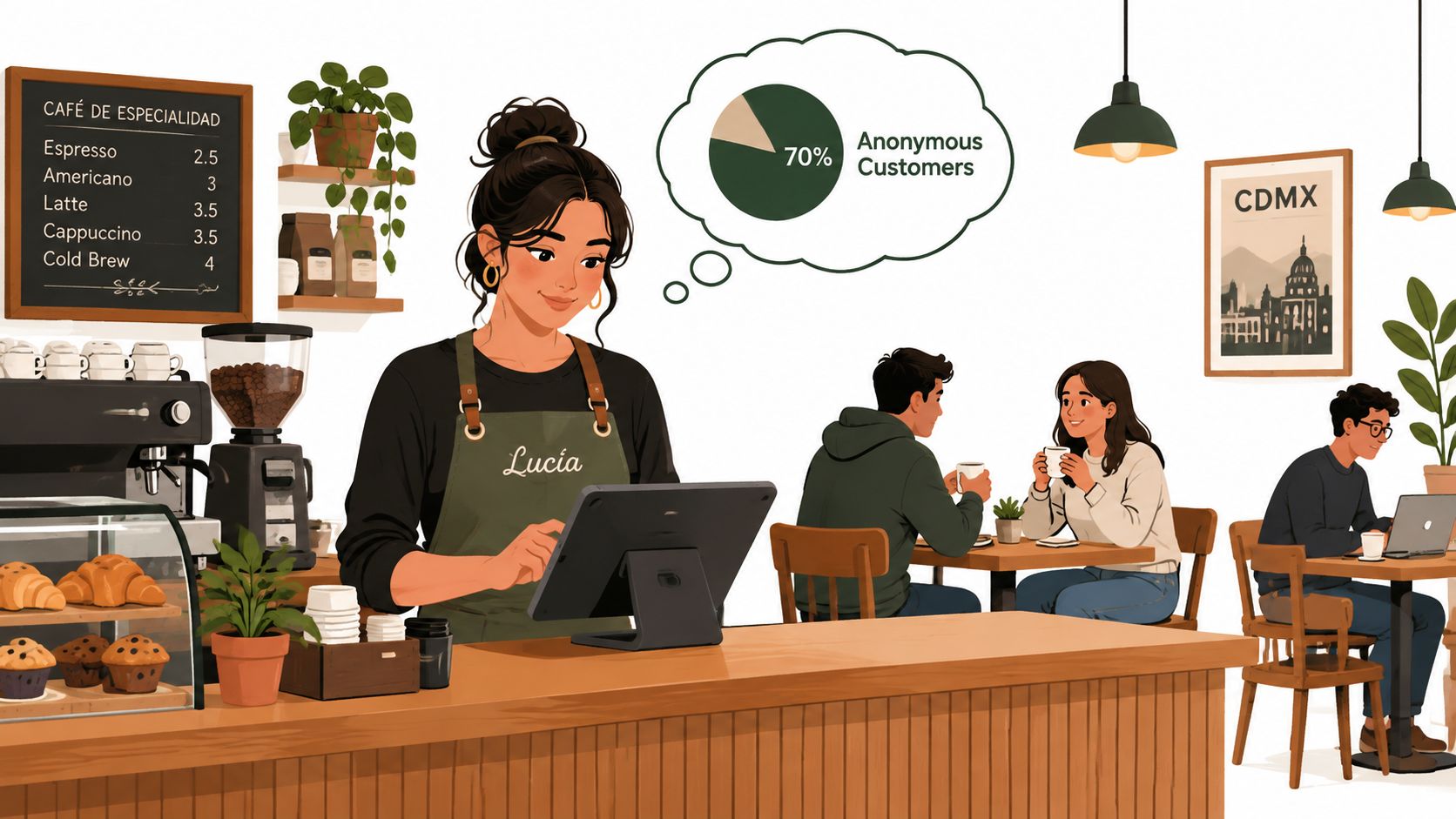
Lucía, owner of a specialty coffee shop in Mexico City, reviews the POS after a slow week between Monday and Thursday. The system records sales, products, and times, but it doesn't answer the question that matters most: who are the returning customers, which location do they visit, and how long has it been since they last visited the business.
This problem is more common than it seems. The Mexican restaurant industry accounts for 581,530 food and beverage preparation economic units, under which coffee shops, soda fountains, ice cream parlors, and juice bars are classified, according to INEGI's 2019 Economic Censuses. In such a fragmented market, selling one more drink today does not solve the lack of repeat business tomorrow.
Why a coffee shop needs retention software today
In a Mexico City coffee shop, the POS can record every morning sale and still leave a question unanswered: who returns, which location do they visit, and how long has it been since they last bought. Lucía can see products and schedules, but cannot distinguish between the person who drops by daily and the one who showed up only once. The POS treats them as isolated transactions, without recognizing that some return every morning.
Mexico City concentrated 7,074 coffee shops and similar businesses as of December 31, 2020, according to INEGI. That competitive density makes it necessary to measure repeat visits by location, schedule, and behavior. Attracting occasional visits is not enough if the business does not know which ones it can convert into repeat purchases.
Three signs of weak retention
The first symptom is a stagnant average ticket. The coffee shop sells the same espresso or americano, but does not know which customers might add pastries, dessert, or a seasonal beverage. Without a unified history, every sale depends on the barista's intuition.
The second is low weekday frequency. The shop is full on Saturday and empty on Tuesday. A database allows activating campaigns for slow hours, as long as it differentiates between those who buy in the morning, those who study in the afternoon, and those who visit only on weekends.
The third symptom is reliance on delivery platforms. They can generate orders, but the coffee shop loses control over the direct relationship, the follow-up, and the possibility of driving a second purchase without paying for acquisition again.
Retention requires data, not random discounts
The on-premise channel shows that there is a concrete opportunity for repeat business. According to data from the INEGI document on food and beverage consumption outside the home, 71% of Mexican consumers had gone out to eat in the two weeks prior to the study and 57% had gone out to drink. The frequency is there. The coffee shop must identify it before another brand captures the next visit.
Operational rule: a coffee shop without unified data competes on price, location, or promotions. A coffee shop with data can compete on relevance.
The best customer retention software for coffee shops connects the purchase with a subsequent action. It identifies the visit, triggers a relevant reward or message, and shows if that intervention produced a new sale. If it only accumulates points and names, it functions as a digital stamp card, but not as a retention system. A proper comparison requires more than a features table: each platform must demonstrate segmentation by location, campaign attribution, and measurable ROI. That filter discards many beautiful options that don't prove impact.
Criteria for evaluating retention software in coffee shops
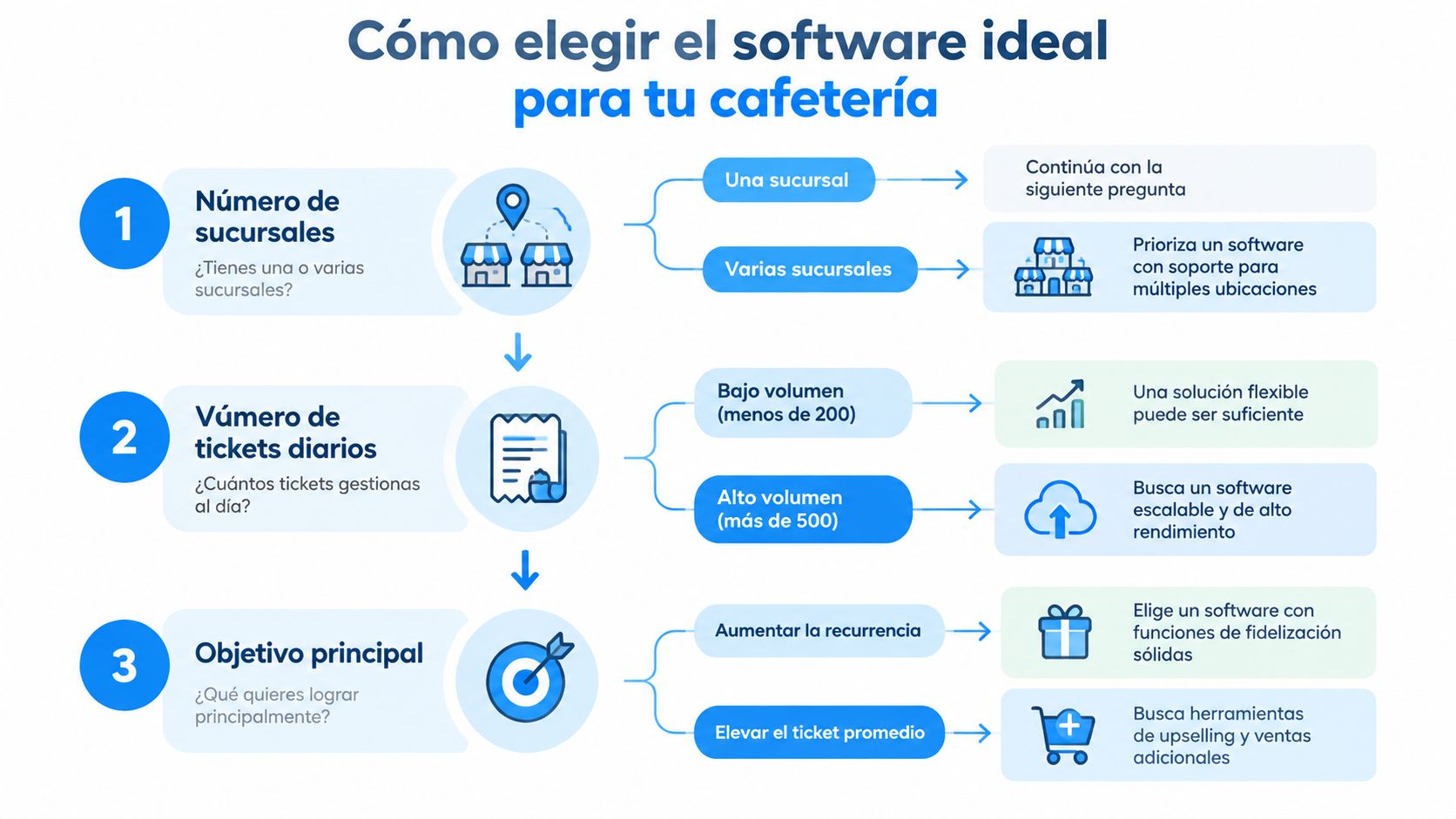
A coffee shop doesn't need another screen full of features. It needs to prove that the software converts purchases into repeat visits. Therefore, every option must demonstrate segmentation by location, behavioral automation, real integration with the POS, and attributable ROI per campaign. That filter separates a useful tool from a pretty platform that only stores contacts.
Six filters that separate utility from digital decoration
Segmentation by location and habits. A coffee shop with three locations must distinguish the customer in a corporate area from the customer in a residential neighborhood. The system must also recognize frequency, time, products purchased, and average ticket. If everything ends up in a general list, campaigns lose relevance.
Behavioral automations. The workflow must detect that a person has not visited for 30 days and trigger a specific communication. That figure serves as an internal campaign rule, not as a universal diagnosis. The system must exclude those who continue to buy frequently and prevent the entire database from receiving the same coupon.
Integrated channels. WhatsApp Business, push notifications, and transactional email must coexist in a single system. WhatsApp deserves operational priority in Mexico, where a penetration of 94.3% is reported.
Its API adoption in companies with 1 to 10 employees grew from 12% to 28% between 2023 and 2025. The software must also control sending frequency to avoid fatigue and unsubscribes.
Configurable loyalty. A low-ticket coffee shop might work with stamps. Another might prefer points, cashback, or a membership. The mechanics must fit the margin, purchase frequency, and campaign goal, not impose an identical program on all locations.
Real POS integration. Uploading files manually does not integrate the operation. Each purchase must sync customer, location, product, and amount without forcing the staff to enter the same data twice.
ROI attribution. The dashboard must show how much revenue each automation generated, which location converted best, and how many inactive customers returned. Coupon redemption is an intermediate signal. The final metric is the attributed incremental sale.
The test any provider must pass
In the demo, ask for a complete workflow. The provider must show how a purchase enters from the POS, how it assigns the location, how it classifies the habit, and how it triggers a campaign. Then, they must show the attributed sale, not just the message sent.
To review data architecture and automations, check out the guide on the best CRMs for SMBs. The decision must depend on the ability to transform operational information into repeat visits, with visible results per location and campaign.
Quick comparison of the main software options
A coffee shop with three locations can have the same points program and still lose money if it doesn't identify where, when, and why its customers return. That is why this comparison does not reward a table full of features. It demands three tests: segmentation by location, campaign attribution, and measurable ROI. With this filter, many attractive platforms stop being practical options.
Comparison of retention software for coffee shops in LATAM
Type of solution | Segmentation by location | Channels: WhatsApp, push, email | POS Integration | Loyalty program | ROI Attribution | Approx. price USD/month |
|---|---|---|---|---|---|---|
Swirvle | Meets, strong | Meets, LATAM focus | Meets | Meets, configurable | Meets, per campaign | Reference, per location |
Digital stamp platform | Partial | Partial | Partial | Meets | Does not apply or limited | Reference |
POS solution with loyalty | Partial | Partial, no native WhatsApp | Meets, main strength | Meets | Partial | Reference |
Platform for chains | Meets in chains | Meets, oriented to broad operations | Meets | Meets | Meets | High, reference |
Swirvle fits best when the coffee shop needs to relate behavior, location, channel, and attributed sales. Digital stamp platforms solve physical card replacement but do not necessarily explain which campaign recovered a purchase. POS solutions with loyalty simplify cash register operations, although they may fall short in reactivating customers via WhatsApp. Platforms designed for chains cover broad processes but usually require more structure than an SMB needs.
The decisive criterion appears in the attribution column. Suppose a coffee shop has three locations: a campaign for inactive customers generates sales in two locations, while the third does not change its frequency. The system must separate those results, show the revenue associated with the campaign, and reveal which segment responded. If it only reports how many coupons were sent or redeemed, the coffee shop still doesn't know the ROI.
To review a concrete difference between a loyalty platform and a location-oriented solution, consult the comparison between LoyaltyPro and Swirvle. The right software connects every campaign decision with a verifiable sale.
Swirvle as an all-in-one CRM for coffee shops

A coffee shop with multiple locations needs to connect every visit with a commercial decision. Swirvle brings together POS, CRM, loyalty, and campaigns to work in a single operation. Its segmentation separates customers by location, schedule, and average ticket, allowing it to distinguish the office worker who buys espresso daily from the tourist who visited once.
The campaign changes based on that behavior. The office customer can be sent a mid-morning promotion. The occasional visitor, a welcome or an incentive to return. The rule must come from recorded purchases, not from a mass database that treats everyone the same.
The case of a coffee shop with multiple locations
A coffee shop with three locations and 800 daily tickets must measure more than just program sign-ups. It needs to identify which location generates repeat business, which schedule has idle capacity, and which segment responds to each incentive. That volume describes an operational scenario, it does not guarantee results.
WhatsApp allows activating segmented reactivations and promotions, provided the coffee shop manages consent, frequency, and exclusions. If it also uses push and email, it must avoid duplicate messages and review which channel produced each purchase. Attribution matters more than the number of messages sent.
Flexible loyalty and reading the margin
A rule like "9 coffees, the 10th free" can be set up without rebuilding the entire operation. The same coffee shop can test points for higher-margin products or rewards for visiting during low-demand hours. Each mechanic needs a goal and a metric: frequency, reactivation, ticket, or margin.
The ROI dashboard must link a recurring sale to the workflow that originated it. The owner can separate an organic visit from a visit driven by WhatsApp or a purchase following a reward. If the system only shows sends and redemptions, it does not prove profitability. To review how a POS with a loyalty program works in a coffee shop, see this Swirvle guide for coffee shops.
Its advantages include POS integration, Spanish-language support, and per-location pricing. The limitation lies in advanced modules, which require onboarding. A small coffee shop must define segments, rules, permissions, and attribution criteria before launching campaigns. That's where a useful platform is separated from a pretty interface with no provable ROI.
Other options worth considering
Not all coffee shops need an all-in-one CRM. An operation with dominant home delivery might prioritize e-commerce-oriented tools, while a regional chain needs control over multiple locations. The mistake occurs when a brick-and-mortar SMB buys a platform designed for another model and forces its processes into it.
Alternative profiles compared to Swirvle for LATAM coffee shops
Type of solution | Best use case | Main limitation | Verdict compared to Swirvle |
|---|---|---|---|
E-commerce-oriented platform | Digital catalog, memberships, and online sales | Weak segmentation by location and local POS | Loses in offline-first operations |
Loyalty tool for digital sales | Rewards and data concentrated on e-commerce | Less natural for physical coffee shop visits | Wins in digital ecosystem, loses in brick-and-mortar locations |
Simple stamp program | Business looking for a basic loyalty layer | Limited multi-channel automation and ROI | Suitable for initial needs |
Local activation tool | Business looking to drive visits from local channels | Narrow ROI reporting and automations | Complementary, not a substitute |
Rewards module for e-commerce | Customization of digital incentives | Requires constant online traffic | Convenient for e-commerce, not for a primarily physical coffee shop |
E-commerce-centered solutions work when the coffee shop sells a significant portion of its catalog online, manages digital memberships, or uses the online store as its data hub. A neighborhood coffee shop that measures visits at the register needs the physical purchase to be the primary event in the system.
Stamp and local promotion tools make sense for businesses with simple requirements. They help organize a database or activate offers, but fall short when the strategy requires WhatsApp, push, email, location segmentation, and sales attribution in a single view.
The difference is proven in daily operations. A coffee shop with multiple locations must know which location generated the purchase, which campaign influenced it, and how much margin the reward left behind. If an alternative does not demonstrate segmentation by location, campaign attribution, and measurable ROI, it is discarded, regardless of how attractive its interface is.
An offline-first solution, with regional POS integration and Spanish-language support, has a practical advantage for physical coffee shops. Swirvle offers 24/7 Spanish-language support; validate the onboarding level included in your plan during the demo. The decision must be based on evidence from cash registers, campaigns, and profitability, not on a features table.
How to choose the ideal software for your coffee shop
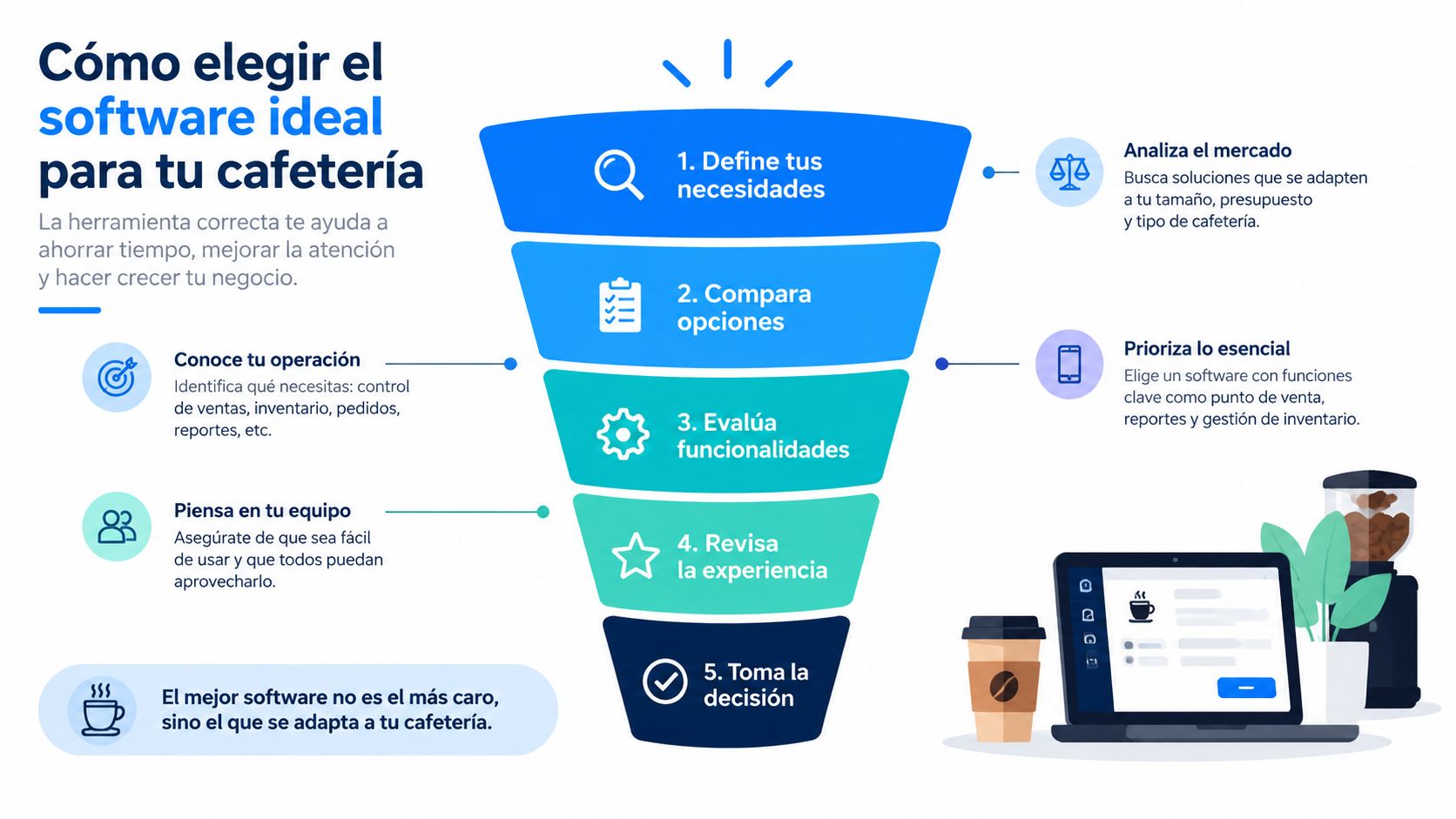
The choice can be narrowed down to three variables: number of locations, daily tickets, and primary goal. A single-location coffee shop does not need the same system as a chain with multiple points of sale and independent campaigns.
First filter: number of locations
A single location allows prioritizing simplicity, speed at checkout, and low cost. The coffee shop should look for a tool that captures customers without adding work to the staff and that activates a basic welcome, reward, and reactivation flow.
With multiple locations, segmentation is no longer optional. The operation needs to separate customers by location, transfer histories correctly, and compare results between points of sale. A campaign that works in a corporate zone might fail in a residential zone, even with the same offer.
Second filter: volume and goal
Daily volume determines how much manual operation can be tolerated. A single-location coffee shop with fewer than 300 daily tickets can prioritize simple implementation. A chain of 3 to 5 locations with more than 1,000 daily tickets needs scalability, POS integration, per-location permissions, and campaign attribution. These thresholds serve to guide the decision, they do not represent a universal market rule.
The objective also changes the platform choice:
Repeat business: choose loyalty by visits, inactivity automations, and frequency segmentation.
Average ticket: choose recommendations, smart coupons, and campaigns to add products.
Chain operation: choose multi-location control, comparable dashboards, and centralized management.
Dominant digital sales: choose a platform that connects e-commerce, memberships, and automated communication.
Three questions before signing
The provider must answer directly:
Does it measure ROI per campaign and per location?
Does it segment by location, time, frequency, and ticket?
Does it send via native WhatsApp without charging unexpected fees per message?
If the provider does not demonstrate ROI during the demo, it is not retention software. It is email marketing with a prettier interface.
The golden rule is simple. The coffee shop must buy the system that converts a purchase into a measurable next action, not the one that promises the most features in a presentation slide.
Action plan to start retaining customers this week
A coffee shop can activate a measurable strategy in less than 30 days if it avoids launching too many campaigns at once. The order matters: first, the data is cleaned; then, the mechanics are defined; and finally, you test which channel generates recovered sales.
Days 1 to 3: organize the database
The team must audit the current POS database, remove duplicates, and check phone numbers, emails, and locations. They must also define at least three initial segments, for example, morning customers, afternoon students, and weekend visitors.
It is not advisable to create a dozen groups from day one. Three clear segments allow detecting errors and seeing if an offer makes sense for each group's actual behavior.
Days 4 to 7: activate a simple mechanic
The program should start with a rule that is easy to explain and operate. "Every 9 coffees, the 10th is free" works as an example because the customer understands the reward and the staff can communicate it at the register.
The automated welcome via WhatsApp must explain how to participate, what purchase advances progress, and when the reward can be used. The message must not include an indiscriminate promotion for the entire database. It must mark the beginning of a measurable relationship.
Week 2: test recovery and recognition
Two automations should be launched in parallel:
Inactive customers: contact those who have not visited for more than 21 days, with a limited-time coupon. The coffee shop must measure recovered visits and revenue, not just deliveries.
High-value customers: reward the top 10% with a surprise benefit. The goal is to recognize frequency or ticket size without giving away margin to the entire database.
Segmentation must be maintained by location. If a campaign recovers customers at one location but not another, the result must open an operational question, not trigger a misleading average.
Week 3: capture consent and connect channels
The coffee shop must add short forms to capture email and consent, sync WhatsApp, push, and email, and clean the records once again. An email subject line A/B test can compare two ways of presenting the same campaign, always with a single variable modified.
Checkout staff need a short script. Asking for details should take little time and explain the benefit clearly. A large database without consent or context is useless for building sustainable retention.
Week 4: measure and document
The weekly dashboard must compare average ticket, frequency, and reactivation rate against the baseline defined before launch. It must also show which location, segment, and channel produced each attributed sale.
The campaign budget must move toward the channel with the best attribution, not the one that generated the most messages sent. The coffee shop must document learnings, exclude customers who have already purchased, and adjust inactivity windows when data justifies it.
Measuring ROI from day one is the only way to know if the chosen software delivers. If the platform does not connect campaign, customer, location, and revenue, the owner will keep seeing activity but won't know if the program is growing the business.
Swirvle offers an all-in-one CRM with location segmentation, configurable loyalty, WhatsApp, push, and email automations, as well as dashboards to attribute sales and measure ROI. To turn a coffee shop's visits into measurable repeat business, it is worth learning how Swirvle works and requesting a demo focused on POS, campaigns, and results per location.
Related Blogs

Sep 16, 2026
How to organize a private coffee tasting: a practical guide

Sep 14, 2026
How to optimize Google Business Profile for barber shops

Sep 13, 2026
The best customer retention software for coffee shops

Sep 12, 2026
Cómo optimizar Google Business Profile para restaurantes

Sep 11, 2026
Cómo optimizar Google Business Profile para cafeterías

Sep 10, 2026
Mejor programa de lealtad para negocios en latinoamérica
Try Swirvle for free
No card required · 30 days free
Start your free trial