
How to calculate your coffee shop's gross and net margins, which costs reduce them the most, and strategies to increase them without losing customers.
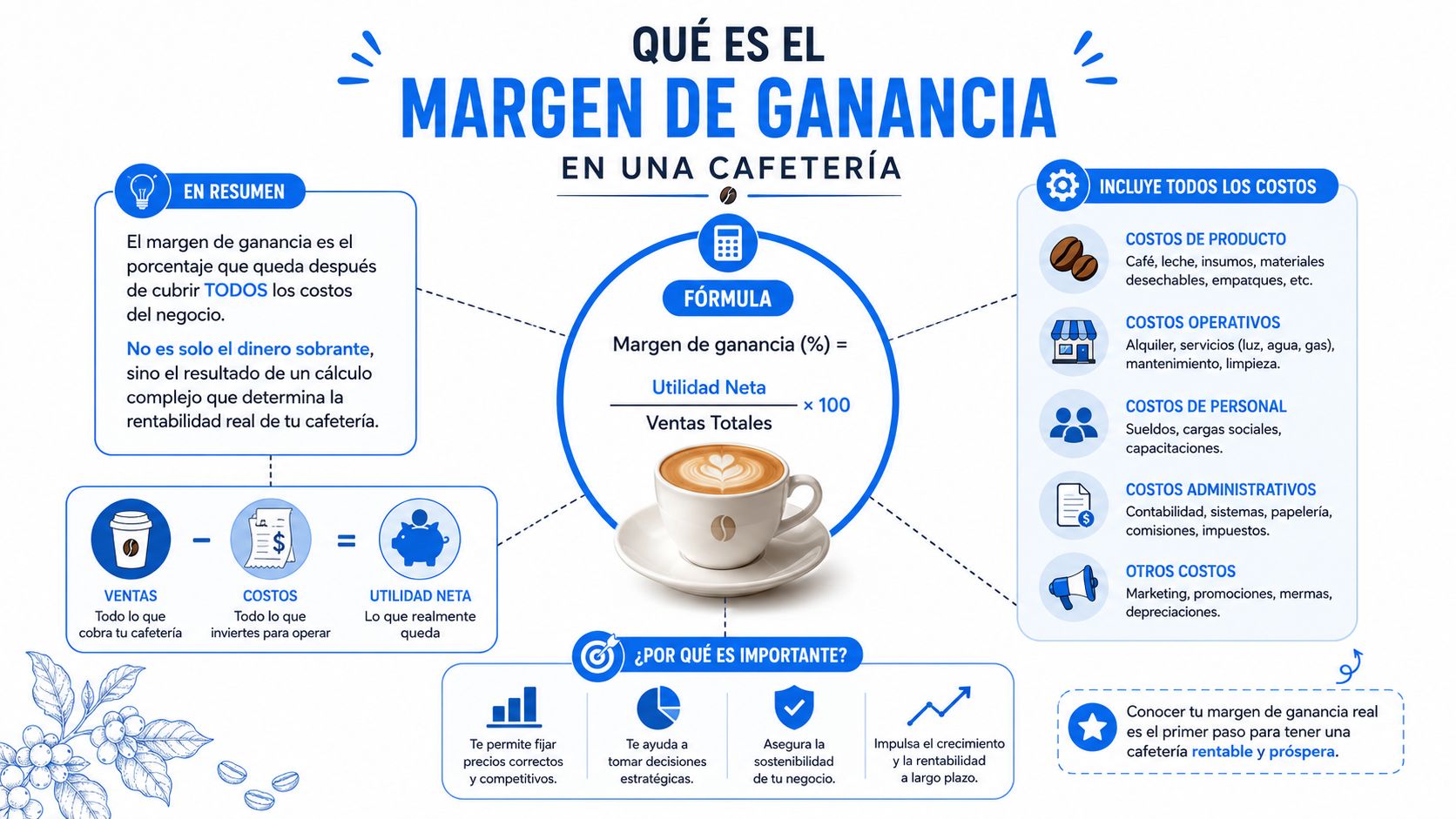
In a coffee shop, the ideal margin is not a fixed number: it depends on your price, your recipe, and your expenses. The sound approach is to calculate the gross margin of each beverage and then confirm that the net margin—factoring in rent, payroll, waste, and visit frequency—leaves real profit. If the business fails to convert that percentage into sufficient absolute profit, an attractive margin only serves to decorate the spreadsheet.
The most common trap in this business is believing that selling coffee “leaves a lot” by definition. Yes, the product's structure helps, because in a properly costed beverage, direct ingredients are a minor part of the sales price, but a shop doesn't cover its operations with foam or promises; it pays for them with real cash flow, repeat business, and fine-tuned cost control.
What profit margin means in a coffee shop
The profit margin in a coffee shop is not a single figure. If everything is blended into a single percentage, prices end up miscalculated. The gross margin shows what remains after paying for the direct ingredients of each drink or food item. The net margin shows what actually remains after rent, payroll, utilities, waste, and other expenses that occur each month.
Wide glass, narrow pipe
The correct interpretation is straightforward. The gross margin marks the room left by each sale. The net margin is what reaches closing time, after the operation absorbs its share. A large glass doesn't guarantee more money if the pipe leaks too much.
The gross margin of a drink depends on how much coffee, milk, and add-ons weigh in its sale price. Calculate it using your actual recipe, but take it only as a technical floor, not as a guarantee of profit.
The point that many owners overlook is volume. A high gross margin might look solid on the menu and still fall short if the coffee shop is in a shopping plaza with heavy rent and low foot traffic, as often happens in various parts of Yucatán compared to a higher-traffic operation in Monterrey. The difference isn't in the pretty percentage, but in how many cups it sells per day and how much of that survives after covering fixed costs.
Rule of thumb: a high gross margin does not fix heavy rent, inflated payroll, or disorganized operations. It only provides room for the business to balance the rest of the books properly.
What you should review before setting prices
Before touching a menu, it is advisable to answer five questions in order:
What does it cost to serve the cup? Direct costs must be separated from overhead expenses.
What percentage goes into operations? Rent, payroll, and utilities are still there even if the product sells well.
What drives more revenue, volume or ticket size? A drink can seem profitable yet bring in very little total money.
How much is wasted? Shrinkage and waste eat away at margins without the customer ever seeing it.
How often do customers return? Without repeat visits, the business relies on attracting new people all the time.
If a coffee shop doesn't distinguish between price, direct cost, and operating expenses, it ends up celebrating the wrong percentage. And in this business, the wrong percentage usually hides a very small profit.
How to calculate your coffee shop's margin step by step
A high gross margin might look good on the menu and still leave little cash at the end of the month. In a coffee shop, the right evaluation starts with a single calculation and ends with three layers: direct cost, fixed expenses, and sales volume.
The base formula remains simple: Margin = profit / sale price. To apply it properly, first isolate the beverage's direct cost, then calculate the gross profit, and finally check how much of that amount survives once rent, payroll, utilities, and waste enter the picture.
A real-world example with a cup in Mexico
If a cup sells for $65 MXN and its direct cost is $18 MXN, the gross profit is $47 MXN. That yields a 72% gross margin. The number looks strong on paper, but it still doesn't answer the question that matters: how much net profit remains after operating the shop?
That is where the critical point emerges. A coffee shop can have a high gross margin and still close with a small profit if the volume isn't enough to absorb fixed costs. In Monterrey, a more consistent flow of customers can better support that percentage than in a plaza with lower foot traffic. In Yucatán, higher rent or less favorable seasonality can make the very same margin misleading.
Margin calculation by product type in a Mexican coffee shop | ||||
|---|---|---|---|---|
Product | Sale price | Direct cost | Gross margin | Gross margin % |
Americano coffee | $65 MXN | $18 MXN | $47 MXN | 72% |
Milk-based beverage | Varies by recipe | Varies by recipe | Variable | Variable |
Combo product | Varies by menu | Varies by menu | Variable | Variable |
How to read the right number
A useful calculation doesn't end with an individual drink. A menu might include high-margin beverages alongside food items governed by a different logic, so it is wise to analyze the business on three levels.
Margin by product: shows whether each cup leaves real breathing room between price and cost.
Margin by category: lets you see whether beverages, food, or add-ons are sustaining operations.
Shop's net margin: reveals what remains after paying for the entire cost structure.
To measure food items with the same financial discipline, it helps to follow a methodology on how to calculate the cost of a dish. The logic is the same: properly separated costs, properly interpreted prices, and profit reviewed against total operations.
Audit benchmark: if the margin per product seems solid but the business isn't generating cash, the problem is rarely in the cup. It is usually in the volume, the rent, or the cost structure.
The five costs that eat your margin
An attractive gross margin can vanish across five very specific areas. In coffee shops across Mexico and LATAM, these leaks usually appear in supplies, labor, rent, utilities, and waste. The correct evaluation isn't “how much do I make per drink,” but “how much of that margin survives month-end.”
Where the money goes in operations
The first drain is in supplies. The price of coffee isn't fixed, and when bean costs rise or add-ons change, the margin compresses before the customer even notices. The second hit comes from labor, because bar service requires time, coordination, and coverage during peak hours.
Rent defines much of the profitability floor. In a high-traffic plaza in Mexico City or Monterrey, a location can absorb far more than a small spot on the outskirts. In tourist areas of Yucatán or Puebla, the weight of the lease can strain the equation even further if foot traffic falls short.
Utilities and waste seem minor at first glance, but they disrupt operations when they accumulate. Electricity, water, internet, and losses from preparation or poorly controlled inventory end up slashing the money that seemed available.
Ingredient yield matters more than it seems
A kilogram of coffee can yield between 100 and 120 cups; if the kilo costs 200 pesos, the base cost per cup is around 2 pesos before milk, cream, or other additions El Economista. That benchmark helps explain why yield per kilo is an underestimated lever.
A useful reference for an owner is to examine whether the shop is buying expensive, over-serving, or losing product due to poor dosing. The same gram of coffee can act as profitability or as a leak, depending on operational discipline.
This analysis on how cost of goods sold is determined serves as a guide for separating purchasing, inventory, and the actual cost of operations.
Real-world net profit scenarios in Mexico
A pretty margin doesn't pay payroll. What pays for the business is net profit and, above all, the volume that sustains it each month. In a small coffee shop, this point changes completely between Yucatán, Puebla, Monterrey, or Mexico City, because traffic, rent, and average ticket size do not behave the same way.
Three very different readings of the same business
A small coffee shop in Yucatán can yield a net profit of 9,200 MXN per month in a low scenario. In well-located and well-managed businesses, Coffee Solutions identifies much broader outcomes, from 6,000 to 80,000 MXN monthly. The gap between those cases isn't defined by the percentage; it is defined by the actual volume of sales coming through the door.
In a mid-sized business in the State of Mexico or Puebla, an orderly operation can push profit into an intermediate range if customer traffic sustains the register. In a premium shop in Nuevo León or Mexico City, profit can climb higher when location, average ticket, and turnover work in its favor. The same coffee, served with different demand, leaves a different result.
Ideal margin does not mean sufficient profit
A good net margin might look healthy on paper. If the shop sells little, that percentage won't be enough to sustain the life of the business or the owner's retirement. On the other hand, with high traffic and steady ticket sizes, that same margin can indeed turn into useful cash.
The barrier to entry also changes the goal. It doesn't cost the same to open a cart or small counter as it does a full shop with a kitchen, seating, and a complete espresso setup. That difference requires different volumes to recover the investment and sustain operations.
A high gross margin might seem strong, but in Yucatán it doesn't work the same as in Monterrey if the shop doesn't sell enough. The driving variable is how many actual cups are sold each day, not the isolated percentage.
The right question isn't “what margin looks good?” The question is “how much do I need to sell for that margin to let me make a living from the coffee shop?”
Actionable strategies to improve your margin
Raising your margin doesn't rely on a single lever. It depends on moving several pieces at once, but systematically. In coffee shops, the typical mistake is starting with discounts or promotions without reviewing actual prices, sales mix, or visit frequency.
Price first, then the rest
The first adjustment is sale price. If actual costs are already measured, the menu can absorb a moderate increase when the value proposition supports it. A 5-peso change on a latte can turn into a material improvement in monthly revenue, provided the customer perceives consistency among price, flavor, and service.
The second lever is menu engineering. Not all drinks drive profit equally, so it pays to visually highlight the items that provide a better contribution. The menu shouldn't be a catalog; it should function as a sales board.
Control, upselling, and retention
Waste and bean yield: controlling gram weight, calibration, and portioning prevents direct costs from inflating without warning.
Upselling and cross-selling: offering sizes, pastries, or milk alternatives raises the value of each visit without overhauling the entire operation.
Purchase frequency: a customer who returns more often makes any unit margin more effective, because the business earns more times from the same base.
Smart retention: incentives should reward repeat visits, not aggressive discounts that condition customers to pay less.
Tracking by location: when multiple stores sell differently, each one needs its own price and category adjustments.
A tool featuring CRM and loyalty can help streamline this commercial side, because it centralizes customer data, segments habits, and enables campaign tracking by location. Under that type of framework, a business can trigger different promotions based on behavior, rather than intuition.
The logic of a POS with a loyalty program for coffee shops fits right in there, where margin depends just as much on the average ticket as it does on repeat visits.
How a CRM with loyalty like Swirvle protects and boosts your margin
A CRM with a loyalty program doesn't fix a bad recipe or excessive rent, but it does target two variables that drive net margin: average ticket and purchase frequency. In coffee shops, that matters more than it seems, because real profit comes from compounding visits, not just closing good individual receipts.
What it does with customer behavior
A shop in Baja California or Monterrey can use smart coupons via WhatsApp (Premium plan) to win back customers who haven't visited in days. It can also segment by location to identify those who only buy basic drip coffee and encourage them toward a fuller combo. The logic is simple: sell better to the same customer instead of always relying on new foot traffic.
Swirvle, as an example of this approach, centralizes customer data, enables segmentation by habits and branch location, and runs campaigns via WhatsApp (Premium plan), push notifications, and email with automations for welcomes, win-backs, birthdays, and seasonality. Its value here is not about “doing more marketing,” but providing visibility into which campaign is driving sales and what portion of revenue comes from existing customers.
What to automate without overcomplicating things
Welcome: triggers a second purchase shortly after sign-up.
Lapsed customer recovery: re-engages guests who stopped visiting.
Birthdays: creates a simple reason to return to the shop.
Seasonal campaigns: highlights drinks or combos on high-intent dates.
Points or visits: rewards repeat business instead of sacrificing margins with flat discounts.
If loyalty lifts ticket size and frequency, the math changes quickly. There's no need to promise miracles; what's needed is for each customer to spend a little better and visit a little more often. That is the point where technology stops being a vanity expense and starts protecting profit. That is why it makes sense to have a point of sale with loyalty for your coffee shop: points are earned at checkout, without needing to run a separate system.
Key metrics every owner should track
Margins are managed through numbers reviewed consistently, not through month-end gut feelings. A well-organized Monday can prevent weeks of blind decisions. If a shop doesn't measure, it ends up running on guesswork.
The five must-have metrics
Ingredient cost per product: calculated as direct cost divided by sale price. It should be reviewed weekly to catch deviations in recipes, waste, or purchasing.
Gross margin by category: shows which product line provides the most financial breathing room. It is best reviewed weekly and compared across beverages, food, and add-ons.
Average ticket: obtained by dividing total sales by the number of tickets. A higher ticket usually eases the burden of overhead.
Visit frequency per customer: indicates how often the loyal customer base returns. Improved frequency sustains revenue without relying as heavily on new customer acquisition.
Sales attributable to loyalty campaigns: lets you know what portion of revenue came from specific actions rather than incidental walk-ins.
What the owner should look for on the dashboard
A dashboard doesn't need to be sophisticated to be useful. It can live in a spreadsheet, as long as it shows trends and not just a single snapshot. What matters is that the owner can see when the average ticket drops, when waste spikes, and when a campaign actually moves the needle at the register.
If a coffee shop reviews these five metrics every week, it stops debating pretty percentages and starts managing real profit.
Frequently asked questions
How do you calculate a coffee shop's profit margin?
Subtract the direct cost of the drink from its sale price and divide the result by the sale price. For example, a $65 MXN cup with an $18 MXN cost leaves $47 MXN, a 72% gross margin.
What is the difference between gross margin and net margin?
Gross margin only deducts the direct ingredients of each product. Net margin also subtracts rent, payroll, utilities, waste, and other expenses—it represents what actually remains at the end of the month.
Why does my coffee shop sell a lot but make little profit?
Typically due to high fixed costs, uncontrolled waste, recipes that aren't followed, or outdated pricing. Check the true cost of each recipe and how much rent and payroll weigh against your total sales.
How can I improve margins without raising prices?
Control portions and waste, promote complementary products with good margins, and get your frequent customers to return more often. A well-measured loyalty program helps drive more sales without relying on discounts.
Swirvle centralizes customers, segments by branch location and consumption habits, and allows you to track which campaigns actually move sales and visit frequency. For a coffee shop looking to protect margins rather than just increase sales volume, this kind of control transforms the financial conversation. It is worth exploring how it works at Swirvle and seeing if it fits your shop's daily operations.
Related Blogs

Nov 22, 2026
How to identify frequent customers in a physical store?

Nov 21, 2026
How to Connect Your POS System with Restaurant Email Marketing: A Guide

Nov 20, 2026
How much does a small restaurant make per month in Mexico?

Nov 19, 2026
How to Run a Small Coffee Shop Step by Step? 2026

Nov 18, 2026
How can you check out customers faster in a coffee shop during peak hours?

Nov 17, 2026
How to create a loyalty program for a clothing store or boutique?