
How to set up a WhatsApp loyalty program for my business? Learn step-by-step how to set up a WhatsApp loyalty program
WhatsApp is the messaging application most used by people with internet in Mexico. To build a loyalty program that generates sales, the business must convert that reach into an omnichannel retention system, not a broadcast list.
The difference matters. A list sends coupons and waits for responses; a loyalty architecture records a purchase, identifies the customer, calculates a reward, communicates the next best step, and attributes the redemption to the generated revenue. It also documents consent, separates transactional messages from promotions, and offers an immediate opt-out. Without these controls, the channel may attract attention for a while, but it ends up accumulating opt-outs, complaints, and rewards that are difficult to reconcile with the cash register.
Why WhatsApp is the channel that really matters for loyalty
The reach of WhatsApp changes the question. It is no longer about whether a business should "do WhatsApp marketing," but how to connect a digital interaction with a physical visit, a repeat purchase, and a profitable reward. For many customers, it is already the most natural way to write to a business, ask about an order, or confirm an appointment.
That reach does not convert on its own. A coffee shop can have many contacts and zero incremental sales if it sends the same coupon to everyone. A restaurant can get quick responses but lose margin if it offers discounts to customers who were already planning to return. A barbershop can remind of an appointment but damage trust if it mixes that notification with unauthorized advertising.
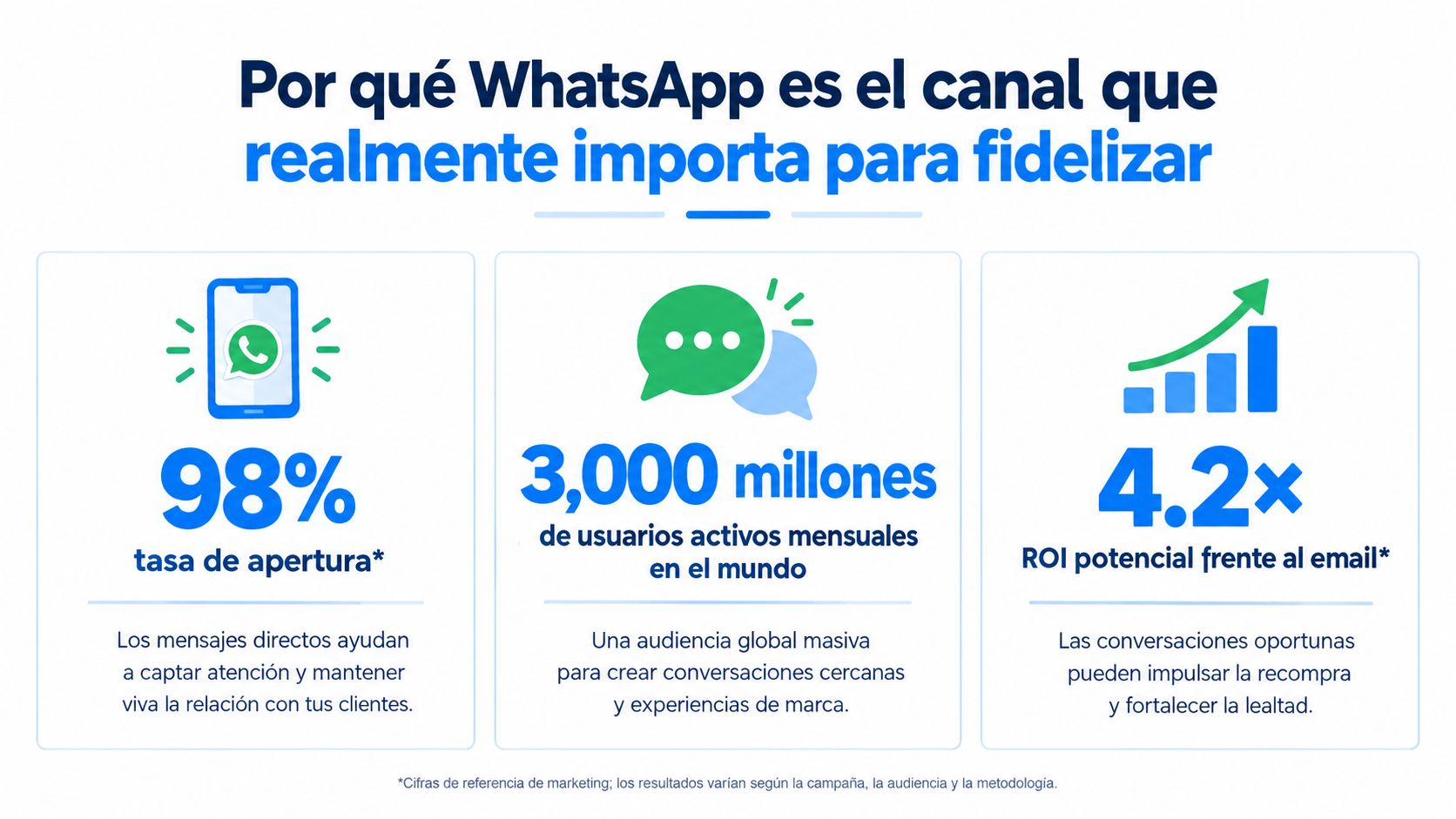
The 18th Study on the Habits of Internet Users in Mexico 2022, cited by the INAI, reported that WhatsApp was used by 87.9% of internet users with an active account, above Facebook with 83.1%, and YouTube with 41.6%. The same study indicated that 63.3% used WhatsApp for video calls during the analyzed year, a sign that the application was already part of frequent communication activities (habits of internet users in Mexico).
The difference between broadcast and retention
A broadcast list responds to a volume logic. A loyalty program responds to an event logic:
Broadcast: the same message is sent to a broad audience.
Activation: a purchase or visit triggers a relevant action.
Service: the customer checks their balance, validity, or reward.
Attribution: the POS records if the benefit produced a purchase and with what margin.
Before the first send, the business needs a unique identifier per customer, a reliable source of purchases, a reward rule, and evidence of consent. It also needs to know when to exclude a person, how to register an opt-out, and who handles a human request. To delve deeper into the relationship between experience and recurrence, it is useful to review resources on how to build customer loyalty, provided that the recommendation translates into measurable processes and not just polite messages.
The program can start with a simple rule, such as a reward after several visits, but it must grow on data of location, category purchased, frequency, and date of last visit. Messaging activates the relationship; CRM preserves the commercial memory. A practical guide on bulk messages on WhatsApp can serve to understand the channel, but the goal must be to segment, not to multiply sends.
Operational rule: WhatsApp opens the conversation. The CRM, POS, and consent rules determine if that conversation produces profit.
Technical architecture from the purchase event to the CRM
The correct flow starts at the checkout, not on the campaign calendar. Each purchase or visit must become an event with enough data to decide which message corresponds and what reward can be offered without destroying the margin.
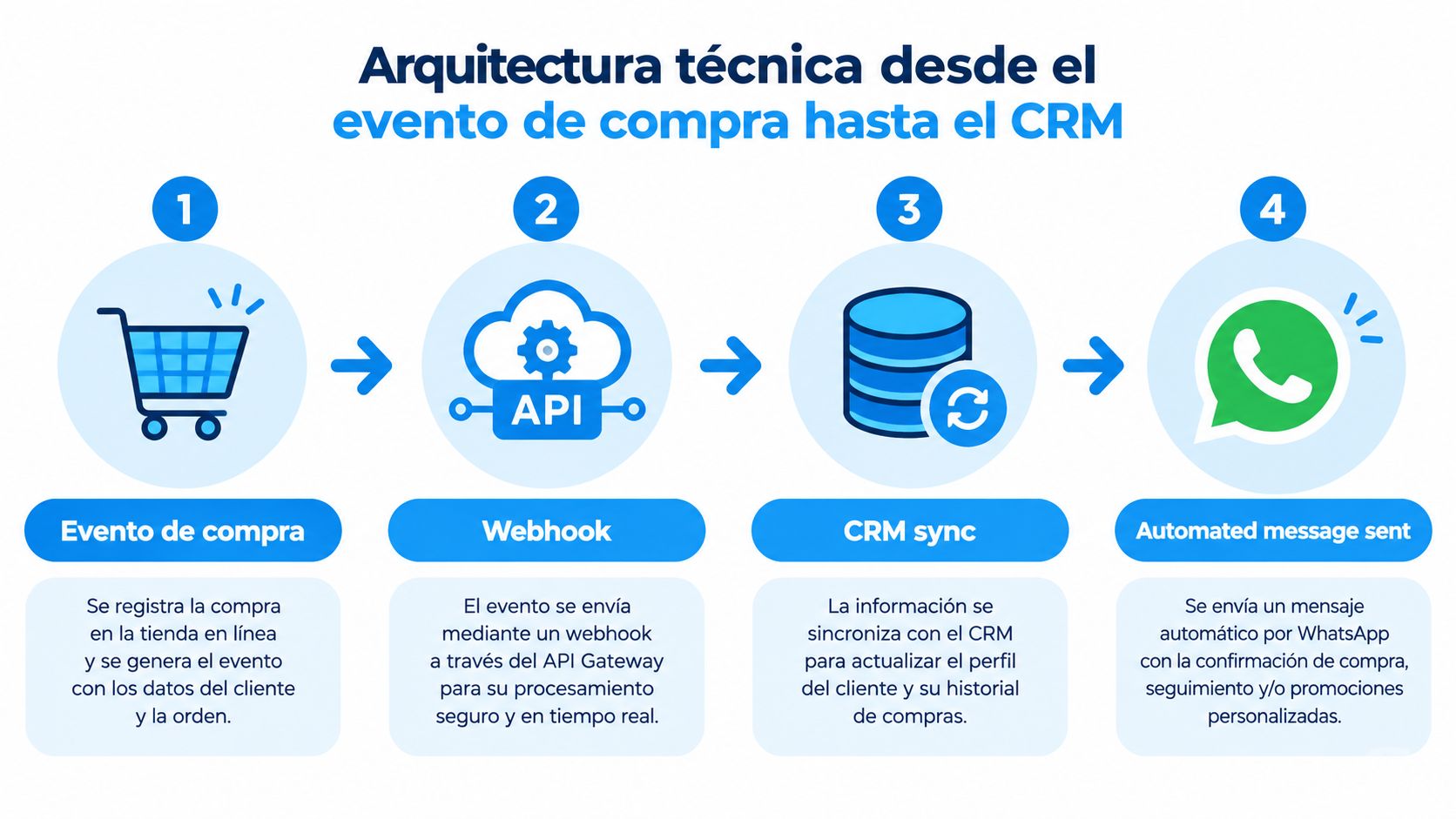
The architecture can be organized as follows:
Consent capture: at checkout, the customer scans a QR, registers their number from a form, or activates enrollment from the receipt. The business preserves the date, channel, purpose, and version of the accepted privacy policy.
Event registration: the POS sends the purchase or visit with phone number, branch, category, amount, frequency, and date of last purchase. If the number does not match a profile, the system creates a profile pending validation.
Unique identifier: each person receives an internal identifier that avoids duplicating accounts when purchasing at different locations or changing the contact point.
Segmentation: rules separate new, frequent, inactive customers, buyers of a specific category, or members who have already redeemed a reward.
Approved message: a template initiated by the business communicates the benefit, shows an action button, and clearly distinguishes whether it is a transactional notification or a promotion.
Redemption and synchronization: the customer presents the coupon or balance at checkout; the POS records the redemption, deducts the reward, and updates the profile, history, and attribution.
The synchronization must account for retries. If a connection fails and the system processes the same event twice, a coffee shop could deliver two rewards for one purchase. An event key, a redemption status, and a daily reconciliation with the cash register reduce this risk.
For businesses capturing contacts from their site, WhatsApp buttons on the website can make it easier to start a conversation, but they do not replace documented consent or CRM integration. Connecting events and conversions requires a more complete logic than a button, such as the one described in the integration of conversion data with WhatsApp.
Define contact windows and frequency limits from day one. After a purchase, the system can temporarily exclude the customer from a reactivation campaign. After an opt-out, it must block all promotions, even if the profile retains the minimum history necessary to avoid new sends. For inactive customers who have not opted out, see how to write a WhatsApp message to win back a customer.
Types of rewards according to the margin and frequency of each sector
The right reward depends on two variables: how long it takes the customer to return and what margin remains after the benefit. Points are flexible, visits are easy to understand, and coupons are direct, but no mechanic works the same for a coffee shop, a barbershop, and a restaurant.
The EY study on loyalty programs in Latin America 2025 reports that 87% would switch brands for better rewards, 90% prioritize tangible benefits, and approximately half value choosing their own rewards. The conclusion is not to give away more. A permanent discount can increase program usage while reducing margin and attracting customers who only buy when there is a promotion.
Type of business | Recommended reward | Key advantage | Risk to watch |
|---|---|---|---|
Coffee shop | Benefit on the sixth visit, such as a product or cost-controlled add-on | Reinforces frequency without discounting every purchase | Delivering the reward before validating unique visits |
Barbershop | Benefit for the second visit within a defined period | Reduces churn after the first service | Rewarding visits that would have occurred anyway |
Restaurant | Reward associated with a specific category or bundle purchased | Allows protecting the margin and increasing order value | Applying the benefit to low-margin products |
Beauty salon | Eligible benefit among services or add-ons | Aligns the reward with real preferences | Creating too many options that are difficult to operate |
How to choose without giving away margin
In a coffee shop, a reward after five purchases can be more sustainable than a discount on every receipt. The business can choose an extra, an add-on, or a product whose cost is controlled. In a barbershop, the goal may be to activate the second visit within the usual interval, rather than giving points indefinitely. In a restaurant, it is advisable to test a reward conditioned on a category or a combination that increases the ticket.
The calculation must start with the incremental profit per customer. The cost of the reward, messaging, and operations is subtracted from the additional profit attributed to exposed customers, and the result is compared against non-exposed customers. Redemption is a sign of usage, not proof of causality.
An attractive reward that does not cover its cost is a promotion, not a profitable loyalty program.
Personalization can also be simple. A customer can choose between an extra, a drink, or a benefit on their next visit, provided each alternative has a defined maximum cost. The smart coupons platform can support eligibility rules, expiration, single use, and attribution without turning control into a manual task.
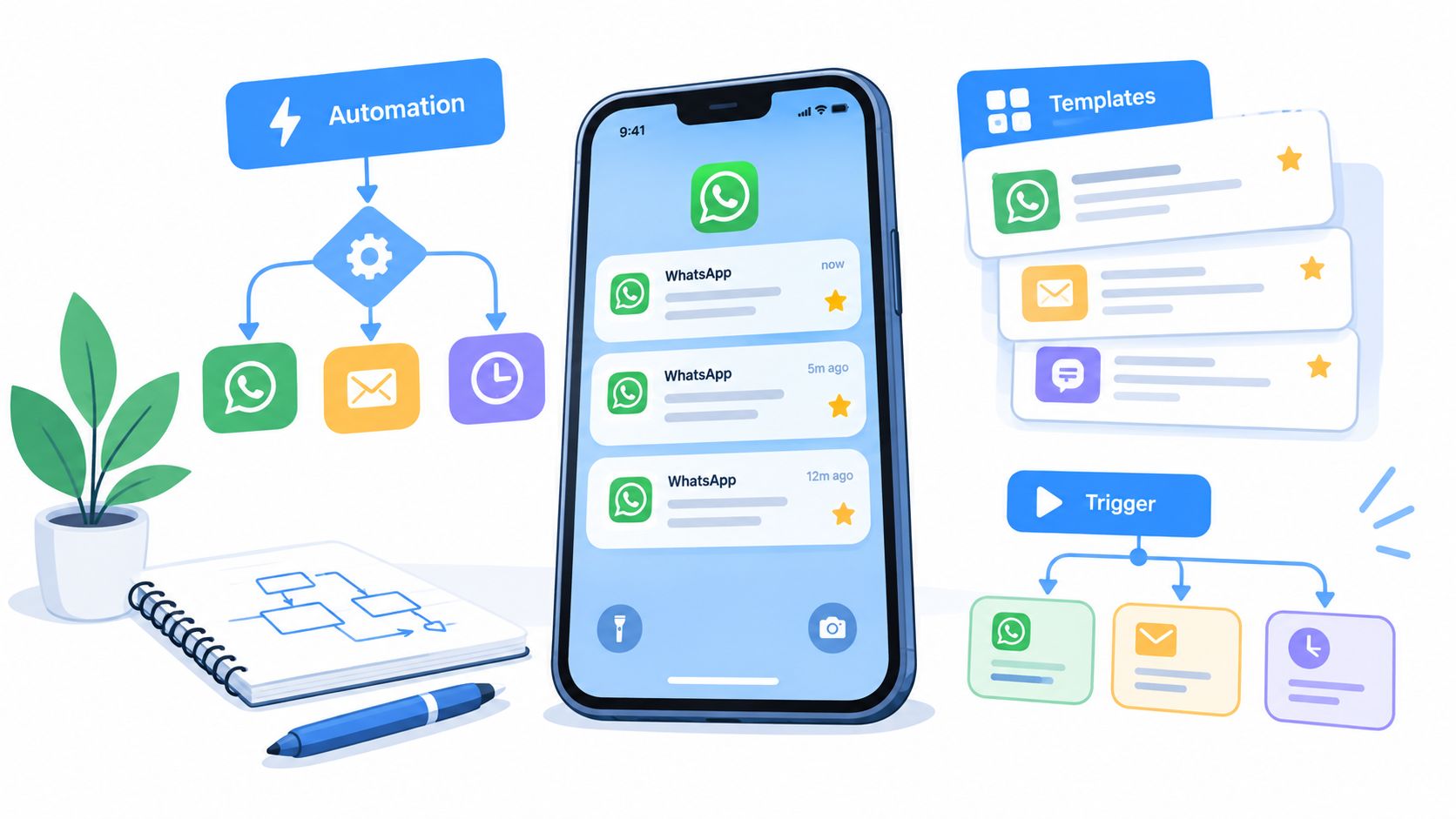
Templates and automated flows ready to use
Irrelevant programs usually fail due to the message, not the idea. In Mexico, 89% of companies claim to have a loyalty program, but only 54% of consumers consider it relevant or useful; additionally, 59% expect real financial benefits, such as discounts or exclusive promotions (perception of utility of loyalty programs). Communication must put the benefit first and ask for a concrete action.
Coffee shop, registration and first reward
Trigger: first purchase with confirmed promotional consent.
Message:
Your first visit is registered! Accumulate visits and receive a benefit on your next reward. Tap "Check balance" to see your progress. To stop receiving promotions, reply "STOP".
Buttons: "Check balance", "View rules", "STOP".
The transactional message confirms the registration. The promotion can come later, in a separate template and only to those who accepted that purpose. The branch and category purchased prevent the customer from receiving an offer for a product they never consume.
Barbershop, recurrence reminder
Trigger: date of last visit and segment of customers who usually return before the next cut.
Message:
Your benefit for your next visit is available. Book with the barbershop and use it before its expiration date. Tap "Book" to request a time. If you do not want to receive promotions, reply "STOP".
Buttons: "Book", "View benefit", "STOP".
The reminder should be treated as a promotion if it includes a reward. A confirmation of an appointment, on the other hand, is transactional and must be kept separate. That distinction prevents a person who only wants to confirm their schedule from receiving a chain of offers.
Restaurant, reward by category
Trigger: purchase of an eligible category and sufficient balance for the benefit.
Message:
Your purchase activated a reward for your next visit. Choose an eligible add-on and redeem it at the selected location. Tap "Choose benefit". To stop receiving promotions, reply "STOP".
Buttons: "Choose benefit", "See locations", "STOP".
The automation must validate location, expiration, single use, and redemption status before showing the benefit. If the POS does not confirm the redemption, the CRM should not mark it as used. This reconciliation prevents the customer and the business from seeing different balances.
Consent, ARCO, and opting out of the program
Most guides explain how to send coupons. Few explain how to prove that the customer agreed to receive marketing, how to distinguish a service notice from a promotion, or how to handle an opt-out and ARCO rights. This omission turns a phone number given to pay or receive a receipt into a marketing authorization that does not exist.
The INAI guide indicates that consent can be obtained through electronic means when it allows clearly demonstrating that it was granted, and requires informing about the processing of personal data (INAI's practical guide on rights and consent). For sensitive, property, or financial data, express consent is required. WhatsApp should not be used to request financial information or confidential data.
What the checkout must record
Registration must separate purposes. Receiving purchase confirmations is not equivalent to accepting promotions. The form, QR, or conversational flow must preserve:
Identity of the controller: name of the business and contact channel.
Promotional purpose: specific authorization for loyalty campaigns.
Evidence: date, time, channel, and version of the simplified privacy notice.
Minimum data: phone, branch, purchases, and necessary preferences.
Visible exit: immediate instruction to reply "STOP".
Support: route for human queries and ARCO requests.
The privacy notice must explain the options to limit use and the mechanisms to exercise the corresponding rights. The business must keep a minimum record of objection, such as date, channel, and deletion status, without reusing it for marketing.
Separated messages and automatic exclusion
A transactional message confirms a purchase, a redemption, or an appointment. A promotional message seeks to activate a future purchase. The system must store the purpose of each template and automatically exclude the customer when they request not to receive campaigns.
Opting out does not erase traceability. It stops marketing and retains only the record necessary to avoid contacting the person again.
Sending promotions without opt-in, ignoring an opt-out, or persisting after a complaint does not show growth. It shows that the business does not control its channel. Trust becomes an operational advantage when the customer understands what they will receive and can stop it without friction.
12-week controlled trial and calculation of real ROI
A loyalty program needs a test, not an intuition. EY's research for Latin America, which included consumers and marketing executives in Mexico, found that 82% believe that loyalty programs influence their level of spending, with 62% reporting some influence and 20% a major influence. For companies, retention is the primary reason for implementation, with 75%, followed by increasing customer margin, with 50%.
The test can last between 8 and 12 weeks, depending on the purchase cycle. It must include three comparable cohorts:
Control: receives operational communication, but not a loyalty incentive.
Points per purchase: accumulates balance based on verified purchases.
Reward per visit: receives a benefit after reaching the defined rule.
The allocation must consider branch and category purchased. If one branch receives the incentive and another concentrates higher frequency customers, the result will be biased. It is also advisable to keep a cohort of non-enrolled customers to observe if the variation comes from the program or from general changes in demand.
Minimum dashboard
During the experiment, the business must record:
activation, from registration to the first interaction;
conversion to second purchase;
frequency of visits;
average ticket;
incremental margin;
attributed sales;
redemptions, opt-outs, and complaints;
cost of reward, messaging, and operation.
The increment formula is:
uplift = (conversion of the treatment - conversion of the control) / conversion of the control
The decisive result is not open rates. It is the incremental profit per customer minus the cost of reward, messaging, and operation. A coupon can be redeemed because the customer was already going to buy. That is why control is indispensable.
Deciding after the test
If the reward per visit outperforms the points group in incremental margin, the rule should be scaled even if it generates fewer interactions. If both cohorts increase redemptions but neither improves profit compared to the control, the business should reduce the benefit, change eligibility, or stop it. If opt-outs or complaints increase in a segment, the campaign should be paused and reviewed before expanding the reach.
Launch checklist and continuous monitoring
The commercial digitalization of Mexican MSMEs shows a clear opportunity, but also a limitation. According to ECLAC, MSMEs represent around 99% of companies in Latin America and, with data from INEGI, e-commerce already accounted for 5.8% of Mexico's GDP in 2018, according to an academic study on the digitization of MSMEs. Having a digital presence does not guarantee converting it into repeat transactions.
Before activating
Consent: verify that each contact has promotional purpose, date, channel, and notice version.
Data: validate phone, unique identifier, branch, category, frequency, and last purchase.
Templates: separate confirmations, balance, redemptions, and promotions.
POS: test unique coupons, expirations, retries, and reversals.
CRM: confirm event synchronization, segmentation, and attribution.
Opt-out: test "STOP", global exclusion, and human support.
Control: create control, points, and visits cohorts before the first send.
After activating
Daily review should focus on deliveries, replies, integration errors, and duplicate messages. Weekly review should cover redemptions, opt-outs, complaints, cost per incremental purchase, and segments with anomalous behavior. Monthly review should calculate incremental margin, attributed sales, and performance by branch and category.
The business can configure an automatic pause when the opt-out rate exceeds 2%, the complaint rate exceeds 0.5%, or the marginal contribution of redemptions is negative. These conditions are operational rules of the experiment, not universal indicators; each business must document why they chose them and review them with their own data.
If the program fails, the diagnostic should follow the event:
No activations: review consent capture and clarity of the benefit.
There are activations, but no second purchase: review validity, attractiveness, and friction of the redemption.
There are redemptions, but no margin: reduce discount or change the eligible product.
Opt-outs increase: reduce frequency, separate purposes, and review segmentation.
The POS and CRM do not match: stop campaigns and reconcile events before continuing.
Swirvle centralizes CRM, segmentation by habits and branch, points or visit rewards, automatic coupons, and personalized campaigns, including WhatsApp campaigns in the Premium plan. Visit Swirvle to turn this flow into a measurable program, with sales attribution and ROI tracking from a single place.
Related Blogs

Nov 16, 2026
How to manage a coffee shop's inventory day by day?

Nov 15, 2026
Clip vs Mercado Pago: Which terminal is best for your restaurant or coffee shop in 2026?

Nov 14, 2026
Checklist: Your Coffee Shop POS Features (9 Essentials)

Nov 13, 2026
What rewards should you offer in a restaurant loyalty program? 2026

Nov 12, 2026
How to manage clothing store inventory without losing sales? 2026 Guide

Nov 11, 2026
How to Use a CRM with WhatsApp to Keep Customers Coming Back: 2026 Guide