
What does a CRM look like in practice for a coffee shop or restaurant? Check out 6 examples of capture, campaigns, loyalty, automation, and metrics.
A customer orders a latte, shares their phone number at the register, and receives a reward to return. Days later, the business doesn't send them a generic promotion, but rather an offer related to their usual drink and the hours they typically visit the branch. The next purchase is linked to their profile, the point of sale, and the campaign that originated it.
In practice, that answers the question: What does a CRM look like in practice in a coffee shop or restaurant? It does not look like an isolated database. It looks like an operational journey that starts with capturing consent and ends with a decision about recurrence, ticket, margin, or channel. The following six examples show how to connect habits, branches, preferences, and sales in physical businesses in Mexico and LATAM. Swirvle can serve as a reference all-in-one platform for SMBs with physical stores, especially when the CRM must coexist with the point of sale, loyalty, and campaigns.
1. Frequent Customer Management and Loyalty Programs in Coffee Shops
The loyalty program must convert every purchase into an operational signal. For a coffee shop, tracking what the customer bought, when they bought it, and where the transaction occurred makes it possible to distinguish between recurring visits, inactive customers, and redemptions that contribute little margin. The phone number or email identifies the person, but the history explains their behavior.
At the register, staff request consent, capture the phone number, and link the purchase to the branch, time, beverage, modifiers, and amount. The CRM calculates recency, frequency, and monetization, and then triggers specific rules. For example, it can identify someone who visited twice in thirty days and has been absent for fourteen days. The next action would be to try a segmented win-back campaign and compare it to similar customers who did not receive an incentive.

The reward must match the behavior
The available Mexican evidence positively and statistically significantly relates perceived value, satisfaction, and loyalty in customers of a restaurant chain with three branches, according to this analysis on perceived value and restaurant loyalty. For operations, this implies designing relevant benefits and measuring their cost, not distributing discounts without segmentation.
New customers: a simple visit dynamic makes it easy to explain at the register and reduces recording errors.
Frequent customers: a beverage or add-on related to their consumption can preserve margin better than an open discount.
Absent customers: a win-back offer should be measured against a comparable group without an incentive.
The dashboard must show frequency, average ticket, reward cost, redemption, margin, and incremental sales. This way, the manager can separate more redemptions from more profitability, and decide whether to modify the benefit, the segment, or the channel. These examples of loyalty programs for physical coffee shops show how to document mechanics applicable to physical businesses. The final decision is to keep only the rules that produce attributable visits and sufficient margin.
2. Multi-Channel Automated Campaigns in Restaurants
A customer might dine in, write on WhatsApp, and purchase through a delivery platform within the same month. If each channel keeps a separate record, the restaurant cannot distinguish a preference, a repeat visit, or an attributable purchase. The CRM must reconcile these events with consent, phone number, channel, branch, and transaction. Thus, the capture at the register is connected to the message sent and to the sale finally recorded.
The IIEG 2024 Restaurant Survey shows an uneven participation of apps: 29.7% of establishments reported they contributed 5% or less of their revenue in the last month, 27.0% indicated a share of 6% to 25%, and 8.1% indicated a share of 26% to 50%. The same survey recorded that 24.3% of businesses had average orders of $100 or less, while 16.2% reported orders of $200 or more. This data justifies separating campaigns by channel and order size, instead of applying a single offer.
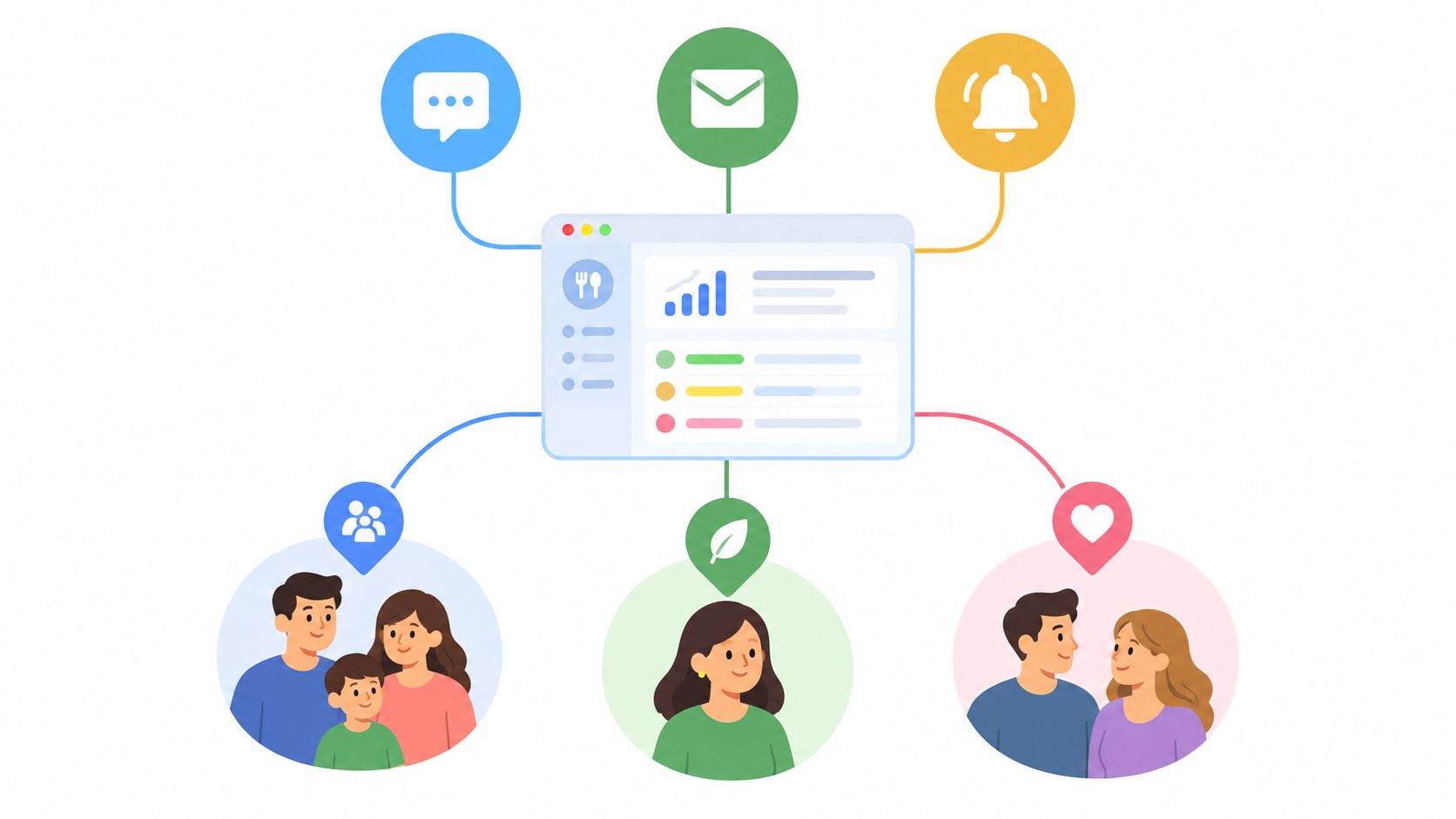
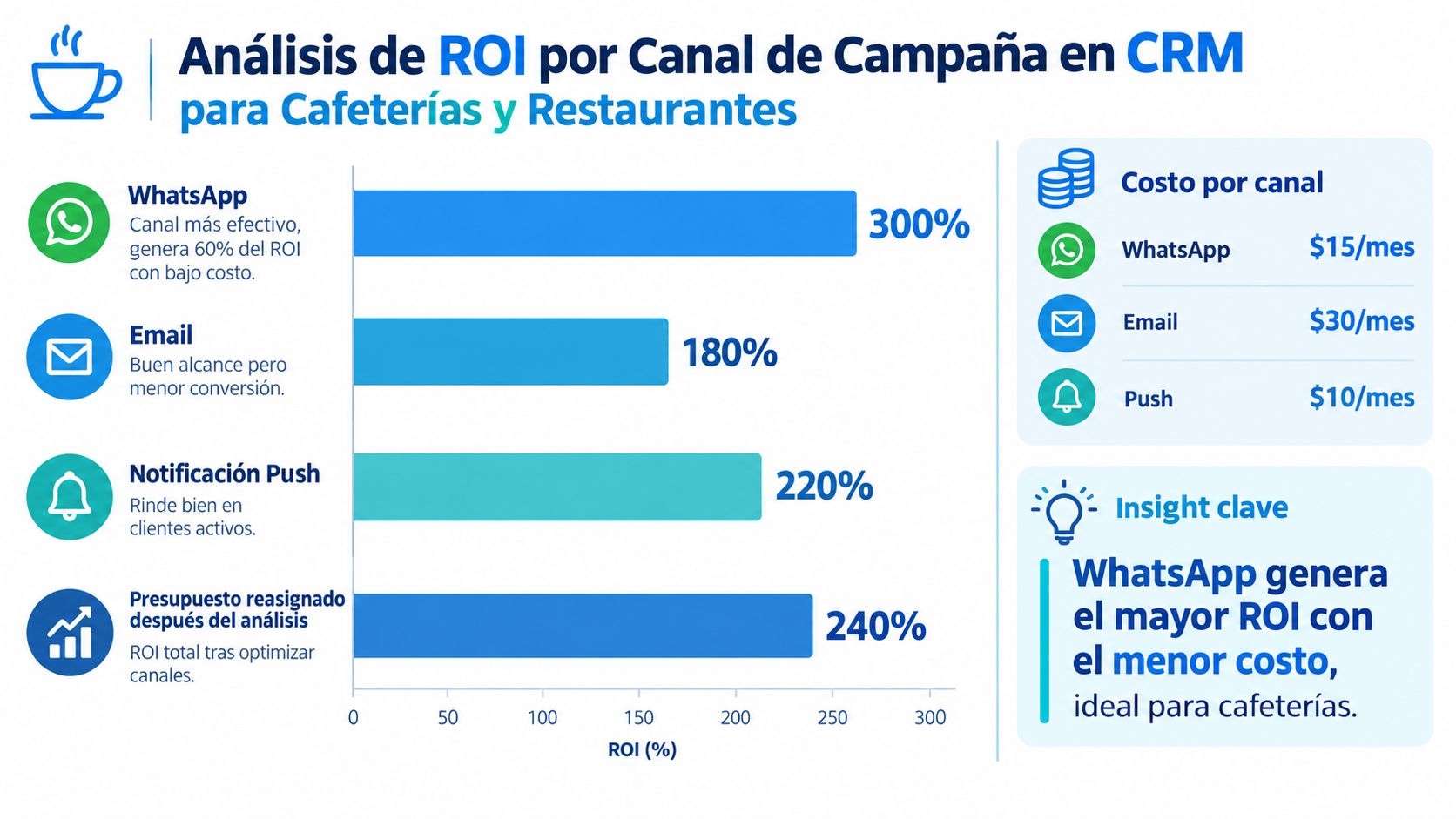
A replicable flow starts with a concrete rule: if a person had a low ticket, they can receive a suggestion for an add-on or a campaign for a second visit. WhatsApp serves to trigger an action close to consumption, with consent. Email allows for broader information about the menu, events, or news. Push notifications require an active digital relationship, while the register and POS must validate the coupon to avoid ambiguous redemptions and facilitate attribution.
The decision is made based on ticket, margin, and recurrence per channel, not the volume of messages sent. The CRM must limit frequency, respect the branch, and define sending windows. An offer to recent customers might subsidize a purchase that would have occurred anyway; a campaign for inactive customers needs a control group. The next step is to review the result by segment and adjust only one variable. The CRM automations for physical businesses describe this flow by connecting segment, message, validation, and result.
3. Bookings and Calendar Control in Barbershops and Hair Salons
In a barbershop or salon, the CRM turns every appointment into an operational record. The profile can store the service performed, the professional chosen, the last visit, the amount paid, and the recommended maintenance date. This way, the customer does not have to repeat their preferences and the team can prepare the next service with verifiable information.
The scale of the sector makes this memory relevant. Mexico accounted for approximately 290,432 establishments dedicated to personal grooming and care in 2025, while the State of Mexico registered 44,130 beauty establishments, more than Mexico City, according to the Profeco Consumer Magazine. In a small chain, linking each booking to a branch and professional helps separate availability issues, low recurrence, and cancellations.
The calendar must trigger the next service
The flow starts by capturing preferences during the first visits. Before providing service, the barber or stylist consults this history. Afterwards, the CRM sends the confirmation, registers attendance, and requests a post-visit review via WhatsApp, always with consent. The main metric combines booked appointment, attendance, and generated revenue. Opening the message only indicates exposure, not the result.
Operational rule: the reminder must include a verifiable action, such as confirming, rescheduling, or booking the next service.
If a person usually returns every four weeks, the system can send the notice before that interval. The salon can also propose a complementary service related to the customer's history, but must compare its margin and occupancy against the cost of blocking an hour for a less profitable service. The operation must measure cancellations, no-shows, and time between visits, not just delivered messages.
The 71,883 establishments classified as beauty salons, clinics, and barbershops in the INEGI 2024 Economic Censuses show that the CRM must serve appointment-based businesses, as well as over-the-counter purchases.
A calendar with CRM to manage demonstrations must connect history, communication, and availability. The next step is to create the recommended maintenance field and review weekly how many appointments come from each reminder.
4. Segmentation by Branch and Differentiated Local Campaigns
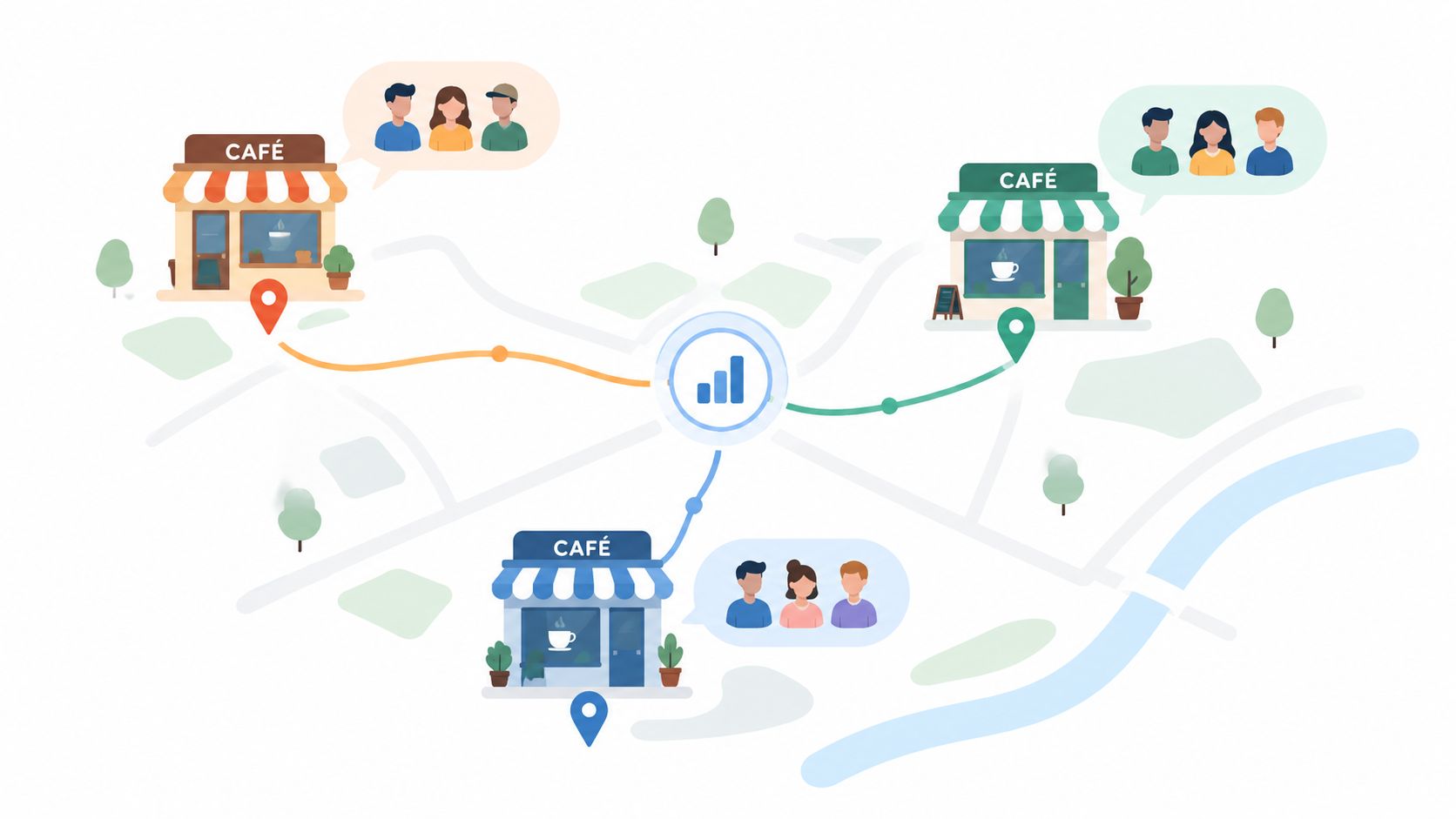
A chain with multiple locations needs to distinguish communities, not just accumulate contacts. Hours, products, professionals, and habits change between branches. For this reason, the CRM must maintain a single profile and associate each purchase with branch, channel, and local context.
In a coffee shop in Mexico, one person may buy almost always at Downtown and another may alternate between North and South. Creating an independent profile for each location fragments the history and can lead to contradictory offers. The consolidated identity, along with the branch code in each transaction, allows local recurrence to be calculated without losing the complete view of the customer.
Segmentation must lead to a decision
The team can classify single-location customers, multi-branch customers, and people who stopped buying at a specific establishment. That distinction changes the action: a coupon valid for the entire chain is attributed to the branch where it is redeemed, while a local promotion is limited to that unit's trade area.
For the journey to be measurable, the operation needs four controls:
POS Capture: the branch code automatically travels with the sale.
Local Reports: each manager consults recurrence, ticket, redemption, and inactive customers for their unit.
Executive Report: management compares incremental margin and performance by location.
Shared Experience: anyone visiting another branch keeps their preferences and benefits.
Delivery adds a layer of reconciliation. According to DiDi Food, cited in this article on the delivery market in Mexico, 60% of the more than 70,000 restaurants operating on its platform are MSMEs. Before launching a local campaign, the business must verify that each external order can be linked to its own profile and a source of sale. This way, the promotion is evaluated by attributed sales and not just by messages sent.
5. Modifier Management and Specific Preferences in Restaurants and Coffee Shops
“No sugar,” “almond milk,” “not spicy,” or “double cheese” are commercial and operational data points. Registered from the register or digital order, they allow the next order to be personalized, demand patterns to be identified, and prevent a campaign from recommending a product incompatible with the customer's history. The value appears when the data accompanies the customer throughout the entire journey, from capture to preparation and subsequent purchase.
A coffee shop can save the usual drink and its adjustments in the profile, along with the branch and purchase channel. A restaurant can record restrictions communicated by the customer, but critical allergies require safety protocols and human validation. The responsibility remains with the kitchen staff: a stored preference does not confirm that an ingredient has been removed from the entire preparation.
The data must return to the team
The modifier must appear where the decision is made, whether at the register, on the kitchen display, or in a WhatsApp order. If it remains inside the marketing dashboard, it does not change the operation. If it appears out of context, with ambiguous labels, or without indicating its validity, it can generate errors during preparation.
Personalization generates value when the data reaches the person who prepares, confirms, or delivers the order.
Aggregate analysis also guides the menu, inventory, and communication. If a coffee shop registers a constant demand for alternative milks, it can adjust stock and suggest related add-ons. If a restaurant detects repeated requests for a preparation, it can evaluate whether it is worth making it a visible menu option. The decision must incorporate profitability: a popular modifier can increase costs and require a specific price or rule.
The CRM must connect each preference with product, time, branch, channel, and reward cost. Payment at the terminal provides transactional context, but only guides a commercial action when it is linked to the order and the customer's profile.
The next action is to create a template of common modifiers, define which ones require a visible alert, and measure preparation errors, add-on adoption, and repurchase by registered preference.
6. ROI Analysis and Sales Attribution by Campaign Across All Formats
A coffee shop can send a coupon via WhatsApp, receive the redemption at the register, and observe an attributed sale. The CRM still has to resolve whether that purchase was incremental or if the customer would have visited anyway. To distinguish both cases, each campaign requires an identifier, a defined audience, an attribution window, and a comparison rule.
The identifier can be a unique coupon registered in the POS, while a tagged link relates an order to its digital origin. The time window establishes how long a visit can be attributed to the message. Without these conditions, the dashboard shows conversions but does not provide a sufficient basis for reallocating budget.
Margin matters more than redemption
The analysis changes depending on the business. A coffee shop can compare a campaign to increase visits against another for add-ons. A restaurant with two branches can use the same creative concept and separate results by location and time. In a beauty salon, the comparison must include bookings, attendance, service performed, and margin, not just generated appointments.
For the analysis to be operational, the CRM must relate:
Unique Code: links the campaign to the transaction at the register.
Control Group: shows what happened to similar customers without an incentive.
Incremental Margin: subtracts the cost of the reward and associated costs.
Subsequent Frequency: indicates whether the campaign encouraged repeat visits.
Channel and Branch: identifies where the message works and where it requires adjustments.
The dashboard must separate gross sales, incremental sales, cost of benefits, redemption, margin, and frequency. It must also distinguish between a promotion that fills off-peak hours and one that discounts purchases during peak hours, when capacity is already strained. That difference connects the capture at the register with an operational decision.
Attribution works like an investment rule. The next action is to review each campaign with its control group, calculate the incremental margin, and stop those that generate unprofitable activity.
Practical CRM Comparison in 6 Scenarios
Case | Implementation (Complexity) | Resources Required | Expected Results | Ideal Use Cases | Key Advantages |
|---|---|---|---|---|---|
Frequent Customer Management and Loyalty Programs in Coffee Shops | Low‑Medium, configure CRM and loyalty rules | POS with contact capture and CRM platform with loyalty rules | Increased visit frequency and measurable average ticket | Small/medium coffee shops with recurring customers | Improved retention; marketing automation; data-driven decisions |
Multi-Channel Automated Campaigns in Restaurants | Medium, integrate POS and multi-channel orchestrator | Clean database, POS integration, channels (WhatsApp, email, push) | Recovery of inactive customers; better conversion per channel | Restaurants with different segments (families, couples, vegetarians) | Multi-channel reach; churn recovery; operational time savings |
Bookings and Calendar Control in Barbershops and Hair Salons | Low, integrated calendar and automated reminders | CRM with calendar, reminders, and staff training | Fewer no-shows; higher occupancy and recurrence | Barbershops and salons with 1–10 professionals | Fewer no‑shows; better customer experience; staff planning |
Segmentation by Branch and Differentiated Local Campaigns | Medium, define rules by zone and sync POS | POS with branch code and CRM with consolidated reports | Better conversion with local messages; inventory optimization | Multi-branch businesses (3+ locations) | Local relevance; centralized control; store performance comparison |
Modifier Management and Specific Preferences in Restaurants and Coffee Shops | Medium‑High, POS/kitchen integration and granular capture | Technical POS‑CRM‑kitchen integration and team training | Fewer preparation errors; faster service; higher satisfaction | Premium coffee shops and allergy-sensitive restaurants | Advanced personalization; fewer remakes; competitive differentiator |
ROI Analysis and Sales Attribution by Campaign Across All Formats | Low‑Medium, configure tracking and campaign dashboard | Comprehensive CRM with coupon/code tracking, discipline in experiments (included in many platforms) | Budget optimization; more attributable sales; better ROI | Businesses running regular campaigns that need to measure impact | Data‑driven decisions; identifies effective channels; justifies budget |
Turn Every Visit Into a Measurable Decision
A practical CRM begins with a minimal, useful capture at the point of sale. The phone number, consent, branch, and transaction form the basis, but the value appears when the business adds habits, channel, time, preferences, and response to campaigns. The entire sequence connects identification, segmentation, contextual messaging, reward, automation, and sales attribution.
The first move is to choose a data point that the team can capture without friction. A coffee shop can start with phone number and usual drink. A barbershop can prioritize professional, service, and maintenance date. A restaurant with delivery can start with phone number, channel, and branch, because a fragmented identity prevents calculating the real value of the customer.
The second move is to activate a simple dynamic. A visit rule, a non-monetary reward, or a second-visit campaign allows behavior to be observed without building a complex program from the start. The incentive must adjust to margin, capacity, and hours. A benefit that fills peak hours or subsidizes regular purchases can worsen the business's economics even if it increases redemption.
The third move is to measure a campaign with a unique code. The manager must compare gross sales with incremental sales, deduct the cost of the reward, and review the result by branch, channel, ticket, and frequency. That discipline prevents the CRM from becoming a database full of contacts that nobody uses.
The same logic applies to calculating the return on investment of each campaign. In all cases, the data must trigger a decision and that decision must yield a verifiable result.
Swirvle can fit into this journey as a CRM platform with loyalty, segmentation by habits and branch, campaigns via WhatsApp (in the Premium plan), push and email notifications, automations, and statistics dashboards. The selection should depend on the team's ability to capture data, connect the POS, and act on the metrics, not on the number of advertised features.
Swirvle offers an all-in-one CRM for SMBs with physical stores, featuring loyalty programs, coupons, segmentation, automations, and campaign measurement. To connect visits from a coffee shop, restaurant, or store with verifiable business decisions, businesses can learn about Swirvle and see how to apply this flow to their branches and channels.
Related Blogs

Nov 22, 2026
How to identify frequent customers in a physical store?

Nov 21, 2026
How to Connect Your POS System with Restaurant Email Marketing: A Guide

Nov 20, 2026
How much does a small restaurant make per month in Mexico?

Nov 19, 2026
How to Run a Small Coffee Shop Step by Step? 2026

Nov 18, 2026
How can you check out customers faster in a coffee shop during peak hours?

Nov 17, 2026
How to create a loyalty program for a clothing store or boutique?