Learn what a workflow is and how to apply it to your business. A guide with examples for SMEs, car washes, and coffee shops to retain customers.
Workflow in Spanish means "flujo de trabajo". It is the ordered sequence of steps that is always repeated in the exact same way to achieve a result: first something happens, a condition is checked, and an action is executed.
Three everyday examples:
Opening the coffee shop: turning on the espresso machine, counting the cash drawer, and checking if there is enough milk, always in the same order.
Receiving a supplier: counting the merchandise, comparing it against the purchase order, registering the entry in inventory, and saving the invoice.
Recovering a customer: if a frequent customer has not visited for 21 days, the system sends them a coupon for their favorite drink.
Term | What it is | Example |
|---|---|---|
Workflow | English word for a work flow | "We have a workflow to close the cash register" |
Flujo de trabajo | The translation to Spanish: the ordered steps of a task | Count cash → balance with the POS → record discrepancies |
Proceso automatizado | A workflow executed by a system without someone having to remember to do it | The POS sends a coupon to someone who has not returned in 21 days |
Many business owners in Puebla experience the same thing. They open early, check the register, coordinate staff, attend to suppliers, and, between one thing and another, put off following up on customers who haven't returned. The weekend promotion is sent late, frequent customers do not receive an incentive on time, and information remains scattered among notebooks, chats, and the manager's memory.
This exhaustion isn't always seen as a sales problem. Instead, it feels like operational fatigue. But when a business lives by putting out fires, it also loses opportunities for repeat purchases, loyalty, and increasing the average ticket without relying solely on attracting new people.
That is where the workflow in Spanish, or flujo de trabajo, comes in as a practical way to organize repetitive tasks so the business runs with less friction and better commercial follow-up.
Table of Contents
Could the day-to-day of your business be easier?
What a Workflow is and its translation into Spanish
Thinking of it as a recipe or an operational routine
It is not a new fad
What it does solve and what it does not solve
Key Components of a Workflow
The trigger
The condition
The action
The objective
Examples of Workflows for Physical Businesses in Mexico
Coffee shop in Yucatan
Car wash in Baja California
Gas station with several branches in Nuevo Leon and Puebla
Comparison of Manual Process vs. Automated Workflow
How to Implement Your First Workflow Without Being an Expert
Start with a single goal
Define trigger, rule, action, and measurement
Keep it simple at the beginning
Measuring the Success of Your Workflows
What is actually worth checking
What errors distort ROI
The Future of Your Business is Automated
Frequently Asked Questions
What does workflow mean?
How do you say workflow in Spanish?
Could the day-to-day of your business be easier?
An owner of a small chain of coffee shops in the State of Mexico usually starts the day with accumulated pending tasks. They have to check inventory, cover absences, confirm promotions, and answer messages from customers asking if their loyalty card is still active. At the end of the day, there is still one important task left: remembering who stopped visiting the business and who deserves a special offer for their frequency.
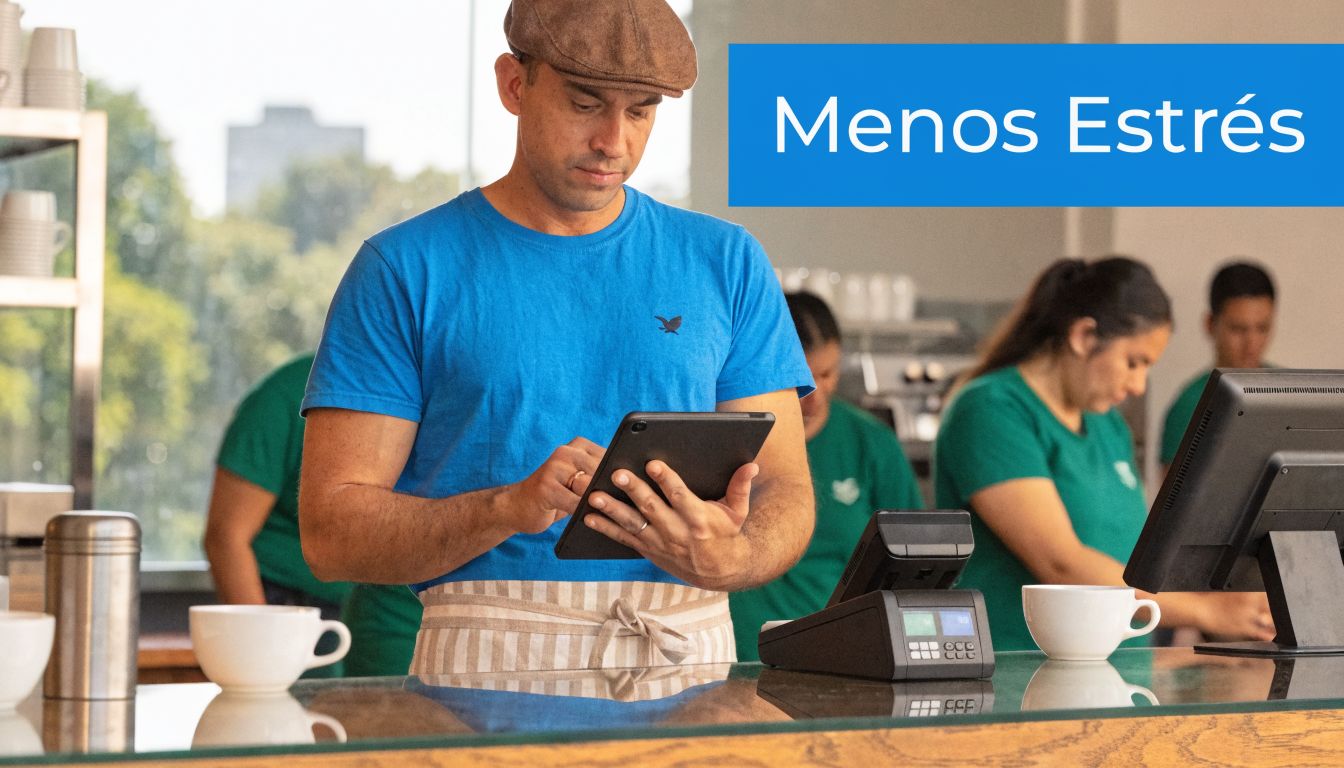
In many physical stores, this follow-up depends on the manager's memory or on someone "keeping track" in a spreadsheet. The problem is that this does not scale. When the business has two or three locations, or when the volume of customers rises during peak seasons, the manual process starts to fail.
When follow-up depends on someone remembering, customers who were close to returning are lost without anyone noticing. For a local business, this is not a technical issue. It is money that was already close and was let go.
Rule of thumb: if a task is repeated every week and someone has to remember to do it, that task is already calling for a workflow.
A workflow does not replace the human touch. It protects it. It relieves the team of repetitive tasks so they can focus on selling better, serving better, and spotting real opportunities. This also reduces simple errors, such as sending out-of-time promotions or rewarding the wrong customer.
Even in daily operations, fatigue matters. Anyone who spends hours at the register or on the tablet needs lighter processes and less rework.
What a Workflow is and its translation into Spanish
The direct translation of workflow in Spanish is flujo de trabajo. The phrase sounds technical, but in practice, it is something very familiar to any physical business. It is the ordered sequence of steps that is repeated to achieve a result.
Thinking of it as a recipe or an operational routine
In a pastry shop in Puebla, a recipe does not depend on the mood of the day. It has steps, times, and conditions. If a step is missing, the product turns out wrong. The same thing happens in a car wash in Baja California. Receiving the car, registering the service, charging, notifying when it is ready, and offering an additional service should not depend on whether the manager remembered or not.
That is a workflow. First, something happens. Then, a condition is checked. Next, an action is executed. If the process is well-designed, the result is more consistent.
A good workflow takes the logic of the process out of a person's head and puts it into a system that anyone on the team can follow.
It is not a new fad
The concept has history. Manufacturing companies have been using workflows for decades to organize production and supply chains, as summarized in the definition of workflow. The logic was simple: less improvisation, more order, fewer bottlenecks.
Today, the application has changed context, but not core substance. Before, it was about production and logistics. Now, it is also applied to repeat sales, loyalty, location-specific promotions, and post-purchase follow-up.
What it does solve and what it does not solve
A workflow is indeed useful for:
Automatically reminding you who to contact.
Segmenting by behavior without relying on manual review.
Sending timely incentives when the customer still has the purchasing habit fresh in mind.
Standardizing operations across branches in Mexico City, Puebla, or Yucatan.
A workflow does not solve on its own:
A bad offer that does not interest the customer.
Incorrectly captured data at the register or in the loyalty program.
Poorly designed processes that were only digitized without being corrected.
When a business understands this difference, it stops looking for "tech magic" and starts building useful processes.
Key Components of a Workflow
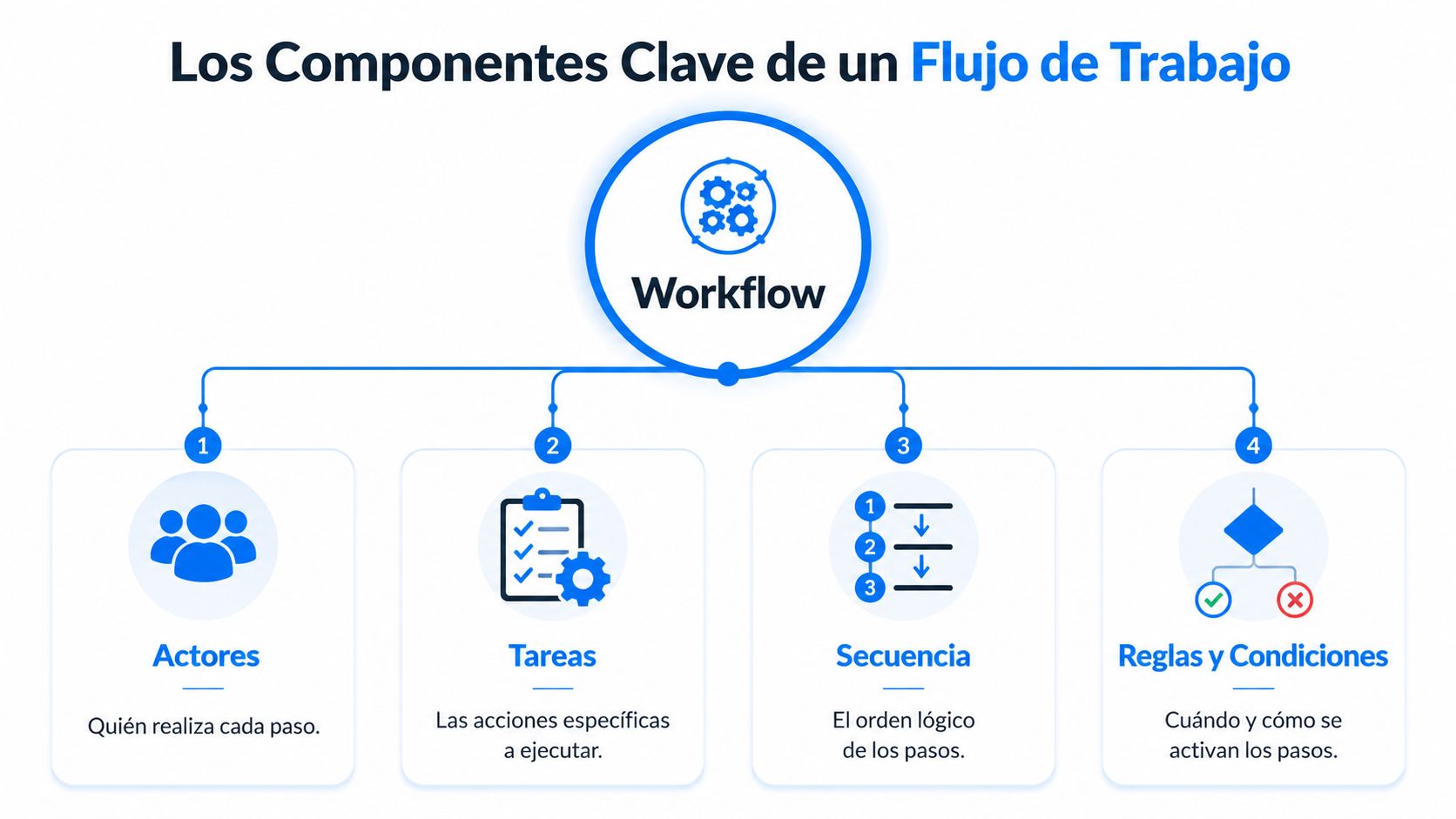
A well-made workflow does not need to be complicated. It works best when each piece is clear and when the owner can explain it in a brief conversation. If it cannot be explained easily, it is almost always too tangled.
For anyone who does not yet work with a centralized system, it is useful to first understand what a CRM system is, because that is where the information that triggers these processes usually lives.
The trigger
The trigger is the event that starts everything. It does not have to be complex. It can be something as simple as "the customer made their third purchase" or "21 days passed without a visit."
In a coffee shop in Puebla, a useful trigger would be a person accumulating several visits in a short time. In a gas station, it could be a fuel fill-up recorded after a period of inactivity. The point is for the system to detect the exact moment without someone having to check it manually.
The condition
Here, it is decided whether or not the customer enters the workflow. The condition responds to an "if this happens, then" logic.
For example:
If the customer belongs to the Cholula branch.
If they have already purchased more than once.
If they have not redeemed a previous reward.
Conditions prevent common mistakes. It is not wise to send the exact same promotion to everyone. Nor to someone who just purchased yesterday.
The action
The action is what the system does on its own. It could be sending a message, assigning a task to the manager, adding points, releasing a coupon, or moving the customer to another segment.
Operational tip: the action must be specific and easy to execute. "Send promotion" is ambiguous. "Send medium drink coupon via push or WhatsApp (Premium plan) to customers without a recent visit" is actually actionable.
In physical businesses, the best action is usually the most direct. A clear incentive, a well-scheduled reminder, or a reward tied to a specific habit.
The objective
Many businesses stop at activating messages and fail to define what they wanted to achieve. This is where clarity is lost. The objective marks when the workflow actually worked.
A reasonable objective can be:
Component | Example in coffee shop | Example in car wash |
|---|---|---|
Trigger | Customer without a recent visit | Basic service registered |
Condition | Belongs to Puebla Centro branch | Has not purchased premium service |
Action | Send coupon via push or WhatsApp (Premium plan) | Offer upgrade for next visit |
Objective | Redeem coupon and return | Achieve repeat purchase with higher ticket |
When these four pieces are aligned, the business stops improvising and starts repeating processes that actually generate commercial activity.
Examples of Workflows for Physical Businesses in Mexico
Theory is of little use if it doesn't land in real-world situations. A workflow in Spanish must be explainable with examples that any branch manager can understand in minutes.
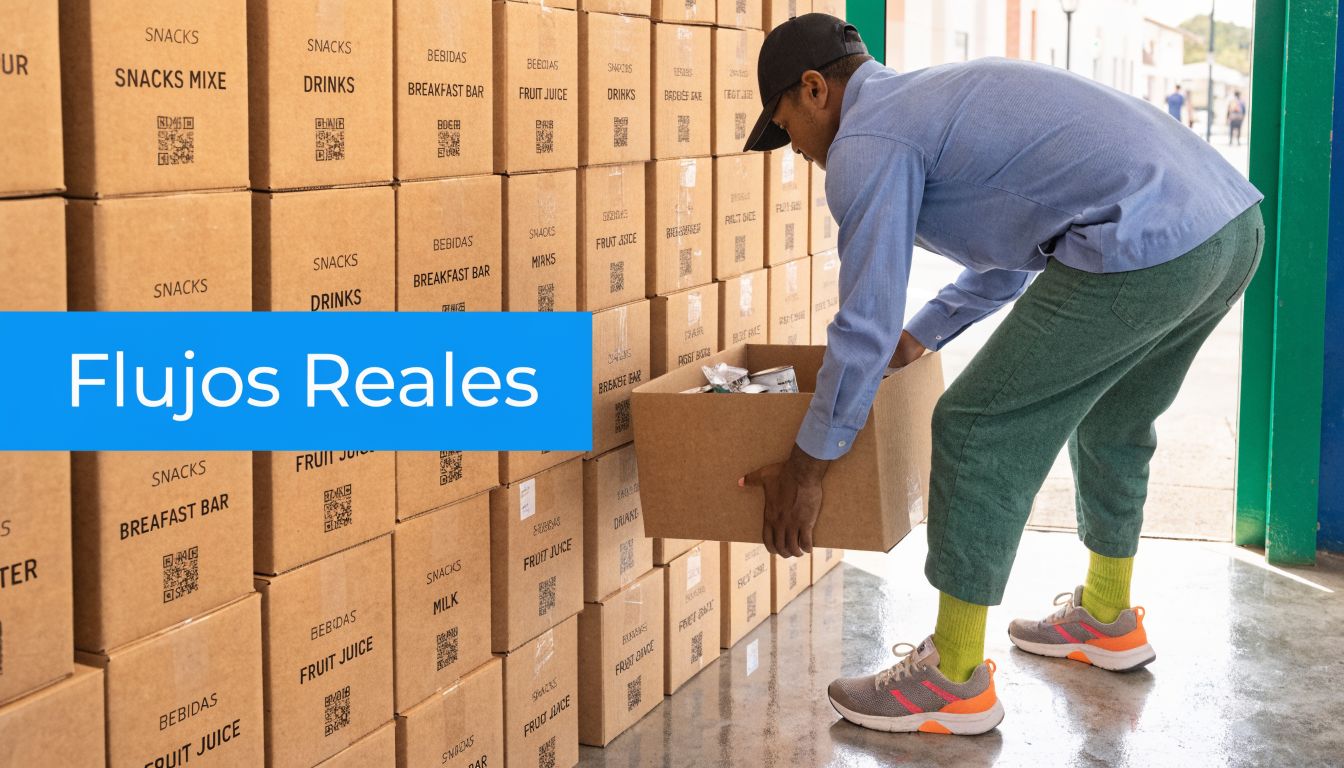
For businesses that want to better organize their commercial and cash register operations, it also helps to check how point of sale systems for small businesses work, because many workflows depend on the purchase being registered correctly from the counter.
Coffee shop in Yucatan
A neighborhood coffee shop usually has frequent customers during the week. The problem arises when someone who used to come every Tuesday and Thursday stops showing up and no one detects it.
The flow can look like this. The system identifies that a frequent customer has not returned within a certain period. If they also belong to a specific branch and usually consume certain drinks, a message with a concrete reward is triggered. Not a generic promotion, but something aligned with their habit.
What does work is offering a simple reason to return. What does not work is sending discounts to the entire database without context. This erodes margin and conditions the customer to expect discounts.
Car wash in Baja California
In a car wash, many sales opportunities are lost at the exit point. The staff charges, delivers the car, and moves on to the next. This is where the possibility of a better-planned repeat purchase is lost.
A useful workflow starts from the service performed. If a customer bought a basic wash, the system can schedule an incentive for the next visit with a related upgrade. The key is in the sequence. You don't push an additional sale when the customer has already left without context. You prepare the next contact in an orderly way.
In quick-service businesses, the best time to plant the seed for the next sale is not always at the register. Often, it is later, with automatic follow-up and a relevant offer.
Gas station with several branches in Nuevo Leon and Puebla
This is where the value of the workflow becomes clearer. When the business operates in multiple locations, the most common mistake is treating all customers the same, even though their behavior changes by area, time, or frequency.
For chains with multiple branches, workflows allow automatically assigning tasks and promotions by location and sending personalized offers after each visit. In a chain of stores, this translates into operational order and better-targeted campaigns.
A customer who fills up in San Pedro does not necessarily respond the same way as one who buys in Puebla capital or at a highway exit. The workflow allows each branch to work with its own rules without losing central control.
Comparison of Manual Process vs. Automated Workflow
Task | Manual Process (The Owner) | Automated Workflow (With Swirvle) |
|---|---|---|
Detecting customers who stopped buying | Checks tickets or remembers names | The system automatically identifies the pattern |
Defining who to send the promotion to | Decided "by estimation" | Segmented by visits, branch, or habit |
Sending message | Sent one by one | Scheduled and executed according to rules |
Following up on redemption | Asked at the register or written down separately | Recorded within the workflow |
Evaluating result | Estimated by perception | Reviewed with campaign and repurchase data |
The important thing is not to automate everything at once. What is profitable is choosing repetitive, clear processes tied to repeat purchases.
How to Implement Your First Workflow Without Being an Expert
Many owners hold back here for one single reason. They think that automating implies talking to developers, configuring complex setups, or redesigning the entire operation. In a physical business, that is almost never the best starting point.

To understand what kind of features are best to activate first, it is helpful to review these marketing automation tools from the perspective of a physical business, rather than a tech company.
Start with a single goal
The first workflow should not try to solve everything. It must attack a specific problem. For example, recovering customers who have not visited the business recently or encouraging a second purchase after a first visit.
When the objective is concrete, the design of the workflow becomes much simpler. It also becomes easier to detect if it worked or if the offer was poorly structured.
Define trigger, rule, action, and measurement
The technical logic behind these systems is more accessible than it seems: they use triggers and conditional rules to automate campaigns via push, email, or WhatsApp (the latter in Swirvle's Premium plan).
This translates into something very practical:
Choose the trigger. A customer did not return, made a certain purchase, or accumulated a certain activity.
Set a rule. Only applies to a certain branch, certain type of customer, or certain pattern.
Define the action. Message, coupon, points, internal reminder, or reward.
Check the result. If they came back, if they redeemed, if they bought more, or if they ignored the incentive.
The most common mistake is automating a bad idea. The second most common mistake is not measuring it.
Keep it simple at the beginning
It is best to start with workflows that have a single action and a single goal. A coffee business in Mexico City can start with recovering inactive customers. A bakery in Puebla can focus on weekly repeat purchases. A gas station in the State of Mexico can use a post-visit loyalty workflow.
What is not advisable is opening several fronts at once. When too many rules are activated from the start, the team loses visibility and stops trusting the system.
Measuring the Success of Your Workflows
A workflow without measurement ends up being just another task. The message is sent, the coupon is activated, and everyone assumes "it helped with something," but no one knows how much, to whom, or in which branch.
This gap is more common than it seems: many businesses launch campaigns without being able to link them to a concrete sale. That is why it is advisable to measure each workflow with a coupon or a rule that leaves a trace at the register.
What is actually worth checking
There is no need to turn the business into a laboratory. It is enough to look at indicators that actually drive decisions.
Customer retention. Measures if people return after entering a workflow.
Purchase frequency. Helps to know if automated contact is shortening the time between visits.
Average ticket. Helps detect if a reward is driving larger purchases.
Coupon or reward redemption. Indicates if the message was relevant or if it went unnoticed.
When these metrics are reviewed by location, the owner stops operating blindly. They no longer rely solely on manager feedback or cash register perception.
What errors distort ROI
The first is measuring too soon. Some workflows need several interactions before showing a useful trend.
The second is not separating campaigns. If a coffee shop launches a general promotion and at the same time activates a workflow for inactive customers, then no one knows what caused the repeat purchase.
If a sale cannot be linked to a concrete action, the business ends up rewarding occurrences, not results.
The third is ignoring data quality. If the branch captures records poorly or does not identify the customer correctly, the automation works with weak information and the conclusions turn out skewed.
The Future of Your Business is Automated
Workflows are no longer a topic reserved only for corporations. In Mexico, physical businesses that want to grow in an orderly way need processes that run without chasing every pending task by hand.
A coffee shop in Puebla, a car wash in Baja California, or a gas station with several branches in Nuevo Leon do not require sophisticated processes to start. They require clarity. What needs to be achieved, what event triggers the workflow, what message is sent, and how the result is measured.
The important change is not technical. It is operational and mental. The owner stops acting solely as a resolver of pending tasks and starts managing a system that works with clear rules. This frees up time, reduces errors, and maintains a more consistent relationship with the customer.
The best time to start is not when the business has "more structure." It is when a repetitive task that consumes time and affects repeat purchases has already been detected. Automating a single thing well-done usually provides more value than trying to digitize everything without order.
Frequently Asked Questions
What does workflow mean?
Workflow means flujo de trabajo: the series of ordered steps that a task follows from start to finish. In a business, it can be anything from opening the register to automatically sending a coupon to a customer who stopped coming.
How do you say workflow in Spanish?
It is called flujo de trabajo. In some contexts, "flujo de procesos" or "proceso automatizado" is also used when a system executes the steps on its own.
Swirvle helps SMBs with physical stores convert that order into repeat sales, personalized campaigns, and actual return measurement. If the business is already ready to leave manual tasks behind and start working with workflows that drive customer loyalty, it is worth learning how Swirvle works.
Related Blogs

Nov 21, 2026
How to Connect Your POS System with Restaurant Email Marketing: A Guide

Nov 20, 2026
How much does a small restaurant make per month in Mexico?

Nov 19, 2026
How to Run a Small Coffee Shop Step by Step? 2026

Nov 18, 2026
How can you check out customers faster in a coffee shop during peak hours?

Nov 17, 2026
How to create a loyalty program for a clothing store or boutique?

Nov 16, 2026
How to manage a coffee shop's inventory day by day?