
Step-by-step grab-and-go snack guide for small coffee shops: assortment, suppliers, pricing, display case, inventory, and loyalty.
In the middle of the morning in Monterrey, the customer walks in quickly, leaves their cell phone on the counter, and looks at the display case without touching anything. They have little time, want something practical, and are not going to read a long list of options; if the display is confusing, they leave empty-handed or buy their usual elsewhere. That is where Counter Snacks (Grab-and-Go) for small coffee shops stops being an extra and becomes a serious part of the business, because it competes on impulse, speed, and clarity.
The Mexican snack market is no longer seen as a passing trend. In Mexico, the category reached USD 2,550.6 million in 2024 and, according to IMARC Group, could reach USD 5,403.9 million by 2033, with a CAGR of 8.70% between 2025 and 2033 (IMARC Group). For a small coffee shop, that analysis matters because the counter is not fighting for an isolated sale, but for a space within a category with structural growth.
There is also a clear signal in more mature markets. In Spain, snacks already represented 36.1% of the national foodservice market and generated nearly 30,000 million euros in 2024, with year-over-year growth of 5.7%; furthermore, the European snack market totaled 234,000 million euros that same year, with progress of 2.9% (Hostel Vending). These are not Mexico's figures, but they do set a useful benchmark for LATAM, where value is captured through clear display, impulse buying, and fast rotation.
Table of Contents
The decisive moment in front of the display case
The scene repeats itself almost identically in Coyoacán, Polanco, or downtown Monterrey. The morning customer walks in with 90 seconds before their meeting, looks at a display case with five different cookies, two sandwiches that are too soggy, and a price tag that can barely be read, and ends up drinking black coffee or leaving without a snack. That indecision does not seem major from the counter, but for a small coffee shop, it is a lost sale every day.
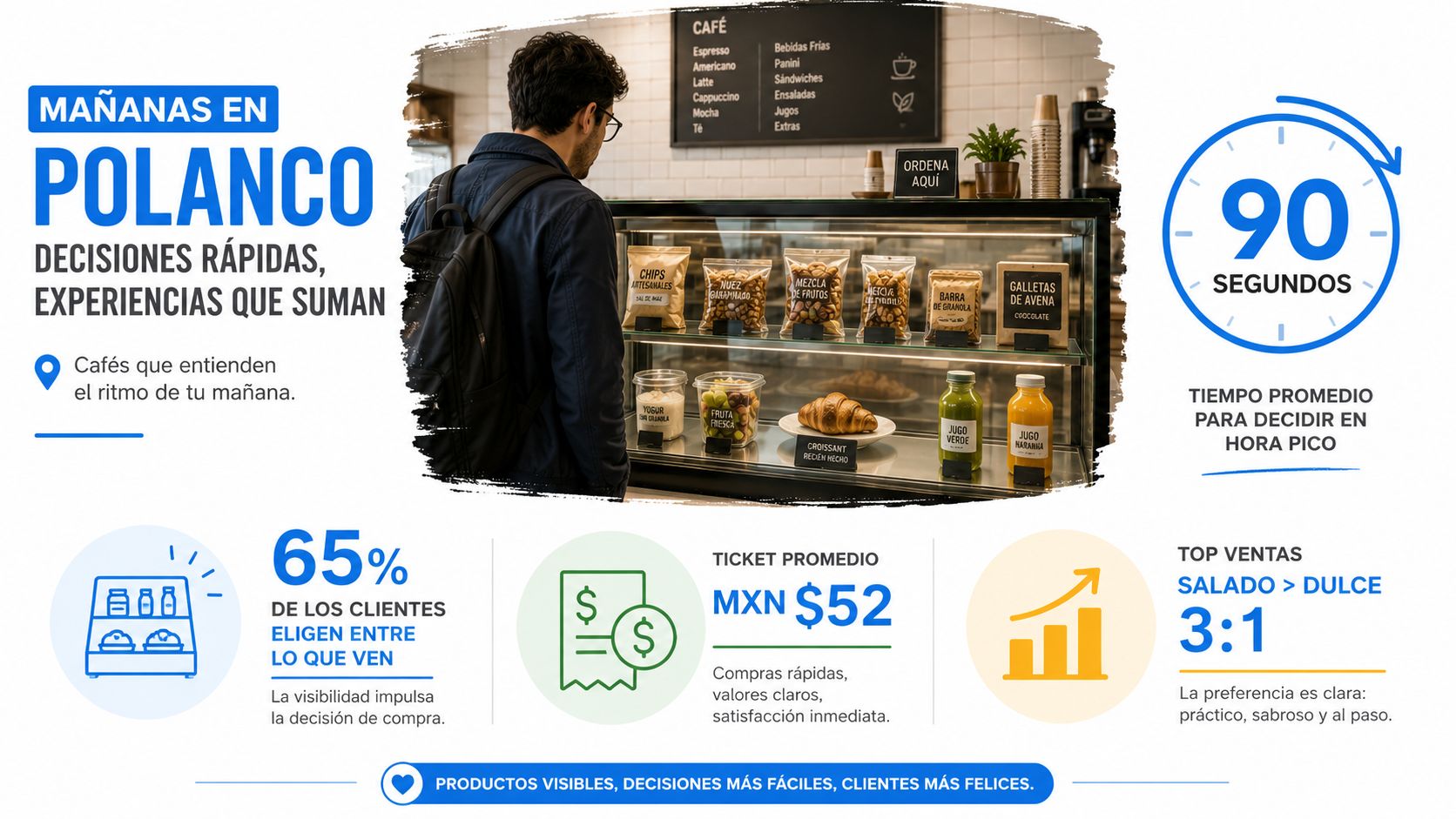
Rule of thumb. If the customer has to think too much, the counter has already lost part of the conversion.
The opportunity is better understood when the display case stops being viewed as a shelf and starts being treated as a quick purchase channel. In small venues, that channel competes with the corner convenience store, the chain coffee shop, and any point that delivers an immediate response. A well-assembled display does not need a full catalog, it needs clarity, visible pricing, and products that satisfy the craving without friction.
The logic also explains why the counter should not operate as a decorative appendage. In neighborhood coffee shops, gas stations with coffee on the go, or car washes with short wait times, the visible snack works because it accompanies an existing habit: grabbing something quick and keeping moving. A well-thought-out grab-and-go module converts that pause into an additional ticket, as long as the assortment, display, and price are aligned.
There is an operational layer that often goes unnoticed. When the store fills the display case with too many options, the customer takes longer, the product rotates worse, and waste increases. When, instead, the display case behaves as a curated selection, the decision is simplified and the counter starts to sell on its own, not through staff persistence. In a small coffee shop, this shift is worth more than adding another pretty but slow-moving product.
Suggestive selling helps, but only if the staff understands what to offer and when. A useful framework for training the team is explained in this practical guide on suggestive selling techniques, especially when the suggestion is made without disrupting the line or turning the service into a long conversation.
How to choose the ideal assortment for a small coffee shop
A healthy assortment is not born from intuition, but from the actual size of the store and its sales pace. For a small coffee shop, the most useful operational benchmark is to work with 20-28 total SKUs and leave only 8-12 SKUs visible in the display case at the same time, especially in spaces of 25-40 m² (Piso Uno Comercial). This reduction avoids visual chaos and forces rotation to focus on what actually sells.
Sweet and savory do not compete the same way
The inventory mix also matters. A technical merchandising guide for snack sales recommends that between 60% and 73% of available inventory be sweet, and between 27% and 40% be savory (UCAB). At the counter, this proportion works best when products are grouped by type and the price can be read from a distance, because the customer decides faster and the impulse does not cool down.
Sweet and savory should not be viewed as two separate shelves, but as two purchase routes with different times.
The commercial reading is simple. Sweet usually drives impulse and accompaniment purchases, while savory resolves hunger, a long break, or a light meal. In a coffee shop in Nuevo León, State of Mexico, or Mexico City, this difference helps to avoid filling the display case with the usual items and to maintain a balance between margin, recurrence, and variety.
Classification by sales velocity is the filter that prevents emotional purchases. First, separate SKUs by rotation, then leave only the top-selling items in the display cases depending on the hour, then rotate the display between morning and afternoon, and finally review weekly which products are not converting. This discipline reduces the temptation to display everything together and, with it, lowers decision friction.
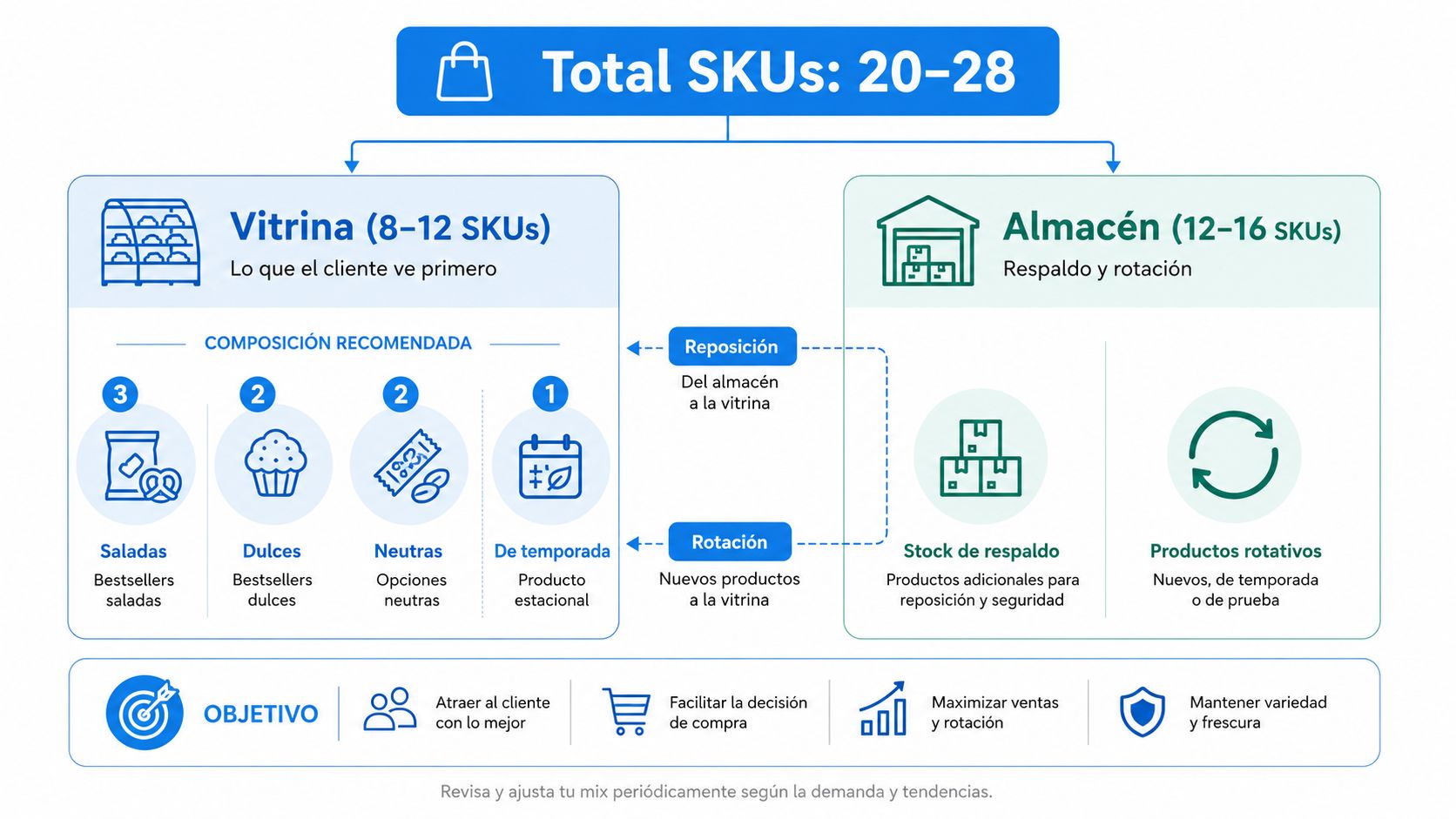
In practice, the ideal assortment is not the widest, but the most legible. A compact display case sells better when each product has a clear role: quick breakfast, mid-morning snack, grab-and-go dessert, or emergency savory snack. When the customer understands that in seconds, the purchase stops depending on the team's patience and starts depending on the counter design.
Suppliers and packaging that protect your margin
The purchasing route also defines the margin. In a small coffee shop, the owner usually chooses between foodservice distributors, local wholesalers, and artisanal producers from states like Yucatán, Puebla, or Nuevo León; each path has a different balance of minimum order, freshness, shelf life, and labeling support. Changing suppliers every month usually breaks consistency, and in grab-and-go, consistency carries more weight than novelty.
What to check before buying
The decision should not start with the lowest price, but with the actual shelf life of the product, supply stability, and display friendliness. If the supplier delivers packaging that gets crushed, blurry labels, or items that are difficult to align in the display case, the problem is not just aesthetic, it is also operational.
A reliable supplier does not just deliver product, they deliver predictability.
Individual or duo packaging is not a visual whim. It helps control expiration dates, reduces unnecessary contact between pieces, and allows moving product with less waste. In addition, when the packaging carries the coffee shop's name, the snack stops being an anonymous item and becomes part of the counter brand, which is very important for impulse and repeat purchases.
To organize purchases and batch costs, it is useful to review a purchasing cost guide and use it as support when negotiating minimums and evaluating how much each presentation can hold without hurting inventory. This prevents the typical mistake of bringing in too much artisanal variety without a clear restocking logic.
The best practice is simple. Choose a base supplier for the highest rotation products, reserve a second supplier for seasonal rotation or testing, and only then add more differentiated pieces. This sequence protects the margin and prevents the display case from looking like an uneven catalog.
Prices, margins, and the 14-day pilot
Pricing for counter snacks is not defined by custom, it is defined by cost absorption, sales velocity, and customer sensitivity. In Mexico, food inflation has continued to pressure purchasing decisions, so the counter needs more discipline in combos, sizes, and rotation than a simple expansion of assortment. When ticket sizes change quickly, visible pricing and controlled testing are worth more than an extensive offer.
How to test without compromising the display case
The safest way to start is to launch a pilot of 3 products for 2 weeks and review sales at 14 and 30 days before keeping, withdrawing, or replacing them. This logic reduces the risk of filling the display case with slow SKUs and forces you to read actual behavior by the hour, not by assumption.
A useful approach is to start with three different profiles: a high-rotation product, a comfortable-margin product, and a test product. Then observe which one pairs best with coffee, which one moves on its own, and which one only gets in the way of the display. In small venues in Monterrey, Puebla, or CDMX, this filter prevents emotional purchases that end up hurting the cash flow.
Useful criterion. If a snack does not rotate during the test period, it does not deserve permanent space out of sympathy for the supplier.
To fine-tune the final number, it helps to review the concept of price elasticity, because not all customers react the same way to a small price increase. The grab-and-go customer is usually more accepting of a quick purchase with clear value than an unexplained item, but the margin is only sustained if the price also aligns with sales velocity.
Practical profitability improves when the snack is integrated with coffee instead of being sold in isolation. A well-structured combo can drive more ticket sales without forcing too much of a reduction in the unit price, as long as the discount does not eat into the profit of the main item. For owners who want to measure utility more orderly, the net yield guide serves as a complementary reference to think about actual revenue, cost, and output, not just gross sales.
The display case as a fast conversion channel
The display case sells before the staff speaks. That is why it is convenient to place sweet and savory items from eye level downward, use cards or labels with names and descriptions, and avoid crowding sandwiches so they do not get squished or lose their shape. It also helps to wrap them in clear film when the product requires it, as this reduces drying and improves presentation inside the refrigerator.
What should be seen first
Visual logic is straightforward. What sells easiest should be seen first, and what leaves the best margin should have a position that does not compete with clutter. In small coffee shops, the display case should not behave like a visible warehouse, but like a conversion funnel that guides the hand without demanding too much attention.
Criterion | Recommendation | Objective |
|---|---|---|
Visual placement | Sweet and savory items from eye level downward | Reduce decision friction |
Price | Legible cards from a distance | Accelerate impulse buying |
Grouping | Separate by snack type | Avoid display case confusion |
Sandwiches | Do not crowd them, keep them well presented | Avoid flattening and poor perception |
Wrapping | Use clear wrap when it helps to preserve | Reduce drying and unnecessary contact |
The physical part also matters. In cold display cases for bars or coffee shops, dimensions usually range from 120 cm to over 200 cm in length, with a standard height of 85-90 cm; in small locations, a 1.2-meter unit is usually sufficient, while larger volume spaces may require equipment of 2 meters or more (Arsent). The correct display case is not the largest, but the one that lets the product breathe and sustains sales flow.
A well-lit counter, with few categories and clear prices, converts better than a long line of confusing options. This is highly noticeable in grab-and-go coffee shops, gas stations with a coffee corner, or spots with high morning rotation, because the customer decides in seconds. The goal is not to display everything, but to direct attention toward what is actually profitable to sell.
Inventory control and waste reduction
Waste in grab-and-go almost always starts with disorder, not bad luck. If each product does not have a visible date, if rotation does not follow a FIFO order, and if the storage mixes ready-to-go snacks with ingredients from another category, inventory becomes difficult to read and waste increases. In a small coffee shop, that loss hurts more than a slow sale because it impacts cash, space, and trust in the counter.
Labeling, separation, and order of release
The first rule is visible and simple. Each product must carry a legible expiration date, and the staff must move the oldest items first, not whatever is closest to hand. This order reduces confusion and prevents new pieces from getting left behind while older ones are on their way out.
The second rule is physical. Ready-to-go snacks should be separated from the rest of storage to prevent inventory crossover and so the team can clearly see what is on display and what is in back stock. When everything is stored together, the display case seems stocked for longer than it actually is, and replenishment ends up arriving late.
The third rule is operational. The order must respond to the actual sales pace and not to Monday's optimism. If a product does not rotate, it is not restocked by inertia, and if another disappears early in the week, the purchase limit per SKU is adjusted before the display case runs dry or storage fills with slow pieces.
Waste is not corrected by buying cheaper, it is corrected by buying less blindly.
On the regulatory side, prepackaged snacks must comply with NOM-051 with a nutritional table, ingredient list, allergens, batch, and expiration date. If the coffee shop repackages bulk product, the labeling responsibility can no longer be treated as a minor detail. It is also convenient to keep prices visible and look after special preservation conditions when the product requires it, because a pretty display case does not compensate for poor sanitary practices.
A good routine is to weekly review the five items that generate the most waste, adjust their purchase, and move them to less exposed zones if they still do not sell. The goal is not to have more stock, but to have the stock that actually rotates within the time it still makes economic sense.
Cross-selling and loyalty of the grab-and-go customer
The counter snack is not finished when the customer pays. Well executed, it opens up a second purchase and then a third, because whoever already stopped by for coffee usually repeats the visit if they find something that solves their rush. In a small coffee shop, that repetition carries more weight than going out to find new customers all the time.
How to increase the average ticket without forcing the sale
The most natural cross-sale remains coffee with a snack. The mid-afternoon combo also works, as long as the discount does not eat the margin and the suggestion changes according to the hour, rather than as a blanket promotion for everyone. The staff does not need a long speech, they need to spot when a beverage alone falls short and when a snack closes the purchase without friction.
In my grab-and-go module in Monterrey, the clearest shift came from three pairings that indeed sold themselves: black coffee with a muffin, latte with an oatmeal bar, and cold brew with something savory. What did not work was pushing larger combos during slow hours, because the discount moved volume without leaving real profit. After six months, I preferred to sustain a few well-measured pushes rather than introducing promotions that look good in the display case but hurt the register.
Here, analysis by customer also comes into play. If the coffee shop registers what each person buys, it can detect preferences by branch, schedule, and craving type. A loyalty system with coupons, points, or rewards configurable via WhatsApp helps convert single visits into measurable recurrence without separating the counter from the customer's history.
The useful data is not how many snacks are in the display case, but who returns, when they return, and what they combine with their coffee.
A 14-day pilot keeps control without extending the test too long. The first week, the display case is set up and 3 pilot products are chosen. The second week, sales and rotation are measured. With that, it is already clear whether the price aligns with the actual customer flow or if the item is just taking up space and generating waste. If an SKU does not move, it goes out quickly. If one does respond, the purchase limit is adjusted before inventory inflates.
The indicators that truly matter are few. Rotation by SKU, weekly waste, average ticket with snack, and percentage of repeat customers. When those four numbers move in the same direction, the grab-and-go module stops relying on the month's enthusiasm and starts sustaining an operation that pays for itself.
Related Blogs

Sep 25, 2026
How to standardize operations in branch offices

Sep 24, 2026
Strategies to get 5-star Google reviews

Sep 23, 2026
Digital marketing customer loyalty

Sep 22, 2026
Loyalty Marketing Services for SMBs: 2026 Guide

Sep 21, 2026
Strategic difference between a soft launch and a grand opening for a coffee shop

Sep 19, 2026
Effective promotions to increase sales during low-traffic hours: 2026 guide
Try Swirvle for free
No card required · 30 days free
Start your free trial