Strategies to get 5-star Google reviews with scripts, ethical flows, and automation for restaurants, coffee shops, barbershops, and more.
The best review is won before it is requested. Increasing 5-star reviews on Google is not about pressuring customers, filtering opinions, or promising prizes for a positive rating. It is about improving specific moments of the experience, asking for an honest opinion from real customers, and eliminating friction with a direct link.
The core criterion is operational: the business must allow any rating, avoid incentives conditioned on five stars, and measure what happens from purchase to publication. In Mexico, the window of satisfaction can be short: only 18.6% of consumers declared being “totally satisfied”, while 74% would stop using a brand after a bad experience, according to regional evidence on customer service in Mexico. Therefore, the following strategies connect the moment of the experience with the channel, the industry, Google's policies, and the metrics that a CRM can control.
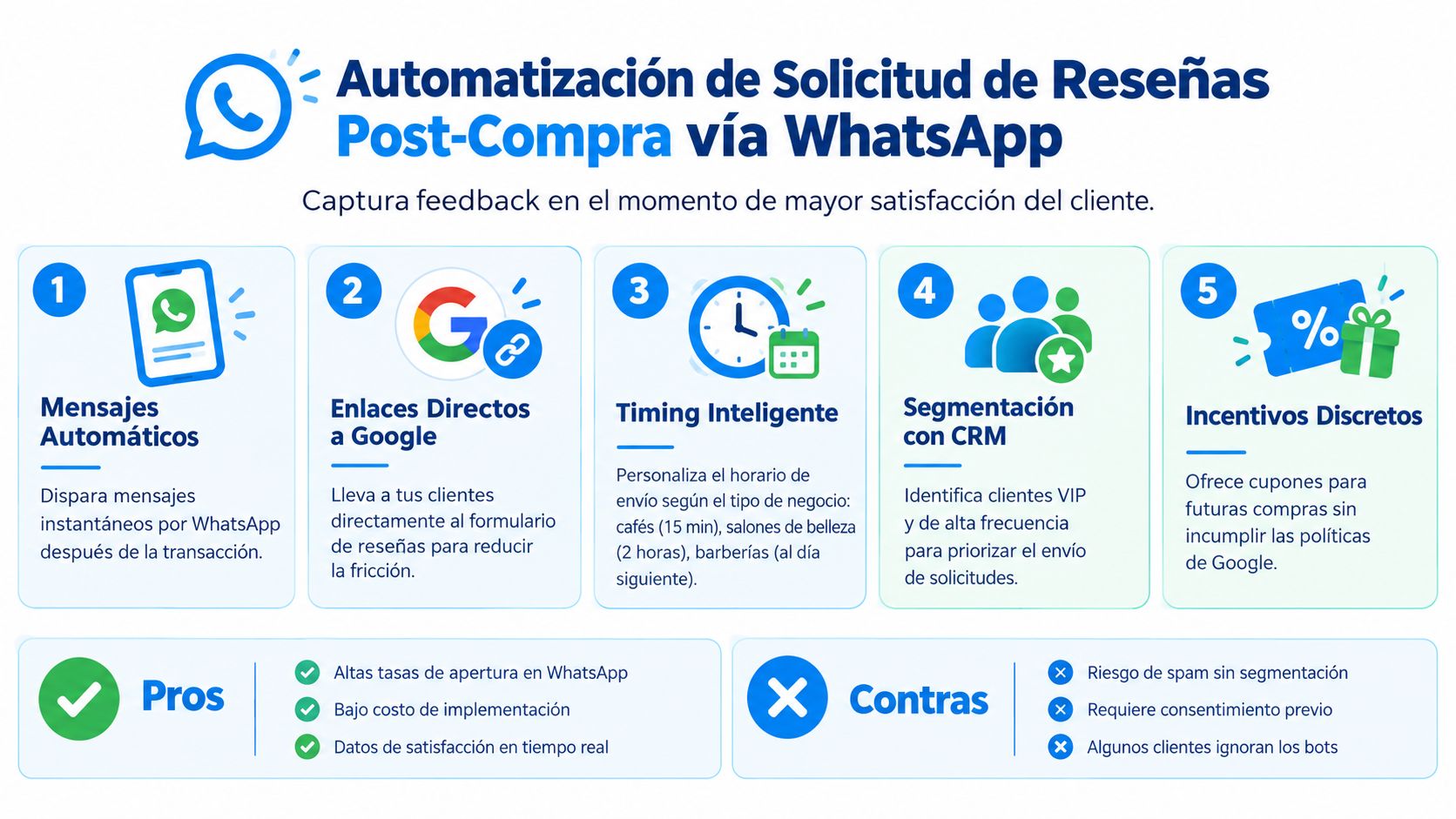
1. Automation of post-purchase review requests via WhatsApp
The request must arrive when the customer still remembers the product, the service, and the resolution received. For a coffee shop, it can be sent after confirming that the order was delivered correctly. In a barbershop or beauty salon, it should be related to the completion of the service, not the arrival at the premises.
WhatsApp reduces steps because the customer already knows the channel and can directly open the Google listing. Automation also prevents the team from forgetting to ask for feedback during peak working hours. A platform like Swirvle AI for WhatsApp can centralize contact, segmentation, and tracking of each request.
The flow must separate satisfaction from rating
The first message can include the customer's name and the type of service, but must retain a neutral tone. A brief satisfaction field helps detect problems and direct team attention to an issue, rather than blocking a negative review.
Automation can measure:
Timing of delivery: compare the behavior of customers contacted immediately after purchase with those who receive the message the next day.
Channel and schedule: observe deliveries, opens, clicks, and responses based on the audience.
Customer status: exclude contacts with an open complaint or a pending return, but without hiding the possibility of leaving a review.
Branch and service: identify if reviews relate to a specific drink, haircut, dish, or treatment.
Operational rule: an internal survey can detect dissatisfaction, but must never work as a filter to show Google only to those the business expects to give five stars.
The recommendation to send the follow-up after the service and wait between 24 and 72 hours appears in the guide on review requests after service. The business can test the appropriate timing within that window, always with consent for communications and with a request for an honest opinion.
2. Referral program without mandatory review
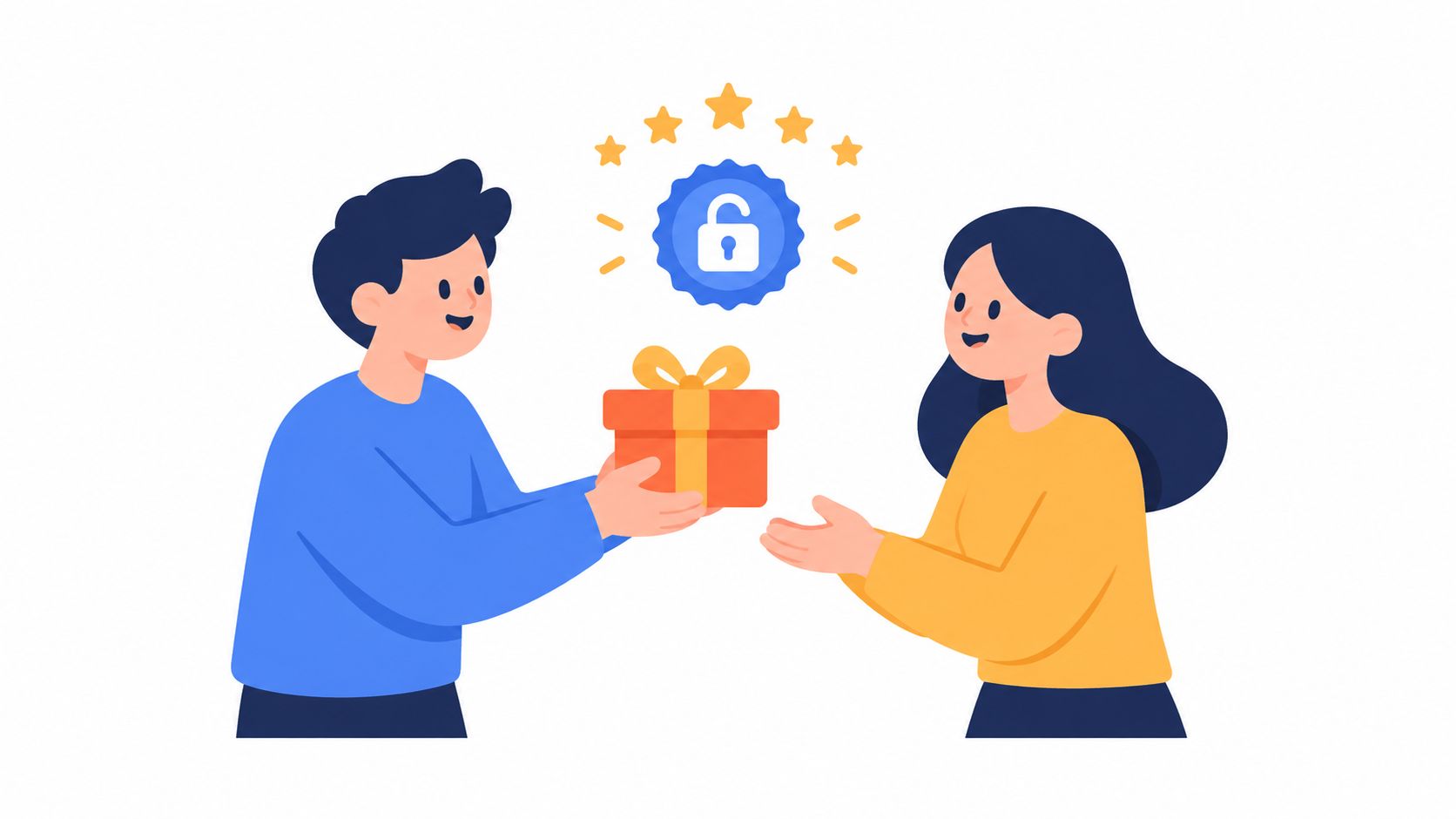
A referral program can increase retention and generate conversations about the business, but tying the reward to a published Google review poses a clear risk. Google prohibits offering money, gift cards, discounts, or other incentives in exchange for reviews, and also prohibits selectively asking for positive reviews, as explained in its policy on prohibited content in reviews.
The correct structure separates the two actions. The customer can receive points for a valid referral, while any customer, whether they referred someone or not, receives a neutral invitation to share their experience. The reward must depend on the referral or a valid purchase, not on a review appearing or its rating.
How to preserve the value of word of mouth
A coffee shop can offer points for bringing in a new customer. A restaurant can provide a benefit for a referred customer's first purchase. A barbershop can acknowledge the recommendation when the new customer completes their visit. The invitation to review must appear as an independent option, with equal access for positive, neutral, or negative opinions.
The process needs controls:
Separation of benefits: loyalty points are awarded for the referral, not for the review.
Clear communication: the message must state that Google allows any rating and that the reward does not depend on the stars.
Prudent reminders: follow-ups about the program can be scheduled, but do not persist until an opinion is obtained.
Review of patterns: unusual concentrations of reviews, accounts with no history, or identical messages deserve manual review.
Data protection: the business must only use contacts with consent and avoid asking for private information within the public review.
The low adoption of review platforms on commercial sites in Mexico, with only 3.4% of sites identified in that category, suggests that many SMEs can still differentiate themselves through organized processes, according to the measurement of review technologies in Mexico. The advantage is not in manufacturing opinions, but in turning legitimate recommendations into a measurable experience. Word of mouth practices for businesses work best when the referral, the reward, and the review maintain distinct purposes.
3. Differentiated experience for frequent customers with an invitation to review
Frequent customers know the business better, but that does not authorize selectively asking them for a review while excluding others. The opportunity lies in using history to improve service and then offering a personalized invitation, open to any rating.
A coffee shop can recognize a recurring customer's usual drink. A barbershop can record the preferred style and the professional who usually attends to them. A beauty salon can keep in mind allergies, scheduling preferences, or previous treatments. That knowledge does not buy a review, but it does reduce mistakes and creates a consistent experience.
The VIP criteria must improve operations
The CRM can define a segment of frequent customers with documented criteria, such as recurrence, tenure, and average purchase value. The team receives an alert upon arrival and consults only the information necessary to provide better service. It is not advisable to turn the segment into an automatic list of people who are always asked for a positive rating.
After an especially well-executed experience, the manager can send a human message one or two days later. The text should thank them for the visit, mention the service received, and provide a QR or direct link to Google. It can also offer format alternatives, such as a written review or an image, as long as the request does not condition the benefit or suggest which stars to choose.
Personalization must change the experience, not the customer's right to state their opinion.
Satisfaction has operational weight in Mexico. 87.3% of customer experience leaders consider it a priority, according to the regional reference on customer experience. This data helps interpret reviews as a sign of retention and repurchase, not just as a task for the marketing team.
A special visit also serves to discover what details generate useful comments. If the customer spontaneously mentions speed, cleanliness, atmosphere, or service, the team can record those topics as service learnings, without writing the review for them. For an SME that needs to improve service, it may be appropriate to contact Dr. Jonathan Uriarte to strengthen the service approach before intensifying requests.
4. Segmented campaigns by branch and performance
A brand with multiple locations should not distribute the same volume of requests to all branches. The decision must be based on local performance, recent activity, and the team's ability to resolve issues. A branch with few recent reviews needs to increase the conversation; another with open complaints needs to correct the experience before asking for more feedback.
The analysis available for Mexico shows that 88% of consumers read reviews before visiting a local business and that 52% consider both positive and negative ones, according to the guide on Google responses. That makes the branch a management unit, not just an administrative filter.
Each location needs a hypothesis
The CRM can create a weekly report with requests sent, clicks, published reviews, average rating, and response time by location. It should also exclude those who have already left a recent review to avoid fatigue and allow the team to focus effort on customers who have not yet received the invitation.
A useful campaign can combine WhatsApp, email, and push notifications based on consent and the customer's relationship with each branch. The text must name the location visited and ask for an honest opinion, without suggesting a score. The customer segmentation in Swirvle can organize these groups by consumption habits, branch, and visit frequency.
Internal competition is only healthy if it measures processes, not if it pressures staff to get artificial reviews. The manager can share that a branch received new reviews during the week, but must also check if those reviews reflect wait times, cleanliness, service, and product quality.
Decision metric: if a location gets more clicks but does not increase its published reviews, the problem may be in the link, the timing, consent, or the subsequent experience. It should not be solved by sending more messages indiscriminately.
Responding to every review offers a second opportunity for learning. The public response should thank favorable comments and address criticisms with respect, without revealing personal data or discussing sensitive details. Publishing internal results can motivate the team, but must never turn the customer into a mandatory source of points.
5. Customer-generated social content with a call to Google Reviews
User-generated content shows how a business is experienced, but a social media post is not equivalent to a Google review. A photo of coffee, a video of the atmosphere, or the result of a haircut can generate engagement without the intention of publicly rating the experience. Separating both objectives avoids measuring a post as if it were a conversion.
A coffee shop can ask for permission to repost an image of the product. A restaurant can highlight a dish and respond with a separate invitation to share the experience on Google. A barbershop or salon must request authorization before posting a transformation, especially if the customer's face is shown. Permission to use content must not be conditioned on posting a review.
The call to action must be optional
The link to Google can appear in a story, a pinned comment, or a personalized reply. The message should state that an honest opinion is requested, without asking for five stars or suggesting that a negative rating will harm the business. If the customer has already shared content, the business can thank them and offer the link as a next step, never as a requirement to mention them.
A CRM allows measuring the journey without confusing reach with reputation:
Permission for reuse: record whether the customer authorized publishing their image or testimonial.
Social interaction: measure replies, clicks, and visits to the link, without attributing every interaction to a review.
Source of the request: separate stories, posts, WhatsApp, and printed links.
Content quality: value detail, context, and authenticity, not just volume.
Final conversion: compare clicks with published reviews by industry, branch, and channel.
The freshness of reviews influences the perception of the business, according to the compilation of online review statistics. Therefore, it is advisable to maintain a reasonable cadence of content and requests, without repeating messages or persisting with the same customers. Automation can trigger the link after a social interaction, but must respect consent, leave the decision to the customer, and avoid any incentives conditioned on a positive rating.

Comparison: 5 strategies to get 5★ reviews
Strategy | Implementation Complexity | Resource Requirements | Expected Results | Ideal Use Cases | Key Advantages |
|---|---|---|---|---|---|
Automation of post-purchase review requests via WhatsApp | Low–Moderate: automated flows and consent compliance | WhatsApp API/CRM, templates, timing rules, little development | Increase in immediate reviews, higher open rate, and real-time satisfaction data | High transactional frequency businesses (coffee shops, restaurants, salons) | Capture at the optimal moment, high open rate, low cost |
Referral program with mandatory review | Moderate–High: review verification and reward management | Points/rewards platform, review tracking, investment in incentives | More reviews and referrals, more detailed reviews; risk of detection by Google | Businesses with the capacity to offer rewards (restaurants, barbershops, salons) | Aligns incentives with review generation, measurable ROI in referrals |
Differentiated service experience for VIP customers with an invitation to review | Moderate: semi-manual process and precise segmentation | VIP identification in CRM, trained staff, small costs for upgrades/gifts | Highly credible and detailed reviews, increased loyalty, and lower risk of detection | Companies with high-value and frequently repeating customers | High credibility, reinforces loyalty, avoids perception of manipulation |
Segmented review request campaigns by branch and performance | Moderate–High: multi-site integration and performance dashboards | Integration with Google My Business, multi-channel (email/WhatsApp/push), analytics | Targeted rating improvement by branch, A/B tests, rapid score recovery | Chains and franchises with performance variation among branches | Focuses resources where there is greater impact, creates local accountability |
Customer-generated social proof content + CTA to Google Reviews | Moderate: UGC management and constant moderation | Social media management, UGC incentives, link tracking, moderation | Increase in authentic visual content, higher engagement, and traffic to reviews | Brands with a strong social presence (coffee shops, salons, restaurants) | Authentic and shareable content, natural ambassadors, and greater organic reach |
Turn reviews into a continuous improvement system
The priority is not to launch five campaigns at the same time. An SME should choose a controllable touchpoint, such as the receipt, WhatsApp, or post-appointment follow-up, and document what happens before and after the request. The first flow can be simple: confirm consent, send a neutral message after the experience, include a direct link, and record the result.
The text must ask for an honest opinion, not a specific rating. If the customer has an open issue, the team must address it quickly, but they cannot prevent them from posting a review or redirect them to a private form with the intention of hiding a negative opinion. Google's policy considers fake and incentivized reviews problematic, so compliance is part of the reputation, not a separate legal detail.
The weekly dashboard should show:
Requests sent, by channel, branch, and type of service.
Clicks on the link, to detect friction in the message or destination.
Published reviews, separated from simple interactions.
Rating and recency, to understand current perception.
Conversion by branch, with context of customer volume and open issues.
Business responses, with review of tone, personalization, and resolution.
The most useful indicator is not chasing an isolated figure. It is identifying which service moment produces better comments and what failure generates repeated negative reviews. A coffee shop may discover that speed matters more in the morning; a barbershop may find that the explanation prior to the haircut reduces misunderstandings; a restaurant may detect that correct delivery weighs as much as flavor.
Swirvle can centralize segmentation, automations, and measurement panels to connect that data with WhatsApp campaigns, push notifications, and email. The tool does not substitute for consistent service, and no reward should depend on a positive review. Sustainable reputation appears when the business improves the experience, requests feedback legitimately, responds to all reviews, and turns patterns into operational decisions.
Swirvle centralizes customer data, segmentation by habits and branch, automated campaigns, and results measurement to organize the review request process. Visit Swirvle to evaluate how to integrate loyalty, post-sale follow-up, and reputation analysis into the operations of a physical SME.
Related Blogs

Sep 24, 2026
Strategies to get 5-star Google reviews

Sep 23, 2026
Digital marketing customer loyalty

Sep 22, 2026
Loyalty Marketing Services for SMBs: 2026 Guide

Sep 21, 2026
Strategic difference between a soft launch and a grand opening for a coffee shop

Sep 19, 2026
Effective promotions to increase sales during low-traffic hours: 2026 guide

Sep 18, 2026
Examples of coffee shop loyalty programs (physical and digital)
Try Swirvle for free
No card required · 30 days free
Start your free trial