Discover the strategic difference between a soft launch and a grand opening for a coffee shop: objectives, metrics, risks, and how to choose the right approach in Mexico.
There are 10 days left until opening. The lease is already running. Suppliers are asking for confirmation. The espresso machine is already installed. The owner checks uniforms, cups, bakery, the POS terminal, and a doubt that seems like marketing, but is not: to have a soft opening to test or do a major grand opening from day one.
That decision defines much more than the ribbon-cutting photo. It defines whether the coffee shop starts with measurable service times or with disorganized lines. It defines whether the first group of customers leaves useful data for CRM and loyalty or if it only leaves noise. It defines whether the business corrects cheaply or if it learns too late, right in front of the whole neighborhood.
In Mexico, this decision matters because the competition is already dense. INEGI reported 74,787 coffee shops in 2024, according to data released in 2026, and coverage based on the 2024 Economic Censuses pointed out that the number of coffee shops grew by 17,050 units between 2018 and 2023, with an average annual rate of 6.5% in establishments and 6.5% in employed personnel, according to the same statistical database published by INEGI. Opening poorly in a market like this is not cheap.
The thesis is simple. The soft launch buys learning. The grand opening buys attention. If the coffee shop has not yet mastered the bar, the register, dispatch, and data capture, it is better to learn first. Whoever decides without metrics buys tickets to correct mistakes at a high price.
Why this decision defines your coffee shop's first year
The day you open, you do not inaugurate a brand. You inaugurate a system of sales, service, and customer acquisition.
If that system fails in the first week, the problem does not stop at a bad anecdote. It turns into poorly processed tickets, wait times that scare off the second visit, weak reviews, and an empty database. That hits commercial survival directly. A coffee shop does not survive on the opening day line. It survives on recurrence, average ticket, and return frequency.
The right decision is made with operational criteria
The typical owner error is to discuss the opening as if it were just promotion. It is not. The serious question is this: does your operation already handle demand without losing control of the bar, register, and service?
If it does not handle it, holding a grand opening early is expensive. You bring in traffic before you have a process. And the first demand peak, which should serve to accelerate sales, ends up exposing flaws in front of customers who do not yet give you a margin of error.
The practical rule is simple. First stabilize. Then scale.
What defines the first year is not the event's photo
A well-chosen opening allows you to resolve four things that actually change the business's performance in the following months:
Product consistency. That the espresso, the milk, the temperature, and the delivery turn out the same in slow hours as in peak hours.
Payment control. That sales are not lost due to register errors, avoidable refunds, or poorly done shifts closes.
Real service capacity. That the team handles volume without breaking service times or customer treatment.
Data capture from day one. Name, phone number, consent, visit time, frequent product, and the channel through which they learned about the coffee shop.
This last point is usually treated as an accessory. It is a mistake.
If you open without a method to identify who came, who returned, and who agreed to leave their data, you are operating blindly. You cannot trigger second-visit campaigns, you cannot measure recurrence by cohort, and you cannot build a loyalty program with a real database. You are only accumulating passersby.
Soft launch and grand opening impact different metrics
The soft launch serves to lower operational risk and clean up friction before exposing yourself in a big way. The grand opening serves to concentrate attention and accelerate initial acquisition. Both can work, but they do not solve the same problem.
That is why this decision weighs so heavily in the first year. If you choose visibility over control, you buy reach with an immature operation. If you choose testing over exposure, you buy learning, correct cheaply, and arrive at the major launch with better chances of converting curiosity into recurring customers.
In a neighborhood coffee shop, that order matters more than the opening speech.
The goal is not to fill the place on a Saturday. The goal is to finish the first quarter with a stable operation, a useful database, and enough identified customers to work on repurchase and loyalty. That is where real survival begins.
What is a soft launch and what is a grand opening
Before comparing them, it is convenient to clarify the language. They are not synonyms. They do not fulfill the same function. They should not be used for the same problem.
In operational terms, a soft launch is a controlled opening aimed at a small group before the official opening; the grand opening is reserved for the general public and serves as a high-impact event to maximize visibility and initial demand.
What is a soft launch in operational terms
A soft launch is a rehearsal in real-world conditions. It is not a party. It does not seek to impress everyone. It seeks to find friction with real customers before exposing the brand in a big way.
For coffee shops and other physical businesses like barbershops or salons, this practice is understood as a test of processes, staff, and service before the grand opening.
In Mexican coffee shops, a specific recommendation is to operate the soft launch with limited guests, a reduced menu, and a period of 2 to 3 days to detect flow failures, service times, and POS performance. In practice, it is proposed to work with 50 to 100 attendees and a menu that covers approximately 80% of the final offering.
What a real grand opening is
The grand opening is something else. It is a public event with the goal of visibility, social proof, and initial acquisition. The logic is not to learn in private, but to amplify an already refined version of the business.
In coffee shops, the sequence recommended by local guides is to do a digital pre-launch, then a soft opening with feedback, and then the official opening with measurable objectives in the first 90 days as this reference states.
The soft launch corrects. The grand opening accelerates. Reversing the order is usually expensive.
What each one measures
A serious owner should separate metrics.
In a soft launch, it is convenient to measure:
Time per ticket
Billing errors
Drink consistency
Repeated complaints
Early recurrence
Captured data per customer
In a grand opening, it is convenient to measure:
Attendee registration
Conversion to second visit
Channel that brought the customer
Promotion redemption
Volume of initial reviews
New database for CRM or loyalty
A restaurant uses this logic to test the kitchen and pass. A barbershop uses it to validate schedule, times per chair, and price communication. A salon uses it to refine service protocols and idle times between appointments. The principle is the same. First you stabilize the experience. Then you amplify it.
Strategic comparison between both launches
Choosing between one and the other should not depend on the taste of the loudest partner. It must be resolved with operational and commercial criteria. The following table serves to decide with pencil in hand.
Soft launch vs. grand opening according to what the coffee shop needs
Criterion | Soft launch | Grand opening |
|---|---|---|
Main objective | Validate operation, correct flaws, capture learning | Gain visibility, attract traffic, strengthen positioning |
Nature | Controlled trial with limited access | High-impact public event |
Duration | Several days or weeks of testing | One day or a short activation window |
Public exposure | Low and controlled | High and open |
Menu | Trimmed down to reduce complexity | Stable menu or already defined experience |
Ideal team | Base staff in learning mode | Full team or reinforced for volume |
Dominant risk | Detecting slowness, errors, and bottlenecks | Exposing service flaws in front of a wide audience |
Critical metrics | Service time, errors, consistency, early recurrence, captured data | Registration, attendance, redemption, second visit, reviews, and follow-up |
Type of invitation | Curated, by list, neighbors, close circle, and selected customers | Massive, open, and oriented to awareness |
Correct commercial use | Refine before scaling | Scale an operation that already works |
The practical implication of each choice
If the coffee shop prioritizes a soft launch, it sacrifices immediate reach. In return, it gains control. That helps correct recipes, bar sequence, stocking, and cash flow without testing the general public's patience.
If it prioritizes a grand opening without a prior trial, it buys attention before having operational certainty. It can go well. It can also turn every service error into an early review, a neighbor complaint, or a visit that is not repeated.
A strong opening does not correct a weak operation. It only makes it more visible.
The Mexican context makes this comparison more serious
The strategic difference between a soft launch and a grand opening for a coffee shop becomes clearer when looking at the size and concentration of the sector. An analysis of specialized coffee shops in Mexico found that these businesses had operated on average for 4.8 years, with establishments as new as 0.3 years and as mature as 25 years. In addition, coverage based on INEGI indicated that the State of Mexico, Mexico City, Jalisco, Puebla, and Guanajuato concentrated half of the country's coffee shops according to this sector analysis.
The practical reading is clear. In competitive markets, the initial launch is not a mere formality. It is a test of execution. If the coffee shop is in a neighborhood with direct competition, a bad first impression does not just fade away on its own.
How this logic applies in coffee shops, barbershops, and salons
The mechanics are the same, but the design changes depending on the industry. What a coffee shop needs to test is not the same as what a barbershop or a beauty salon must validate.
Application of soft launch vs grand opening by industry
Industry | Soft launch: duration and focus | Grand opening: event emphasis |
|---|---|---|
Coffee shop | Short testing window for the bar, bakery, payments, delivery times, and data capture | Product activations, local community, attendee registration, and second-visit promotion |
Barbershop | Brief test of scheduling, times per chair, cleanliness, reception, and price clarity | Atmosphere, space presentation, socializing, and future bookings |
Beauty salon | Validation of service protocols, times between appointments, staff coordination, and package sales | Opening appointments, demonstrations, promotional packages, and customer follow-up |
Coffee shop
In a coffee shop, the soft launch should focus on what breaks down most under real pressure: bar, milk, grinding, raw materials replacement, bakery output, and payments. If any of those points fail, the entire experience collapses.
A grand opening in a coffee shop is only worth it when there is already consistency. If the star drink comes out different between shifts, if the register gets stuck, or if delivery takes longer than tolerable for daily consumption, the business burns visits that could have become a habit.
Barbershop and salon
In a barbershop, the test is more compact. The focus is on scheduling, real time per service, tolerance for delays, and the reception. The grand opening can afford to have a more showy layer, because the service is more scheduled and less dependent on simultaneous production.
In a beauty salon, the logic changes again. There, it is convenient to validate service sequence, space preparation, idle times between services, and communication of what the package includes. A grand opening without that base usually saturates the schedule and generates uncomfortable wait times.
The same opening concept should not be copied across different industries. Each business has a different bottleneck.
The local variable that many underestimate
Neighbor permits, shopping mall restrictions, capacity, noise, and circulation change the convenience of the event. A neighborhood coffee shop with a small terrace cannot copy the grand opening of an anchor store in a mall. Neither can a barbershop with narrow access.
The useful rule is simple. The more fragile the operation and the more sensitive the environment, the more a controlled opening is recommended before making noise.
Step-by-step operational planning for a soft launch
A well-executed soft launch is not designed to maximize revenue. It is designed to learn quickly, record errors, and correct them before the big event.
For restaurants, a specific operational reference proposes executing the soft opening between 1 and 3 weeks before the official opening, with at least 5 or 6 real services, occupancy reduced to 40% to 60%, and a menu cut down to 60% to 70% of the final menu according to this technical reference. For a coffee shop, that framework works very well if adapted to the bar and counter.
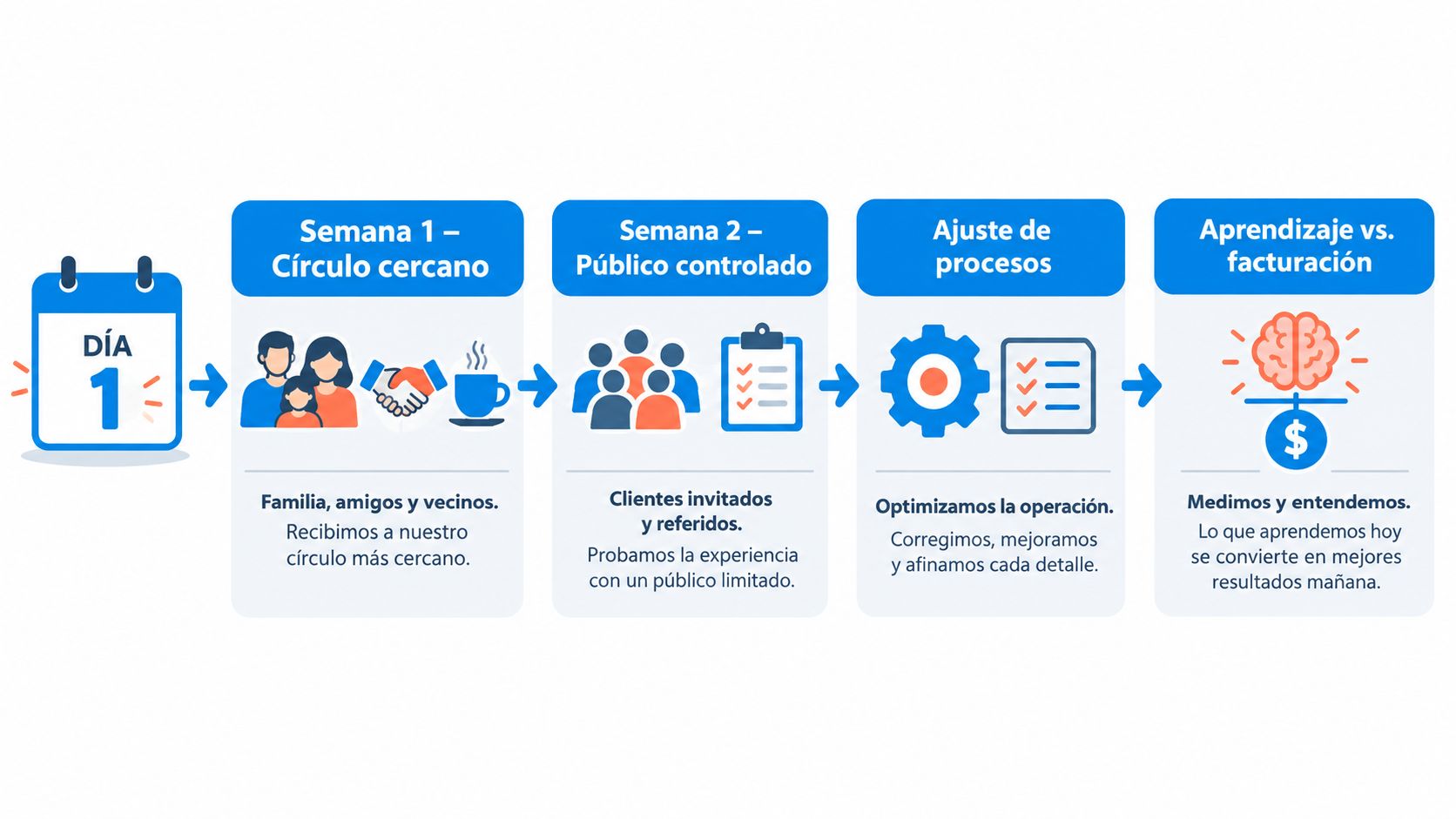
Week 1 closed and useful
The first phase must be closed. Family, partners, suppliers, close neighbors, and some identifiable potential clients. It is not convenient to fill the premises out of social obligation. It is better to bring in people who observe, wait, try, and give honest feedback.
At this stage, the coffee shop should operate under these rules:
Trimmed menu: few products, but the ones you actually want to sell well.
Limited capacity: less pressure, more visibility of errors.
A clear payment flow: ideally a main method already tested.
Registration from day one: name, phone number, visit, and brief observation.
Week 2 with a controlled public
The second phase can now be opened more, but with control. The invitation can be sent via broadcast list, QR in the window, neighborhood groups, or a simple dynamic. The important thing is not to "fill." The important thing is to measure who came, at what time, what they ordered, and if they returned.
A functional message would be this:
Trial opening this week. Partial menu, limited slots, and a gift on the second visit for those who register upon arrival.
That type of invitation filters expectations. People understand they are going to a test, not a perfect experience. And the business gains permission to adjust.
What to measure without getting complicated
A soft launch is ruined when the owner wants to measure everything. It is better to focus on a few useful variables.
Service time
From order to delivery. If it varies too much between similar tickets, there is a process issue.Error rate
Incorrectly made drink, misread modification, incorrect payment, or product out of stock without notice.Average ticket
Not for financial ambition, but to see if the menu pushes full or individual purchases.Early recurrence
Who came back within a few days. That is worth more than a line of curious people.Brief verbal feedback
One question is enough: what would you order again and what wouldn't you.
For coffee shops that want to convert this trial into a CRM database, it is best to combine registration, observations, and subsequent follow-up. A useful reference to activate a more controlled experience is this guide on how to organize a private coffee tasting, because it serves to invite, register, and evaluate without unnecessary noise.
Grand opening planning for maximum visibility
When the operation is already stable, the grand opening does make sense. But it must be designed for something more ambitious than a line, photos, and discounts. It must serve to capture data and convert that peak of attention into repeated consumption.
The competitive context demands it. INEGI's DENUE reports more than 6 million establishments in the country, and an INEGI sector publication identified 581,530 restaurants. In addition, Canirac estimated that in 2024 there were around 730,000 food and beverage establishments and that 80,000 new businesses were opened that year according to the DENUE reference. In such an environment, opening with noise without a follow-up mechanism is wasting expensive attention.

Useful operational sequence
T-30
Define campaign image, reason for the visit, and a simple narrative of the concept. No need to exaggerate. It is enough to make clear what makes the place special and what the customer should try first.
T-15
Activate pre-registration. The classic mistake is to invite without capturing anything. It is better to use a short form or simple registration on a landing page, message, or QR. The minimum data is name and contact information.
T-7
Warm up the audience with behind-the-scenes content, product trials, setting up the space, and reminders. This content should not inflate unrealistic expectations. It should prepare the customer to attend and register.
The day of the event
The grand opening has to compel a measurable action. If you give something away, make it conditional on registration. If you offer a dynamic, have it capture data. If it promises a future benefit, make sure it can be tracked.
A coffee shop can use:
Short tasting of a signature drink
Latte art demonstration
Promotion for second visit
Simple referral dynamic
Registration to learn about launches and rewards
An opening without data capture is fleeting advertising. It generates movement, but it does not build commercial memory.
T+30 and the mistake almost everyone makes
Follow-up defines whether the grand opening worked or not. Without follow-up, the business only accumulated attendees. With follow-up, it begins to build cohorts of customers.
To trigger concrete ideas from that first impulse, it helps to review approaches for high-impact promotions for the first day of opening, but with one condition: every promotion must push for a second visit, not just instant consumption.
The question that matters at the close of the month is not how many people went. It is how many people returned.
When to choose each approach and how to boost it with CRM and loyalty
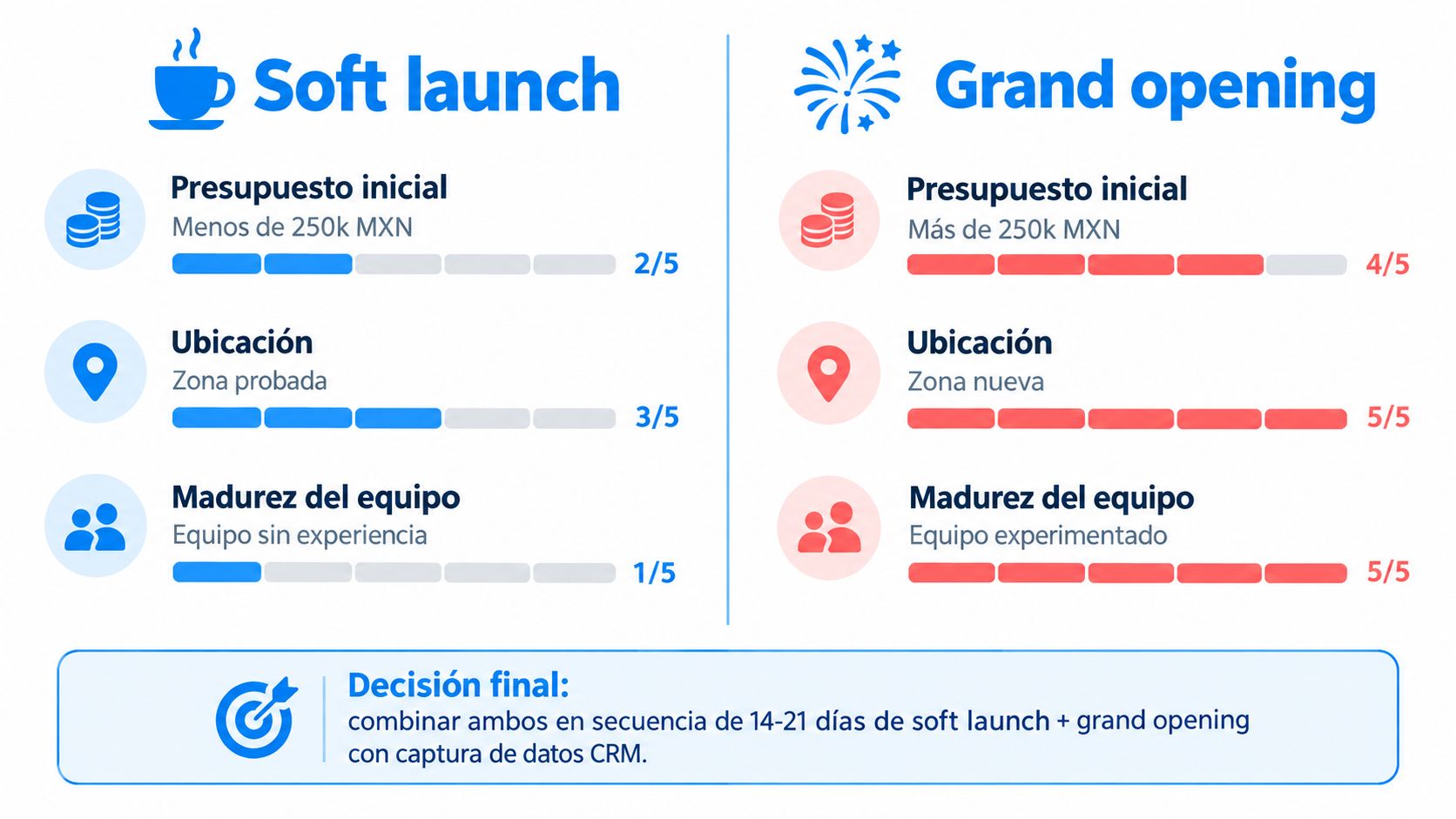
The short answer is this. Almost no coffee shop should choose just one. The correct path is usually a sequence. First a soft launch to validate. Then a grand opening to accelerate.
When a soft launch should be mandatory
If the initial budget is limited, if the team has never operated full service, or if the menu has too many variables, the soft launch is not open to discussion. It is done. Even in the comparative visual of these types of decisions, the soft launch usually aligns with scenarios of under 250k MXN, proven areas, and less mature teams.
It is also suitable when the real priority is to build clean data. A coffee shop needs to know early on who buys in the morning, who returns for bakery products, who only comes on weekends, and who responds to a simple reward. That learning does not come from an anonymous crowd. It comes from a controlled opening.
When the grand opening does deserve investment
The grand opening is convenient when there is already a calibrated operation and the branch needs a boost of local awareness. It can be very useful in a new area, in a mall with high traffic, or in a visually strong concept that benefits from initial word-of-mouth.
But even in those cases, it should not operate only as an event. It must function as the first major entry into the CRM and the loyalty program. If the coffee shop cannot register attendees, segment them, and reactivate them, it is leaving the job half done.
The bridge between both
The strategic difference between a soft launch and a grand opening for a coffee shop is not solved only with logistics. It is solved with a data system. During the soft launch, it is convenient to test the registration flow, segmentation tags, and the second-visit reward. During the grand opening, that same flow must already run without friction.
A platform like Swirvle can help centralize data, segment by consumption habits and branch, and trigger automated campaigns via WhatsApp, push, or email. There is the useful point. Not only organizing contacts, but converting the launch into a measurable recurrence base.
To go deeper into that stage, it is convenient to check how to create a loyalty program that works and is not just a pretty card, because the grand opening should lead there, not end with the event's photo.
Simple decision tree
If the team is not refined, soft launch first.
If the menu is still changing, soft launch first.
If the location is new and the brand needs local noise, grand opening after the rehearsal.
If there is already consistency and follow-up capacity, it is worth investing in a strong opening.
Three minimum loyalty triggers from day one:
Useful registration: do not ask for data just for the sake of it. Ask for what is necessary to contact them again.
Clear reward: second visit, not a generic gift without follow-up.
Early segmentation: separate neighbors, office workers, weekend visitors, and frequent customers.
A coffee shop does not fail because it did not hold a showy opening. It fails more easily when it confuses attention with traction and opens without learning.
Swirvle helps a coffee shop not waste its opening on one-off visits. It centralizes customer data, activates loyalty, and automates follow-up to turn a soft launch or grand opening into measurable recurrence. To ground that logic in a real operation, it is recommended to visit Swirvle.
Related Blogs

Sep 21, 2026
Strategic difference between a soft launch and a grand opening for a coffee shop

Sep 19, 2026
Effective promotions to increase sales during low-traffic hours: 2026 guide

Sep 18, 2026
Examples of coffee shop loyalty programs (physical and digital)

Sep 17, 2026
Pros and cons of the "free coffee for the first 100 customers" promotion

Sep 16, 2026
How to organize a private coffee tasting: a practical guide

Sep 14, 2026
How to optimize Google Business Profile for barber shops
Try Swirvle for free
No card required · 30 days free
Start your free trial