
Discover examples of coffee shop loyalty programs (physical and digital), along with tactics, metrics, and messages to increase visits and sales.
Loyalty begins with concrete behavior. The best program is not the most sophisticated, but the one that rewards the profitable action a coffee shop wants to repeat: an additional visit, a higher ticket, a recommendation, or a recurring purchase. The choice changes completely if the business needs to form a habit, raise consumption per occasion, or win back customers who stopped returning.
In Mexico, more than half of the coffee shops were already offering some loyalty program in 2019, according to evidence on loyalty in Mexican coffee shops. Additionally, a study cited by the industry reports that 91% of respondents actively participate in at least one loyalty program and that 82% would switch brands for the right incentive (loyalty industry analysis in Mexico). The opportunity exists, but a poorly aligned reward can attract registrations without creating recurrence.
The following examples are organized by the behavior they seek to modify. Each model includes when it is appropriate, how to implement it, what to measure, and adaptable texts for store, WhatsApp, email, or notifications. The safest decision consists of starting with simple mechanics, verifying real behavior, and scaling later with data, segments, and automation.
1. Points program per purchase
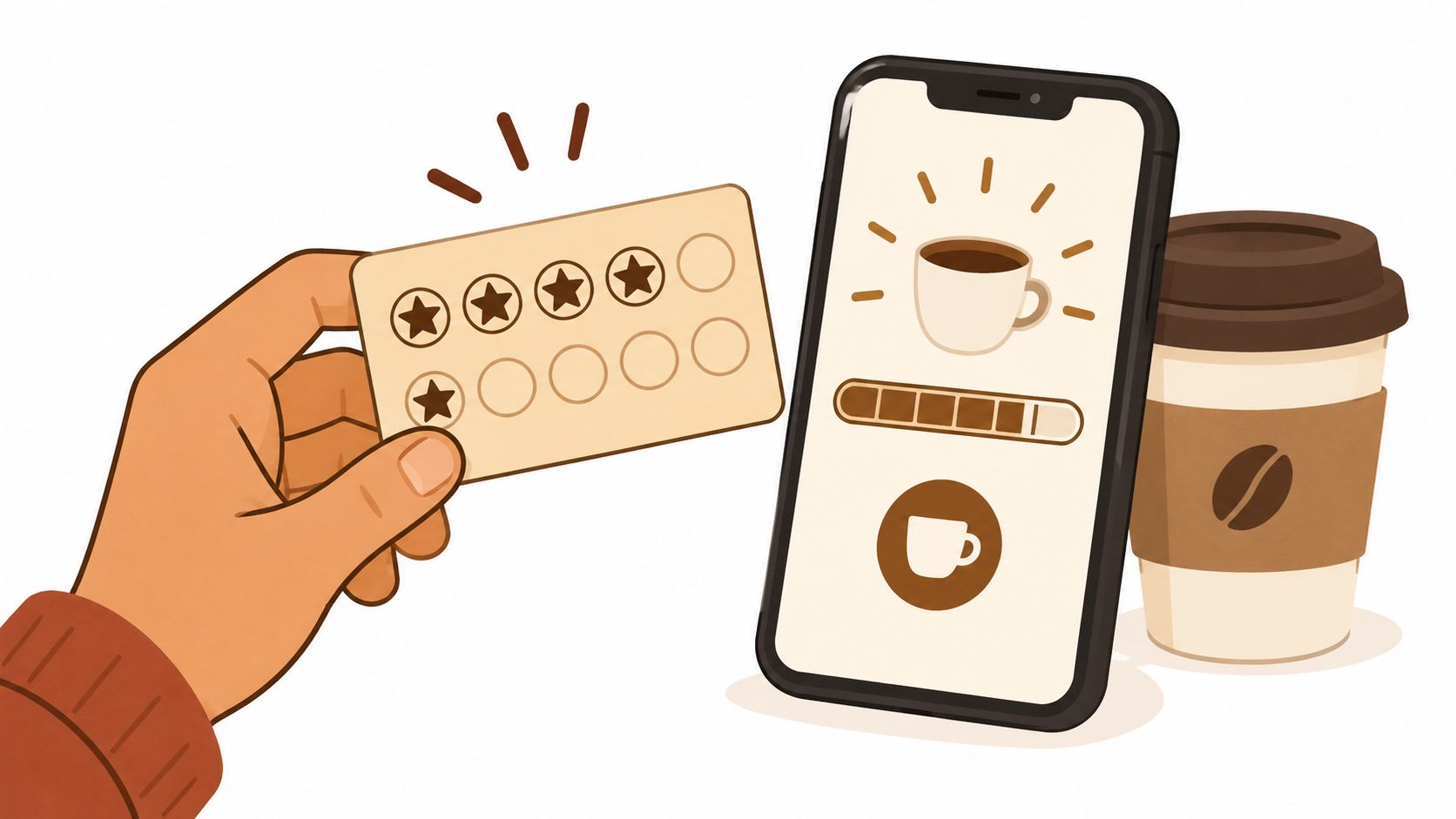
The points program per purchase works when the coffee shop needs to connect spending and reward. Each transaction adds units that the customer can redeem for drinks, pastries, sides, or configurable discounts. A physical stamp card can serve a simple operation, while WhatsApp, an app, or a CRM allow checking the balance and registering the purchase without depending on a card that the customer might lose.
The rule must be transparent. The business has to define which products generate points, which items can be redeemed, and how the margin is protected. A high-turnover beverage can work as a reward, while an expensive product might require more accumulation. The system must also distinguish between accumulated points and redeemed points, because outstanding balances represent an operational liability and can distort perceived profitability.
When to choose points
Points are suitable for coffee shops with diverse menus, variable tickets, or customers who buy different combinations. They can also work in a restaurant, a barber shop, or a beauty salon, provided that the spend per visit changes and the business wants to reward total value, not just arrival at the premises.
The minimum implementation needs one registration per customer, an accumulation rule, a redemption catalog, and a balance report. Integration with the POS reduces errors, but a hybrid card may be sufficient to validate the concept before investing in a platform. To evaluate the design, it is useful to review purchase frequency, average ticket, points issued, points redeemed, and margin after the reward.
Operational rule: the customer must understand how they earn and how they redeem in a brief explanation. If the team needs to check several conditions at checkout, the mechanics already have too much friction.
The counter text can be: “Every purchase adds points for drinks and food. Would you like to register and check your balance via WhatsApp?”. On WhatsApp: “Your purchase has already added points. Reply to check your balance and see available rewards.” Before choosing this option, it is worth reviewing if a points card is worth it or just adds work.
2. Frequency program by visits
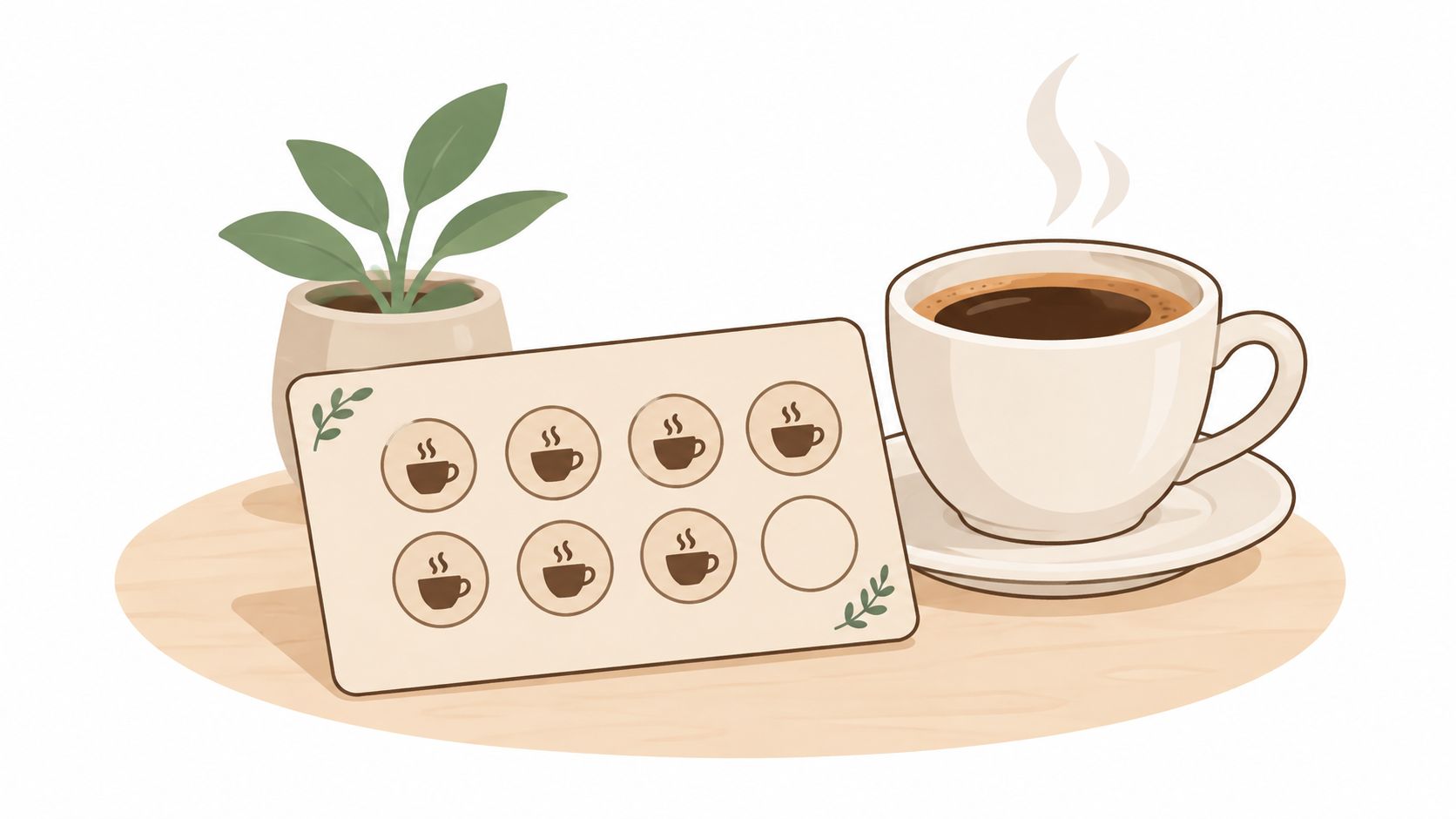
A visit card seeks a different behavior: returning, even if the customer does not increase the amount of each purchase. The coffee shop validates one visit per consumption and delivers a drink or benefit upon reaching the goal. The format can be a cardboard card, a paper stamp, a digital counter, or a QR code that staff activate from the counter.
This mechanic fits particularly well with frequently consumed, low-ticket beverages. A neighborhood coffee shop can use it to turn an occasional choice into a routine. A restaurant with less frequent visits would have to adapt the reward to its purchase cycle, while a barber shop or a beauty salon could use visits to stimulate the next appointment.
The advantage and the limit of the stamp
Visible progress is its main strength. The customer knows how many visits are left and staff can explain the program without talking about monetary equivalencies. Its limit is also clear: it rewards frequency, not the ticket. If one person buys a basic drink and another adds food, both can advance the same.
To implement it, the business must define what counts as a visit, what happens with multiple purchases at the same time, and how the counter restarts after redemption. A QR code avoids lost cards and allows sending reminders, but requires the team to validate each registration consistently. The main metric is the visit frequency of those enrolled, accompanied by participation rate, redemptions, and cost of the reward per incremental visit.
The in-store message can say: “Each visit adds a stamp. Complete your card and receive a selected drink.” For WhatsApp: “Your card has registered progress. Return this week and get closer to your next reward.” The comparison between a digital stamp card and a loyalty app helps assess the balance between simplicity, control, and data.
3. Digital tiered program
Tiers serve to modify value and retention, not just to trigger the next visit. The customer advances through categories such as Bronze, Silver, or Gold based on accumulated spending or activity. Each step must offer progressive benefits, for example early access to products, service advantages, differentiated rewards, or special conditions for higher-value customers.
The coffee shop needs reliable data so that the tier reflects a real relationship. A digital dashboard can show progress, current benefit, and the path to the next level. There must also be a clear rule about the duration of the status. A periodic renewal can keep the relationship active, while a permanent tier reduces the sense of loss but can make progress feel less relevant.
When it makes sense to complicate the experience
This model is appropriate when an active base already exists and the business knows its purchase patterns. A coffee shop with little data may end up creating arbitrary tiers. A restaurant can link them with reservations or experiences, a barber shop with appointment priority, and a beauty salon with early access to services. The reward does not have to be a higher discount. It can also be recognition, availability, or convenience.
Implementation should begin with few tiers and easy-to-explain differences. Each benefit must have a controlled operational cost. If the top tier promises priority attention, staff must be able to deliver it during peak hours. If it offers exclusive products, inventory and communication must be aligned.
The most useful metrics are movement between tiers, average ticket per tier, frequency of premium members, retention in each category, and actual utilization of benefits. A tier that almost no one reaches does not create aspiration, it creates distance.
Text for email: “Your activity is getting you closer to the next tier. Check your available benefit and find out what is needed to unlock the next advantage.” In notification: “New tier available. Your next visit can activate an additional benefit.” The message must sell visible progress, not an endless list of rules.
4. Referral or word-of-mouth program
Referrals aim for acquisition. An active customer receives a personal code, link, or QR to share with friends and family. When the invited person makes their first purchase, both parties receive a reward. The coffee shop turns a personal recommendation into a trackable action, instead of leaving it as a conversation impossible to attribute.
WhatsApp is a natural channel for this dynamic. The customer can share a link from their phone and the business can confirm when the first purchase is validated. The same scheme can work for a restaurant wanting to attract groups, a barber shop seeking new clients, or a beauty salon that works with recommendations among acquaintances.
How to control the cost of acquisition
The reward must be activated after a validated purchase, not upon registration. This way, the business pays for a verifiable acquisition. It is also advisable to limit the operation to one code per customer, record the identifier of the referrer, and monitor anomalous patterns, such as multiple sign-ups with repeated details.
The available evidence shows why this control matters. A benchmark that analyzed 1.47 million transactions linked to loyalty programs in Latin America reported an acquisition rate of 57.13% and a retention rate of 42.29% for Mexico in sectors like coffee shops, QSR, and retail (digital loyalty benchmark in Mexico). The strategic takeaway is direct: acquiring users is not enough. The referral must enter a subsequent welcome and second-purchase sequence.
Metrics: shared referrals, attributed first purchases, cost of reward, link conversion, and subsequent recurrence of the new customer. The text can be: “Invite someone who doesn’t know us yet. When they make their first purchase, both receive a benefit.” On WhatsApp: “This link is personal. Share it with whoever enjoys coffee and activate the reward when their first purchase is registered.”
5. Birthday and celebration program
Birthdays and anniversaries modify emotional connection and retention. The coffee shop requests a date, explains what it will be used for, and sends an offer at the right time. The reward can be a drink, food, a discount, or an exclusive benefit, always with simple conditions to avoid arguments at checkout.
The model is hybrid because capture and communication can be digital, while redemption happens on-site. WhatsApp and email allow automating the notice; the POS can record the redemption to avoid duplicate redemptions. In a barber shop, it can be applied to birthdays or customer anniversaries. In a beauty salon, it can be linked to a self-care visit, without requiring a massive campaign.
Personalization without overexposing data
Birthdays are personal information. The business should ask only for what is necessary, explain the use, and protect access. Identity validation can be simple when the benefit is limited, but a higher-value reward requires controls that do not make the experience uncomfortable.
The offer must be designed to drive a visit, not just a discount. A free drink can attract a complementary purchase. A benefit for two people can stimulate company, but also raises the cost. The coffee shop has to track redemptions, associated sales, win-back customers, and subsequent churn, in addition to the campaign response rate.
The email message can say: “The coffee shop has a little something to celebrate your day. Show this benefit at the branch within the indicated period.” On WhatsApp: “Happy birthday. A complimentary drink is now available at your usual branch. See redemption conditions.” The communication should feel personal and not like aggressive data mining.
6. Automatic recurring purchase program
Subscriptions seek recurrence and predictable revenue. The customer chooses a drink or package, defines a frequency, and authorizes recurring payments. This could be coffee for an office, drinks for a weekly routine, or a selection for students. The flexibility to pause, change, or cancel is not a technical detail, it is part of trust.
The coffee shop must calculate the cost of the product, preparation, delivery if applicable, and payment administration before publishing the offer. A flat discount can simplify communication, but the business needs to verify that the recurrence does not erode the margin. It must also define what happens with declined payments, out-of-stock products, holidays, and renewals.
Service flow decides feasibility
This model requires a robust payment system and communication prior to each renewal. Expired cards or insufficient funds can disrupt service. A clear screen to update the payment method reduces manual work, while a difficult cancellation can turn a commercial advantage into a complaint.
For an office, the message could be: “Receive your coffee selection at your chosen frequency and pause the plan when your needs change.” In a notification: “Renewal is coming up. Review your product and payment method before the indicated date.” Metrics should include active subscriptions, successful renewals, pauses, cancellations, payment declines, actual benefit usage, and margin per subscriber.
Subscriptions should not be launched just because they generate automatic payments. It is best to test them with customers who already buy regularly and then check if the plan increases retention without overwhelming operations. In other physical businesses, like barber shops, it can be transformed into a service membership, but the calendar and installed capacity must support the promise.
7. Gamified program with challenges and tasks
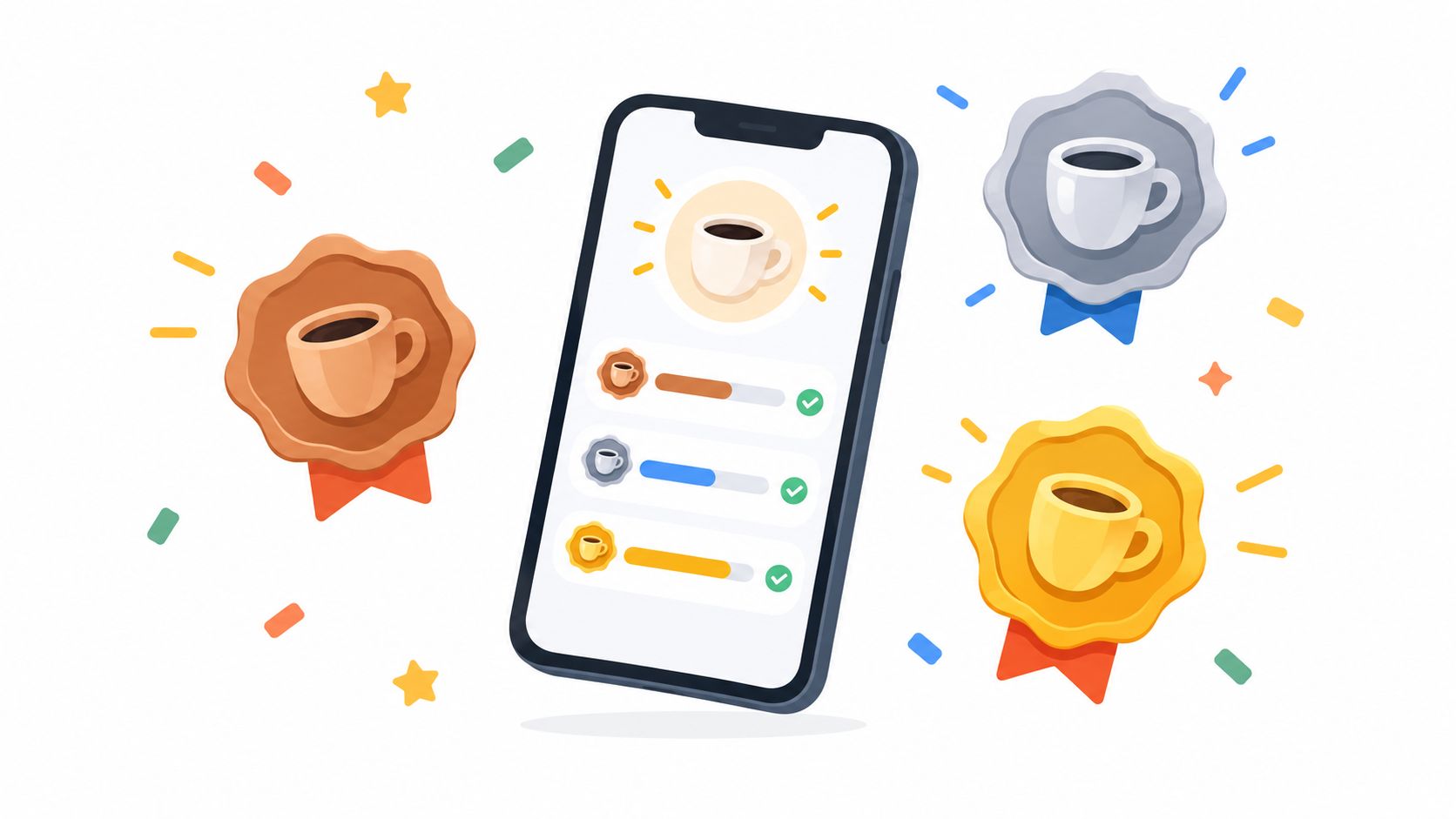
Gamification modifies exploration, frequency, and ticket through concrete missions. A challenge might ask to try a seasonal drink, visit multiple times during a period, or pair a drink with food. The customer tracks their progress, receives a badge, or unlocks a reward. The design works best when the playful activity drives a specific commercial action.
A coffee shop can use a challenge to move new products, fill off-peak hours, or boost add-ons. A restaurant can create challenges around dishes or categories. A barber shop could reward consecutive visits or complementary services. The difference lies in not turning the game into a simple point counter unrelated to the store's results.
Designing challenges that actually convert
The challenge must have an action, a deadline, visible progress, and a sustainable reward. A leaderboard may motivate certain customers, but it can discourage those who know they won't reach the top spots. A better alternative is to combine individual goals with collective recognition or exploration achievements.
The coffee shop needs to refresh challenges to avoid repetition. It must also guard against “gaming,” meaning actions that increase registered activity without producing profitable sales. Metrics are participation, completion, explored products, frequency during the challenge, average ticket, redemption, and incremental margin.
In-store text: “Try the seasonal drink and activate the challenge from the QR code at the counter.” On WhatsApp: “You have a challenge available. Complete the mission and receive the indicated reward.” In notification: “Your progress changed. One action left to unlock the benefit.” Clarity matters more than the number of badges.
8. Smart data and analysis program
CRM with automation turns purchase data into decisions for retention, reactivation, and attribution. It centralizes branch, frequency, favorite products, and campaign responses to avoid blasting the same promotions to the entire database. It then triggers messages based on specific signals, such as a welcome, a repurchase reminder, or a win-back.
The objective must be defined by behavior. The coffee shop can segment by habit, branch, or purchased category, and link each group to an action: increase frequency, win back inactive customers, boost a category, or raise the ticket. A restaurant can recommend products related to the last order; a barber shop can remind of an appointment; a beauty salon can separate services and preferences. Quality depends on complete, identified, and updated data.
Automation with operational control
The flow starts at the point of sale. Each transaction feeds the profile and allows associating the corresponding reward or coupon. WhatsApp, email, and push notifications serve to execute campaigns, always with frequency limits. An irrelevant promotion can silence the channel, reduce response rate, and cause unsubscribes from the database.
The analysis must combine commercial and operational indicators: average ticket, lifetime value, churn rate, reactivation, redemption, attributed sales, and ROI per campaign. It is also useful to compare segments, identify who responds, and detect who only consumes benefits. Thus, automation reduces intuitive decisions without substituting margin control.
Data principle: the right message reaches the right customer, through the right channel, after a behavioral signal that the business can explain.
Implementation requires a prior step: defining what data is captured, what event triggers contact, what benefit can be sustained, and when communication stops. This order prevents automating errors and allows measuring if each campaign modifies frequency, ticket, retention, or recurrence.
A coffee shop that needs to centralize these processes can look into an AI-powered CRM to automate campaigns and consult the capabilities of Swirvle. An adaptable reactivation text would be: “Your visit is missed at your usual branch. There is a benefit available to return and discover a recommendation based on your previous purchases.”
Comparison of 8 loyalty programs for coffee shops (physical and digital)
Program | Implementation Complexity | Required Resources | Expected Results | Ideal Use Cases | Key Advantages |
|---|---|---|---|---|---|
Points Program per Purchase (Physical and Digital) | Low–Medium (hybrid possible) | Cards/app, POS integration, reports | Higher purchase frequency and consumption data | Coffee shops with recurring customers; hybrid model | Easy to understand, motivates repetition, generates data |
Frequency Program per Visits (Stamp or Digital) | Very low | Physical cards or digital counter | Increases frequent visits; stable ticket | Venues with low average ticket and high traffic | Simple, low cost, generates predictable traffic |
Tiered or Levels Program (Digital) | High | App/CRM, tier and benefits management | Increase in LTV and average ticket | Premium cafes and high-spend customers | Creates aspiration, segments, and retains VIP customers |
Referral or Word-of-Mouth Program (Digital with Physical Incentive) | Medium | Codes/QR, tracking, communications (WhatsApp) | Efficient and viral acquisition | Businesses with an active base and heavy WhatsApp usage | Low cost per acquisition, social trust, scalable |
Birthday and Celebration Program (Hybrid) | Low–Medium | Dates database, message automation | Specific visits and higher emotional retention | Retain inactive customers and build loyalty in occasional ones | Highly personalized, low cost per reward |
Automatic Recurring Purchase Program (Digital Subscription) | High | Payment processing, subscription platform, compliance | Predictable revenue and high retention | Offices, students, high-consumption customers (B2B/B2C) | Recurring revenue stream, reduces purchase friction |
Gamified Program with Challenges and Tasks (Digital) | Medium–High | App/automations, leaderboard, challenge design | Higher engagement, frequency, and average ticket | Young demographics, cafes with varied menu | Highly engaging, encourages product trials and competition |
Data and Smart Analysis Program (CRM + Automation) | High | CRM platform (Swirvle), POS integration, clean data | Data-driven retention and measurable ROI | Businesses looking for scalability and personalization | Personalization at scale, automation, and clear measurement |
Choose the mechanic you can measure and sustain
The right selection depends on the behavior the coffee shop wants to change. Frequency per visits serves to form habits. Points balance frequency and spend. Tiers recognize high-value customers. Referrals support acquisition. Birthdays build emotional connection. Subscriptions organize recurring revenue. Challenges drive exploration. CRM coordinates data, messages, rewards, and attribution.
Mexican evidence also reminds us that a program cannot compensate for a bad experience. In a study on local Tabasco restaurants, loyalty was primarily related to satisfaction, product quality, service quality, and good taste, according to the UJAT thesis on restaurant loyalty. Another study on restaurant SMEs in Puebla reported a positive and significant impact of flow, functionality, and loyalty programs on attitudinal loyalty (UANL research on restaurant SMEs). The reward must facilitate a good relationship, not try to hide service failures.
The published result of an artisanal coffee shop in Mexico City shows the potential, but also the need to measure. In that case, a digital program with cards in Apple Wallet and Google Wallet, using the “buy 9, get the 10th free” mechanic, raised visit frequency from 2-3 to 4-5 times per month, increased monthly sales by 28%, boosted average purchase value by 35%, reached 1,200 active members (equivalent to 65% of the customer base), and reported an ROI of 320%, according to the published case study of a Mexican artisanal coffee shop. This is a specific case, not a transferable guarantee to any venue.
A 30-day implementation plan
During the first days, the coffee shop must choose a single goal: increase visits, raise tickets, win back customers, or get referrals. Next, it has to define the reward, check its margin, and establish what event counts as a visit, purchase, redemption, or recommendation. The rule must be easily explained at the counter without disrupting cash flow.
In the next phase, the team registers customers with the minimum required data and prepares a visible piece in the store. The QR code should lead to a short registration. The physical card must have enough space to validate progress. Staff need a uniform script, because a program offered only when someone remembers will have irregular adoption.
The final stage consists of launching a welcome message and a subsequent flow. WhatsApp can confirm registration, email can explain terms, and a notification can remind of progress. Review should cover visits, average ticket, sign-ups, redemptions, wins, referrals, and ROI. If the program attracts registrations but does not generate a second purchase, the problem might be the reward, the message, or redemption friction.
Strategic principle: start with a single mechanic, measure real behavior, and scale with automation.
When operations require centralizing customers, campaigns, and attribution, Swirvle can function as an option to coordinate rewards for visits, points, or purchases, segmentation, and communication via WhatsApp, email, and push notifications. The tool should be evaluated against the real flow of the business, team capacity, and quality of available data.
Swirvle centralizes CRM, loyalty programs, segmentation, and automated campaigns for coffee shops, restaurants, barber shops, and other businesses with physical stores. To turn these mechanics into measurable actions, the operation can visit Swirvle, review its automations, and organize a first program with sales and recurrence tracking.
Related Blogs

Oct 6, 2026
Which campaigns work to fill a restaurant during the week?

Oct 5, 2026
Does Excel work as a CRM for a small business, or is it better to use a software?

Oct 4, 2026
How to organize my client information if I have a small business? Guide
Oct 3, 2026
What message should I send on WhatsApp to win back a customer who is no longer returning?

Oct 2, 2026
Grocery Store Software: 2026 Comparative Guide

Oct 1, 2026
Omnichannel CRM for Physical Businesses in 2026
Try Swirvle for free
No card required · 30 days free
Start your free trial