Learn what selling price is, how to calculate it using markup and margin, and practical examples for coffee shops, restaurants, and barbershops in Mexico.
A customer walks into a coffee shop, looks at the menu, and comments that the place across the street sells something similar for less. The owner reviews a napkin full of calculations, hesitates about lowering the price, and ends up applying a promotion that drives sales but no profit. This scene is repeated in restaurants, barber shops, and beauty salons: the business sells, but the selling price is not enough to cover all costs.
The problem is rarely that the price is "expensive" or "cheap" on its own. Almost always, it is poorly calculated, poorly compared, or poorly adapted to the channel where the sale occurs. The solution is to start from the real total cost, distinguish markup from margin, measure customer response, and adjust by product, branch, and channel.
Why your price today is probably wrong

A coffee shop owner crosses out a number, adds up the cost of coffee, subtracts a promotion, and starts over. At that moment, a customer tells her that the product is expensive. The most common reaction is to lower the price, but that decision responds to the pressure of the moment, not the profitability of the business.
The first mistake is calculating with only the cost of the raw material. The coffee, milk, or flour are visible. Rent, electricity, staff time, packaging, waste, commissions, and taxes are usually left out. A product may seem profitable on paper and leave losses at the cash register.
The second mistake is confusing markup with margin. Both compare cost and price, but use different bases. Applying a multiplier "by eye" can cause the business to charge too much in a sensitive category or too little in another that needs to contribute more to cover fixed expenses.
Copying the competitor is not a strategy
The third mistake is copying the price of the neighboring business. Two establishments can sell similar products and have completely different structures. One might pay less rent, buy in higher volume, or work with less staff. The other may offer a better location, service, atmosphere, speed, or an experience that justifies a different price.
Rule of thumb: the competitor's price serves as a market reference, not as a profitability formula.
Housing shows why an average can be misleading. In Mexico, between January and March 2024, the national average price of housing for sale was 1,702,000 pesos, while the median price was 1,040,595 pesos. The economic reference on housing price dispersion in Mexico explains that half of the transactions fell below the median and the other half above. For an SMB, the lesson is clear: an average does not replace the analysis of each product, channel, and customer.
What selling price is and what it is not
The selling price is the final amount paid by the customer for a good or service. It is not a decorative figure on the menu. It is the amount that actually enters the operation after considering discounts, promotions, returns, taxes, and charges billed to the customer when applicable.
The technical definition from INEGI considers separate charges such as transportation, installation, and taxes levied on the product when leaving the establishment. It also includes the deduction of discounts, rebates, and returns. The INEGI definition of selling price and commercial margin is especially useful for an SMB because it forces looking at the amount charged, not the list price.
The taco analogy makes it simple. The cost is the tortilla and the filling. The list price is the amount written on the sign. The selling price is what the customer pays after including Tuesday's promotion. The rate, on the other hand, corresponds to a regulated price or one established by a sector or authority, such as the price of public transportation.
Concept | What it represents |
|---|---|
Selling price | The final amount charged to the customer, with applicable adjustments. |
List price | The reference value before discounts or promotions. |
Total cost | What it costs to produce, prepare, deliver, or provide the good or service. |
Rate | A price established by regulation, authority, or sector conditions. |
The figure that must enter the analysis
To compare branches or channels, the business must record the net amount of each transaction. The list price can serve to communicate value, but profitability depends on what is actually charged and what it actually costs to handle the sale.
This criterion also helps evaluate operational investments. Anyone reviewing options to invest in Maska should separate the published price, applicable charges, and the expected economic benefit, just as they would when analyzing any business expense.
Markup vs. margin, the confusion that costs you money
Markup and margin are not synonyms. The markup measures how much is added on top of the cost. The margin measures what part of the final price remains after covering the cost. The same sale can show very different percentages depending on the formula used.
If a product costs $100 and sells for $250, the markup is 150% on cost, because the $150 profit is divided by $100. The margin is 60% on selling price, because that $150 is divided by $250.

When to use each measure
Markup works well for building a catalog quickly, especially when the business buys and sells products with high turnover. A manager can take the acquisition cost and apply a consistent rule to update prices.
Margin is more useful for knowing if each sale truly contributes to paying rent, administrative salaries, utilities, and profit. In food or service businesses, where time and fixed expenses carry heavy weight, this reading prevents celebrating sales that barely cover direct costs.
Measure | Basis of calculation | Recommended use |
|---|---|---|
Markup | Cost | Set prices quickly and consistently. |
Margin | Selling price | Measure real profitability per transaction. |
A frequent mistake is to apply a markup percentage believing it represents the desired margin. The resulting price may fall below what is necessary to sustain the business. It can also become excessive if the multiplier does not consider product elasticity, local competition, and perceived value.
To organize this part, it is convenient to review margin improvement strategies and then decide which indicator will govern each category. The recommendation is simple: markup to build, margin to control.
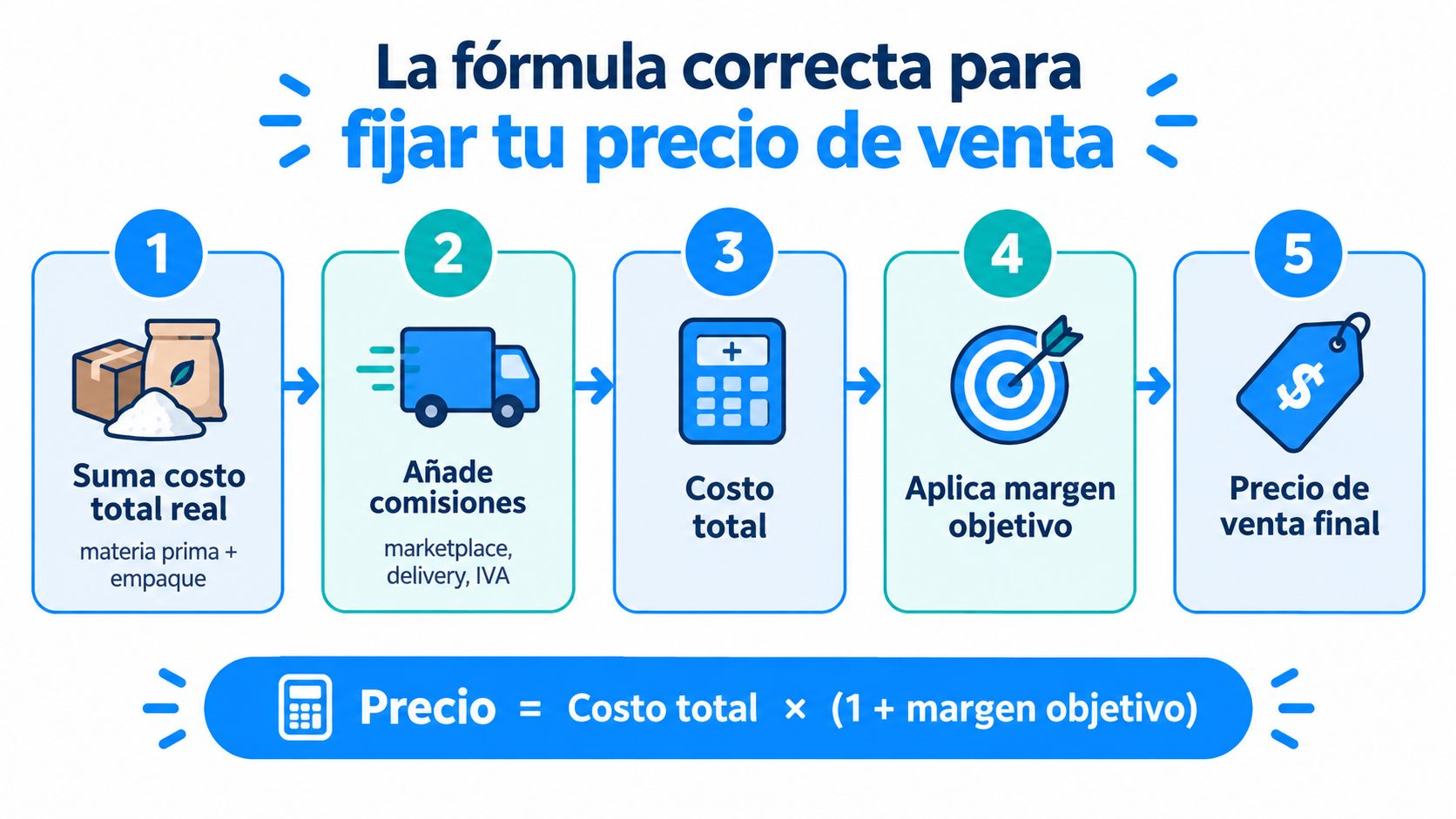
The correct formula to set your selling price
The calculation must start with the real total cost, not with the cost of the main ingredient. A coffee shop that only adds up coffee and milk is ignoring the cup, the lid, preparation time, and the cost of the space. A restaurant that does not incorporate packaging and delivery commission is measuring a different sale from the one it actually makes.
Step by step without missing costs
Sum the raw materials. Includes ingredients, materials, consumables, and reasonable waste.
Add packaging and preparation. Consider cups, lids, bags, labels, specific cleaning, and direct labor.
Distribute fixed expenses. Allocate a portion of rent, electricity, administrative salaries, and other costs that sustain the operation.
Include channel charges. Record marketplace, delivery, payment gateway commissions, and any transaction fees.
Define the VAT treatment. The final price must distinguish what belongs to the business from what is passed on to the customer.
Apply the profitability target. Choose margin or markup, but do not mix them.
The formula to work with margin on the final price is:
The formula to work with markup on cost is:
Commissions change the calculation
A sale through a delivery app does not have the same contribution as an over-the-counter sale. Delivery platform commissions can consume a significant portion of the price, so the business must calculate the channel-specific price or reduce the scope of the promotion. The production cost of goods sold helps organize the base before deciding on the final price.
The list price should leave room for promotions, but that reserve must be budgeted. For consumables, it is convenient to round up to protect cents and cost variations. In services, a psychological multiple consistent with positioning usually works better, as long as it does not hide an insufficient margin.
Real examples by business type
The formula is best understood when observed at the counter. Each business line has a different mix of materials, time, capacity, and commissions. That is why a universal multiplier ends up failing.
Coffee shop
A latte may have a direct cost of $12 MXN, considering milk, coffee, cup, and lid. With a margin goal of 70%, the suggested counter price is $40, but selling through delivery requires reviewing the result because a 25% commission changes the contribution.
If the list price remains at $40 and the channel deducts the commission, the coffee shop receives less before paying rent and staff. The common mistake is keeping the same price across all channels and believing that the additional volume automatically compensates.
Restaurant
A main dish can combine $85 in ingredients and $25 in prorated labor, for a total cost of $110. With a markup of 2.8x, the suggested price is $308.
The list price must be reviewed if the dish is sold with a discount, includes an extra side, or requires packaging. The typical failure is calculating the isolated dish and forgetting that the promotion reduces revenue while preparation costs remain.
Barber shop
A haircut may have $15 in products and $50 in prorated barber time, for a total of $65. With a list price of $220 and a margin of 70%, the service can contribute to fixed expenses and profit.
Here the risk is not usually in the commission, but in capacity. If a promotion fills the schedule with low-profit services, the barber shop can displace higher-value appointments without improving the daily result.
Beauty salon
A hair dye service can combine $180 in raw materials and $120 in time, with a total cost of $300. A suggested price of $850 must communicate what the service includes, because the customer compares duration, diagnosis, finish, and follow-up, not just the number on the menu.
The most common problem is not charging for extras that consume material or time. The base price should specify scope and make clear which additional treatments are quoted separately. To delve deeper into food logic, it is useful to consult how to calculate the selling price of dishes.
Business Line | Total cost | Desired margin | Suggested price |
|---|---|---|---|
Coffee shop | $12 MXN | 70% | $40 |
Restaurant | $110 | Not applicable, 2.8x markup | $308 |
Barber shop | $65 | 70% | $220 |
Beauty salon | $300 | Not specified | $850 |
When to raise, when to keep, and when to lower the price
Raising the price can be the right decision when value, costs, or business capacity have changed. In Mexico, demand responds to percentage variations in price and quantity. The explanation of price elasticity of demand helps test adjustments with judgment; you can also consult this framework to analyze price elasticity.
Raise with a clear signal
Increase when raw materials rise, average ticket grows without losing proportional volume, or the schedule approaches its limit. A coffee shop can adjust high-demand beverages, while a barber shop can raise services that fill higher-value slots. In restaurants, review the price by channel: a commission or an active promotion may require a different price than the counter.
Raising the entire catalog is usually a bad decision. Start with the categories with the highest perceived value and communicate what each option includes.
Keep to learn
Maintain the price during low season, after a recent increase, or while you compare sales, recurrence, and response to promotions. In a salon, keeping the base price allows observing if extras, duration, and the result justify the service. Change one variable at a time.
Lower only with a purpose
Reduce the price only to respond to a measurable promotion, attract a first purchase, or validate a new product. Define in advance the date, segment, channel, and goal. If a platform charges commission, calculate the net income before announcing the discount.
An example clarifies the decision: a business that sold 100 pieces at $50 and then sells 80 at $60 increased the price by 20%, but lost 20% of the volume. Gross revenue fell from $5,000 to $4,800. Before celebrating the unit price, review margin, variable costs, and recurrence.
Final checklist and next step
A profitable price is audited with discipline, not intuition. This week, each business can review five concrete points:
Recalculate total cost: include raw materials, packaging, labor, fixed expenses, and channel commissions.
Define target margin: separate high-turnover categories, time-intensive services, and promotional products.
Compare with two direct competitors: observe price, presentation, service scope, and experience, not just the number.
Test a pilot product: apply a 5% to 10% adjustment on a low-turnover product and record the response.
Review the result in 30 days: measure average ticket, units, recurrence, and profit, not just gross sales.
A poorly set price leaves money on the table and can also harm repeat purchases. If a promotion attracts customers who do not return or if an increase reduces the frequency of visits, the business needs to review the entire value proposition, not just the displayed amount.

The next decision should be backed by a record by product, customer, branch, and channel. Swirvle centralizes customer data, segments by consumption habits and branch, and allows running loyalty campaigns via WhatsApp, push notifications, and email, with dashboards to relate campaigns and sales. Those who want to turn price into a measurable decision can visit Swirvle and see how to organize promotions, recurrence, and average ticket from a single place.
Related Blogs

Sep 28, 2026
Selling price: what it is and how to set it in your business

Sep 27, 2026
10 CRM best practices for SMEs in LATAM

Sep 26, 2026
8 grab-and-go coffee shop snacks in 2026

Sep 25, 2026
How to standardize operations in branch offices

Sep 24, 2026
Strategies to get 5-star Google reviews

Sep 23, 2026
Digital marketing customer loyalty
Try Swirvle for free
No card required · 30 days free
Start your free trial