
Create a loyalty program that actually works and isn't just generic discounts. A practical guide to creating a loyalty program that works and isn't just
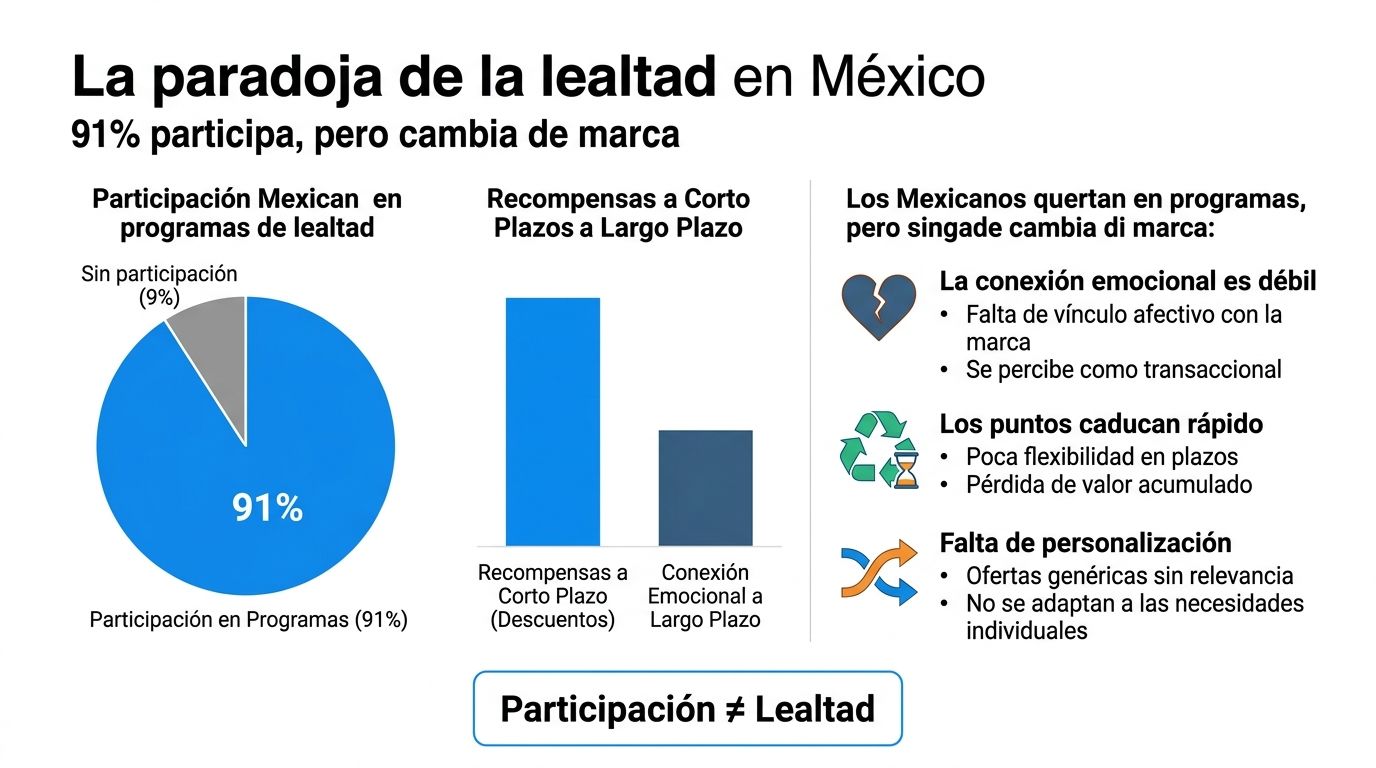
91% of Mexican consumers participate in at least one loyalty program, but 82% are willing to switch brands if the right incentive appears. Creating a loyalty program that works requires accepting an uncomfortable conclusion: signing up does not equal staying.
For an SME with physical stores, giving away universal discounts is usually the fastest way to reduce margins without changing habits. Profitable loyalty is built with a simple digital routine, behavior-linked rewards, and measurement by branch, category, and segment. The Mexican market is already professionalizing. One estimate places the loyalty program market at US$1.33 billion in 2024, with a projection of US$1.55 billion in 2025 and US$2.63 billion by 2029, according to the Mexican loyalty program market forecast.
Why 91 percent of Mexicans participate in loyalty and still switch brands
The paradox is clear. The Mexican consumer knows and uses loyalty programs, but their commitment depends on the relevance of the proposal. Another analysis estimates that more than 70 million people in Mexico are registered in some program, around 80% of adults. However, 61% are enrolled in more than one program within the same segment and 62% occasionally buy similar products outside their program due to price or proximity, according to Mexican consumer behavior data.
A coffee shop in Nuevo León can register hundreds of customers and still have irregular visits if it offers the same coupon to those who buy coffee daily as to those who appeared once. A gas station in the State of Mexico faces the same problem: a general discount does not distinguish between those who pump fuel frequently, those who buy products in the store, or those who only respond when the price drops.
Empty participation has visible signs
A program is failing even if it has many sign-ups when:
The majority register and do not return: sign-up measures curiosity, not habit.
Redemption is concentrated in broad offers: the business subsidizes purchases that might have occurred anyway without the incentive.
Branches show opposite results: the same reward can work in an office area and fail in a residential area.
The team cannot explain the benefit: operational friction destroys the perception of value.
Consumers also value clarity. A regional study reports that the factors that generate the most satisfaction are the accumulation of redeemable points, at 35%, ease of use, at 31%, and availability in an app, at 25%, according to the analysis on tangible rewards and digitalized routine in Mexico.
Rule of thumb: a program works when it changes a profitable behavior, not when it accumulates registrations.
Before increasing the budget, the owner must review three signals: purchase frequency of the registered group, average ticket compared to unregistered customers, and margin after redemption. If those three variables do not improve in a controlled manner, discounts are buying isolated transactions, not loyalty.
How to define measurable objectives before choosing rewards
The most expensive mistake is choosing points, coupons, or levels before deciding which behavior needs to change. A coffee shop may need more weekday visits, while a restaurant in Puebla may look to raise the ticket during low-demand hours. The correct mechanics depend on the objective, not on what is simple to set up.
The four-decision methodology
1. Define target behavior by segment. The business must choose a priority: repurchase, visit frequency, average ticket increase, or recovery of inactive customers. A carwash in Monterrey, for example, can focus on getting its exterior wash customers to return more regularly, while reserving higher-value benefits for those who combine wash and additional services.
2. Set thresholds based on real value. Not all customers deserve the same reward. An occasional customer can receive a simple return incentive. A frequent customer can unlock priority, complementary service, or early access. Thresholds should consider margin, category, and operating capacity, not arbitrary demographic labels.
3. Measure redemption against margin from day one. Each reward needs a financial sheet: direct cost, affected category, branch, attributable sales, and remaining margin. If a restaurant offers a reward during peak hours, it may be financing a visit that would have occurred anyway. The same benefit during a slow hour can serve a different purpose.
4. Review monthly cohorts. A cohort groups customers by their registration date or first purchase. The review should show if those registered in each period visit again, how much they spend, and how much it costs to activate them. The customer lifetime value analysis helps connect the immediate reward with cumulative profitability.
The internal document that the manager must approve
The program needs an operating budget, even if it is simple. It must include:
Target behavior: for example, second visit or purchase of a strategic category.
Eligible segment: new, frequent, inactive, or high-margin customers.
Reward threshold: visits, purchases, or spending necessary to unlock it.
Maximum cost: how much margin each redemption can consume.
Success indicator: frequency, ticket, return, or attributable sales.
Review date: the moment when the decision is made to maintain, adjust, or cancel.
A restaurant in Puebla could test a reward for low-occupancy periods, with different rules than those for high-demand lunch or dinner. The manager should compare the incremental margin, not just the number of coupons used. That discipline avoids turning the program into a permanent promotion.
Segmentation by purchasing behavior versus demographics
Age, gender, and location serve to describe an audience, but they rarely indicate which offer will trigger the next purchase. Two customers can live near the same branch and respond to completely different stimuli. One buys every month. The other visits when they need an urgent service.
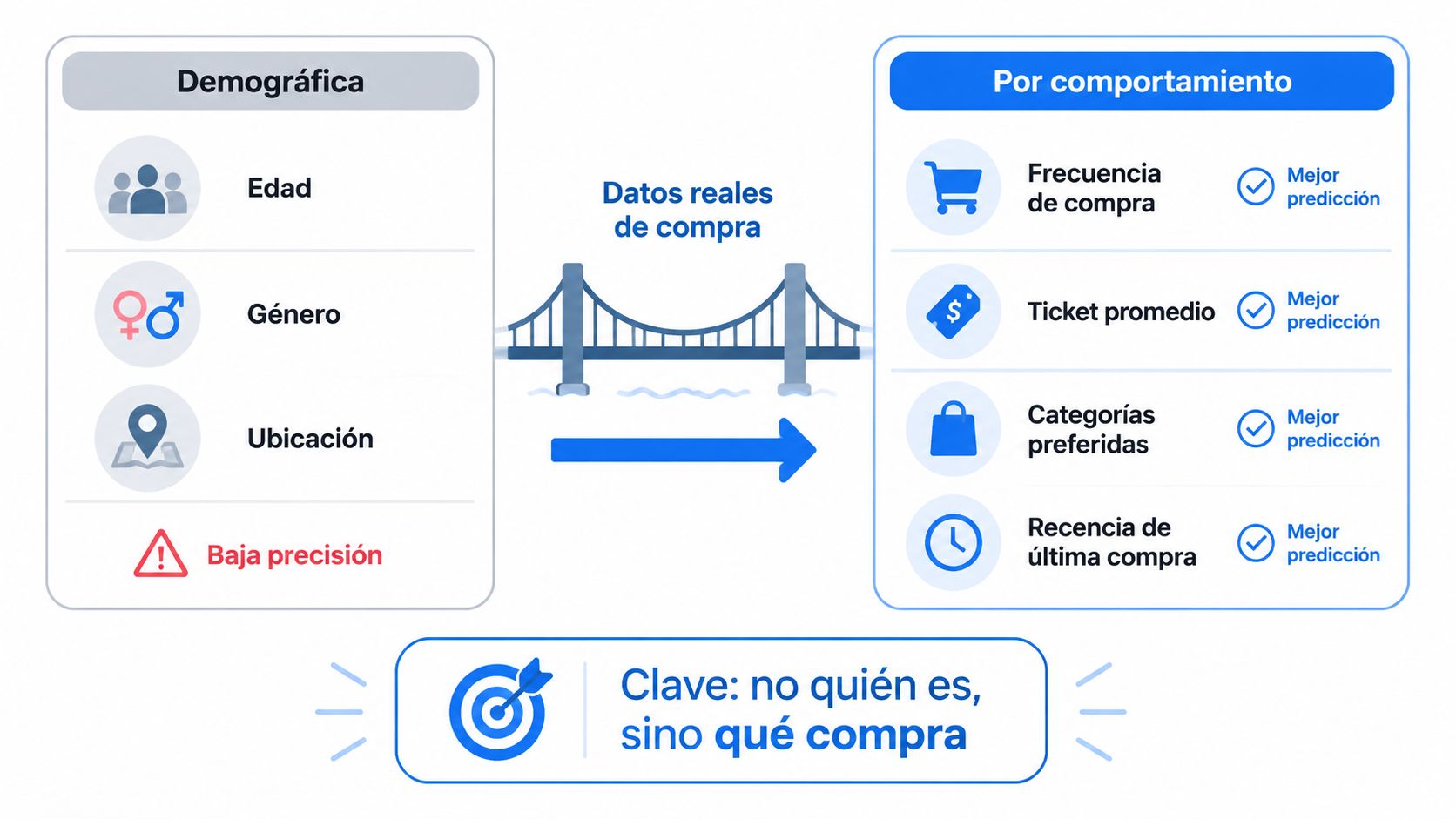
The comparison that matters for an SME
Demographic segmentation | Behavioral segmentation |
|---|---|
Groups by age or gender | Groups by frequency and recency |
Assumes general preferences | Uses observed purchases |
Can send the same offer to everyone | Activates rules by category and timing |
Describes who the customer is | Explains what the customer does |
Has lower precision for the next purchase | Allows adjusting the incentive to behavior |
A barber shop in Guadalajara may have one group that visits monthly and another that appears when they need an urgent haircut. The first group could receive a recurring booking dynamic or a benefit for maintaining frequency. The second needs timely reminders and an offer that reduces the friction of booking, not necessarily a permanent discount.
A convenience store in Yucatán can detect that certain customers buy early and others at night. The useful rule is not "people of a certain age receive a coupon," but "whoever buys a specific category at a certain time receives a reward related to their next visit."
The useful question is not who the customer is. It is what they buy, how often, and how much time has passed since their last visit.
Three variables before activating a campaign
The minimum framework must cross-reference recurrence, average ticket, and last visit. Recurrence separates the regular customer from the occasional one. The ticket shows what level of benefit the margin can absorb. The last visit indicates whether it is better to reward continuity, stimulate a complementary purchase, or try to win back the relationship.
It is also useful to add the branch and the category purchased when the business operates in different locations. A customer in Mexico City may have a different transit routine than one in Puebla, while a branch near offices may require different campaigns than one in a residential area.
To dive deeper into the logic of classifying customers by actual actions, it is helpful to understand customer segmentation. The eligibility rule must be written before sending. If the team cannot answer why one person received an offer and another did not, the segmentation is not ready yet.
Reward mechanics that build routine instead of isolated transactions
Points can work, but they shouldn't carry the entire program alone. The Mexican consumer already participates in multiple initiatives, and 78% have two or more paid memberships, while 57% have three or more, according to research on loyalty and memberships in Mexico. A proposal that is difficult to understand loses out to a simple, available, and relevant experience.

The four motivations the design must cover
The Monetary motivation responds to a clear economic benefit, such as redeemable points or a complementary product. Habit rewards repetition and turns a visit into a routine. Status recognizes those who reach a level with priority, access, or experiences. Reciprocity returns value for actions that strengthen the relationship, such as referring, answering a survey, or participating in an activity.
A coffee shop in Mexico City can replace the universal discount with a reward linked to the beverage the customer repeats. The mechanic becomes more relevant and allows protecting categories with narrow margins. A self-service chain in Baja California can add membership levels, as long as each level has an understandable and operationally sustainable difference.
Selection matrix for physical businesses
Business type | Main mechanic | Complementary benefit |
|---|---|---|
Coffee shop | Visits or digital card | Reward for frequent category |
Carwash | Recurrence packages | Priority or additional service |
Gas station | Combined purchases | Contextual benefit in store |
Restaurant | Ticket and time slots | Access or experiential reward |
Barber shop | Frequency and booking | Benefit for continuity |
Self-service | Levels and categories | Early access or premium advantages |
The operational rule is simple: one mechanic to create a habit, another to elevate value, and a third to recognize the relationship. There is no need to activate all of them from the start. A business with little technological capacity should start with a digital card or visits; one with more data can add smart coupons and levels.
Simplicity is not a design detail. VML reports that ease of use and digital availability are among the central factors of satisfaction, so the customer must understand progress, the value of the prize, and the conditions without asking staff for help.
There is also an opportunity to test a paid membership, but only when recurring benefits have tangible value and the cost is transparent. Mexican research on pay-to-play models identifies an emerging willingness to pay for benefits when the proposal justifies the outlay, according to the Mexican loyalty research collection.
Communication automation via WhatsApp, push notifications, and email
A program without contextual communication becomes a forgotten card. Automation must respond to moments of purchase, not send identical promotions to the entire base.
WhatsApp to activate immediate actions
WhatsApp works for short, actionable messages: welcome after the first visit, notice of points available for redemption, confirmation of a reward, or recovery of a customer who stopped visiting. The message must show the benefit, the condition, and the next step. To organize campaigns without turning them into spam, it is advisable to review criteria for bulk messages on WhatsApp.
Push to build routine
Push notifications work when the person has already agreed to receive reminders and has a digital relationship with the business. A coffee shop can notify about the progress of a visit dynamic. A gas station can remind of a benefit linked to a habitual purchase. Content should be short and connected to previous behavior.
Email to explain value and memberships
Email has more space to communicate levels, rules, membership anniversaries, and premium benefits. It can also explain changes in the rewards catalog with transparency, which is essential when there are expirations, branch conditions, or excluded categories.
A sequence for a bakery in downtown Puebla can start with a welcome after the first purchase, continue with a progress reminder, and end with a return proposal after an absence. The platform must send each message according to the defined rule, not according to the operator's memory. In Mexico City and the State of Mexico, where DENUE registers 44,141 food preparation and service establishments in the capital, automation helps compete for recurrence without increasing manual tasks, according to the INEGI registry of establishments.
Essential KPIs to measure profitability by branch and segment
The metric that decides program continuity is incremental utility, after rewards, communication, and operation. To understand unit economics, each campaign must be linked to attributable revenue, direct costs, and margin by branch. Sign-ups only matter if they return and leave a profit.
Monthly dashboard
KPI | What it measures | Alert threshold | Review frequency |
|---|---|---|---|
Activation rate | Registered customers who perform a valid action | Many sign-ups without a subsequent purchase | Weekly |
Recurrence by cohort | Repeat purchases of groups registered in the same period | New cohorts below previous ones | Monthly |
Average ticket | Average value of member purchases | Ticket equal or lower despite the cost of the benefit | Monthly |
Redemption rate | Actual use of rewards | Low redemption, or concentrated in low-profit products | Weekly |
Redemption cost per customer | Average subsidy delivered | Cost higher than incremental margin | Monthly |
Sales attributed to campaign | Purchases linked to a message or incentive | Many interactions without traceable sales | Per campaign |
Margin by branch | Program profitability at each location | One market erodes margin while another improves recurrence | Monthly |
Set thresholds based on margin, operational capacity, and objective. Do not use a universal figure. A carwash can accept an additional service to fill a weak slot. A coffee shop should avoid giving away an expensive drink when the customer would have purchased without the incentive.
The review must separate branch, category, channel, and cohort. This detects if a dynamic creates a habit or only concentrates redemptions during a campaign. A coffee shop in Mexico City can compare the average redemption by area with the margin of each category. DENUE registers 7,074 coffee shops, soda fountains, ice cream parlors, juice bars, and similar establishments, compared to 33,431 restaurants in the capital, a scale that requires adapting mechanics by business type, according to INEGI sector data.
Financial criterion: if redemption grows faster than incremental sales, the program is buying activity with margin money.
The manager must review the dashboard every month and make concrete decisions: keep the reward that increases profitable recurrence, restrict the one that attracts low-margin purchases, and remove the one that does not produce attributable sales. It is also advisable to compare branches with the same segment, not mixing a high-traffic location with one of weak demand.
Attribution completes the diagnosis. Record which message, rule, or incentive originated the purchase and calculate its margin, not just its volume. Thus, the program becomes a measurable routine by branch and segment, instead of another source of general discounts.
Eight-week launch plan and mistakes to avoid
A controlled launch reduces the risk of turning a good idea into a permanent promotion. The schedule can be organized as follows:
Week one: define objective, segments, branches, and budget.
Week two: set up rules, rewards, and redemption conditions.
Week three: load products, validate margins, and prepare messages.
Week four: train the team in Monterrey, Mexico City, or Puebla depending on operations.
Week five: test the flow with one branch and correct friction.
Week six: launch to the public with POS and digital channel communications.
Week seven: review activation, redemption, recurrence, and attributable sales.
Week eight: compare cohorts, adjust thresholds, and decide on the next test.
The most costly mistakes are copying points without attribution, promising benefits without making their cost transparent, mixing manual and automated campaigns without control, ignoring the launch cohort, and not adjusting the program during the first 30 days. Commercial density also requires adaptation. The State of Mexico registers 703,920 economic units, Mexico City 476,096, Jalisco 380,131, and Puebla 345,119, while Baja California Sur registers 36,360, according to the INEGI DENUE 2024 bulletin.
Before communicating the program, the manager must confirm that the customer understands how to earn, how much each reward is worth, where they can use it, and what data is recorded. If a branch cannot operate the mechanics without improvising, the launch is not ready yet.
Swirvle centralizes CRM, segmentation by habits and branch, configurable rewards, and automated campaigns via WhatsApp, push notifications, and email. To turn this framework into a measurable program, visit Swirvle and check out how it can help an SME increase recurrence, average ticket, and ROI control.
Related Blogs

Oct 22, 2026
How to prevent employee petty theft in my business?

Oct 21, 2026
How to Control Food Waste in a Restaurant: 2026 Guide

Oct 20, 2026
What is the global invoice for the general public and when is it issued? SAT Guide

Oct 19, 2026
How to take restaurant orders on WhatsApp without losing any?

Oct 18, 2026
How to Create a WhatsApp Business Catalog to Sell More: 2026 Guide

Oct 17, 2026
How to set up quick replies in WhatsApp Business?