
Learn how to connect Swirvle + Meta Conversions API step-by-step: events, payloads, and deduplication for SMBs in LATAM.
A coffee shop owner can see clicks, page views, or sales, but still not know how many repeat customers returned to the branch after seeing an ad. A car wash in Puebla faces the same issue when conversion happens at the register/branch and not on a website, which is the case for many SMBs in LatAm.
That is where Swirvle + Meta Conversions API changes the conversation. The integration connects events that already exist in the loyalty program with Meta's measurement and audiences, without relying solely on a web page. The initial connection is simple, but the real value comes from sorting out consent, events, identifiers, and customer segments.
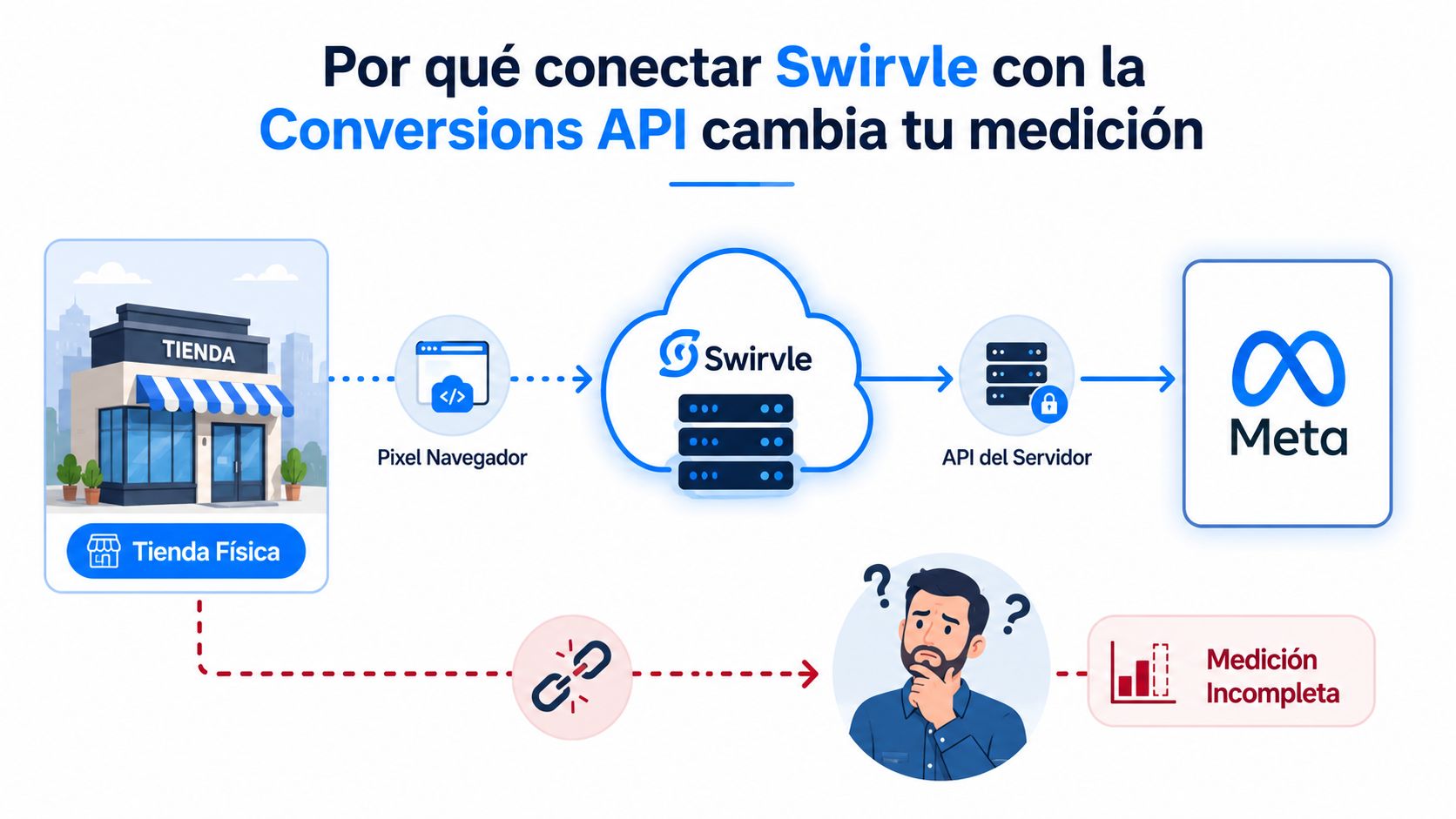
Why connecting Swirvle with the Conversions API changes your measurement
A physical business usually starts with a familiar feeling: campaigns generate engagement, but reports do not match branch sales. The browser Pixel becomes completely invalid because the purchase simply happens off-site, right at the counter. The Conversions API allows sending events from the server and receiving signals from web, app, physical store, or business messaging in a single path, as documented in the official Meta documentation on Conversions API.
In a first campaign connected with Swirvle, the clearest change was not seeing a magic return figure. It was seeing that Meta could work with real business customers, not just people who had loaded a page. The owner could activate an audience of frequent buyers, separate customers by branch, and re-engage those who had recently redeemed points.
Mexico offers sufficient scale for this difference to be strategic. Facebook reached 93.5 million users in Mexico by the end of 2025, equivalent to 70.7% of the total population, according to Meta audience data in Mexico. Instagram reached 48.8 million users at the start of 2025, with a growth of 3.90 million, equivalent to 8.7%, compared to 2024, from the same source. For a chain of coffee shops, gas stations, or car washes, sending better signals can influence how audiences are built and multi-channel campaigns are read.
Scale is also related to digital adoption among SMBs. A study by the DAI found that 47% of surveyed businesses in Mexico were already using digital tools before the pandemic and 60% used them during the last year following the start of COVID-19. In addition, 40% of online MSMEs had used Facebook applications for marketing, according to data compiled in the Mexico digital report. The opportunity lies in connecting that digital behavior with purchases, visits, and rewards that the business already tracks.
Key takeaway: Swirvle + CAPI is not just better tracking. It is turning your loyalty program into fuel for Meta.
To understand first-party data logic and its role in this flow, it is useful to review the guide on first-party data in Swirvle. The operational point is simple: the Pixel helps capture intent in the browser, while Swirvle provides an identifiable relationship with customers who already purchased, visited, redeemed, or any custom event of your choice.
Prerequisites before touching any configuration
The integration starts before clicking the connection button. If credentials, permissions, or consent are missing, the mapping might look correct and yet produce an incomplete signal.
Credentials and access
The practical order is as follows:
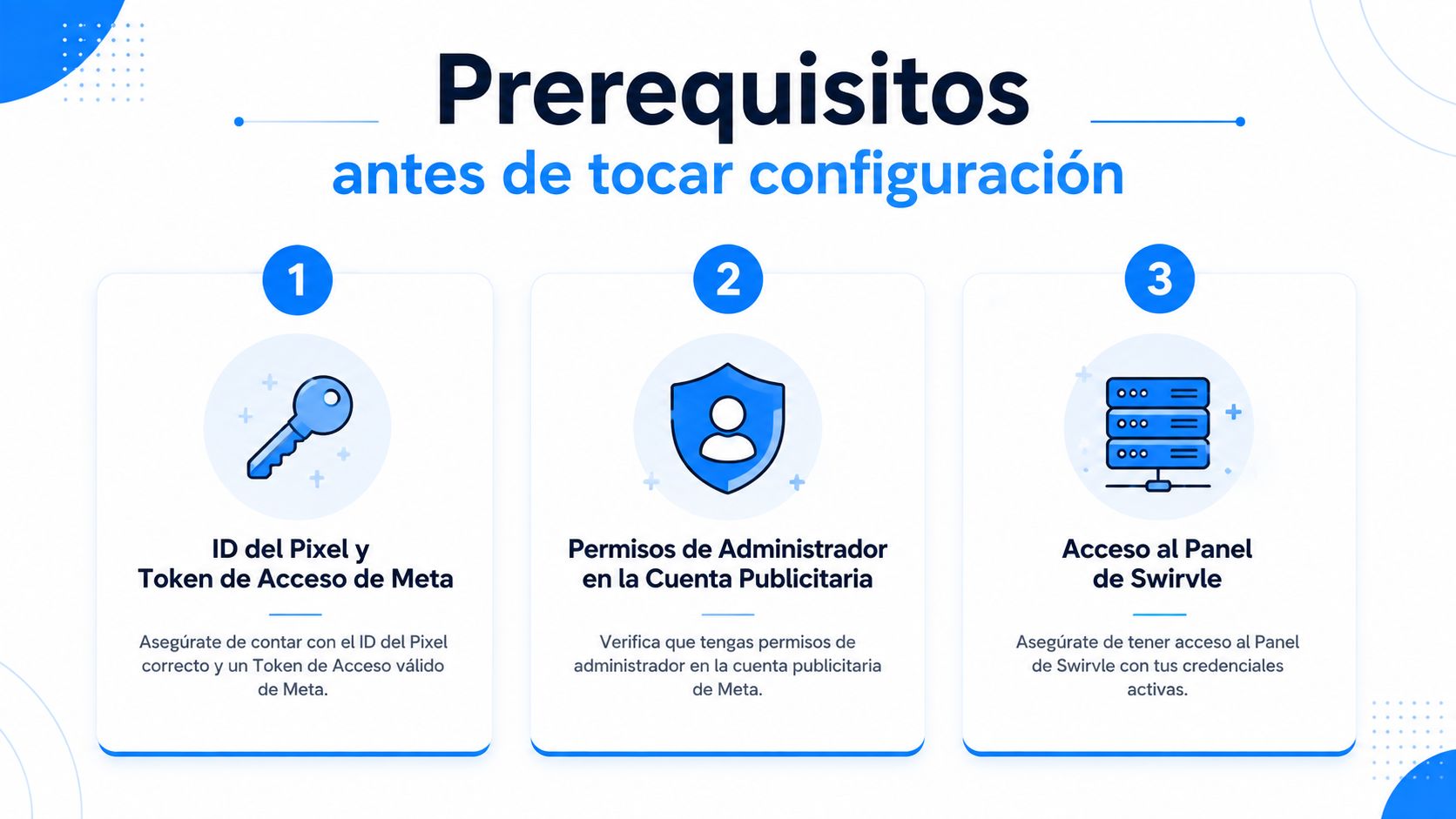
Pixel or Dataset ID. The business needs to correctly identify the Meta resource where events will land. A wrong ID sends the information to another destination or prevents Meta from processing the event as expected.
Access Token. The token authorizes server-side delivery. It must be generated from the corresponding administrative environment and kept under access controls because it represents an operational credential.
Admin permissions in Meta. The person configuring the integration needs sufficient permissions in the ad account, data set, and Events Manager. Without them, the team may see some resources but cannot complete the connection.
Admin access in Swirvle. We will use the automation tool in Swirvle to select the loyalty program events we want to send to Meta.
The easiest step is usually entering the Meta Pixel details. The part that requires the most care is confirming that the Pixel, Dataset ID, ad account, and business property belong to the same ecosystem.
Registration quality
Swirvle handles all the technical mapping of the information; the only thing you need to select is the event you want to send, using:
Automation trigger, whether it is a sale, redemption, etc.
Event name in Meta, to keep a reference of events in Meta.
Branch, in case you want to segment by branch or globally.
Before opening a support ticket, it is best to verify that the token, the correct ID, administrative permissions, consistently formatted phone numbers, or registered consent are not missing. Technical integration does not compensate for an unorganized customer database.
How to send events from Swirvle
Not all businesses need the same architecture. The best option depends on three factors: how much technical control the team has, how quickly events need to reach Meta, and how much maintenance the operation can sustain without getting overcomplicated.
Swirvle Webhooks
Webhooks are the fastest and simplest way to get started. When a purchase, registration, visit, or redemption occurs, Swirvle sends the event to the configured endpoint in near real-time.
For a car wash in Nuevo León with three branches, this route is usually sufficient. It allows maintaining a clear taxonomy, validating events, and operating without setting up additional infrastructure. Its limitation appears when the business needs more complex transformations, multiple destinations, or more advanced consent rules.
Server-side GTM
A server-side container offers an intermediate layer to receive, transform, and distribute events. It requires more coordination with development, but allows separating capture from activation and managing routing, consent, and deduplication rules from a central point.
A coffee shop with e-commerce and POS in Yucatán can benefit from this route if it needs to unify online orders, counter purchases, and loyalty events. Latency can be better controlled, although maintenance increases when Meta conventions or business fields change.
Custom Backend
A custom backend gives the greatest control over data, validations, retries, and business logic. It is a reasonable option for a chain with sensitive information, complex operations, or specific needs in the State of Mexico and Mexico City.
The cost is not just about development. The team must maintain tokens, versions, logs, error handling, deduplication, and schema changes. The advantage lies in controlling the entire pipeline and reconciling it with CRM, POS, and financial reports.
Criterion | Swirvle Webhooks | Server-side GTM | Custom Backend |
|---|---|---|---|
Technical control | Low to medium | Medium to high | High |
Implementation time | Fast | Intermediate | Longer |
Latency | Low if endpoint responds well | Controllable with configuration | Controllable by design |
Maintenance | Simple | Requires periodic review | In-house responsibility |
Best fit | SMBs with simple operations | Teams with developer support | Chains and complex flows |
The right route is not the most sophisticated one. It is the one that delivers reliable events without creating an operation that the business cannot sustain.
How to map Swirvle events to Meta events
Mapping starts with the business action, not the technical name. Swirvle tracks loyalty behaviors, while Meta needs standard or custom events that can be used for measurement and audiences.
The configuration described by the product is straightforward: the operator chooses which loyalty program events they want to send and Swirvle handles the mapping. This ease reduces initial friction, but does not eliminate the need to decide what each event means for the business.
Equivalences that make sense
Event in Swirvle | Recommended Meta Event | Practical Use |
|---|---|---|
Purchase completed |
| Measure sales and feed buyer audiences |
Redemption |
| Post-benefit remarketing |
Birthday | Custom event | Activate birthday campaigns |
Branch visit | Custom event | Analyze frequency and segment by location |
Standard events usually make tracking within Meta easier. Custom events are useful when the action represents logic specific to the loyalty program and does not fit cleanly into an existing convention.
Values come from the event, such as the sale amount and the order_id. For a broader guide on how to organize customer information, you can consult the Swirvle customer database.
A Lead event can represent a branch sign-up, while RedeemEvent can feed an audience of people who have already received a benefit and might respond to a repurchase offer. In a car wash, redemption can trigger a message for an additional cleaning. In a coffee shop, it can separate those who redeemed a reward from those who only accumulated points.
A common mistake is sending arbitrary names like newBranchPurchase when the team expected Purchase. A defined taxonomy before activating campaigns prevents fragmented reports and hard-to-interpret audiences.
Testing in Meta Events and monitoring in Swirvle
The first test should happen before moving any budget. The team can open Meta Events Manager, activate the test events view, and trigger a controlled purchase from a real or simulated branch in Swirvle.
What to validate in Meta
The event must appear with the Server label. That label confirms that Meta received the signal via the server-side route, though quality and consistency still need to be checked.
The verification order can be:
Event name. Confirm that
Purchase,Lead, or another custom event matches the agreed taxonomy.Arrival time. Compare the time of purchase with the received timestamp.
Identifier. Check that
event_idexists and is consistent with the browser event.Match. Observe the match score and verify if the available user data allows for correctly linking the action.
Deduplication. When both Pixel and server participate, verify that Meta processes only a single conversion.
Click-through and view-through attribution must be reviewed alongside CRM and POS records. CAPI improves signal delivery, but on its own does not prove that a campaign generated incremental growth.
What to watch inside Swirvle
Swirvle monitoring should show sent events, failed events, and delivery time. This view allows distinguishing a campaign issue from an infrastructure issue.
Failures usually focus on expired credentials, a mismatched Pixel ID, or event names outside the convention. Discrepancies can also appear between the register sale, the sent event, and the purchase that Meta attributes.
During the first week, it is best to review daily:
Delivery: sent events vs. failed events.
Latency: delays between the action at the branch and arrival at Meta.
Match score: prioritize reviewing events with low scores; as an operational reference, the team can aim for values above 6, without treating it as a guarantee of attribution.
Deduplication: confirm that purchases shared between Pixel and server are not duplicated.
Loyalty events: validate that redemptions, visits, and tier changes arrive before launching remarketing.
The integration is considered stable when data from Swirvle, POS, CRM, and Meta tell the same story, even if each system retains its own attribution logic.
Audiences, LATAM privacy, and final checklist
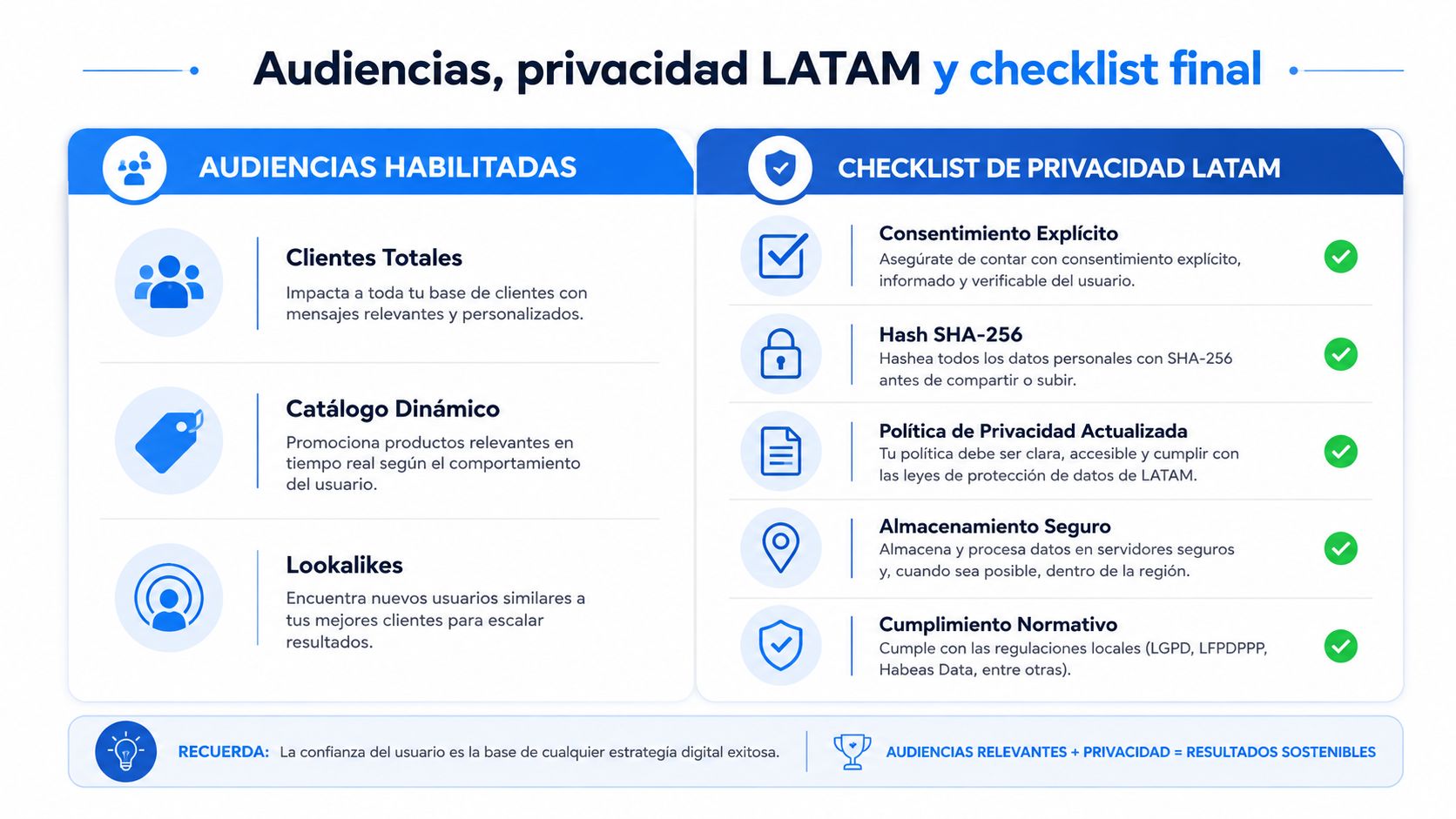
The signal obtained from a loyalty program allows building audiences that are closer to the business. Swirvle can organize total customers, customers by branch, birthday celebrants, and recent redeemers, provided there is valid consent and data is properly prepared.
A chain can separate buyers from a branch in the State of Mexico from those in Baja California. A gas station can create an audience of frequent customers. A coffee shop can target those who redeemed points with a repurchase message, while reserving a different communication for the birthday celebrants of the month.
The Swirvle audiences can also serve as the basis for lookalike audiences. The logic is not to look for any user similar to a web visitor, but to start from customers who have already purchased, returned, or used a reward. The result can be more useful for prospecting, though it should always be balanced against total revenue and organic repeat business.
Privacy before activating audiences
Explicit consent to use contact information in custom audiences must be recorded from the source. The privacy notice must explain the corresponding processing and delivery to Meta for measurement or advertising activation. Sensitive data that is not necessary for the business purpose should not travel to CAPI.
The final checklist must confirm:
Consent: verifiable opt-in exists for each actionable contact.
Hashing: email, phone, and other eligible identifiers are sent with SHA-256.
Events: names follow a stable convention.
Deduplication: Pixel and server share
event_id.Audiences: each segment has a purpose and a specific message.
Reconciliation: attributed sales, total revenue, and repeat purchases are analyzed separately.
With an orderly implementation, Swirvle stops functioning solely as a loyalty CRM and becomes the missing source of signal to connect frequent customers, branch purchases, and Meta campaigns. The API does not replace strategy or prove incremental growth on its own, but it delivers a more actionable foundation for deciding whom to reach, with what message, and in what location.
Swirvle centralizes CRM, loyalty, branch segmentation, and the events that can power the Meta Conversions API from physical operations. To convert frequent customers, redemptions, and repeat purchases into actionable audiences, visit Swirvle and learn how it can adapt to your business in Mexico or LATAM.
Related Blogs

Oct 11, 2026
How to set up a WhatsApp loyalty program for my business?

Oct 10, 2026
What Day of the Dead promotions work in coffee shops and restaurants?

Oct 9, 2026
How can I track my business's daily sales?

Oct 8, 2026
How to do a daily grocery store inventory without wasting time?

Oct 7, 2026
What does a CRM look like in practice for a coffee shop or restaurant?

Oct 6, 2026
Which campaigns work to fill a restaurant during the week?
Try Swirvle for free
No card required · 30 days free
Start your free trial