What Day of the Dead promotions work for cafes and restaurants? Eight ideas with mechanics, KPIs, and how to execute them with Swirvle in 2026.
What Day of the Dead promotions work in coffee shops and restaurants if the goal is not just to sell on November 1 and 2, but to secure a second visit? The answer is not to decorate the premises more or to apply a general discount. The promotions with the greatest commercial logic combine a recognizable seasonal product, a specific reason to return, and a measurement that allows separating incremental sales, margin, and recurrence.
Day of the Dead offers a broad opportunity, but the customer also faces greater spending pressure. For 2024, Concanaco Servytur estimated an economic spillover of $45,318 million pesos, while ANPEC calculated the average cost of a family altar (ofrenda) at $1,809. Therefore, a good campaign must communicate tangible value, not just urgency.
The following eight promotions are presented as decision cards. Each includes mechanics, target segment, example of copy, KPIs, and an implementation path with Swirvle, as well as applications for coffee shops, restaurants, barbershops, and beauty salons.
1. Special Day of the Dead Menu with Gastronomic Offerings (Ofrendas)
What seasonal menu achieves immediate sales and also a second visit? The one that takes recognizable seasonal products, reduces operational complexity, and leaves a clear reason to return. In coffee shops, that usually translates into a short combination of pan de muerto, café de olla, Mexican hot chocolate, or atole. In restaurants, it works better as a closed experience with an entrée, beverage, and dessert. In barbershops and salons, the logic changes: the service remains the main product and the seasonal element enters as a low-cost consumable detail.
The demand has a visible base. Kantar reported that in-home consumption increases by 8% during this season and that hot chocolate grows 64% in volume. It also places coffee, chocolate, and desserts among the categories associated with the season, so the menu does not need to educate the customer from scratch. It is advisable to present a family offer, easy to order for on-site consumption, takeout, or sharing.
Operational rule: the seasonal menu should have few combinations, a fixed price, and a visible end date. More variety complicates production, inventory, and communication.
Decision Card
Mechanics: launch a limited menu with a hot beverage, a seasonal product, and an optional side. In a restaurant, it can be a multi-course menu with traditional ingredients. In a barbershop or salon, it can be integrated as a themed service with coffee, chocolate, or an individual pan de muerto.
Segment: customers who already buy hot beverages, desserts, food to share, or mid-ticket seasonal experiences.
Suggested Copy: “Seasonal Offering. Stuffed pan de muerto, hot chocolate, and a moment to share. Available until November 2.”
KPIs: units per product, average ticket, margin per menu, percentage of tickets with a side, repurchase rate during the campaign, and menu share in total seasonal sales.
Implementation in Swirvle: create segments by purchase history, activate messages for frequent customers, open presales via WhatsApp if you have the Premium plan, and issue a second-visit coupon for those who purchase the menu in the first half of the campaign.
The evaluation should focus on margin and recurrence, not just volume. If the menu sells well but relies on heavy discounts or too many ingredients, it is advisable to adjust portions, sides, or price before expanding promotion. The goal is not to have more options, but a seasonal offer that is quickly understood, is profitable, and triggers a second purchase within the same season.
2. Day of the Dead Themed Points and Rewards Program
What promotion helps most to drive repeat visits during the season without cutting too much into the margin? In many cases, a points program resolves that tension better than an immediate discount, because it rewards a sequence of purchases and allows reserving the reward for products with controlled costs.
The logic works especially well in coffee shops, where frequency already exists and the visit can be repeated within a few weeks. It also adapts to restaurants with seasonal consumption, and in barbershops or salons, it can operate as a benefit tied to a service and a seasonal add-on. The key is that the reward has a direct relationship with what the customer already buys.
There is enough demand for that reward to feel familiar. A survey cited by El Economista recorded that 93.7% of respondents consumed pan de muerto during the season. That makes it reasonable to offer an individual pan de muerto, a seasonal drink, or a simple extra, instead of giving away higher-cost products.
Instead of treating this promotion as a list of prizes, it should be decided as a retention mechanic. If the business needs repeat visits in a short period, points usually fit better than tiers, because the goal is specific and the expiration can be closed at the end of the campaign. The operational difference between the two schemes is best understood in this guide on the difference between points and tier programs.
Mechanics: assign points for purchase, visit, or choosing seasonal products.
Target Segment: frequent customers, hot beverage buyers, diners with a history of seasonal consumption, and service clients who accept add-ons.
Example of Copy or Artwork: “Each visit adds to your offering. Collect points this season and redeem them for your Day of the Dead reward.”
KPIs: visit frequency, accumulation rate, redemption rate, cost per reward, margin per customer, and return percentage during the campaign.
Implementation Path in Swirvle: define the accumulation rule, set the reward and its deadline, identify those close to redemption, and activate messages via SMS or push based on each customer's progress, or via WhatsApp if you have the Premium plan.
The correct evaluation is not how many points were issued. What matters is how many additional visits the program generated, which reward converted best, and if the redemption maintained enough margin to repeat the campaign.
3. Tiered Discounts Based on Number of Visits in the Month
What promotion is best if the goal is not just to attract one purchase during the season, but to get the customer to return multiple times before the campaign ends? The tiered discount works well when frequency is already plausible and all that is needed is a concrete reason to return soon.
Its advantage lies in the sequence. Instead of concentrating the incentive on a single ticket, it distributes the benefit across successive visits and allows adjusting the cost of each reward to the business's actual margin. In a coffee shop, this usually translates into a clear path: a first visit with a moderate incentive, a next one with a low-cost extra, and a final reward reserved for those who have already shown intent to return. In a restaurant, the logic changes slightly, because visits are less frequent and it is advisable to set the reward at a higher threshold. In a barbershop or beauty salon, the mechanic serves more as a reminder for the next service than as an aggressive discount.
How to Decide If It Is Suitable
Mechanics: track visits during October and November and assign progressive benefits. A useful example is a discount on the first visit, a side on the third, and a seasonal drink on the fifth. The conditions must be visible from the start.
Target Segment: occasional customers, people with a recent visit, and customers who used to buy frequently but have not yet returned during the season.
Example of Copy or Artwork: “Your next visit counts. Return before the campaign closes and get your Day of the Dead reward.”
KPIs: visits per customer, time between purchases, progress per tier, redemption rate, and cumulative margin per participant.
Implementation Path in Swirvle: activate a visit counter, program alerts when a visit is missing for the next reward, and send reminders in the last week. Smart coupons can be limited per person, branch, and period.
The operational point is not just to offer the final prize. It is beneficial to show progress. A message like “You are one visit away from getting your drink” drives action better than a generic post, because it reduces ambiguity and turns the goal into something immediate.
The evaluation also changes. Here, what matters is what percentage of participants advanced between tiers and if the final incentive sustained the margin. If the reward is concentrated on a low-cost, high-perceived-value product, such as an individual pan de muerto, topping, or seasonal beverage, the campaign can increase recurrence without relying on deep discounts.
4. Referral Promotion with Themed Rewards
What promotion best converts a social celebration into a measurable second visit? In referrals, the answer usually lies in the shared reward, not the isolated discount. CGA analysts found that a significant portion of consumers in Mexico planned to go out during the season and that restaurants, coffee shops, and similar businesses were among the options to visit, with a high presence of couples, friends, and families in those consumption plans Source from CGA on consumption during Day of the Dead. For this campaign, that changes the design of the incentive.
If the customer arrives accompanied, it is best if the benefit also feels social. A coffee shop can offer a seasonal drink or a pan de muerto to share on the next visit. A restaurant can provide a reward valid for two people to drive a return. In a barbershop and salon, the referral works best when the prize is activated after the paid service and not just for sharing the code.
Instead of treating it as a generic promotion, it helps to view it as an operational card:
Mechanics: assign a unique code to the current customer, validate the new customer's purchase, and unlock the reward only after that transaction.
Target Segment: frequent customers, satisfied buyers, and users who usually attend as couples, with friends, or with family.
Example of Copy or Artwork: “Invite someone this season. Their first visit receives a benefit and you get a reward to return.”
KPIs: codes sent, referrals with validated purchases, acquisition cost, second-visit rate, and sales generated per referred customer.
Implementation Path in Swirvle: create unique codes, distribute them via SMS (or WhatsApp with Swirvle's Premium plan), validate at checkout, and segment those who already show high frequency to offer an additional prize for confirmed references.
There is an operational point that usually defines the outcome. The rules must be visible from the start: which products participate, if there is a minimum purchase, how long the code lasts, and in which branches it applies. This clarity reduces friction at checkout and prevents the incentive from being perceived as an ambiguous promise.
Social networks can expand reach, but actual measurement depends on the individual code. Without that validation, the campaign gains visibility but loses attribution.
5. Themed Combos and Packages with Preferred Pricing
What package makes a second visit during the season more likely, a cheap one or one that makes it clear what each type of customer receives? For Day of the Dead, the combo works best when it reduces choice friction, structures consumption, and shows perceptible savings without deteriorating the margin.
The decision changes by business. In a coffee shop, an individual package with a hot drink, pan de muerto, and a seasonal side is recommended. In a restaurant, the format performs better as a menu for two or a small group, with a complete sequence and fixed price. In a barbershop or salon, the logic is not gastronomic but replicable: main service plus a themed extra or benefit for the next visit, presented as a seasonal package.
ANPEC estimated the cost of a family altar in 2024 at $1,809, a 26% increase compared to 2023. This context makes offers with visible value more attractive, provided the customer quickly understands the difference between buying separately and buying the package.
Instead of repeating a list of ideas, it is best to treat this promotion as a concrete business decision:
Mechanics: define packages by consumption occasion—individual, couple, and family—with margin-controlled products and fixed pricing.
Target Segment: customers buying for themselves, couples, groups of friends, families, and buyers prioritizing convenience.
Example of Copy or Artwork: “Seasonal combo to share: drinks, pan de muerto, and traditional dessert in a single purchase.”
KPIs: average ticket, package share in sales, margin per combo, attachments per order, and advance order rate.
Implementation Path in Swirvle: configure packages by audience, activate QR or coupons, share them at checkout, on social media, or via WhatsApp (the latter on the Premium plan), and measure which format generates better repurchases.
The package architecture should follow criteria for designing promotions and offers that increase the average ticket. The central metric is not how many items it includes, but how much margin it retains and if it accelerates the purchase decision.
Advance orders add operational control. They allow allocating quotas, adjusting production, and reducing waste without turning the preferred price into a hard-to-keep promise.
6. Segmented Campaigns by Preferences and Purchase Behavior
What promotion should you send if two customers buy from the same business, but one always orders hot drinks and the other only responds to food packages or complementary services? The answer is not to send more messages, but to decide which offer corresponds to each purchase pattern, in which channel, and with what commercial objective.
During Day of the Dead, several categories are associated with the season, but that signal alone does not define the best campaign. A coffee shop must distinguish between those who buy coffee out of routine, those who add dessert on special dates, and those who only show up on weekends. A restaurant needs to separate the customer who gets a quick meal from the one who responds to a shared consumption proposal. The logic is simple: if the incentive does not match the habit, conversion drops and margin is wasted.
Here, customer segmentation stops being a database label and becomes a decision card:
Mechanics: create campaigns according to purchased category, frequency, usual branch, visit time, and recent inactivity.
Target Segment: beverage buyers, food buyers, mixed customers, weekend customers, weekday customers, and users who have not returned during the season.
Example of Copy or Artwork: “If you usually choose something hot, this week you have seasonal chocolate with pan de muerto at your usual branch.” For restaurants: “Come back during the week with a seasonal dessert when ordering your menu.” For barbershops: “Your next visit can include a themed beard trim.” For salons: “Book a hairstyle and add Catrina makeup in the same appointment.”
KPIs: conversion per segment, average ticket, margin per offer, second visit, response rate by channel, and performance by branch.
Implementation Path in Swirvle: group customers by actual buying habits, activate push messages or, on the Premium plan, WhatsApp, test copy variations per segment, and measure which combination generates repurchases without punishing margin.
The correct evaluation does not ask how many segments exist. It asks which ones change a useful behavior: returning sooner, adding a new category, or booking in a slot with available capacity. If everyone receives the same promotion, the campaign remains mass-market, even if the database is organized.
7. Exclusive VIP Experiences with Advance Bookings
What seasonal promotion best protects margin when it is no longer advisable to compete on discounts? Advance booking for a VIP experience usually works better than a general price cut because it structures demand, sets expectations, and filters for customers with a higher willingness to buy.
Here, the decision is not just about designing something "special." It is about defining if the experience fits within operations and can be repeated without friction during the season. In a restaurant, that can take the form of a themed dinner with a set menu. In a coffee shop, a pan de muerto tasting or a chocolate workshop. In a barbershop and salon, a premium appointment with themed styling, Catrina makeup, or a photoshoot of the result.
Capacity rules. If staff, ingredients, hours, and the reservation system are not confirmed, the premium experience becomes a hard-to-fulfill promise. In appointment-based businesses, a clear timeframe also helps distribute demand and avoid peaks that saturate the schedule.
It is advisable to evaluate this promotion as a decision card, not as an isolated creative idea:
Mechanics: advance booking access to a limited-capacity experience, with a defined service and an additional benefit, such as preferred seating, tasting, photography, or more personalized attention.
Segment: customers with high average spend, high frequency, or good margin, identified by purchase history and response to previous campaigns.
Example of Copy or Artwork: “Private invitation. Reserve your spot for the Day of the Dead experience with preferred attention and limited availability.”
KPIs: confirmed bookings, actual attendance, revenue per attendee, event margin, cancellations, and post-experience purchases.
Implementation Path in Swirvle: create the premium segment, send the invitation via push or, if you have the Premium plan, via WhatsApp, activate confirmations and reminders, and record which attendees bought again.
The commercial value appears after the event. If the customer attends, posts content, and does not return, the experience generated visibility but not necessarily repeat business. Therefore, it is advisable to separate the booking revenue from the subsequent sale and activate a short-duration second-visit incentive, especially in coffee shops and restaurants.
Photography from the event can also become a seasonal asset, always with the permission of the attendees. The booking database leaves another useful signal: those who pay for early access are usually better candidates for future high-ticket experiences.
8. Collaborations with Local Influencers and Micro-influencers
What makes a collaboration with local creators drive people to the branch rather than just staying as views? The difference usually lies in the ability to connect the consumption occasion with a nearby audience and, above all, in measuring the response per creator.
Here, it is advisable to evaluate each collaboration as a business decision, not as an outreach action. In a coffee shop, a food creator can showcase a seasonal combo and explain what time of day is best to order it. In a restaurant, the content works better if it shows the full experience, from the atmosphere to the themed dish. In barbershops and beauty salons, the piece performs better when it documents a transformation linked to the date, such as Catrina makeup, hair styling, or beard grooming for an event.
Profile selection changes the outcome. Geographic proximity, alignment between audience and offering, and the ability to attribute sales are what matter. A creator with followers in another area can provide visibility. A micro-influencer with a local community and a clear response in codes or bookings usually brings a more useful commercial signal.
Mechanics and Target Segment. Deliver a product or service to a local creator in exchange for agreed content, with creative freedom and an individual promo code. The target segment is audiences close to the branch with a real interest in gastronomy, beauty, style, or seasonal activities.
Copy or Artwork and KPIs. A functional message would be: “Try the seasonal experience at [business name]. Use the creator's code when booking or buying and activate your benefit.” The metrics that matter are code uses, attributed sales, cost per customer, average ticket, repeat visits, and reusable content pieces.
Implementation Path in Swirvle. Create a coupon per creator, link it to the campaign, and review results by code, branch, and channel. Before publishing, it is advisable to lock down the product, dates, conditions, deliverables, and main message. The creator needs room to explain the experience in their style. That is usually where the difference between credible content and content that just looks sponsored appears.
Comparison: 8 Day of the Dead Promotions
Strategy | Implementation Complexity | Required Resources | Expected Results | Ideal Use Cases | Key Advantages |
|---|---|---|---|---|---|
Special Day of the Dead Menu with Gastronomic Offerings | Medium (training and recipe adjustments) | Seasonal ingredients, staff training, social media promotion | 25–40% average ticket increase; repeat visits during festive period | Coffee shops and restaurants for 2–4 weeks | Thematic exclusivity, content for networks, differentiation from competitors |
Day of the Dead Themed Points and Rewards Program | Medium (CRM configuration and point rules) | CRM platform (e.g., Swirvle), rewards budget, POS integration | +30–50% frequency; +15–20% ticket; high post-campaign retention | Coffee shops with frequent purchases and high recurrence | Improves retention, generates consumption data, automated communication |
Tiered Discounts Based on Number of Visits in the Month | Low–Medium (track visits and manage discounts) | Visit registration system, notifications, POS integration | +35–55% frequency; 40–50% conversion from occasional to regular | Coffee shops looking to increase repeat visits in the short term | Motivates fast repetition, low acquisition cost, easy to communicate |
Referral Promotion with Themed Rewards | Low–Medium (code tracking and validation) | Referral codes, automatic tracking, incentives for both | 40–60% lower CAC; +25% referral LTV; 20–30% activation rate | Social businesses (coffee shops, restaurants) during the season | Organic virality, cost-effective acquisition, easy for customers to understand |
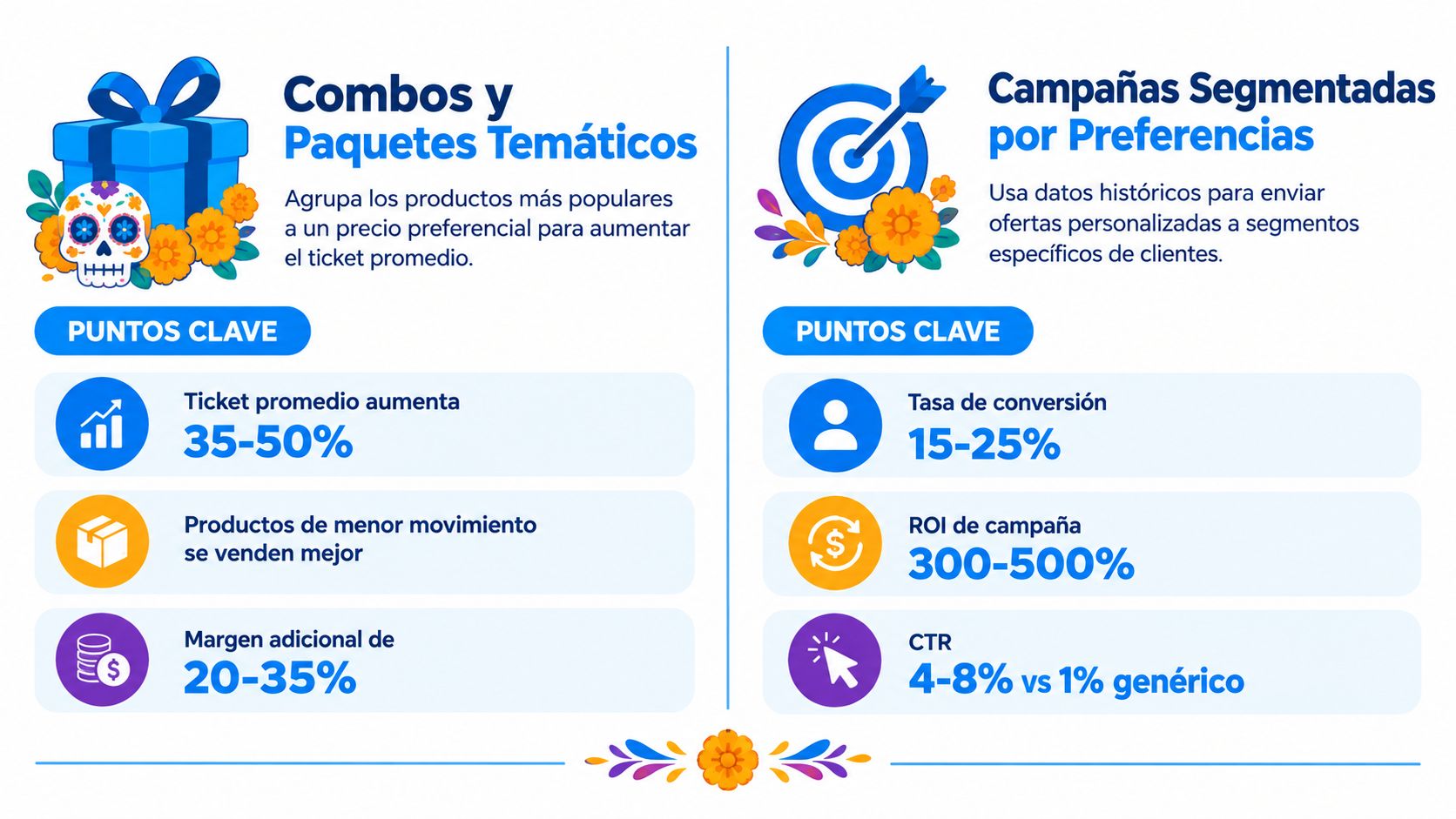
Themed Combos and Packages with Preferred Pricing | Low–Medium (bundle design and inventory control) | Themed packaging, cost calculation, promotion, and configurable POS | +35–50% average ticket; 25–40% bundle conversion; 20–35% additional margin | Coffee shops, bakeries, and restaurants wanting to increase ticket size | Increases ticket, sells slow-moving products, drives trial of new items |
Segmented Campaigns by Preferences and Behavior | High (data cleansing and segment design) | Historical data, CRM/automation (Swirvle), time for analysis | 15–25% conversion; 4–8% CTR; 300–500% campaign ROI in festive period | Data-driven businesses wanting personalization by buying habit | More relevant messages, better ROI, reduces generic messaging fatigue |
Exclusive VIP Experiences with Advance Bookings | High (event logistics and experience) | Additional staff, decoration, entertainment, booking management | 30–50% event margins; VIP clients generate ~5x LTV | Premium restaurants and coffee shops looking for differentiation | High margin, deep loyalty, viral content, and premium positioning |
Collaborations with Local Influencers and Micro-influencers | Low–Medium (coordination and briefs) | Complimentary products, potential fees, content management, and tracking | 50k–500k reach per influencer; 2–8% engagement; 50–200 acquired clients | SMBs seeking organic reach and social proof in LATAM | High organic reach, authentic content, cost-efficient vs. paid advertising |
Choose Two Promotions and Measure Their Impact Before Scaling
The best campaign is not the flashiest. It is the one that proves a specific mechanic can generate profitable sales and subsequent visits. To avoid decisions based on impressions, the business should start with two complementary promotions: one based on visits and another on segmentation.
A coffee shop can combine the visit counter with an offer for hot beverage buyers. A restaurant can test a package for two and an invitation targeted at weekend customers. A barbershop can pair referrals with an offer for customers whose usual return window is about to expire. A salon can combine a Catrina makeup experience with differentiated messaging for haircut clients and aesthetic service clients.
Each promotion needs a primary KPI. For a visit-based dynamic, the indicator can be purchase frequency or second-visit rate. For a combo, average ticket and margin per package take priority. For a segmented campaign, conversion per segment, reward cost, and incremental sales show if personalization is working.
The comparison should be made against the weeks prior to the season, without repeating previously used statistics as if they were campaign results. It is also beneficial to separate:
Gross sales: how much revenue came in during the promotion.
Margin: how much was left after product and reward costs.
Redemptions: how many customers utilized the benefit.
Repeat visits: how many returned within the defined period.
Attribution: which channel, code, branch, or segment generated the purchase.
Day of the Dead should not be limited to the peak on November 1 and 2. For 2025, Concanaco Servytur projected a national economic spillover of $49,500 million pesos, 9.2% more than in 2024. The same source notes that October 31 coincided with "Viernes Muy Mexicano" (Very Mexican Friday), a circumstance that expanded the promotional window. The operational consequence is to design three phases: presale before the peak, themed offer during high intent, and second-visit reward after.
The presale can offer early access or a low-cost benefit. During the weekend, the menu or combo must have controlled inventory and capacity. Afterward, only customers who purchased should receive the return incentive. This avoids subsidizing the entire audience and connects the message with a trackable action.
Swirvle can centralize customers, segments, coupons, visit mechanics, rewards, and analytics dashboards. The business should use this information to decide what to repeat, what to adjust, and what to eliminate. A promotion that generates traffic but destroys margin needs a redesign. An offer with less reach but more second-purchase conversions can be the foundation for the next season.
The final decision must be made with data per branch, channel, and customer type. If the combo for two raises the ticket but does not drive returns, it can be kept as an occasional offer. If segmentation produces a second visit with a smaller incentive, it deserves to be scaled. The right campaign is the one that leaves a reusable operational rule, not just a seasonal sale.
Swirvle centralizes customers, segments by habits and branch, and allows automating coupons, points, visits, and push/email campaigns (and WhatsApp on the Premium plan) for Day of the Dead promotions. Discover how to apply these mechanics and measure their impact on Swirvle.
Related Blogs

Oct 10, 2026
What Day of the Dead promotions work in coffee shops and restaurants?

Oct 9, 2026
How can I track my business's daily sales?

Oct 8, 2026
How to do a daily grocery store inventory without wasting time?

Oct 7, 2026
What does a CRM look like in practice for a coffee shop or restaurant?

Oct 6, 2026
Which campaigns work to fill a restaurant during the week?

Oct 5, 2026
Does Excel work as a CRM for a small business, or is it better to use a software?
Try Swirvle for free
No card required · 30 days free
Start your free trial