How to do the daily inventory of a grocery store without wasting time? Discover how to do the daily inventory of a store
With 15 minutes and an opening or closing routine focused on high-turnover products, a store can maintain daily control without halting operations. The method works best when you prioritize critical items, record entries, sales, and shrinkage, and compare the expected balance with what is actually left on the shelf.
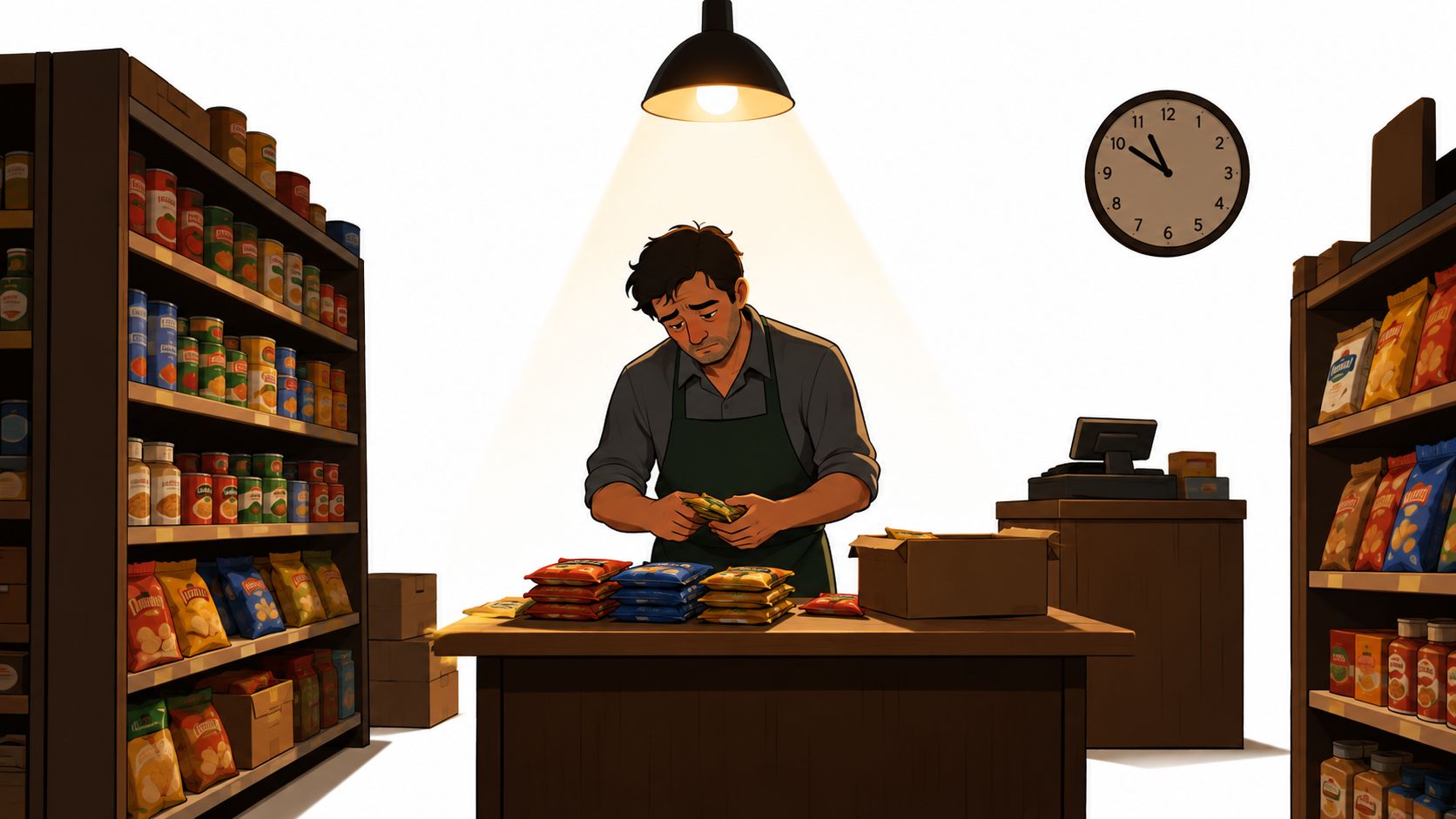
At nine o'clock at night, after serving customers, receiving suppliers, and resolving credit accounts, counting every package seems responsible, but is usually impractical. The owner ends up tired, the counting becomes irregular, and the next day they buy again from memory. The solution is not to count more, but to count what can cause a lost sale or a margin leak.
The reality of daily inventory in your small store
A complete inventory can take hours in an operation run by one or two people. While someone is counting cans, bottles, and bags, no one is helping at the counter. If a customer arrives, the process is interrupted, and later duplicates, forgotten lines, or quantities written down from memory appear.
Data from the INEGI 2024 Economic Census helps explain why a supermarket routine does not fit a small neighborhood store. Between 2018 and 2023, grocery stores added 81,500 establishments, the highest growth in economic units among the reported activities. They also concentrated 4.3% of the national employed personnel, equivalent to 1,191,398 people, while 95.4% of the country's economic units are micro-businesses with up to 10 employed people.
The ABC count changes the question
The wrong question is: “How do we count the entire store every day?”. The useful question is: “Which products should be checked today to decide what to buy, what to remove, and what to investigate?”.
The ABC method separates items according to turnover, margin, and risk of shrinkage:
A Products: sodas, water, beer, milk, eggs, snacks, cigarettes, and promotional items. They are counted daily because they sell frequently or a visible shortage can turn into a lost sale.
B Products: medium-movement items, such as certain cleaning product sizes, packaged food, or complementary stationery. They are checked on alternate days.
C Products: slow-moving merchandise, rarely requested sizes, or products with low immediate impact. They are verified weekly or biweekly.
Daily inventory does not replace a full count. To review the entire catalog, sizes, and general balances, it is best to consult the guide on how to manage a grocery store. The ABC count is used to operate today without neglecting the scheduled comprehensive review.
Rule of thumb: if counting everything forces you to close, distracts the clerk, or is abandoned after a few days, the method is too heavy for the business.
Why daily frequency changes the rules
The physical channel remains decisive for grocery shopping. The INEGI Economics Magazine points out that retail commercialization of groceries represented 12.8% of total retail trade income in 2021, and that 82.3% of transactions were made directly inside the establishment.
In a store, the difference rarely appears as a huge problem all at once. A bottle that the system marks as available, but is not in the refrigerator, can cause the customer to buy elsewhere. Repeated with high-demand products, that failure affects replenishment, service, and trust in the records.
Three levels, not just one count
Daily level, A products. They are checked at opening or closing. The manager counts the visible units, confirms entries and sales, and notes any difference. In a grocery store, this includes water, milk, eggs, sodas, and active promotions.
Alternate level, B products. They are counted two or three times a week. The schedule can be divided by aisle, supplier, or product family. This way, shortages are detected without turning every closing into an audit.
Periodic level, C products. They are reviewed weekly or biweekly. This review uncovers stagnant merchandise, sizes that take up space, and products close to expiring. The result can be changing the display, adjusting the purchase, or removing the item.
Each line item needs exact information: product code or name, unit of measure, physical stock, received entries, daily sales, and shrinkage. “Soda” is too general if there are several sizes. The record must identify the specific item so the balance is useful when buying.
The frequency must also be adapted to the type of business. A coffee shop may prioritize milk, bread, coffee, and cups. A restaurant must monitor recipe ingredients and prepared foods. A barbershop or beauty salon can count hair dyes, blades, gloves, and retail products daily, instead of reviewing every item in the shop.
The daily 15-minute routine that actually works
The routine starts before touching the shelf. The clerk needs a fixed list, grouped by aisle or category, and must always walk it in the same order. Consistency matters more than the tool: a simple sheet used every day produces better decisions than a complex system that nobody updates.
Minutes 1 to 3, prepare the walkthrough
The person in charge opens the sheet for the day, confirms the date, and reviews the received entries. They also identify promotions, pending returns, and merchandise that arrived in boxes but has not yet been placed on shelves.
The list should show only critical items. There is no need to write down every product during the walkthrough if it did not change. Exceptions are noted: shortages, expirations, damage, differences, or an incomplete receipt.
Minutes 4 to 9, count in a fixed order
The walkthrough can start with refrigerators, continue with drinks, follow with snacks, and end at the counter. Sellable units are counted, without mixing on-hold, damaged, or expired products with available merchandise.
The expected balance is calculated as follows:
Starting stock + purchases − sales − shrinkage = theoretical stock
Then, the theoretical stock is compared against the physical count. If the result does not match, the difference is not corrected by erasing the number. It is kept as a signal to investigate.
Minutes 10 to 12, record shrinkage
A broken bottle, a cracked egg, or an expired dairy product is not a sale. It is recorded as shrinkage with product, quantity, cause, responsible person, and a brief note or photograph. This step prevents the system from appearing correct while the margin deteriorates.
To organize entries and exits in more detail, you can consult the guide on warehouse entries and exits.
Minutes 13 to 15, decide on action
The close must end with a concrete decision: buy, remove, arrange, check the cash register, or investigate a difference. An inventory that only accumulates numbers does not help the business.
Category | Starting stock | Entries | Sales | Shrinkage | Physical stock | Difference |
|---|---|---|---|---|---|---|
Cold drinks | 24 | 12 | 18 | 1 | 17 | 0 |
Dairy | 10 | 6 | 9 | 1 | 6 | 0 |
Snacks | 20 | 8 | 14 | 0 | 14 | 0 |
Promotion | 12 | 0 | 7 | 0 | 4 | -1 |
The example in the last row shows a hypothetical difference. If the theoretical stock was five and the physical count was four, the manager must check for an unrecorded sale, an on-hold product, or an incorrect entry. The table does not accuse anyone on its own, but it shows where to look.
How to record shrinkage and avoid silent losses
Silent shrinkage grows when the business only records what it buys and what it sells. A difference can be due to shoplifting, expiration, internal consumption, data entry error, or incomplete receiving. Each cause requires a different response, which is why it is not advisable to use a generic adjustment called "missing."
The sector coverage cited by El Economista describes a sector of more than one million grocery stores, an approximate share of 20% of the total MSMEs, and the incorporation of more than 260,000 businesses into digital ordering and management tools. The same coverage mentions losses of up to 30% due to lack of control, but this data does not represent an official national measurement. It should be treated as a commercial alert, not as a figure applicable to all stores.
The minimum file for each adjustment
Each shrinkage record must include SKU, quantity, cause, responsible person, and brief evidence. Evidence can be a receiving slip, a photograph of the packaging, or a note about the closing. It is not about filling out forms for the sake of it. It is about turning a difference into an action.
Expiration: remove the product and review the purchase date or the arrangement.
Damage: record the time and check if the product was poorly placed.
Internal consumption: separate it from sales so it does not look like a disappearance.
Incomplete receiving: compare the supplier's invoice or receipt with the units received.
Theft or repeated missing items: observe location, access, and cash register closing without turning a suspicion into an automatic accusation.
For sensitive products, it is advisable to apply FEFO, which means taking out first what expires first. Dairy, drinks, bread, and snacks should be arranged placing the closest dates at the front. Digitalizing orders does not by itself solve dates, batches, returns, or damaged products.
Hypothetical example in Mexican pesos
Suppose a coffee shop receives milk at a cost of $28 MXN per piece. At closing, it detects 2 expired pieces, so the hypothetical shrinkage is:
2 pieces × $28 MXN = $56 MXN
The record must indicate product, quantity, cause, responsible person, and evidence. The action is not just to deduct the $56 MXN. It also implies checking if the new milk was placed in front of the previous one, if the purchase was too large, or if the date was not verified upon receipt.
Tools and templates to scale without wasting time
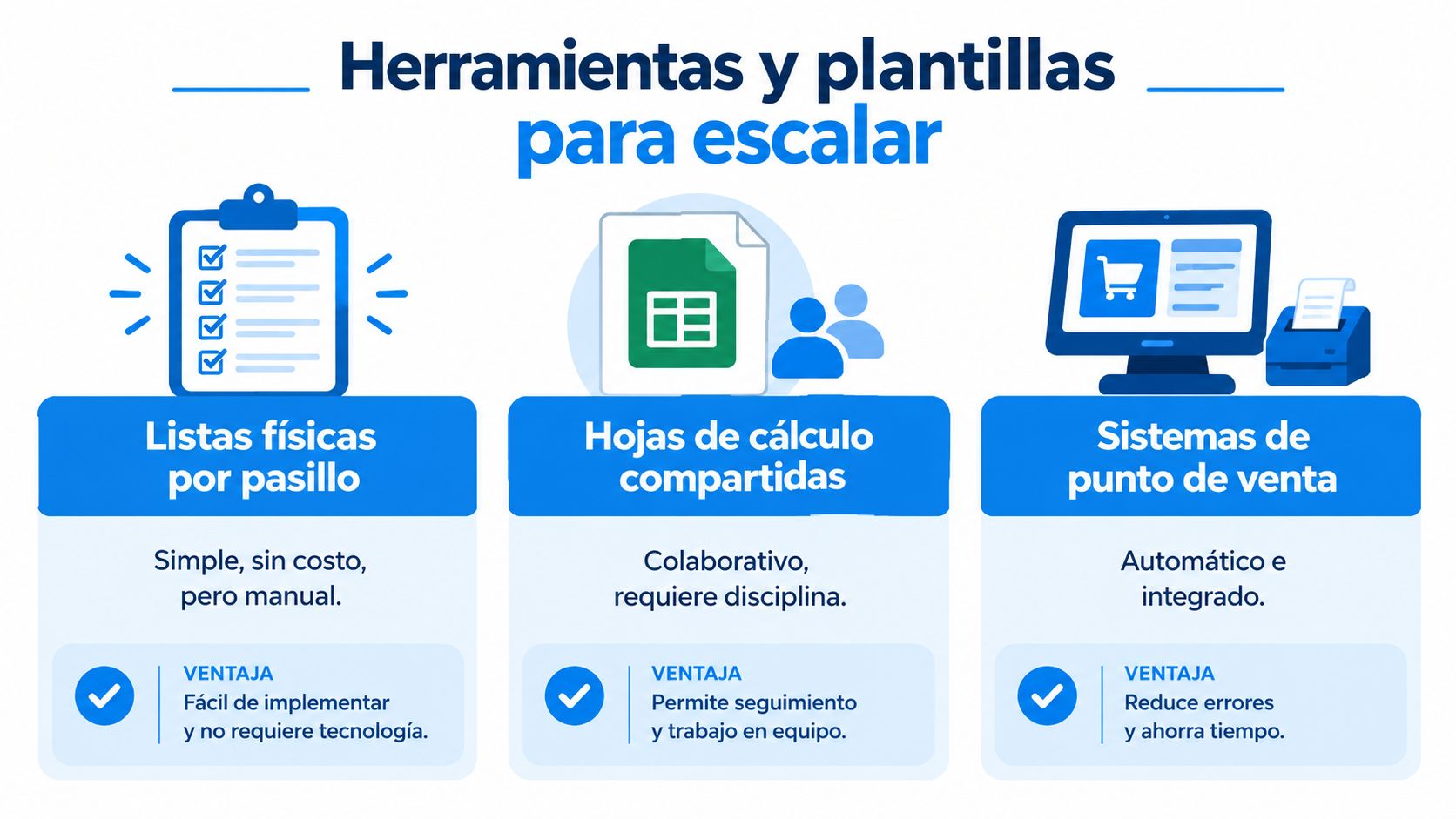
The right tool depends on the size of the catalog, the team's discipline, and the timing of the operation. A physical list may be enough for a small store. A shared sheet helps when two people alternate shifts. A point of sale system is useful when sales and entries must update stock without duplicating data entry.
Option | Main advantage | Operational limit | When to choose it |
|---|---|---|---|
Physical list by aisle | It is simple and requires no setup | Depends on manual data entry and storage | Small catalog and one person in charge |
Shared spreadsheet | Allows collaboration and keeps history | Requires discipline to update entries and sales | Shared shifts or multiple categories |
Point of sale with inventory | Integrates sales and stock | Needs initial setup and training | Operation with frequent sales and need for alerts |
The physical list wins on speed, but loses traceability. The shared sheet organizes data better, although a poorly copied formula can alter the balance. The point of sale reduces repetitive work, but it does not correct a poorly configured unit of measure or shrinkage that no one records.
The same principle works outside the grocery store. A coffee shop prioritizes perishable supplies and packaging. A restaurant separates ingredients, preparations, and waste. A stationery store reviews seasonal items and high-turnover products. A barbershop or beauty salon controls critical consumables and merchandise for sale. The list changes, but the priority remains turnover, margin, and risk.
To evaluate a digital solution oriented towards a small operation, you can review grocery store software. Swirvle offers a point of sale with integrated inventory, stock updates after each sale, monitoring from an administrative panel, and thresholds per item to warn when stock reaches a critical level.
Common mistakes and how to fix them today
The first mistake is counting the entire store every day. The fix is to separate A, B, and C items, and reserve the full count for a scheduled review. More counted products do not mean more control if no one compares the result with purchases, sales, and adjustments.
The second mistake is mixing sellable merchandise with damaged, expired, on-hold, or in-transit merchandise. The solution is to use separate statuses from the moment the exception appears. If a broken bottle remains within the available stock, the record will continue to lie even if the sum looks neat.
Relying on memory also fails. A difference without a cause should not be erased; it must be noted and assigned for review. The manager can change the layout, reduce the purchase, verify the receipt, or check the cash register closing depending on the pattern found.
The daily routine does not seek to prove that everything is perfect. It seeks to quickly reveal what needs a decision.
Daily counting complements, but does not replace, the full or annual inventory. For that broad review, it is best to consult how to do a product inventory. Everyday operations need speed; periodic auditing needs coverage.
Swirvle integrates point of sale, inventory, customer management, and loyalty campaigns so the store can connect its sales with replenishment and retention decisions. Anyone looking to reduce manual entries and check stock from a dashboard can visit Swirvle and learn how to adapt the tool to their business.
Related Blogs

Oct 8, 2026
How to do a daily grocery store inventory without wasting time?

Oct 7, 2026
What does a CRM look like in practice for a coffee shop or restaurant?

Oct 6, 2026
Which campaigns work to fill a restaurant during the week?

Oct 5, 2026
Does Excel work as a CRM for a small business, or is it better to use a software?

Oct 4, 2026
How to organize my client information if I have a small business? Guide

Oct 3, 2026
What message should I send on WhatsApp to win back a customer who is no longer returning?
Try Swirvle for free
No card required · 30 days free
Start your free trial