How do I organize my customer information if I have a small business? Discover practical methods and simple tools to manage your contacts and
A coffee shop owner finishes an intense workday and needs to find a regular customer's phone number. He opens WhatsApp, checks orders, kitchen photos, voice notes, and personal conversations. After several minutes, he ends up asking the barista if they remember the customer's name. That moment seems small, but it reveals a serious operational problem: the information exists, yet nobody can find it when it is needed.
The question "How do I organize my customer information if I run a small business?" has a direct answer: every useful piece of data must live in a single system, with defined fields, recorded consent, and a specific commercial purpose. A coffee shop, a barbershop, or a neighborhood store does not need to start with a complex infrastructure. They need to stop relying on notebooks, chats, and memory.
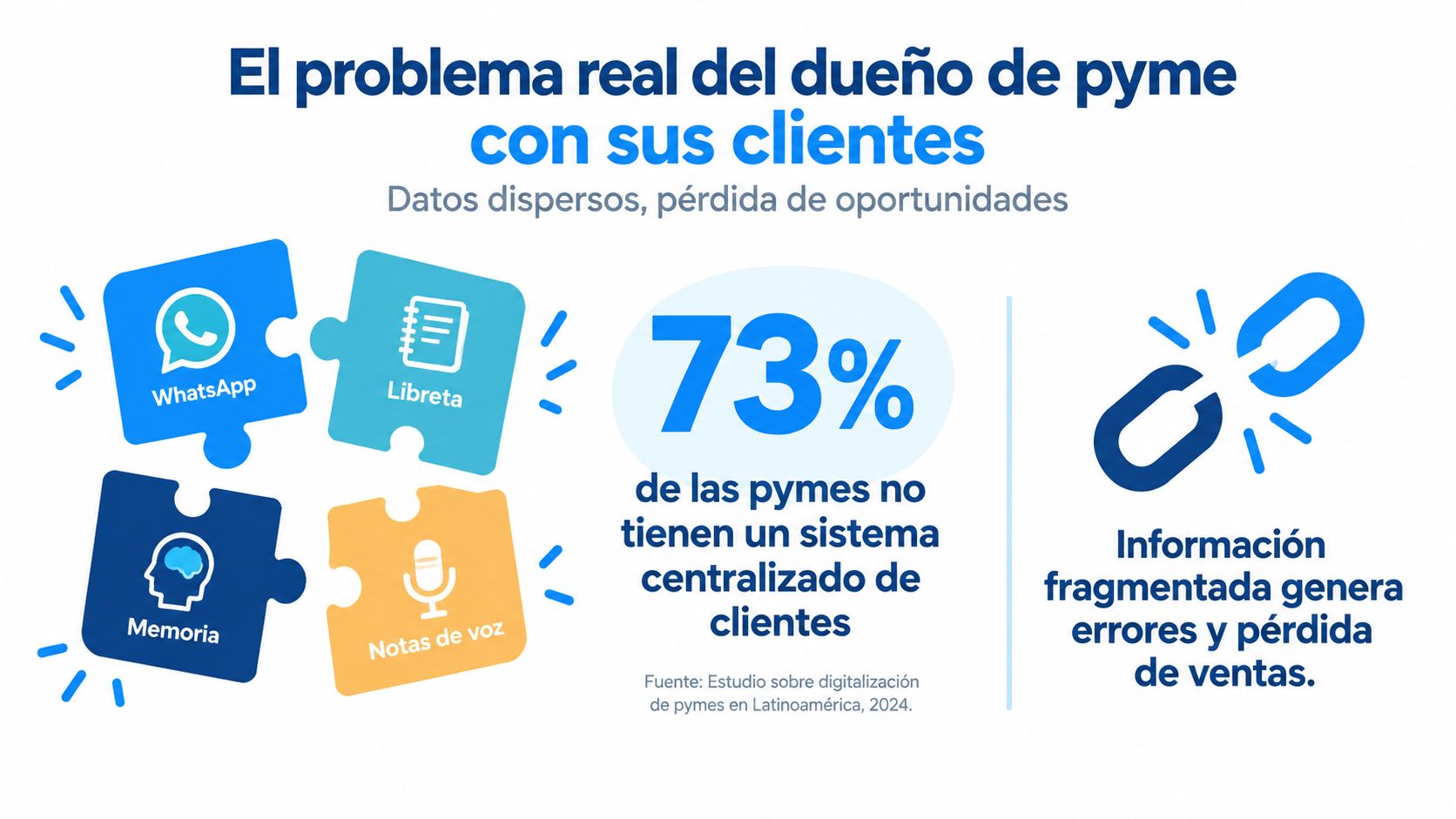
The real problem for SME owners with their customers
In a coffee shop, disorganization appears when a frequent customer receives the same discount twice because one person has them saved as "Carlos coffee" and another as "Carlos office." The team also cannot remember if they accept promotions, if they usually order a specific drink, or if the last conversation was left pending. The business has contact with the customer, but it does not have an organized relationship.
In a barbershop, information might be scattered between a notebook, the barber's phone, and individual messages. Nobody knows for sure which customers prefer a specific professional, who usually requests a specific haircut, or when it is convenient to send a reminder. In a neighborhood store, data ends up on napkins, receipts, and lists that no one dares to clean up because deleting seems more dangerous than keeping everything.
The loss is not limited to a promotion
The lack of order causes several recognizable symptoms:
Lost follow-up: nobody knows who to contact after a visit or a quote.
Repeated promotions: the same customer receives benefits that do not apply because they appear duplicated.
Missed cross-selling: the coffee shop does not identify who buys dessert, the barbershop does not distinguish a haircut from a beard trim, and the store does not recognize recurring categories.
Inconsistent service: each employee responds based on what they remember.
Impossible-to-delete data: the database grows, but there is no criteria to correct, update, or delete records.
The real problem is not having too few customers. It is not knowing who they are, what they buy, when they return, or through which channel they accept communication. A scattered database turns every campaign into a gamble and every conversation into a manual reconstruction of history.
In Mexico, micro, small, and medium-sized enterprises represent 99.8% of private and state-owned sector establishments, while micro-enterprises concentrate 95.4% of economic units and contribute around 45% of the added value, according to information cited in the analysis on Mexican SMEs and digitization. In an ecosystem dominated by small businesses, organizing customers is not a formality. It is a way to compete when team, time, and budget are limited.
What customer data to keep and why
An SME should save only the information that will be used to provide better service, segment, or measure a commercial action. Asking for data out of habit produces long forms, incomplete records, and a database that nobody maintains. The RFC tax ID, for example, makes no sense on a first visit to a coffee shop if the business does not need it for a specific purpose.
The three blocks that actually work
The first block gathers basic contact data: name, phone or WhatsApp, email, and preferred channel. The second describes the relationship: registration date, visit frequency, average ticket, branch, category of interest, and last purchase. The third records consent, with the authorized purpose, date, and corresponding channel.
A coffee shop can start with name, WhatsApp, frequent drink, and authorization to receive promotions. A barbershop needs to add preferred barber, service type, and useful haircut details. A store can record favorite category, branch, or purchase path, without turning the profile into an unnecessary dossier.
Data Type | Coffee Shop | Barbershop | Store |
|---|---|---|---|
Contact | Name, WhatsApp, and preferred channel | Name, WhatsApp, and email if useful | Name, WhatsApp, and contact channel |
Preference | Frequent drink, usual schedule | Barber, haircut type and length | Category or product of interest |
Relationship | Visit frequency and last purchase | Date of last service and recurrence | Last purchase and branch |
Commercial Value | Usual ticket and complementary consumption | Recurring services and usual spend | Purchased categories and response to promotions |
Consent | Promotions via WhatsApp or email | Reminders and authorized campaigns | Channel, purpose, and authorization date |
The criteria for deciding
Each field must answer a question: what decision does it allow us to make? If "frequent drink" helps send a relevant promotion, keep it. If a piece of data does not change the service, segmentation, or measurement, it is unnecessary.
The structure must also accommodate changes. A customer might prefer WhatsApp for reservations and email for receipts. A person might switch branches or stop accepting promotions. The profile must show the current state, not an old snapshot that the team treats as permanent truth.
Operational rule: a small, updated database is worth more than an extensive one with incomplete data, duplicates, and unknown permissions.
How to structure your customer information step by step
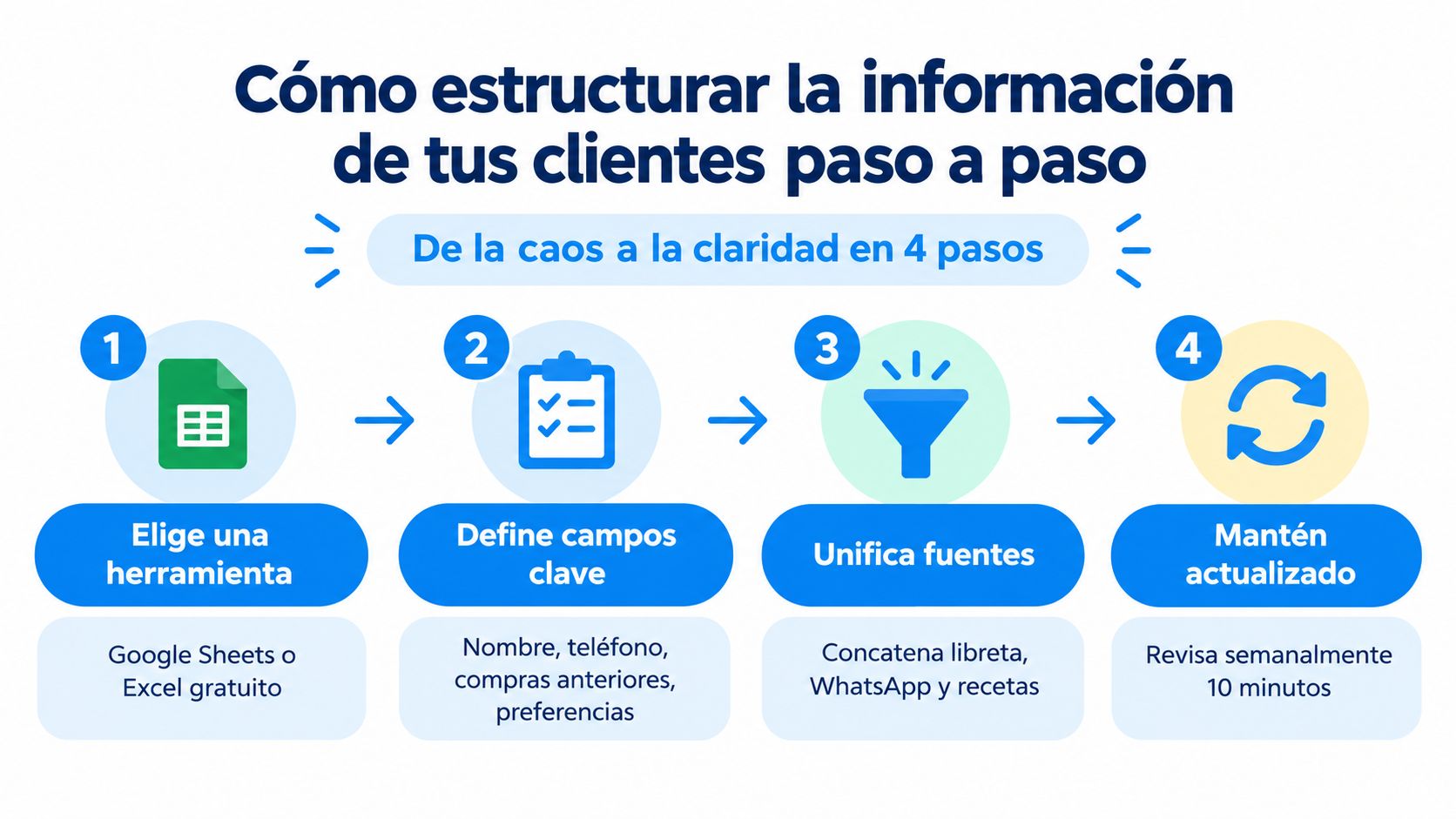
A small business owner does not need to buy software before understanding their own process. The right transition starts with a shared spreadsheet, continues with a form to capture data uniformly, and leads to a basic CRM when the database exceeds 200 records, because at that point searches, duplicates, and manual follow-ups start consuming too much attention.
Step 1: Choose a single source
The first task is to gather the notebook, relevant conversations, and customer lists into a single file. The sheet must have standardized columns, not improvised headers like "cell," "tel," "new number," or "Whats client." A record must retain a name, a contact, a last interaction date, and an internal identifier.
The database can be organized with four column groups:
Fixed fields: name, phone, email, branch, preferred channel, and consent.
Industry-specific fields: drink, haircut, favorite category, preferred professional, or usual product.
Activity fields: last visit, purchase amount, service acquired, and operational note.
Control fields: update date, person responsible for the record, and relationship status.
The guide on how to create a customer database can serve as a reference to define that structure before moving it to a more complete tool.
Step 2: Normalize before segmenting
"María López," "Maria L.," and "M. López" might be the same person. The team must agree on a format for names, phone numbers, branches, and categories. They must also check for repeated records before launching a campaign, because duplicate data can cause repeated messages and misleading reports.
A coffee shop profile could include: name, WhatsApp, frequent drink, last visit, purchase amount, branch, consent for promotions via WhatsApp, and date of consent. A barbershop profile can include VIP customer as an operational tag, preferred barber, haircut type, last appointment, recommended next contact, consent for reminders, and corresponding date.
Consent and its date must be mandatory fields. The Federal Law on Protection of Personal Data Held by Private Parties requires informing individuals of the purposes, responsible party, transfers, and mechanisms to exercise ARCO rights, as explained in INAI's statement on personal data protection. Without that traceability, the database is ready for sending messages, but not for proving why they were sent.
Practical segmentation for coffee shops, barbershops, and stores
Segmenting does not mean filling the database with decorative tags. It means deciding who to talk to first, with what message, and why that contact makes sense. Four variables are enough to start: visit frequency, average ticket, branch or purchase path, and habit or favorite category.
In a coffee shop, one group can gather daily coffee customers, while another includes weekend visitors who usually order dessert. Both buy at the same location, but they will not respond the same way to a promotion. The first group might react to a breakfast special. The second might be interested in a drink and dessert combo.
The barbershop can separate those who return regularly for a haircut from those who only request a beard trim. The store can distinguish recurring buyers of a product from seasonal consumers. Segmentation allows the business to stop sending the same offer to the entire database.
A commercial reading of the customer
The average ticket should not be used to label people as "good" or "bad." It serves to decide the commercial effort. A customer with frequent purchases and a low average ticket might be a candidate for an add-on sale. One with less frequent visits and high purchases might require a specific reminder, not a chain of generic messages.
The branch or route also matters. A local campaign loses relevance if it reaches customers who buy at another location. The habit reveals the consumption occasion, while the frequency shows the likely return time.
Industry | Example Segment | Frequency | Approx. Ticket | Priority Action |
|---|---|---|---|---|
Coffee Shop | Routine weekday coffee | High | Low to medium | Offer a relevant add-on |
Coffee Shop | Weekend drink and dessert | Medium | Medium | Promote a combo purchase |
Barbershop | Recurring haircut | Regular | Medium | Send next visit reminder |
Barbershop | Beard trim | Variable | Low to medium | Activate specific service communication |
Store | Restock product | High | Low to medium | Remind of purchase and suggest add-on |
Store | Seasonal purchase | Low | Medium | Contact close to the corresponding season |
Evidence regarding food businesses provides a useful indicator: 85% of restaurant-goers in Mexico also shop at nearby businesses before or after their visit, with an average additional spend of 370 pesos, and 59% of surveyed consumers visit a local restaurant, bar, or coffee shop at least once a week, according to published information on local restaurant consumption. The priority of the month should combine customer lifetime value and response probability, not intuition.
How to capture and update data without slowing down sales
The best channel depends on the moment the customer is already willing to collaborate. The checkout counter works based on face-to-face trust. WhatsApp is practical when the conversation is already open. The digital form offers cleaner data but can disrupt the interaction if it appears without context.
Comparison of channels
Channel | Advantages | Limitations | Recommended Use |
|---|---|---|---|
Counter | Direct contact, immediate clarification, and opportunity to explain the benefit | Depends on employee memory and the speed of the line | Coffee shops, stores, and businesses with in-person purchases |
WhatsApp Business | Quick conversation, familiar channel, and simple follow-up | Requires quick responses and clear permissions | Bookings, appointments, restocking, and post-sale care |
Digital Form | Uniform fields, fewer entry errors, and organized recording | Can feel distant or interrupt the experience | Voluntary sign-ups, loyalty programs, and campaigns with context |
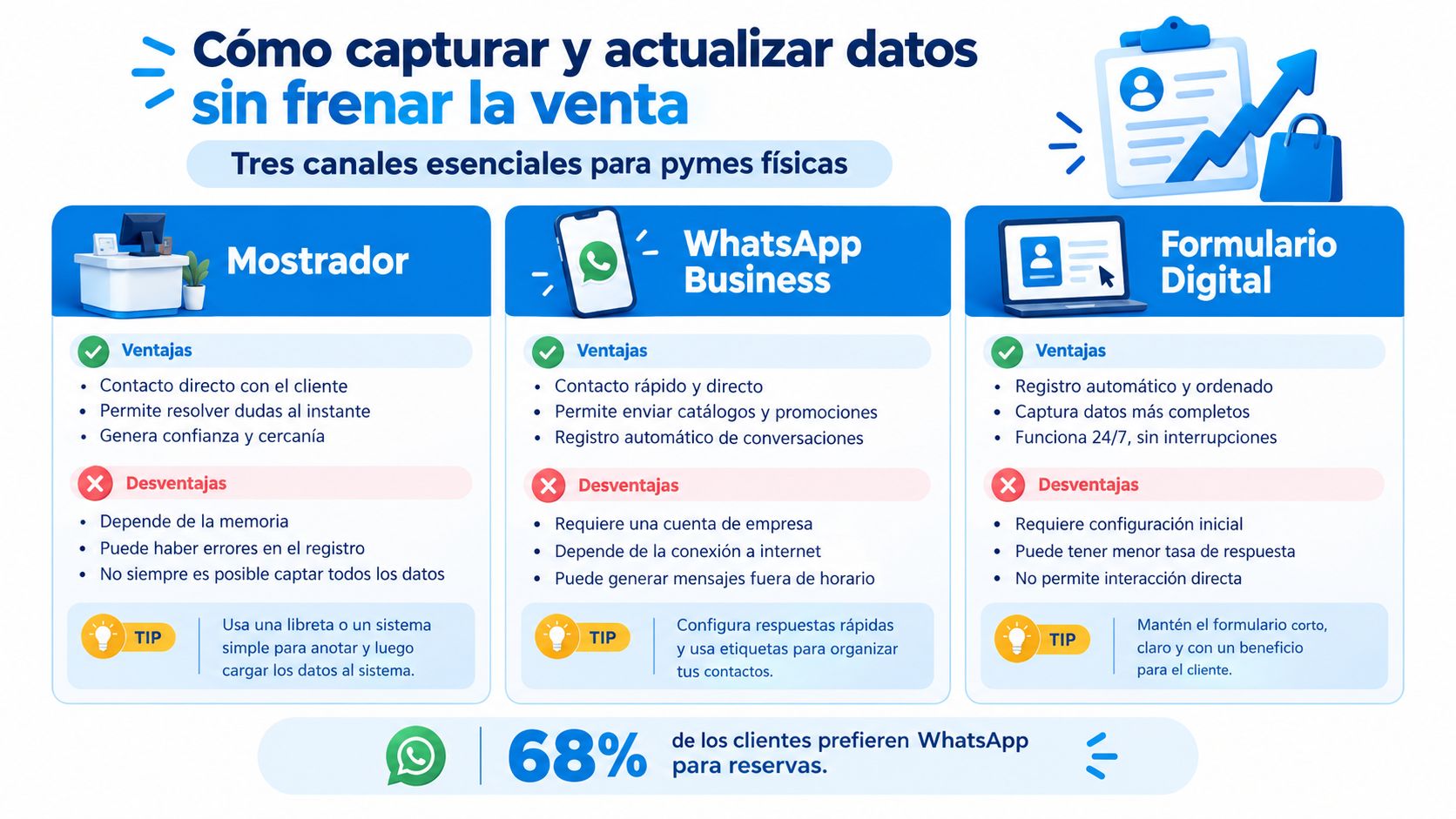
At the counter, the employee can ask for the name and contact channel while taking payment, explain what the information will be used for, and record the response immediately. In a barbershop, the data can be captured when confirming an appointment. In a store, it can be requested after a purchase when the benefit is clear to the customer.
WhatsApp is useful for updating a profile when the customer writes in for a reservation or a question. The team should avoid keeping data in the chat history without transferring it to the central record. The form works best when the business offers a concrete reason to complete it, such as receiving news, saving preferences, or participating in a loyalty dynamic.
Capture limit: ask for only two additional pieces of data per interaction. If the coffee shop needs a name and promo authorization, it should not turn the payment process into an interview.
Updating requires someone to be responsible. The business can review changes at the close of each day or in a weekly routine. The tool matters less than the discipline of recording the data at the right time, with the agreed format and associated consent.
Simple automations that clean up your customer database
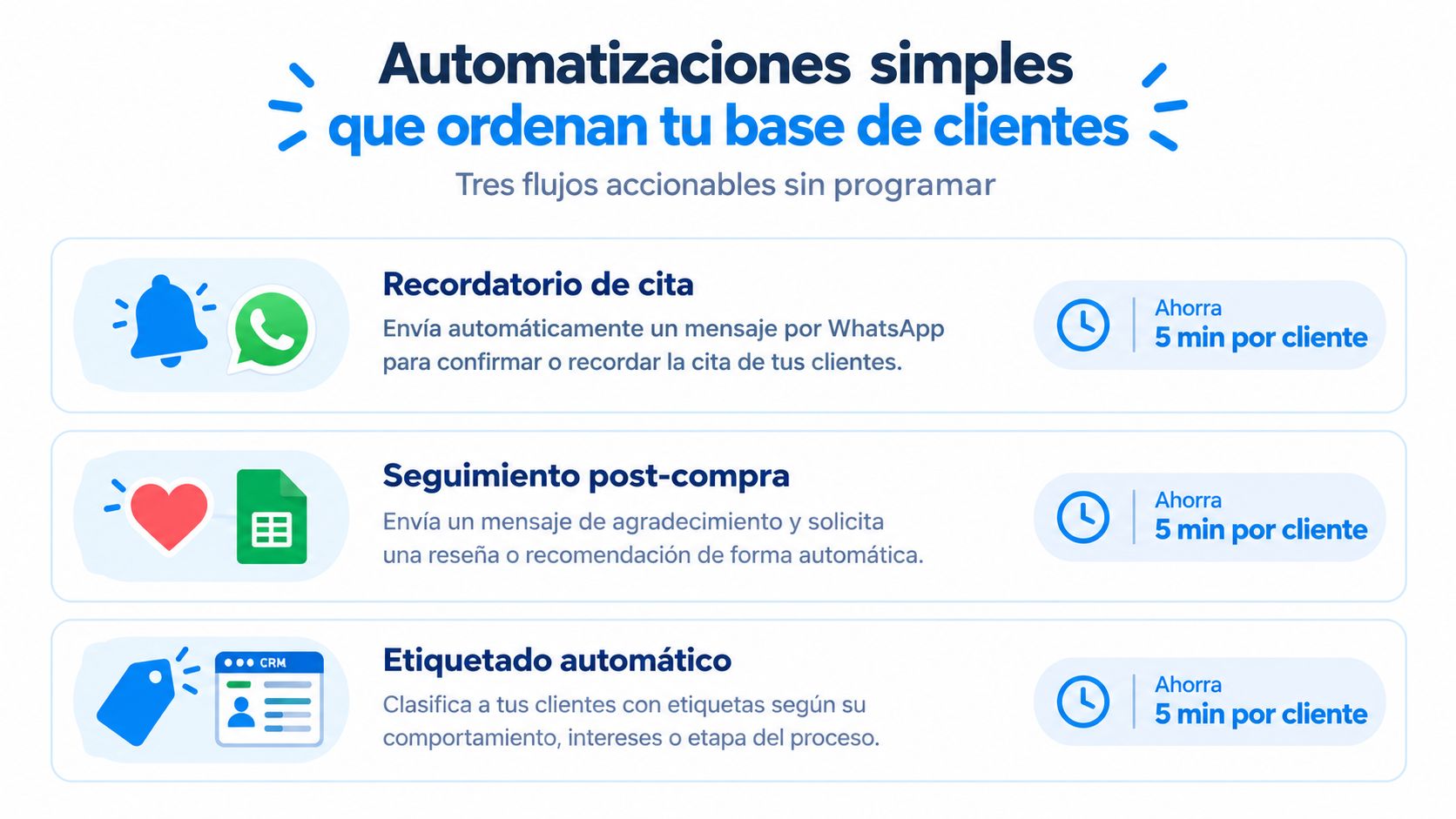
Useful automation starts with a clear condition. A last visit date, a next appointment, a purchased category, or a channel authorization can trigger an action. Useless automation starts with a dirty database and multiplies incorrect phone numbers, duplicates, and out-of-context messages.
Three flows that actually deserve attention
Appointment or restocking reminder. A barbershop can notify a customer approximately three weeks after their last haircut, provided the customer has authorized that channel. A coffee shop can identify a recurring customer and send them a breakfast offer roughly every seven days, without turning it into a daily message.
Return campaign. The business can create a segment of inactive customers for more than 60 days and send a single proposal related to their purchase history. The barbershop can offer an invitation to return for service. The coffee shop can highlight the drink or combo the person used to buy. The store can use the category of interest to avoid a generic offer.
Birthday message. A birthday should only be recorded if there is a clear purpose and the customer agrees to provide that data. The benefit must be defined before sending, for example, a reward related to their usual service or a perk applicable during a specific period.
A spreadsheet can use formulas to calculate days since the last visit, identify categories, and create follow-up lists. A basic CRM can execute those rules with less manual work. Marketing automation for retail provides a framework for thinking about triggers, audiences, and actions without starting with complex flows.
Measure before adding more rules
Each flow must have a hypothesis: the reminder aims to recover appointments, the return campaign aims to trigger a new visit, and the birthday message aims to activate a reward. The owner must review delivery rates, open rates, responses, and attributed purchases before creating another automation.
Organizing customer information does not guarantee more sales on its own, but it does allow you to measure which messages and segments actually respond. The value is not in sending more messages. It is in turning clean data into rules that the team can review.
Privacy and privacy policy as an operational advantage
Privacy should not be treated as a document that is printed and forgotten. A database with verifiable consent improves campaign quality because the business knows who agreed to receive messages, through which channel, and for what purpose. It also reduces the risk of sending communications to people who never authorized the contact.
The Federal Law on Protection of Personal Data Held by Private Parties requires that the responsible party disclose who processes the data, what it is used for, who it may be shared with, and how to exercise ARCO rights. In practice, a coffee shop, barbershop, or store needs an understandable privacy notice at the counter, on the receipt, or on the digital form, along with a clear way to opt out or object to commercial communications.
Permission must go with the record
A general checkbox that says "I accept" is not enough. The record must indicate the purpose and channel. The customer may accept promotions via WhatsApp and decline email. They may also accept appointment reminders but not general campaigns. Separating those preferences allows for sending relevant communications and respecting subsequent changes.
The business must avoid bought databases or numbers copied from chats without authorization. Those lists might seem large, but they lack context, permission, and traceability. A more contained database, with clear consent and the ability to update, offers a more reliable commercial operation.
Three actions solve most of the problem:
Write a brief notice: explain the responsible party, purpose, channels, and rights in language the customer understands.
Record date and channel: save when and where consent was granted for each purpose.
Separate information: keep operational data, like purchases and preferences, separate from sensitive information that the business does not need for sales or service.
The first-party data for SMEs approach helps understand why information obtained directly from the customer must be organized with permission, context, and the ability to update. Properly managed privacy does not slow down sales. It stops the business from wasting efforts on contacts who do not want to receive them.
Your 30-day BLUF plan to organize customer information
The short answer is this: during the first 30 days, the business must define fields, centralize records, clean up duplicates, document permissions, and launch a single measurable action. The tool can be simple. Consistency is not.
Week 1: Define and migrate
The owner must separate minimum fields from optional fields. Name, contact, preferred channel, last visit, and consent form the core. Drink, haircut, category, branch, or preferred professional depend on the industry. Then, all useful information from notebooks and chats must move to a single sheet or system.
Week 2: Clean and unify
The team must detect duplicates, normalize names and phones, and assign an internal ID to each customer. It is also wise to flag incomplete records instead of filling them with assumptions. A clean database allows for searching, segmenting, and correcting without losing history.
Week 3: Document permissions
The business must place the privacy notice, adapt the counter, prepare the digital form, and define a response for WhatsApp. Each new record needs a purpose, channel, date, and consent status. Existing customers should receive a clear update request when the business cannot verify previous permission.
Week 4: Activate and measure
The first segmentation can combine frequency and ticket. The first automation should be a return campaign or an appointment reminder. The owner must measure responses and attributed purchases before expanding the flow.
Five errors slow down progress:
Postponing the privacy notice: leaves data collection without a formal explanation.
Mixing personal and financial data: makes control difficult and increases exposure.
Not recording the consent channel: makes it impossible to know where each person can be contacted.
Relying on the owner's memory: turns operations into a bottleneck.
Not measuring which segment responds best: keeps campaigns based on intuition.
Organization is not about accumulating information. It is about making sure each record helps provide better service, segment, contact, or make better decisions.
Swirvle centralizes customer profiles, consumption habits, and branch locations, and allows setting up campaigns, rewards, and automations via WhatsApp, push notifications, and email. To turn an organized database into measurable recurring actions, the owner can learn about Swirvle and see if it fits the operations of their coffee shop, barbershop, restaurant, or store.
Related Blogs

Oct 6, 2026
Which campaigns work to fill a restaurant during the week?

Oct 5, 2026
Does Excel work as a CRM for a small business, or is it better to use a software?

Oct 4, 2026
How to organize my client information if I have a small business? Guide
Oct 3, 2026
What message should I send on WhatsApp to win back a customer who is no longer returning?

Oct 2, 2026
Grocery Store Software: 2026 Comparative Guide

Oct 1, 2026
Omnichannel CRM for Physical Businesses in 2026
Try Swirvle for free
No card required · 30 days free
Start your free trial