How to track my business's daily sales? Learn how to reconcile cash registers, measure KPIs, and automate reports to make better decisions.
Selling every day is not enough. If at the close of the day the system registers one figure and the bank shows another, the business does not have control, it has an illusion of control. In a coffee shop, a restaurant, a barbershop, or a beauty salon, the difference between "sold" and "collected" is where unauthorized discounts, poorly recorded returns, mixed tips, and pending transfers hide.
How do I track my business's daily sales? Start by stopping looking only at the daily total and start reviewing what happened by branch, by shift, by payment method, and by customer. In Mexico, this discipline makes sense because commerce represents 44.6% of all establishments in the country and the size of the commercial universe demands frequent control, not improvisation (INEGI, Economic Censos 2024). Anyone managing a physical store needs to know, at the end of each day, if they sold more, collected less, or simply moved revenue between channels.
Why monthly reviews destroy profitability
Waiting for the end of the month to review sales is arriving late to almost everything. By then, a branch operating at a loss has already spent several weeks draining cash, uncontrolled discounts have become normalized, and demand peaks that should have been capitalized on are already lost. Monthly readings are useful for budgeting, but not for correcting operations.
Retail sales data shows why averages lie. INEGI reported that real retail revenues in Mexico rose 0.7% in July 2024 compared to the previous month, then barely 0.1% in August, and fell 0.8% in August 2024 on an annual basis (INEGI, 2024 trade bulletin). In a physical store, those small changes can hide very slow days, weeks with low average tickets, or a branch that is selling less than the others.
The four non-negotiable metrics
A serious daily dashboard needs, at a minimum, net income, number of tickets, average ticket, and payment method. Without those four pieces, the manager knows how much came in, but does not know if it came from more customers, larger purchases, or a different mix of cash, card, and transfer. That nuance completely changes the operational decision.
Rule of thumb: if only a single sales figure appears, there is no tracking yet. There is counting.
It is also useful to compare against a moving baseline, not against yesterday. In businesses with irregular traffic, Monday does not look like Saturday, and payday does not behave like an ordinary day. Comparing with the same day of the previous week and with a moving average avoids punishing or rewarding the team for a variation they did not control.
Structure of a cash register close and daily reconciliation
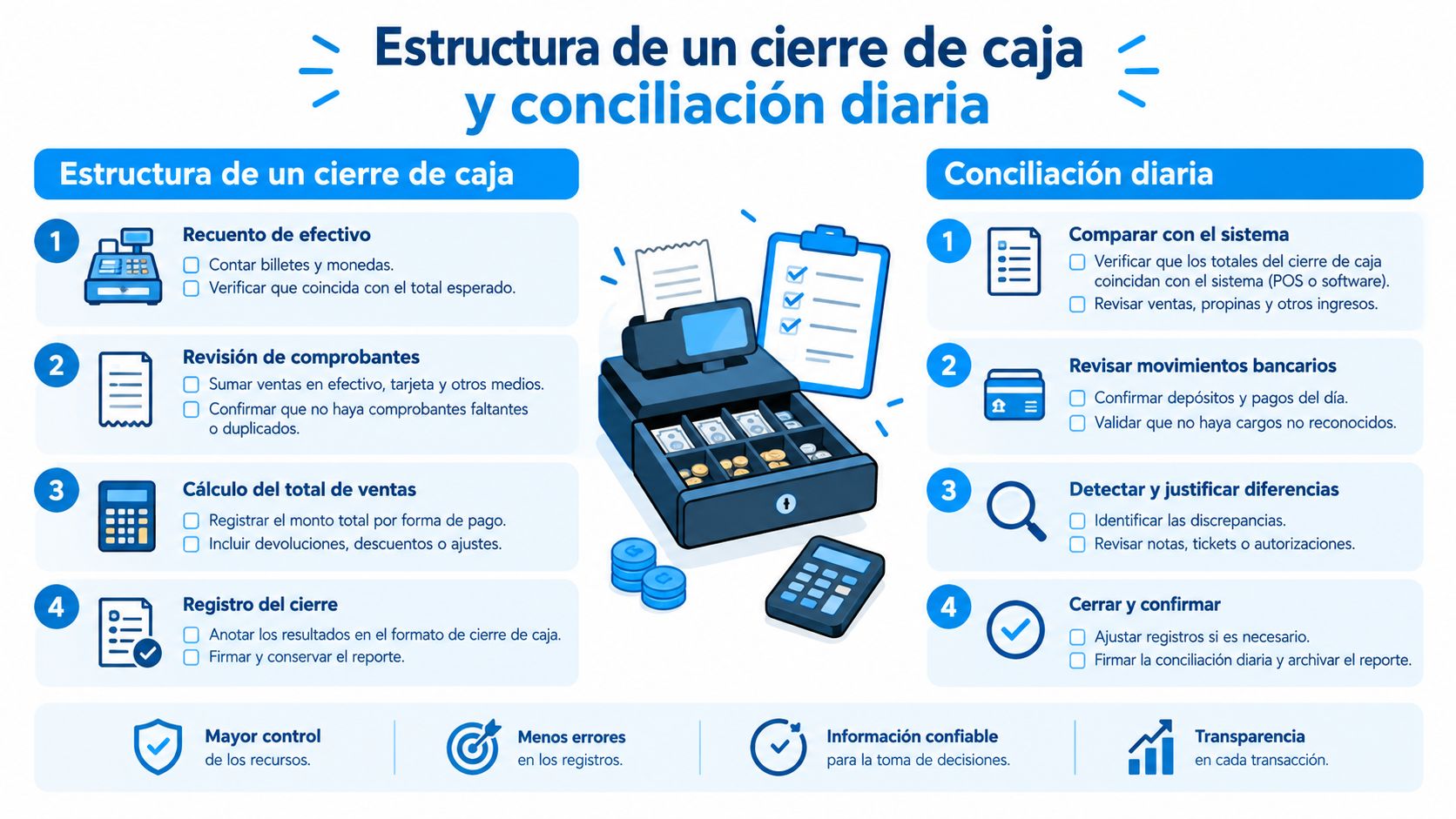
A useful daily close does not start with "how much did we sell?", but with "what was backed up?". The correct sequence is to record gross sales, discounts, returns, taxes, net sales, number of tickets, units, payment method, hour, employee, and category. This cut must be made by branch, because mixing locations erases where the problem is.
How to cross-reference POS, cash drawer, and bank
Real control is achieved through triple reconciliation. First, the POS against the counted cash. Second, the POS against deposits or bank terminal. Third, the POS against inventory sold. If the three matches do not square, the system is not confirming a sale, it is only reflecting a record.
In Mexico, this matters because cash remains central to many operations. CONDUSEF notes that it was the primary medium for sales in 2023, although it fell from 94.9% to 83.8% between 2018 and 2023, while electronic transfers rose from 8.8% to 16.7% (CONDUSEF, statistics). A dashboard that sums tickets without separating expected cash, counted cash, verified transfers, settled cards, and accounts receivable can look healthy where there are shortages.
The daily close must not hide cancellations, comps, or returns. If they are mixed with regular sales, the cash drawer looks better than it actually is.
For a quick review, the manager can apply three questions: does what the POS says match the drawer?, has the bank terminal already settled what was charged?, does what was sold have a physical exit in inventory? If one answer fails, the anomaly is investigated before moving on to the next day. For a basic internal capture template, it is best to use a uniform structure like the one described in the sales log.
Sales attribution to campaigns and loyalty programs
Measuring sales without measuring origin leads to expensive conclusions. A promotion can lift tickets and still reduce margin, or a WhatsApp campaign can seem successful only because it triggered purchases that would have happened anyway. Useful tracking doesn't just ask how much a campaign sold, but how much more it sold.
The daily funnel should include traffic or conversations initiated, identified customers, tickets, conversion, average ticket, margin per ticket, repeat purchases, and sales attributable to each campaign. Banxico also reminds us why it is useful to separate volume and real value, since between July 2024 and June 2025, 10,662 million card transactions were made for 6.18 trillion real pesos, with a real average amount of approximately 580 pesos, compared to 903 pesos in 2015 (Banxico, annual report).
How to attribute without relying on links
In physical stores, there isn't always a click that identifies the purchase. That is why an attribution window per period works better, such as seven or fourteen days, comparing exposed customers, customers who redeemed, and similar unexposed customers. This estimates the net increase instead of celebrating total sales inflated by campaigns.
The right campaign does not always sell more today. Sometimes it advances the purchase, and that must also be measured.
The operational sequence is simple. First, a hypothesis is defined. Then, the period and branches are set. Next, the cost of the incentive, channel, and control group are recorded. Finally, expected sales are compared against observed sales. Without that discipline, the business ends up subsidizing habits that already existed.
Specific metrics for restaurants and barbershops
Each line of business needs a different lens. A restaurant is not analyzed the same way as a barbershop, because one lives on hourly traffic and add-ons, and the other depends on schedule occupancy, service mix, and retail sales. If the dashboard treats everyone the same, the decision goes wrong.
In restaurants and cafes, the daily focus must be on number of tickets, average ticket, add-ons sold, cancellations, and hourly behavior. A Tuesday might sell less due to rain, but that doesn't mean the problem is price. It could simply be lower foot traffic and not lower conversion. The manager needs to see if traffic dropped, if consumption per ticket went down, or if discounts eroded the margin.
In barbershops and salons, the daily cut must separate service, product, tip, and no-shows. The INEGI 2024 Economic Censos record 71,883 beauty salon, clinic, and barbershop establishments, and Data Mexico reported $36,103 million pesos in total revenue for that industry in 2019. That market size justifies measuring by professional, not just by register.
Daily KPIs by business type
Line of Business | Primary Metric | Secondary Metric | Early Warning |
|---|---|---|---|
Coffee shop | Average ticket | Sales per hour | Drop in add-ons |
Restaurant | Tickets | Margin per ticket | More discounts or fewer occupied tables |
Barbershop | Services per professional | Schedule occupancy | No-shows |
Beauty salon | Revenue per stylist | Product sales | Lower service mix |
A barbershop with more sales does not always yield more. If it serves more people but gives away more discounts or sells fewer products, the gross revenue is deceptive. For a practical breakdown of costs and prices per service, operational criteria can be supplemented with the calculation of the selling price of dishes, especially in businesses with immediate consumption and add-ons.
Report automation and tax compliance
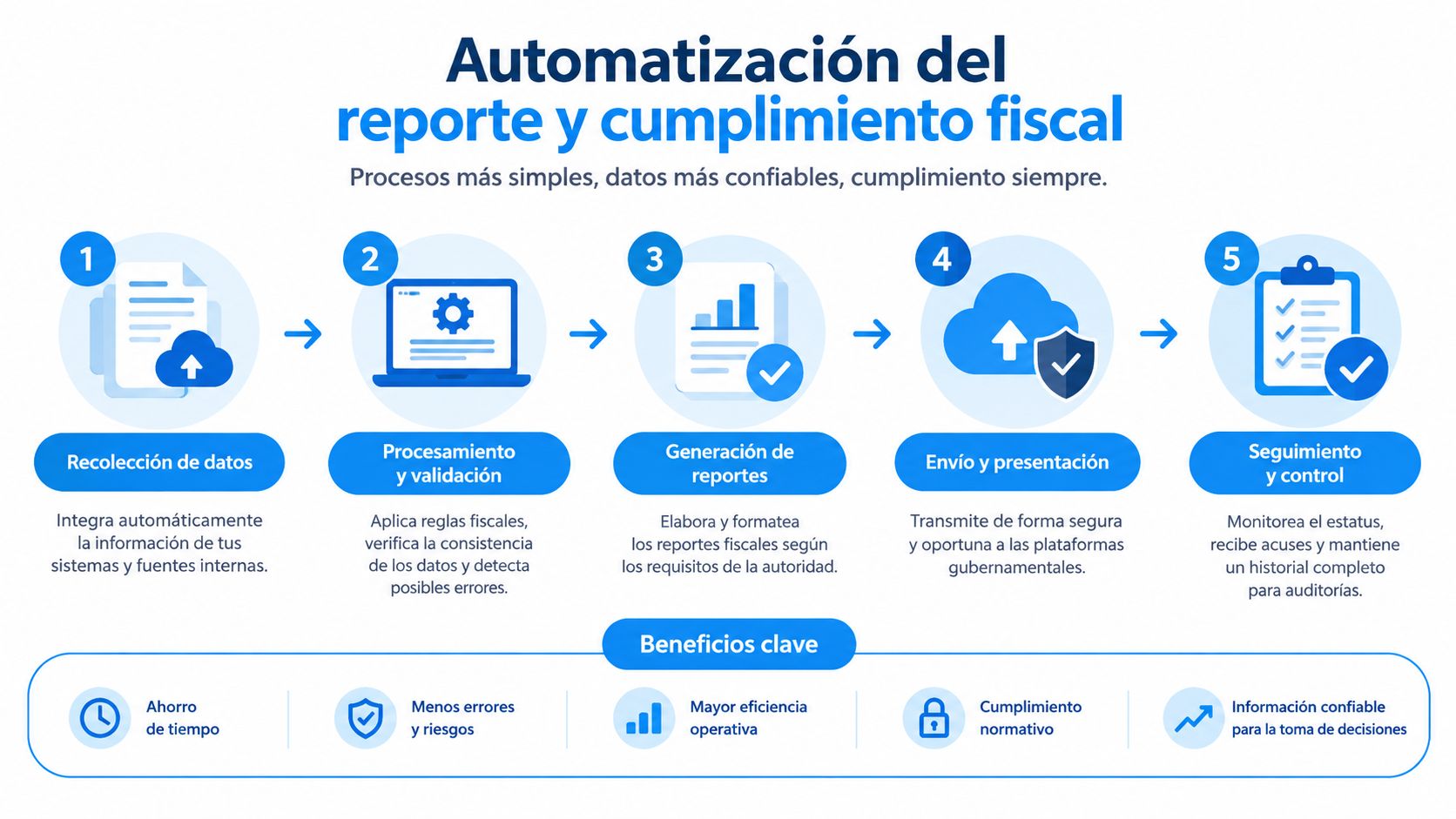
Closing the register by hand every day is a recipe for error. When the team copies amounts onto loose sheets of paper, gaps multiply between recorded sales, tax receipts, and real deposits. Automation does not eliminate supervision, but it does remove friction where errors are most often made.
In Mexico, daily tracking must reconcile the total collected with tax invoices and the register close. For restaurants and coffee shops, transactions without an individual invoice are concentrated into a global CFDI, and that close must be backed up with the operational details of tickets, amounts, taxes, cancellations, discounts, and payment methods (guide on global CFDI in restaurants). If the system says one thing and the cash drawer another, the difference is corrected first, and then any commercial decision is made.
Manual close vs. automated workflow
A manual close depends on memory, repeated data entry, and review at the end of the shift. An automated workflow, on the other hand, centralizes sales, customers, and invoices into a single panel, with traffic light indicators that detect deviations quickly. In high-traffic businesses, this change saves time and makes visible what was previously lost between shifts.
If an anomaly is seen the next day, it is no longer a minor anomaly.
The recommended operational approach is to review exceptions, not the whole day. A clear threshold allows for a response in less than 15 minutes when differences appear between expected cash, bank settlement, or inventory. For tax rules and minimum verification fields, it is useful to keep the tax requirements of an invoice handy and cross-reference them with the daily cut.
Action plan to implement your control dashboard
The first dashboard doesn't need to be a big project. It needs discipline, a fixed structure, and clarity on what will be reviewed each day. A small business benefits more from a consistent report than from a sophisticated panel full of figures that nobody uses.
Start by standardizing payment categories in the POS, separating cash, card, transfer, discounts, returns, and comps. Then, define a moving baseline with the same day of the previous week and the recent average. If a figure moves out of the ordinary, the dashboard should show it without anyone having to search for it manually.
Short path to start today
Organize the close fields. Each branch must close with date, tickets, net sales, payment method, and shift supervisor.
Create a discrepancy review. Any amount that does not square with the drawer, terminal, or inventory is flagged as an exception.
Define simple alerts. Status indicators for sales, tickets, and average ticket.
Review campaigns with causal criteria. If there was no control group, success should not be declared.
Separate volume recovery from profitability. More sales do not always mean a better business.
For teams that need to implement metrics without disrupting operations, a useful resource is metric tracking in TrainerStudio, because it helps to think about indicators that can be sustained on a day-to-day basis. In a physical SMB, this logic prevents reporting from becoming a decorative chore.
In 2024, Mexico had 7,093,631 establishments and 36,592,279 employed people, according to INEGI, and commerce represented 44.6% of the country's establishments (INEGI, Economic Censos 2024). With a market of that size, selling without daily tracking is competing without a dashboard.
Swirvle centralizes sales, customers, and campaigns for physical stores that need to see what was sold, what was collected, and what made it back to the bank. If the business requires daily tracking by branch, reconciliation, and campaign attribution, it is worth checking out Swirvle and evaluating if it fits your operation.
Related Blogs

Oct 9, 2026
How do I track my business's daily sales?

Oct 8, 2026
How to do a daily grocery store inventory without wasting time?

Oct 7, 2026
What does a CRM look like in practice for a coffee shop or restaurant?

Oct 6, 2026
Which campaigns work to fill a restaurant during the week?

Oct 5, 2026
Does Excel work as a CRM for a small business, or is it better to use a software?

Oct 4, 2026
How to organize my client information if I have a small business? Guide
Try Swirvle for free
No card required · 30 days free
Start your free trial