
Designing promotions and offers that increase average ticket size - Learn how to design promotions and offers that increase the average ticket size in your SME. Strategies
In Mexico, 89.8% of consumers have purchased a good or service under some promotion because they perceive it as savings, and 58.2% buy very often when they need it and it is on promotion. The problem is not that people ignore offers; the problem is that many promotions drive purchases, but do not always raise the basket per transaction or protect the margin. To raise the average ticket, the design must change from "visible discount" to incremental spending mechanics.
Why traditional promotions do not raise the average ticket
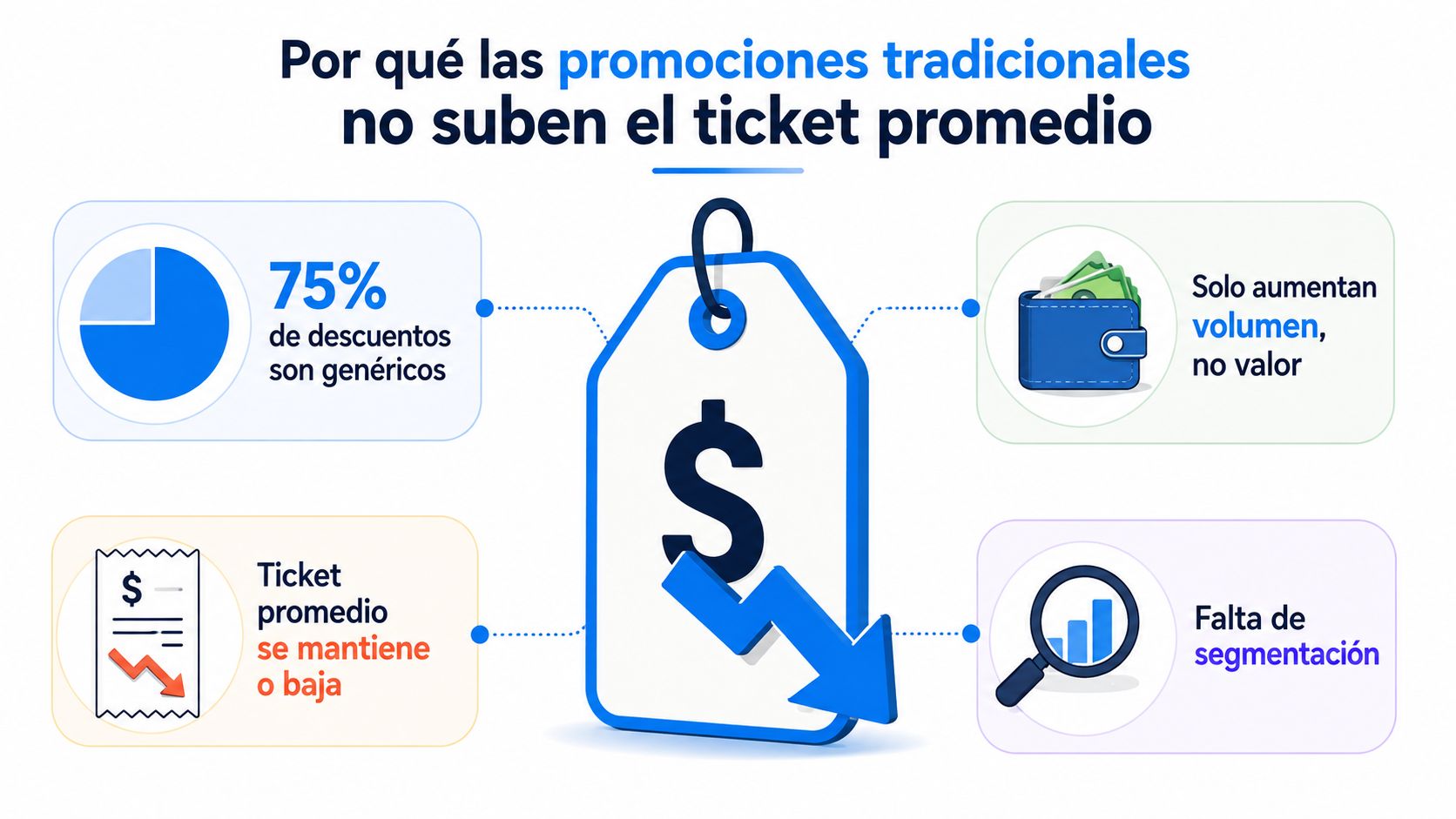
Generic promotions work because they trigger purchase intent, but they do not necessarily increase the value of each ticket. In Mexico, the strongest appeal remains the direct discount at 57.3%, followed by interest-free monthly installments at 36.9% and 2-for-1 at 35.9%; coupons lag behind at 7.8% (preferred promotions by the Mexican consumer). This already leaves a clear clue: the customer responds better to simple, visible incentives than to complicated schemes.
The most common mistake on the sales floor
An isolated markdown lowers the price, but does not force products to be added. In a coffee shop, for example, a discount on the base beverage can accelerate the purchase, but leaves the logic of "I'm only taking what I already came to buy" intact. The same thing happens at a gas station: if the promotion is not tied to an additional purchase, the ticket remains flat.
Rule of thumb: if the offer does not change the behavior of the basket, it is only subsidizing the same purchase.
Academic findings in department stores in Mexico City help refine the focus. In a study with 258 participants, among those who buy with a discount, 50.4% were in the low-income level, 35.4% in the middle-income level, and 14.2% in the high-income level, suggesting greater price sensitivity in lower-income segments (academic study in CDMX). This does not mean that the discount does not work; it means it must be used with structure, not as an automatic reflex.
What actually changes the ticket
The promotions that perform best are those that combine savings with an additional purchase. Volume discounts, bundles, combos, or 2-for-1s with clear rules push a second decision within the same visit. In physical businesses, this usually carries more weight than a flat discount, because the customer perceives value and the business retains a better share of its margin.
Branches also react differently. Someone entering a coffee shop in Mexico City on a Tuesday morning does not buy the same way as someone visiting a location in Mérida at closing time, nor does a store in a commercial area in Monterrey respond the same way as a neighborhood unit. Therefore, copying the same promotion everywhere usually produces volume, but not a higher ticket.
To establish a healthy offer foundation, it is best to start with a simple logic of price and mechanics. A useful guide to avoid poorly designed discounts can be found in how to do a discount, especially when the promo must protect the margin and not just attract attention.
Customer segmentation before designing any offer
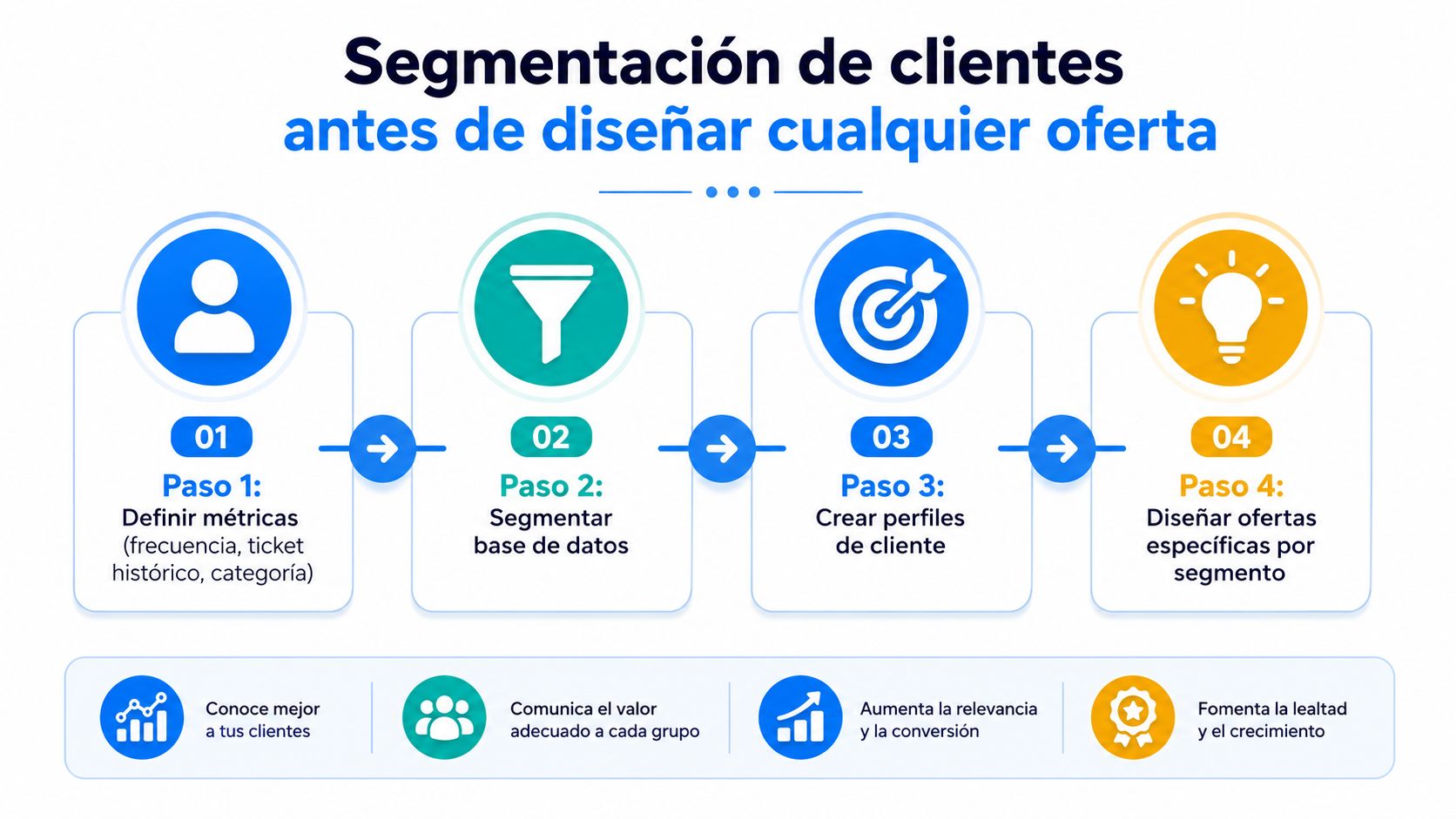
Before thinking about the offer, it is best to know who will receive it. A customer who visits a coffee shop every two days does not need the same push as one who only appears when they "feel like" something, and both react differently if the branch is in Puebla, in Puebla capital, or in an office zone in Mexico City. Segmentation avoids launching promotions that give away margin to those who were already going to buy.
What variables really matter
The minimum foundation is simple: purchase frequency, historical ticket, preferred category, and visited branch. With those four variables, you can already separate customers who buy little but frequently, those who spend a lot when they come, and those who only respond to very clear benefits.
In coffee shops in Mexico City, the average ticket usually ranges between 80 and 120 MXN pesos (coffee shop business reference). This range serves as an anchor for building add-ons, not for breaking the base price. If the customer is already close to the average, the next step is not to discount further, but to offer something that completes the visit.
How to separate three useful groups
A CRM manager can work with three operational profiles.
High-potential customers: they spend well when they visit, but do not always come. These are suited for a spending threshold or reward.
Occasional customers: they need a short, visible, and easy-to-understand incentive. This is where bundles and combinations work.
Loyal customers: they already buy frequently, so they respond better to exclusive benefits, early access, or reward accumulation.
The right segment is not the one that buys the most, but the one with the most room to grow without destroying margin.
In car washes in Nuevo León, weekly recurrence allows for designing visit milestones rather than just loose discounts. If the business already knows how many times each customer returns, it can reward repetition, cross-sell services, and raise the bill with extras like vacuuming, waxing, or interior cleaning. A well-designed criterion drives more than a general promo.
How to implement segmentation in the branch
The store should not view the entire database as a single audience. A high-traffic branch can tolerate a different offer than a moderate-traffic one, and that changes the type of incentive that should be shown to the customer. To structure this logic without improvising, it is helpful to review what customer segmentation is and turn it into operational rules by category and branch.
Mechanics that raise tickets without destroying margin
At the point of sale, the right mechanics change more than the discount. Increasing units per visit, pushing an upgrade, or adding a complement works better than cutting prices flat, because the margin is defended from the structure of the offer.
Direct comparison of options
Mechanics | Main advantage | Margin risk | Best for |
|---|---|---|---|
Upsell at point of sale | Raises ticket value at the final moment | Low, if offered on higher-margin products | Coffee shops, gas stations, car washes |
Bundles of complementary items | Increases the basket with convenience logic | Medium, if the bundle mixes a very cheap anchor SKU | Breakfasts, consumables, combined services |
Spending threshold with reward | Pushes the customer to complete a larger purchase | Medium, if the incentive triggers too early | Retail, neighborhood stores, services with extras |
Conditional smart coupons | Protect margin because they are not given to everyone | Low to medium, depending on eligibility rules | Recurring customers and reactivation |
The best case usually mixes a threshold and a complement. In gas stations in the State of Mexico, a spend that triggers a wash or an additional benefit makes more sense than a flat discount per liter, because the incentive is tied to a behavior that raises the bill. In coffee shops in Puebla, a breakfast with pastry, beverage, and add-on works better than a discount without context, because the purchase already has a routine logic. This is also where upselling comes in, which is worth reviewing with a practical definition in what is upselling so as not to confuse it with a simple discount.
Where the margin begins
Healthy practice: first decide which SKU supports the operation, then build the promotion around that SKU, not the other way around.
Data from Hot Sale 2025 provides a useful reference for physical businesses. An average ticket of $1,100 MXN and an average of 2 items per order were recorded, with 19.2 million orders (Hot Sale 2025 operational benchmark). This suggests that mechanics that move more pieces per transaction can indeed improve the basket, but the incremental margin per SKU remains the metric that rules. If the benefit goes to the wrong product, the volume is misleading.
How to choose based on business
A car wash needs to reward recurrence and value-added service. A coffee shop gains more from combos and add-ons than from generic discounts. A small retailer can use a threshold to trigger a gift, an upgrade, or a delivery, as long as the benefit does not eat into the profitability of the main purchase.
The context also changes the message. For an automotive category, a piece like cars on sale near Monterrey serves as an example of how the promotion becomes more effective when it speaks to inventory and availability, not just price. That contextual logic applies equally in a neighborhood branch, where the incentive must fit what people buy there and the margin that the branch can actually sustain.
Copy and timing for WhatsApp, push, and email
Good mechanics fall apart if they arrive late or sound aggressive. The message has to arrive when the customer can still make a decision, and with a tone that invites them to add, not to defend themselves. In CRM, timing carries as much weight as the offer.
WhatsApp for immediate purchase
WhatsApp works best when the customer already has a visit habit and the message solves a small decision for them. In a coffee shop in Baja California, the text can push a size upgrade or an extra, but it is best to keep it short and concrete. Something like "Your beverage today can come in a large size for a small adjustment" sounds more helpful than a phrase loaded with urgency.
Push for recurrence
Push notifications are best used for pending visits, not for explaining the entire promotion. In a car wash in Monterrey, an alert can remind the customer that they already have an accumulated visit or that they should return before a certain time to unlock a benefit. The value is in the reminder, not in the pitch.
Email for thresholds and combinations
Email accommodates more detail and is suited for explaining spending rules, bundles, or tiered rewards. In retail in the State of Mexico, an email can present a purchase threshold clearly, explain which products help reach it, and show why it is beneficial to complete the basket. The subject line should speak to benefit, not pressure.
Seasonal logic also changes the pace. In summer campaigns, consumers make fewer shopping trips, but with a higher average ticket, which reached 105 pesos in the study cited by Merca20 (summer promotions). This pattern favors messages that push a larger basket, rather than scattered discounts.
Simple timing rules
Purchase day: send the message when the visit is still possible, not at the close of the day if the branch can no longer receive more traffic.
Useful time: speak to the customer before the moment they decide, such as the morning for coffee shops or the afternoon for quick services.
History: if the customer has already responded to bundles, it is not advisable to bombard them with generic coupons.
Branch: a high-traffic store can support a more restrictive offer than a unit with slower demand.
The best message does not shout discount; it reminds the customer of the next logical step in their purchase.
Key metrics and A/B tests by branch
If the promotion is not measured by campaign and branch, the business ends up confusing sales with profitability. The ticket can rise for different reasons, and a larger amount at the register does not always prove that the mechanics worked well. It is necessary to review what changed in the purchase and how much that change cost.
What to review in each campaign
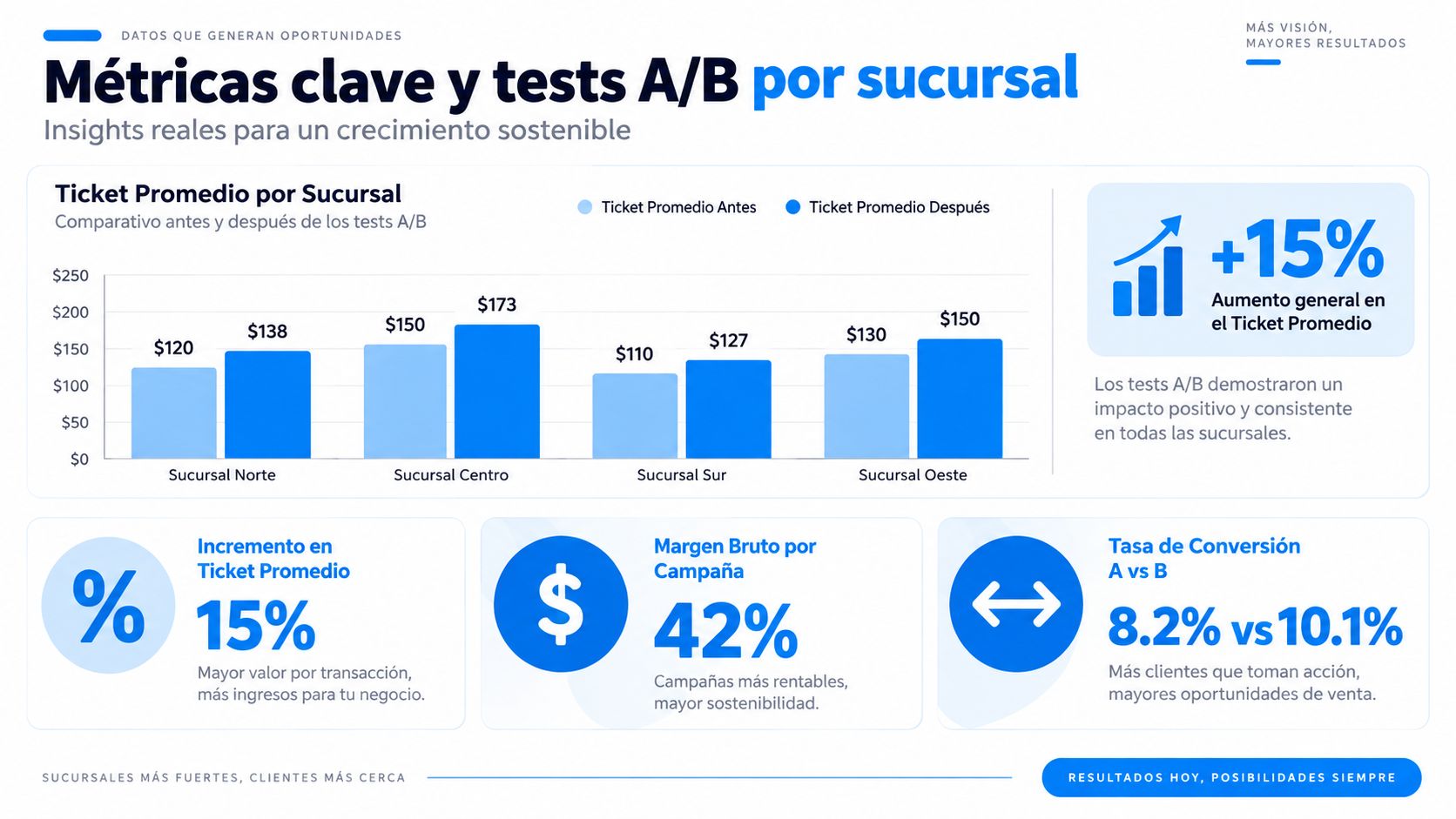
The base metrics are four: average ticket per campaign, items per order, incremental margin per SKU, and redemption rate. It is useful to add attribution by channel, because a sale that came from a physical visit should not automatically credit WhatsApp.
Format context also carries weight. The average ticket in retail increased by 5.6% due to sales of higher-value products and upselling and cross-selling tactics, with increases of 8.3% in shopping malls and 5.3% in street-level stores (report on average ticket in retail). This confirms that the same mechanics do not respond the same way across all points of sale, so the branch format must be included in the analysis.
How to set up a useful A/B test
The test does not have to be complex. One branch can operate with bundles and another with thresholds, always on comparable categories. The key is not to change ten variables at the same time, because then no one knows what moved the result.
If two branches have different sales patterns, the test compares which mechanic fits that customer flow better.
How to avoid false readings
It is not enough for the gross ticket to rise. If the incentive was concentrated on the anchor product, the increase may come with a thinner margin. It is also necessary to check if the promotion only brought forward purchases that were already going to happen, because that inflates the perception of success without creating new value.
According to data from the e-commerce sector in Mexico, in 2024, 65% of SME sales during discount seasons included at least one promotion, and 38% of those promotions were direct discounts or 2-for-1s, 15% coupons, and 12% promos linked to payment methods. This breakdown shows that the mix matters. It is not enough to be on promotion; you must know what each incentive does to the cash register and the margin.
Actionable templates and mistakes that destroy margin
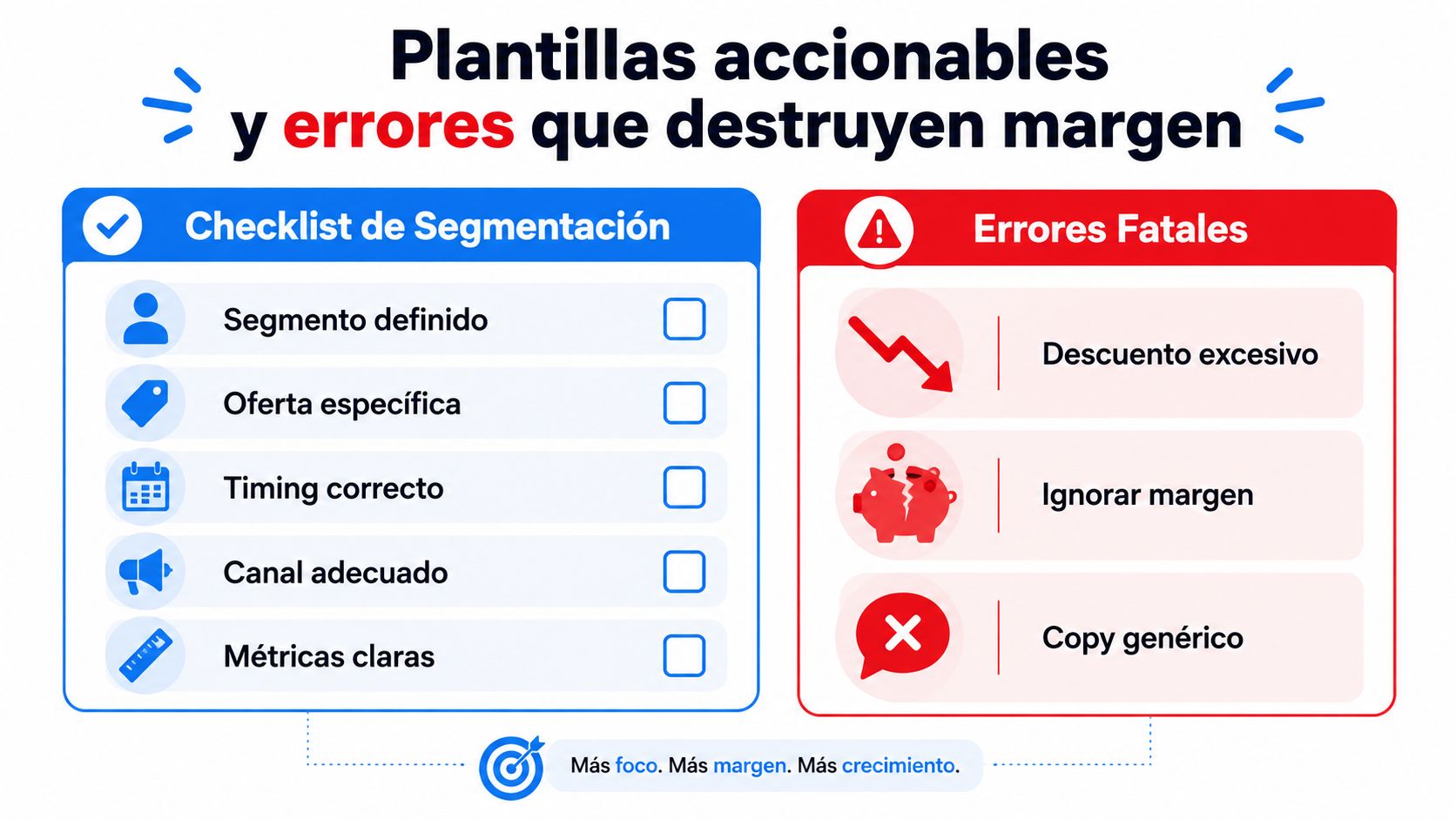
Implementation works best when the offer is born with rules. A coffee shop does not need the same scheme as a gas station or a car wash, but they all share the same logic: defined segment, specific offer, correct timing, appropriate channel, and clear metrics.
Short template by business type
Coffee shop: combine a base beverage with a profitable add-on, like a pastry or a larger size, and trigger it only during peak purchase intent hours.
Gas station: link the benefit to a consumption threshold, with simple rewards that can be understood in seconds.
Car wash: reward recurrence and cross-sell services, especially when the customer returns on a weekly basis.
Neighborhood retail: use full-basket rewards, not open discounts across the entire store.
Checklist before launching
Defined segment: know if the campaign is targeted at frequent, occasional, or high-spending customers.
Specific offer: avoid generic discounts that do not change the basket.
Correct timing: launch when the customer can still buy.
Appropriate channel: use WhatsApp, push, or email based on actual habits.
Clear metrics: measure ticket, margin, and redemption from day one.
Repeated mistakes
The first is designing promotions based on gross ticket rather than net profitability. The second is using the same offer in all branches, even though the traffic and purchase context are different. The third is relying solely on direct discounts, when a behavioral rule usually protects the margin better.
The practical lesson is simple: if the promo does not force adding something, it is not designed to raise the ticket. If the campaign does not distinguish branch or segment, it is probably rewarding customers who were already buying well. And if the report only looks at sales, the business may end up celebrating an expensive markdown.
Swirvle allows you to centralize customers, segment by branch and buying habits, and activate campaigns via WhatsApp, push, or email with loyalty rules and smart coupons. If the goal is to raise the average ticket without giving away margin, it is worth reviewing how to structure campaigns, segmentation, and measurement in Swirvle, because that is where a promotion stops being just a discount and starts operating as a lever for recurrence and transaction value.
Related Blogs

Oct 10, 2026
What Day of the Dead promotions work in coffee shops and restaurants?

Oct 9, 2026
How can I track my business's daily sales?

Oct 8, 2026
How to do a daily grocery store inventory without wasting time?

Oct 7, 2026
What does a CRM look like in practice for a coffee shop or restaurant?

Oct 6, 2026
Which campaigns work to fill a restaurant during the week?

Oct 5, 2026
Does Excel work as a CRM for a small business, or is it better to use a software?
Try Swirvle for free
No card required · 30 days free
Start your free trial