
Discover how to organize your bar and kitchen to serve faster with stations, mise en place, and workflows that reduce times and improve the experience
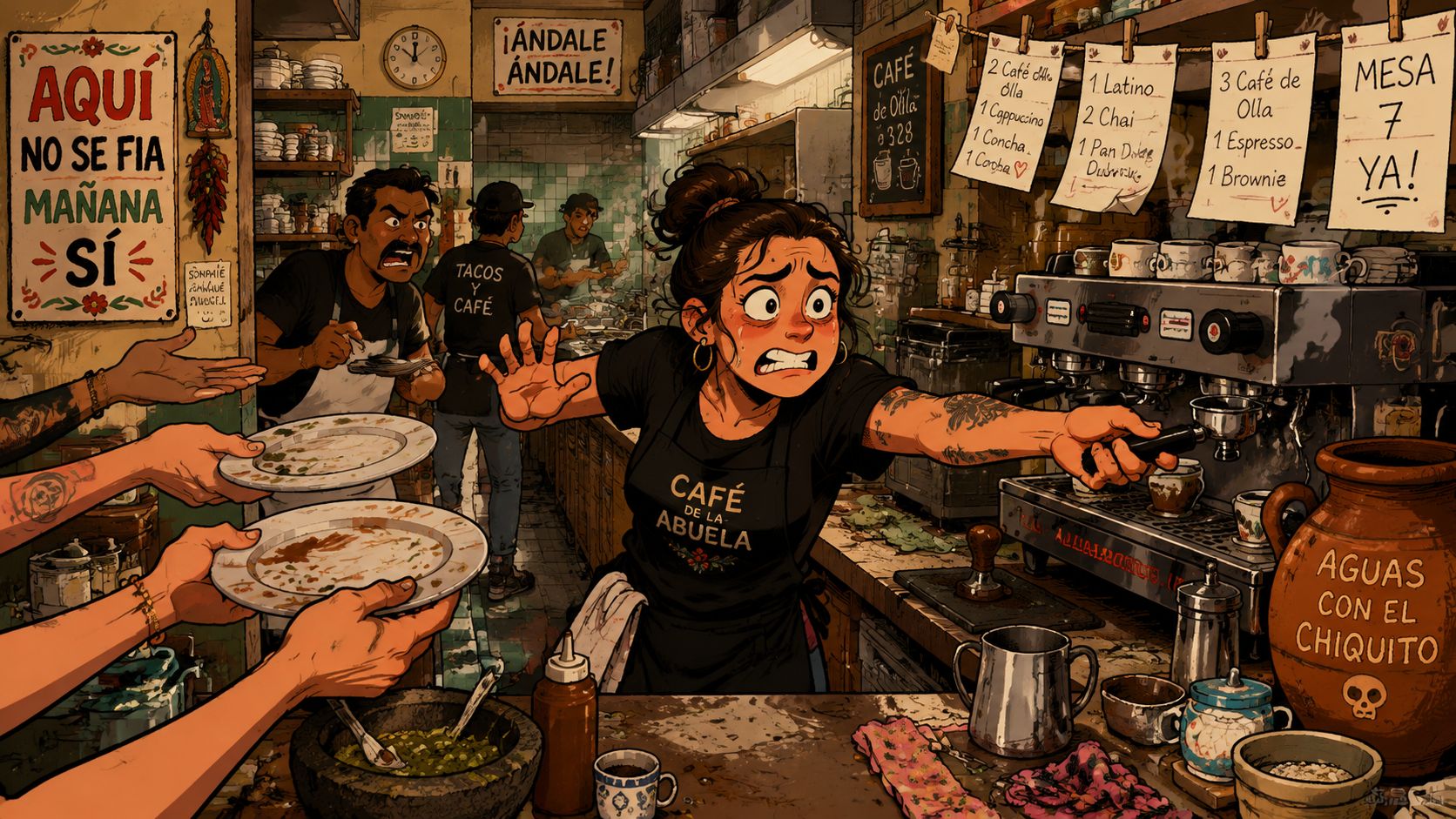
At eight o'clock at night, a coffee shop in Mexico City can become a poorly assembled puzzle. Tickets pile up next to the espresso machine, a barista crosses the same area multiple times to fetch milk, waiters ask about drinks that should have already been served, and the kitchen halts production because no one knows which order has priority. The customer sees slowness. The team feels understaffed. The manager usually discovers something else: the bar and the kitchen are forcing people to walk, ask, and decide too much.
The pressure is not small. INEGI registered 674,826 food and beverage preparation establishments in 2021, compared to 612,259 in 2018, with an average annual growth of 3.3%, according to its national sector data. In this environment, serving quickly does not solely depend on buying new equipment. It depends on designing simple routes, repeatable recipes, and stations that work even when the shift changes.
The rush hour chaos and why your kitchen can't keep up
At eight o'clock at night, a bar in Monterrey can have counter, delivery, and table orders coming in at the same time. The waiter calls out an order next to the bar, someone writes down a modification on a loose piece of paper, and the cook asks if the burger should go out with the drink. Meanwhile, the person preparing garnish searches for lemons, the person in charge of beer shares space with cocktails, and clean glasses block access to ice.
The team moves a lot, but produces little. Each crossing interrupts a task, forces a question, and opens up another possibility for error. The bottleneck is not always in the cooking capacity. It is often in the distance between the information, the ingredient, and the person who must complete the order.
In Mexican coffee shops and restaurants, high turnover and shifts with staff of uneven experience make it costly to rely on a single person who knows all the shortcuts. The operation needs visible instructions, standardized recipes, and stations that a new team member can understand without stopping the line. This discipline also allows the rhythm to be sustained when ordering channels change and demand is concentrated in a few minutes.
The problem is in the route
A poorly placed station forces staff to remember where everything is. An ambiguous recipe leads to confirmations of quantities and improvised changes. A ticket with no visible channel makes the kitchen and bar compete for attention. The result is an operation that depends on whoever has been there longest and can resolve exceptions from memory.
The correct organization aims for the team to walk less, ask less, and repeat better. To know if the current space and equipment support the volume, check the business's installed capacity before buying machinery or expanding hours. More equipment can relieve a station, but it can also clog aisles, increase cleanup, and create another replenishment point.
Each format requires a different layout. A coffee shop needs to bring supplies and delivery close to the beverage station. A bar must separate glassware, ice, and garnish to avoid crossings. A high-volume kitchen needs short routes and recipes that maintain the same assembly even when the shift changes. Sustainable speed comes from removing unnecessary decisions and steps, not from asking staff to run.
Diagnosing the current flow to identify bottlenecks
Before moving a table, a coffee maker, or a sink, the manager must observe the entire flow. The order comes in, is registered, produced, checked, and delivered. Each segment can fail in a different way, which is why it is useful to measure the real process and not the one that appears on the blueprint.
During three days of operation, a responsible person can record four qualitative data points per order: where it stopped, who had to intervene, what movement was repeated, and what information was missing. There is no need to track every ticket throughout the entire shift. It is enough to take representative samples of opening, lunch, afternoon, and closing, and mark crossings, backtracking, and waits on a floor plan.
How to create the heat map
The map should start at the point where the customer orders and end at delivery. It is recommended to draw a line for each important route:
Order entry. Note the channel, the time, and whether the order arrived complete.
Preparation. Identify the station that receives the work and the ingredients they need to locate.
Transfer. Record if the order passes from kitchen to bar, bar to delivery, or between several people.
Control. Observe who verifies modifications, sides, and presentation.
Output. Mark where it is delivered and if staff backtrack on their steps.
In a coffee shop in Puebla, for example, the barista may move repeatedly because the milk is behind the washing area and the glasses are on a side shelf. The problem is not that they make the latte poorly. The problem is that the station imposes a fragmented route. In a restaurant in the State of Mexico, a griddle and the plating area can be separated by a shared walkway. The cook ends up crossing paths with waiters right when they need to place the plate.

What to address first
Not every problem deserves a remodel. Prioritize the points that combine high frequency and high impact. If a person fetches ice once per shift, it can be resolved with a label. If they do it every time a drink comes in, the location of the ice is a structural defect.
Operational rule: if the same delay appears across multiple shifts and different people suffer from it, the process is poorly designed. It is not corrected by blaming the operator.
The second priority is dangerous or confusing crossings. A route that goes through the pass, the sink, and the payment area causes interruptions even if each station is well-equipped. The third is repetitive decisions. If staff ask which glass, which portion, or which side dish corresponds to a high-selling recipe, the solution is visual, not verbal.
The diagnosis must also separate causes from symptoms. A waiting ticket may look like a shortage of cooks, but the cause could be a shared side dish, an illegible modification, or a refrigerator that is too far away. The heat map converts that intuition into a concrete list of changes.
Station design and mise en place that eliminate unnecessary steps
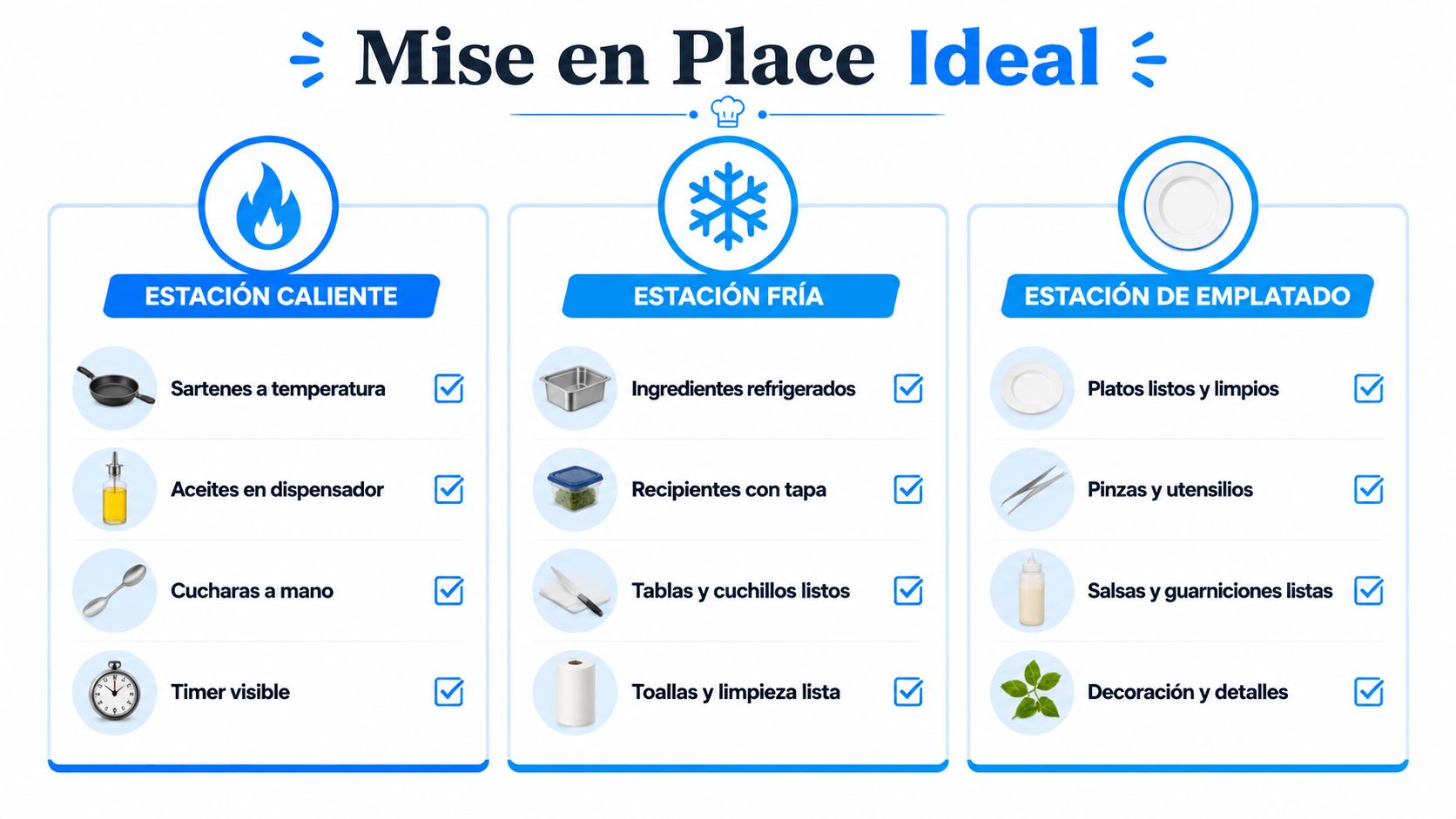
An efficient station places essentials within the operator's natural reach. This does not mean cluttering the work table. It means locating tools, ingredients, and containers according to frequency of use, recipe sequence, and order output flow.
The mise en place should be treated as a production system. Each container needs a visible name, its own spoon, a replenishment level, and a fixed location. High-volume portions should be ready before the peak, while sensitive products are prepared with appropriate quality and conservation controls.
The three-second rule
If an operator takes more than three seconds to find a frequently used tool or ingredient, the location needs a review. The rule does not aim to force absurd speed. It aims to detect hidden objects, unclear labels, and stations that depend on a single person's memory.
In a coffee shop, the espresso station can be organized in sequence: cups, lids, coffee, milk, syrups, and delivery area. Cold drinks require a different line, with ice, blender, bases, cups, and sealing. Fast food must have cold ingredients, griddle or toaster, and packaging connected, without sending the barista to cross the kitchen.
In a bar, cocktails need to separate preparation, ice, and garnish. Beer must have glasses, openers, and napkins close to the dispatch point. In a restaurant, the griddle, fryer, and plating must share an output logic, even if they do not occupy the same piece of furniture. The goal is for each order to move forward and not back.
Adapting the layout to the actual space
Small businesses in Yucatan may need a linear wall station, with vertical storage and a narrow pass surface. In Baja California, a coffee shop with a lot of cold products can gain more by bringing refrigeration and sealing closer together than by installing a central island that complicates circulation.
To decide if a purchase solves a real problem, it is best to first review a restaurant equipment guide. The same logic applies to the dining room. A well-distributed service space should allow staff to serve and bus tables without blocking routes, so you can consult ideas to organize a functional dining room as a reference for circulation and support.
Type of business | Main stations | Critical mise en place elements |
|---|---|---|
Coffee shop | Espresso, cold drinks, fast food, and delivery | Cups by size, milk, labeled syrups, ice, lids, and packaging |
Bar | Cocktails, beer, and garnish | Ice, glassware, high-turnover spirits, citrus, and napkins |
Restaurant | Griddle, fryer, cold prep, and plating | Ready portions, sauces, side dishes, tongs, plates, and pass containers |
The checklist for each shift should confirm quantities, labels, utensils, cleanliness, and replenishment. The list does not replace the manager's judgment, but it prevents the team from starting service by improvising. In compact spaces, simplicity usually beats sophistication.
Ticket management and FOH-BOH communication for hybrid orders
In the middle of rush hour, a coffee shop can receive orders from counter, table, phone, delivery, and apps at the same time. Treating all channels as a single line forces the team to decide on the fly. Each channel needs a visible promise, priority, and output signal.
The kitchen display screen sorts tickets, shows modifications, and distributes tasks by station. It works best when volume changes frequently, but depends on configuration, electricity, connectivity, and training. If recipes or modifiers are poorly uploaded, it digitizes the confusion and spreads it faster.
Physical tickets with color codes cost less and are easy to implement. They are suitable for small operations with a stable menu, as long as there is a single entry point. Color should support reading, not replace it. Paper becomes fragile if lost, if the modification is illegible, or if two people print the same order.
Three possible approaches
System | Advantage | Operational risk | When it is suitable |
|---|---|---|---|
Kitchen display screen | Sorts priorities and centralizes changes | Requires configuration and training | Operations with multiple channels |
Color-coded tickets | Is visible and economical | Can be lost or duplicated | Small businesses with a stable menu |
Hybrid system | Screen for kitchen and paper for bar | Requires clear rules between stations | Coffee shops and restaurants with simultaneous drinks and food |
The hybrid system usually resolves simultaneous food and beverage orders well. The kitchen works with a centralized queue, while the bar keeps visible tickets next to its stations. The color can identify the channel, but the entry time, priority, and modifications must be read without interpretation. To review the structure of an order, consult this reference on restaurant tickets.
Rules for FOH and BOH to speak the same language
Service staff must call out each order in a fixed sequence: table or channel, products, modifications, sides, and critical remarks. This sequence reduces questions and allows a newly hired person to follow the same method as the rest of the shift. Cancellations are recorded in the system or delivered to the station manager, who confirms if production has already begun.
Priority is defined before the peak. The manager can reserve capacity for the dining room when the in-person promise demands immediate output, without accepting more delivery orders if the operational window has already been exceeded. There is no single rule for all businesses. However, it must be clear who decides, which orders wait, and when a channel is paused.
INEGI pointed out that between July and September 2025, employment in restaurants and lodging services remained relevant, although the sector's occupancy recorded an annual decline, according to the ENOE bulletin. With teams that change between shifts, informal communication costs time. Each order must have a route, a person responsible, and an output confirmation.
Roles, rotation, and express training for changing teams
In rush hour, an absence should not halt the bar, kitchen, or delivery. The operation must work even if staff changes and even if orders come in through the counter, delivery, and tables at the same time. In Mexico, occupancy in food and beverage preparation and service reached 2.64 million people in the first quarter of 2025, with 73.5% labor informality, according to Data México. This context makes it costly to rely on a single person who knows all the shortcuts.
The goal is for a recent hire to execute a frequent task without slowing down the shift. To achieve this, each position needs a primary responsibility, a secondary one, and a visible output standard.
Modular roles
A coffee shop can assign espresso, cold drinks, food, and delivery. A restaurant can separate the griddle, fryer, prep, and pass. In businesses with hybrid orders, it is useful to add someone responsible for prioritization or delivery, so the kitchen does not have to resolve counter doubts while producing.
Specialization reduces decisions per person, but can create dependency if no one covers another station. A simple matrix helps identify this gap:
Collaborator | Hot station | Cold bar | Pass and delivery | Next training |
|---|---|---|---|---|
Person A | Intermediate | Basic | Expert | Cold drinks |
Person B | Basic | Intermediate | Basic | Pass |
Person C | Expert | Basic | Intermediate | Hot station |
Each shift must assign a primary and a secondary station. Rotation is scheduled based on fatigue, temperature, and concentration, not just to distribute opportunities. During high-volume hours, keeping the fastest person at the critical point may be correct, as long as another person is learning outside of peak hours.
Training that fits the operation
Express training works in brief, repeatable pieces:
Short video: shows the station, the order of ingredients, and the output standard.
Shadowing: the new person observes a full shift and then executes under supervision.
Certification checklist: confirms recipe, cleaning, replenishment, communication, and handling of modifications.
The average salary reported for this occupation is $5.66k MX monthly, according to the same source from Data México. Standardization makes sense in an operation with high turnover, because it prevents speed from depending on informal experience or individual memory.
To define responsibilities and write clear job descriptions, you can review a guide on cook roles and recruitment. The onboarding document must indicate what each role prepares, where they keep their tools, what recipe they follow, and who validates the product before delivering it. This clarity reduces questions during shift changes and maintains a common route between counter, bar, and kitchen.
Equipment optimization, storage, and daily checklists
Buying more equipment does not fix a poorly designed route. A coffee shop that sells many blended drinks may need a high-performance blender, but only after confirming that the bottleneck is in the blending and not in the lack of cups, ice, or sealing space. A restaurant with high demand for fries can benefit from a double-basket fryer, as long as it has oil, extraction, and storage capacity, and a delivery station that does not get blocked.
The criterion is direct: each piece of equipment must eliminate a step, increase consistency, or free up a station. If it only takes up surface space, adds cleaning, and forces people to walk around it, it can worsen service.
Storage that matches the recipe
Inventory must follow the logic of use. High-frequency ingredients should be within visual and manual reach. Low-turnover products can go in secondary zones, as long as they are labeled and easy to locate. The FIFO system, with visible preparation and opening dates, reduces confusion and facilitates counting.
In a business in Baja California, the cold room can be divided by station, not just by ingredient category. This way, the person responsible for drinks finds their bases together, while the kitchen accesses proteins and garnishes without invading the bar flow. A large label is usually more useful than an elegant but hard-to-read organization.
Three moments to use checklists
Opening: complete mise en place, verified temperatures, clean surfaces, available utensils, and replenished critical products.
Shift change: written pending tasks, identified special orders, refilled containers, equipment handed over in known conditions, and shortages communicated to the manager.
Closing: deep cleaning, quick inventory, documented waste, dated storage, and defined preparation for the next day.
Checklists should be short, observable, and signed by the person executing. To adapt positions, workloads, and responsibilities without ignoring the actual conditions of each person, you can consult practical examples of labor adaptation. Operational adaptation works when it preserves the standard and modifies the way to reach it, not when it eliminates controls.
In high-flow businesses, such as certain gas stations in Puebla, service density requires organizing reception, payment, and exit. A note based on information from Igavim reported 565 gas stations in Puebla, one for every 11,651 inhabitants, in addition to 1,143 stations in the State of Mexico and 689 in Nuevo León, according to ONEXPO. The principle is transferable to food: separating routes prevents one function from interrupting the other.
Metrics to measure service times and continuous improvement plan
Speed must be measured from both the customer's perspective and the operation's. An order can leave the kitchen quickly but sit waiting at the bar or pass. It can also be delivered on time and arrive with an incorrect modification. This is why the manager needs to observe the entire journey, not just the performance of one station.
The essential metrics are:
Total ticket time: from when the customer orders until they receive the order.
Time per station: how long prep, bar, plating, and delivery take.
Error rate: returned, remade, or corrected orders before going out.
Satisfaction: brief customer feedback on speed, accuracy, and experience.
Load by channel: quantity and type of orders arriving via counter, table, and delivery.
During the first two weeks following the change, the team must establish a baseline. It is not advisable to celebrate an isolated improvement. Compare shifts, days, stations, and order types to detect if the progress is sustained or only occurred when the manager was present.
How to read the results
If plating time remains high, a dedicated station, a pass surface, or a ready garnish may be missing. If errors appear mostly at night, the shift change checklist may be confusing or the staff may be receiving modifications without a clear person in charge. If delivery takes up all the capacity, the solution may be to reserve production for other channels instead of demanding that the kitchen work faster.
The 90-day plan should progress in stages:
First month: stabilize recipes, locations, roles, and communication.
Second month: adjust sequences, eliminate repeated movements, and correct slow stations.
Third month: document the standard and replicate it in other shifts or branches.
The restaurant industry has a specific source in INEGI's Economic Censos, the national publication on accommodation and food preparation services, which helps make decisions backed by sector information and not just intuition. In daily operations, the same discipline consists of registering, reviewing, and acting.
Swirvle can complement this work with a cloud-based POS, CRM, inventory, invoicing, and customer data, plus segmentation, campaigns, and dashboards to connect sales with retention actions. To convert a more organized bar into repeat visits, measurable promotions, and better customer follow-up, visit Swirvle and see how it can integrate into your business operation.
Related Blogs

Oct 21, 2026
How to Control Food Waste in a Restaurant: 2026 Guide

Oct 20, 2026
What is the global invoice for the general public and when is it issued? SAT Guide

Oct 19, 2026
How to take restaurant orders on WhatsApp without losing any?

Oct 18, 2026
How to Create a WhatsApp Business Catalog to Sell More: 2026 Guide

Oct 17, 2026
How to set up quick replies in WhatsApp Business?

Oct 16, 2026
Can fake Google reviews be removed and how do you request it?