
How to calculate your coffee shop's gross and net margins, which costs reduce them the most, and strategies to increase them without losing customers.
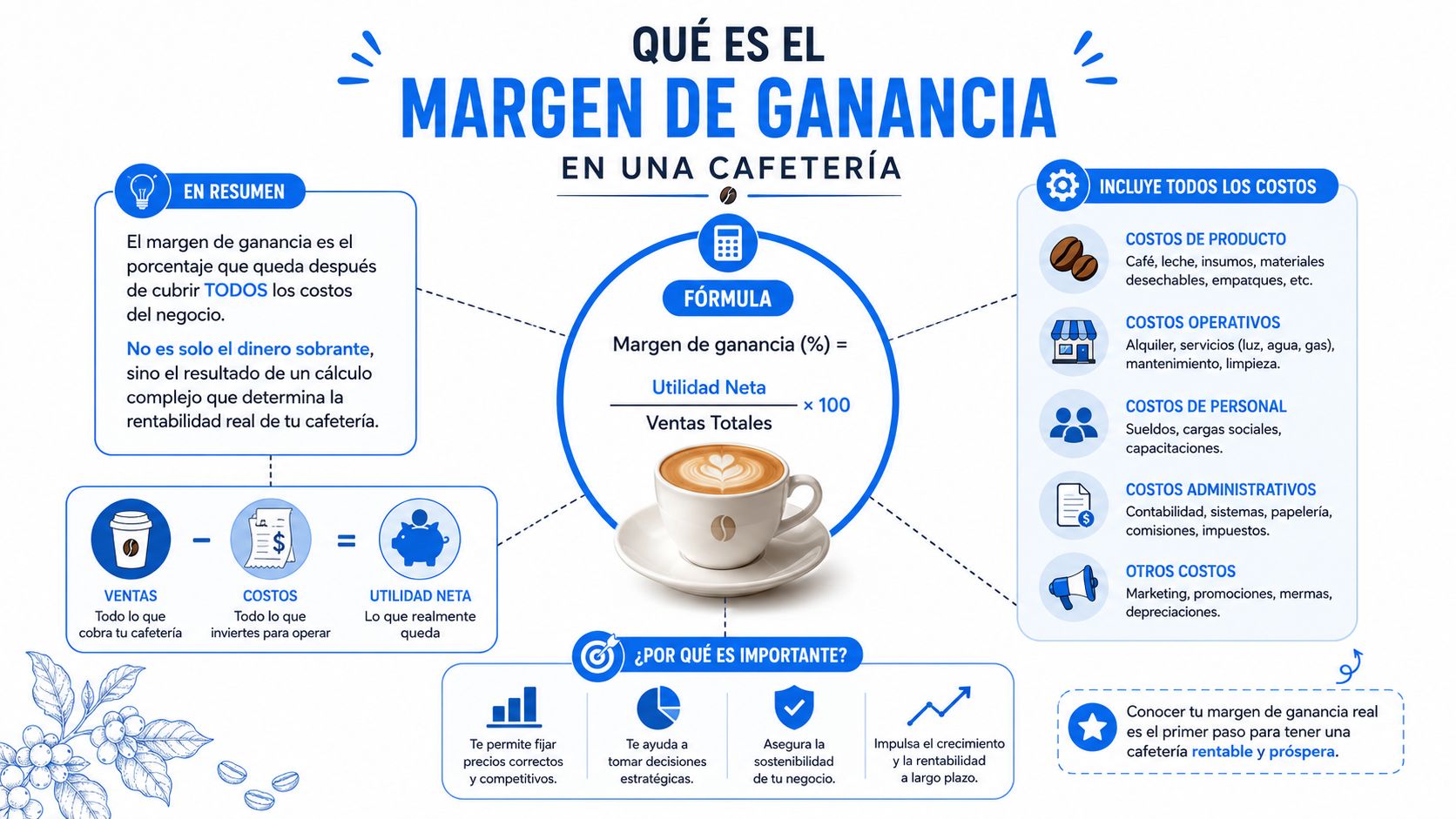
In a coffee shop, the ideal margin is not a fixed number: it depends on your price, your recipe, and your expenses. The healthy approach is to calculate the gross margin of each drink and then confirm that the net margin, already factoring in rent, payroll, shrinkage, and visit frequency, leaves a real profit. If the business fails to convert that percentage into sufficient absolute profit, a beautiful margin only serves to decorate the spreadsheet.
The most common trap in this business is believing that selling coffee "leaves a lot" of profit by definition. Yes, the product structure helps, because in a well-costed drink, direct supplies are a minor part of the retail price, but the shop does not pay for its operation with foam or promises; it pays with real flow, repetition, and fine cost control.
What is the profit margin in a coffee shop
The profit margin in a coffee shop is not a single figure. If everything is mixed into one single percentage, the price ends up being poorly calculated. The gross margin shows how much is left after paying for the direct supplies of each drink or food item. The net margin shows what is actually left over after rent, payroll, utilities, waste, and other monthly expenses.
Wide glass, narrow pipe
The correct interpretation is straightforward. The gross margin marks the space left by each sale. The net margin is what arrives at the close, after the operation absorbs its share. A large glass does not guarantee more money if the pipe leaks too much.
The gross margin of a drink depends on how much coffee, milk, and add-ons weigh against its retail price. Calculate it with your real recipe, but take it only as a technical floor, not as a guarantee of utility.
The point that many owners overlook is volume. A high gross margin can look solid on the menu and still fall short if the coffee shop is in a plaza with heavy rent and low traffic, as often happens in various parts of Yucatán compared to an operation with more flow in Monterrey. The difference is not in the pretty percentage, but in how many cups it sells per day and how much of that survives after covering fixed costs.
Rule of thumb: a high gross margin does not fix a heavy rent, an inflated payroll, or a messy operation. It only provides a buffer for the business to get the other numbers right.
What to review before pricing
Before touching a menu, it is wise to answer five questions in order:
What does it cost to serve the cup? Direct cost must be separated from overhead expenses.
What percentage goes to operations? Rent, payroll, and utilities are still there even if the product sells well.
What sells more, volume or ticket? A drink can seem profitable and move very little total money.
How much is wasted? Shrinkage eats up margin without the customer ever seeing it.
How often does the customer return? Without recurrence, the business relies on attracting new people all the time.
If a coffee shop does not distinguish between price, direct cost, and operating expense, it ends up celebrating the wrong percentage. And in this business, the wrong percentage usually hides a very small profit.
How to calculate your coffee shop margin step by step
A high gross margin can look good on the menu and still leave very little cash at the end of the month. In a coffee shop, the correct reading starts with a single calculation and ends with three layers: direct cost, fixed expenses, and sales volume.
The base formula remains simple. Margin = profit / retail price. To apply it correctly, first isolate the direct cost of the drink, then calculate the gross profit, and finally review how much of that amount survives when rent, payroll, utilities, and shrinkage come in.
Real example with a cup in Mexico
If a cup sells for $65 MXN and its direct cost is $18 MXN, the gross profit is $47 MXN. That gives a 72% gross margin. The number looks strong on paper, but it still does not answer the question that matters: how much net profit is left after operating the premises.
There lies the critical point. A coffee shop can have a high gross margin and still close with a small profit if the volume is not enough to absorb the fixed costs. In Monterrey, a more constant flow can better sustain that percentage than in a plaza with lower turnover. In Yucatán, rent or less favorable seasonality can make the same margin deceptive.
Margin calculation by product type in a Mexican coffee shop | ||||
|---|---|---|---|---|
Product | Retail price | Direct cost | Gross margin | Gross margin % |
Americano coffee | $65 MXN | $18 MXN | $47 MXN | 72% |
Milk drink | Variable by recipe | Variable by recipe | Variable | Variable |
Combo product | Variable by menu | Variable by menu | Variable | Variable |
How to read the correct number
The useful calculation does not end with the individual drink. A menu can have drinks with good margins and food items with a different logic, so it is best to review the business at three levels.
Margin by product: shows if each cup leaves real space between price and cost.
Margin by line: allows you to see if drinks, food, or extras are sustaining the operation.
Net margin of the shop: reveals what remains after paying for the entire structure.
To measure dishes with the same financial discipline, it helps to follow a method on how to calculate the cost of a dish. The logic is the same: well-separated cost, correctly read price, and utility checked against the overall operation.
Audit criterion: if the margin per product seems solid but the business is not generating cash, the problem is rarely in the cup. It is usually in the volume, the rent, or the cost structure.
The five costs that eat your margin
An attractive gross margin can vanish into five very specific categories. In coffee shops in Mexico and LATAM, these leaks usually appear in supplies, labor, rent, utilities, and shrinkage. The correct reading is not "how much do I make per drink," but "how much of that margin survives the close of the month."
Where the money goes in the operation
The first erosion is in supplies. The price of coffee is not fixed, and when the cost of the beans rises or add-ons change, the margin compresses before the customer even notices. The second blow comes from labor, because bar service takes time, coordination, and coverage during peak hours.
Rent defines a large part of the profitability floor. In a high-traffic spot in Mexico City or Monterrey, the venue can absorb much more than a small spot on the outskirts. In tourist areas of Yucatán or Puebla, the weight of the lease can make the equation even harder if the flow is not enough.
Utilities and shrinkage seem minor at first glance, but they disrupt operations when they accumulate. Electricity, water, internet, and losses from prep or poorly controlled inventory end up cutting into the money that seemed available.
Supply yield matters more than it seems
A kilo of coffee can yield between 100 and 120 cups; if the kilo costs 200 pesos, the base cost per cup is around 2 pesos before milk, cream, or other additions El Economista. This reference helps to understand why yield per kilo is an underestimated lever.
A useful reference for the owner is to check if the store is buying expensive, over-serving, or losing product due to poor dosing. The same gram of coffee can behave as profitability or as a leak, depending on operational discipline.
This analysis on how the cost of goods sold is determined serves as a guide to separate purchases, inventory, and actual cost of operation.
Real net utility scenarios in Mexico
A pretty margin does not pay the payroll. What pays the business is net utility and, above all, the volume that sustains it every month. In a small coffee shop, this point changes completely between Yucatán, Puebla, Monterrey, or Mexico City, because flow, rent, and ticket do not behave the same way.
Three very different readings of the same business
A small coffee shop in Yucatán can leave a net profit of 9,200 MXN per month in a low scenario. In well-located and well-managed businesses, Coffee Solutions identifies much broader results, from 6,000 to 80,000 MXN monthly. The gap between these cases is not marked by the percentage; it is marked by the actual volume of sales coming through the door.
In a medium business in the State of Mexico or Puebla, an orderly operation can move the utility into a middle ground if customer flow sustains the register. In a premium venue in Nuevo León or Mexico City, utility can rise higher when location, ticket, and rotation work in its favor. The same coffee, served with different demand, leaves a different result.
Ideal margin does not mean sufficient profit
A good net margin can look healthy on paper. If the venue sells little, that percentage is not enough to cover the life of the business or the retirement of the owner. On the other hand, with high traffic and constant ticket, the same margin can indeed translate into useful cash.
The cost of entry also changes the goal. It does not cost the same to open a small cart or counter as it does a venue with a kitchen, furniture, and complete espresso equipment. This difference forces different volumes to be demanded to recover the investment and sustain the operation.
A high gross margin can seem strong, but in Yucatán it does not work the same as in Monterrey if the venue does not sell enough. The variable that rules is how many actual cups are placed each day, not the isolated percentage.
The right question is not "what margin looks good?". The question is "how much must I sell so that this margin allows me to live off the coffee shop?"
Actionable strategies to improve your margin
Raising the margin does not depend on a single lever. It depends on moving several pieces at once, but in an orderly way. In coffee shops, the typical mistake is to start with discounts or promotions without checking the actual price, sales mix, or visit frequency.
First the price, then the rest
The first adjustment is retail price. If the actual cost is already measured, the menu can absorb a moderate increase when the value proposition supports it. A change of 5 pesos in a latte can turn into a material monthly income improvement, as long as the customer perceives consistency between price, flavor, and service.
The second lever is menu engineering. Not all drinks drive utility equally, so it is wise to visually push the products that leave a better contribution. The menu should not be a catalog; it should function as a commercial billboard.
Control, upselling, and recurrence
Shrinkage and bean yield: controlling grammage, calibration, and portioning prevents direct costs from inflating without notice.
Upselling and cross-selling: offering sizes, cookies, or milk alternatives raises the value of each visit without reworking the entire operation.
Purchase frequency: a customer who returns more often makes any unit margin more useful, because the business wins more times with the same base.
Smart recurrence: incentives should reward repeat visits, not aggressive discounting that accustoms the customer to pay less.
Tracking by branch: when multiple stores sell differently, each needs its own pricing and category adjustments.
A tool with CRM and loyalty can help organize that commercial side, because it centralizes customers, segments habits, and allows measuring campaigns by branch. In this type of setup, a business can activate different promotions by behavior, not by intuition.
The logic of a POS with a loyalty program for coffee shops fits right there, where margin depends as much on the average sale as on repetition.
How a loyalty CRM like Swirvle protects and raises your margin
A CRM with a loyalty program does not fix a bad recipe or excessive rent, but it does target two variables that move the net margin: average ticket and purchase frequency. In coffee shops, this matters more than it seems, because real utility comes from adding up visits, not just closing good unit transactions.
What it does with customer behavior
A venue in Baja California or Monterrey can use smart coupons via WhatsApp to bring back customers who haven't visited in days. It can also segment by branch to detect those who only buy basic coffee and nudge them toward a more complete combo. The logic is simple: sell better to the same customer instead of always relying on new traffic.
Swirvle, as an example of that focus, centralizes customer data, allows segmentation by habits and branch, and runs campaigns via WhatsApp, push, and email with welcome, reactivation, birthday, and seasonal automations. Its value in this area is not "doing more marketing," but giving visibility into which campaign is driving sales and what part of the revenue comes from existing customers.
What to automate without getting complicated
Welcome: triggers a first repeat purchase after registration.
Inactive recovery: re-engages customers who stopped visiting.
Birthdays: creates a simple reason to return to the venue.
Seasonal campaigns: pushes drinks or combos during high-intent dates.
Points or visits: rewards recurrence instead of sacrificing margin with flat discounts.
If loyalty raises the ticket and frequency, the math changes fast. No need to promise magic; it just takes each customer buying a little better and a little more often. That is the point where technology stops being a nice expense and starts protecting profit.
Key metrics that every owner must track
The margin is controlled with numbers that are always reviewed, not with end-of-the-month intuitions. A well-organized Monday can prevent weeks of blind decisions. If the store does not measure, it ends up managing by feeling.
The five metrics that cannot be missing
Supply cost per product: calculated as direct cost divided by retail price. It should be reviewed every week to detect deviations in recipes, shrinkage, or purchases.
Gross margin by category: shows which line provides more financial breathing room. It is wise to review it weekly and compare it among drinks, food, and extras.
Average ticket: obtained by dividing total sales by the number of tickets. A higher ticket usually eases the burden of the structure.
Customer visit frequency: indicates how many times the loyal customer base returns. An improved frequency sustains revenue without relying as much on new acquisition.
Sales attributable to loyalty campaigns: allow knowing what part of the income came from concrete actions and not from casual traffic.
What the owner should look for on the dashboard
The dashboard does not have to be sophisticated to be useful. It can live in a spreadsheet, as long as it shows trends and not just a snapshot. What is important is that the owner sees when the ticket drops, when shrinkage rises, and when a campaign actually moves cash.
If a coffee shop reviews these five metrics every week, it stops arguing about pretty percentages and starts managing real utility.
Frequently Asked Questions
How is a coffee shop's profit margin calculated?
Subtract the direct cost of the drink from its retail price and divide the result by the retail price. For example, a $65 MXN cup with an $18 MXN cost leaves $47 MXN, a 72% gross margin.
What is the difference between gross margin and net margin?
Gross margin only deducts the supplies for each product. Net margin also subtracts rent, payroll, utilities, shrinkage, and other expenses, and is what actually remains at the end of the month.
Why does my coffee shop sell a lot and make little?
Usually due to high fixed costs, uncontrolled shrinkage, recipes that are not followed, or prices that have not been updated. Review the actual cost of each recipe and how much rent and payroll weigh on your sales.
How can I improve the margin without raising prices?
Control portions and shrinkage, push complementary products with good margins, and make your frequent customers return more often. A well-measured loyalty program helps sell more without relying on discounts.
Swirvle centralizes customers, segments by branch and consumption habits, and allows measuring which campaigns do move sales and frequency. For a coffee shop that needs to protect margins and not just sell more, this type of control changes the financial conversation. It is worth checking out how it works at Swirvle and seeing if it fits with the daily operation of the shop.
Related Blogs

Oct 22, 2026
How to prevent employee petty theft in my business?

Oct 21, 2026
How to Control Food Waste in a Restaurant: 2026 Guide

Oct 20, 2026
What is the global invoice for the general public and when is it issued? SAT Guide

Oct 19, 2026
How to take restaurant orders on WhatsApp without losing any?

Oct 18, 2026
How to Create a WhatsApp Business Catalog to Sell More: 2026 Guide

Oct 17, 2026
How to set up quick replies in WhatsApp Business?