How to take restaurant orders via WhatsApp without losing any? Learn how to take restaurant orders via WhatsApp without losing any
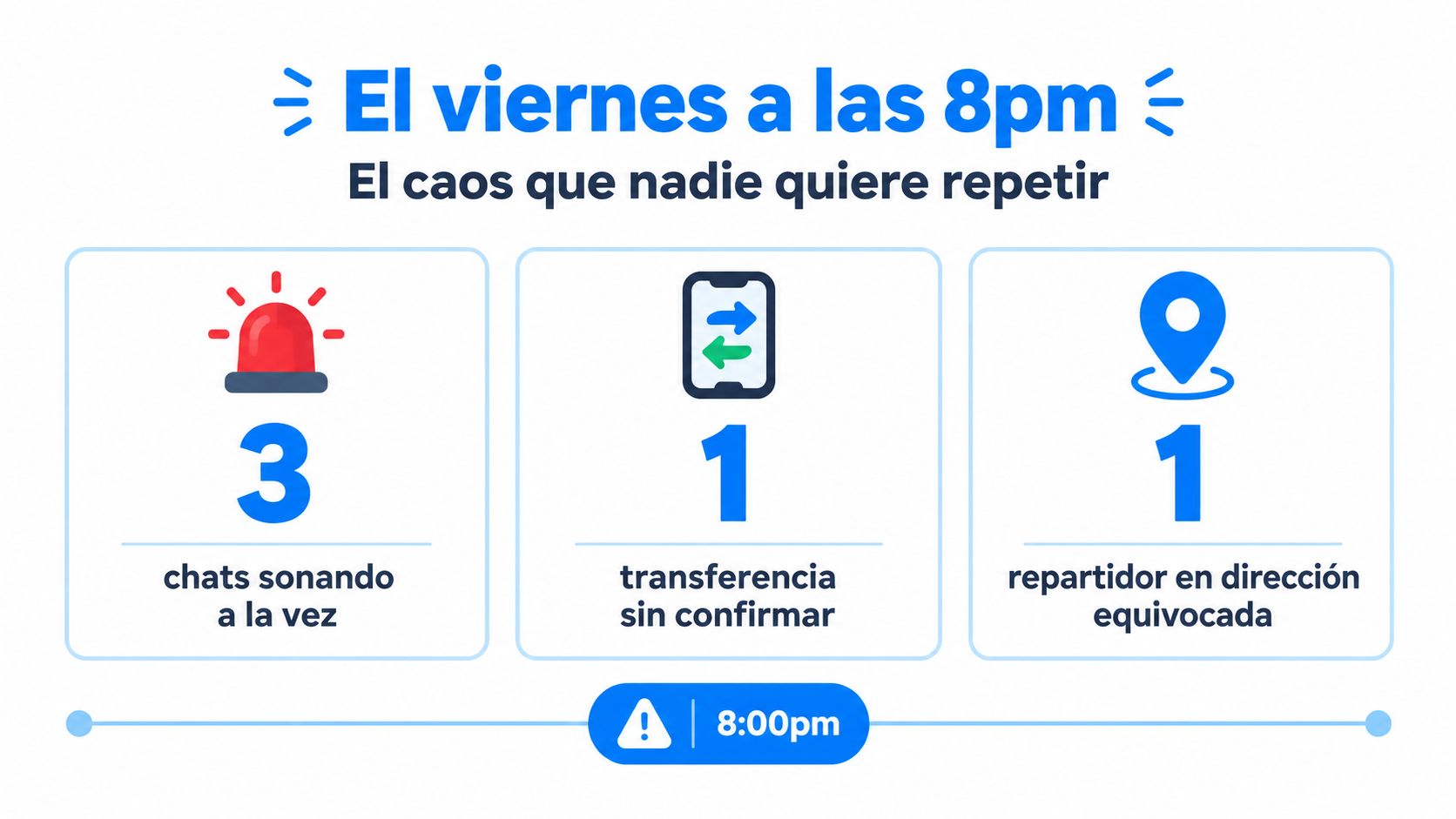
On a Friday night, messages pour in across three chats while two employees reply from the same phone. A screenshot of a bank transfer arrives that nobody verifies, and a delivery driver heads to the wrong address. The order appears settled in the chat, but the kitchen has no record of it and the customer is waiting for a resolution.
The cost isn't just a lost sale. It also drains staff time, overtime, and trust—and sometimes no one can pinpoint where the chain broke down. To take orders via WhatsApp without losing them, a restaurant needs more than automated replies: it needs traceability, clearly defined owners, and a single source of truth.
The 8 PM Friday nobody wants to repeat
At eight in the evening, the problem usually surfaces in multiple places at once. One employee answers the restaurant's chat while another calls the customer to clarify an address; meanwhile, the kitchen prepares an earlier version of the order, and the driver is already en route with the wrong details. Nobody acted in bad faith. The process simply allowed two people to manage the same conversation without keeping a clear record.
This situation isn't unique to large restaurants. A coffee shop can mix up a pickup order with one from another location; a retail shop might set aside a product without recording the deposit. What looks like an isolated mistake happens repeatedly when orders live in individual chats, loose notes, and memory.
WhatsApp is already part of daily operations for Mexican restaurants, but it coexists with older channels. Among restaurants with their own delivery drivers, 32.8% communicated with customers via WhatsApp in May 2024, up from 27.1% in March 2023; in May 2024, mobile phones reached 61.6% and landlines 54.8%, according to the restaurant survey by Jalisco's IIEG.
Channel used by restaurants with self-delivery | May 2024 | March 2023 |
|---|---|---|
32.8% | 27.1% | |
Mobile phone | 61.6% | 43.7% |
Landline | 54.8% | 71.9% |
Receiving a message doesn't mean you have an actionable order. Without logging, confirmation, and tracking, notifications can chime all shift long and still leave orders unfulfilled. The solution is a repeatable protocol, not a collection of quick replies.
Setting up WhatsApp Business to look like a restaurant, not an individual
The first adjustment is separating business support from the staff's personal lives. A business number must feature a clear profile, updated hours, the address of each location, and a description explaining what the restaurant offers. If customers have to ask where the place is or when it opens, the profile isn't doing its job.
The catalog must also match what is currently available for sale: helpful photos, straightforward item names, current prices, and descriptions detailing sizes or sides. To learn how to organize it, check out this guide on creating a catalog on WhatsApp Business. An outdated catalog doesn't speed up the sale; it just creates another back-and-forth conversation for clarification.
Providing the information that prevents repetitive questions
Set up quick replies for frequently asked questions, such as operating hours, delivery coverage, and payment methods. Add a welcome message that acknowledges receipt and promises a response time the team can actually meet. Outside business hours, an away message should explain when staff will be back to assist and offer a helpful alternative, such as viewing the menu or contacting an open branch.
Technological readiness shouldn't be taken for granted. Citing Ministry of Economy data, a study of retail and service SMBs in Hermosillo notes that only 19% of the country's SMBs have access to a computer; among the businesses it analyzed, WhatsApp was the most used messaging app, by more than half, while Messenger stayed under 10%, according to the SciELO analysis on SMB digitization. For this reason, initial setups should be easy to maintain and not rely on configurations that no one on shift knows how to fix.
Protect the device with a PIN or biometrics, and restrict who can delete chats or modify profile information. Do not mix the business account with personal or family chats. Even if staff changes, conversation history and customer care must remain under the restaurant's control.
Designing a conversational menu that closes complete orders
A conversational menu works when it guides the customer through choices the team can fulfill. First, identify the location and service type; next, present available categories; then, capture quantities and modifiers; finally, calculate the total and request an explicit confirmation. Across the 22 markets Kantar surveyed in a study commissioned by Meta, Mexico included, 73.3% of consumers prefer messaging when communicating with a business, according to WhatsApp's State of Business Messaging report.

Guiding the conversation, not guessing the order
A coffee shop can display short codes like C1 or L2, but it must prompt for the quantity and pickup time along with the code. A restaurant that allows customizations must confirm every change—for instance, no onions or an extra topping. At a retail shop that sells through WhatsApp, the order must clearly state the product, quantity, delivery method, and deposit.
The menu must check real-time availability and remove sold-out items from the offerings. During peak hours, displaying all options even when the kitchen can't prepare them only increases drop-offs, clarifications, and cancellations. Accepting an order in free-form text without reiterating the price, modifiers, and time also leaves it unprepared for production.
The flow concludes with a summary detailing the location, items, quantities, adjustments, total, payment method, and delivery or pickup option. The customer must reply CONFIRM before the team treats it as a closed order.
The operational flow that prevents lost orders
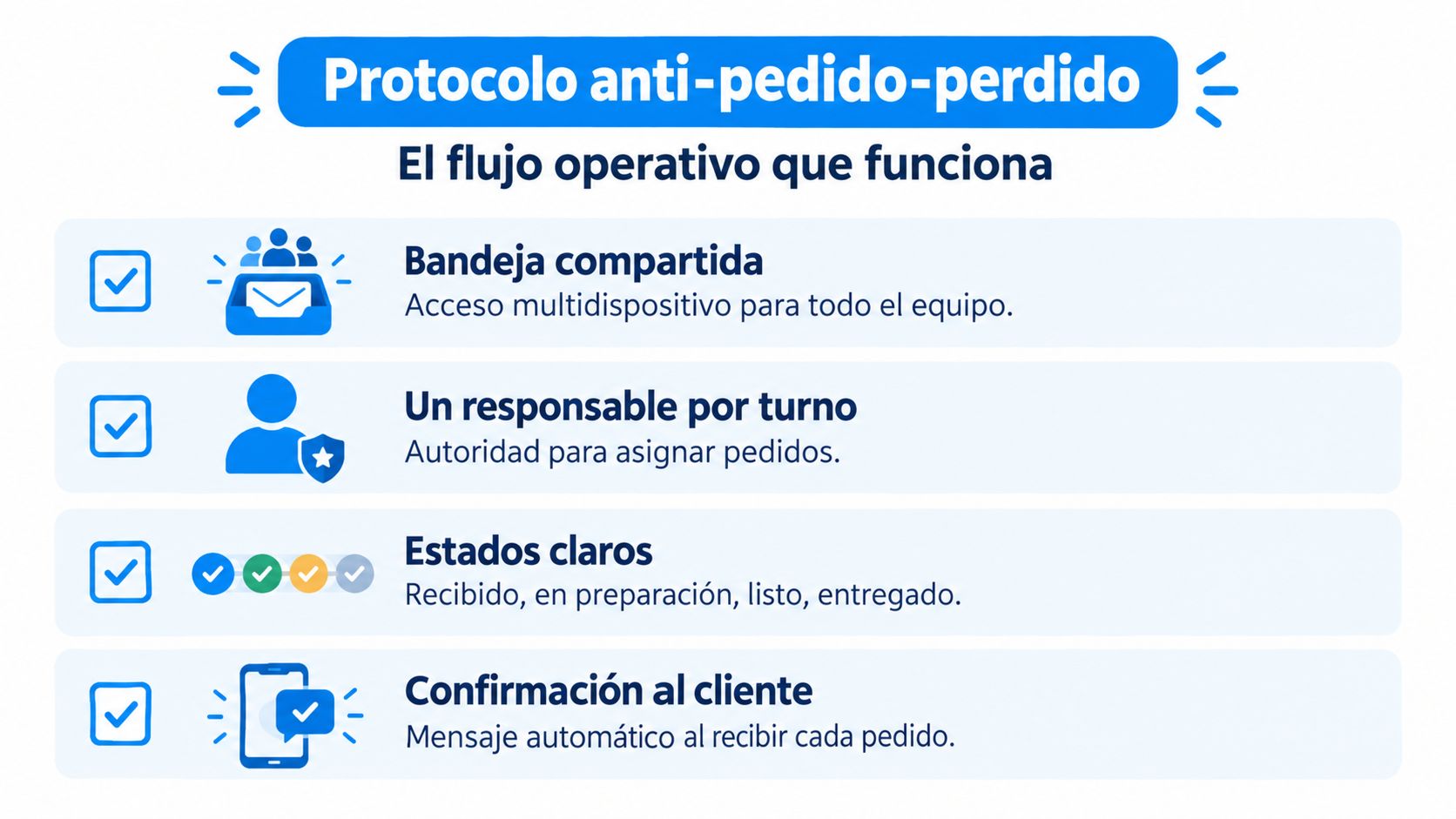
The protocol requires a shared inbox and a designated lead per shift. The lead assigns conversations, handles exceptions, and ensures each order moves forward; the rest of the team can assist, but ownership of closing the order must never be ambiguous. A shared inbox keeps the order from depending on a single person's phone.
Mandatory statuses let you see what is happening without rereading every chat: new, incomplete info, confirmed, in prep, ready, delivered, and canceled. To understand how to organize conversations with labels, the team can consult this guide on what WhatsApp Business labels are used for.
A single record for every order
Each order must be logged with a standardized phone number, location, items, modifiers, quantities, payment method, address, promised time, and special notes. The system or the shift lead assigns a unique ID; this way, if two team members view the same chat, they can verify whether an order card already exists and avoid duplicate entries.
Assignment should also reflect how each business operates. At a restaurant offering delivery, the lead validates inventory and delivery coverage before confirming. At a coffee shop with two locations, the pickup branch is captured upfront and remains visible on the order card. At a retail shop with layaways, the product isn't set aside until the required deposit is recorded.
If no human response is given within 10 minutes, the message should escalate to the shift lead. This safeguard doesn't mean every order must be resolved within that timeframe; it ensures a conversation doesn't slip through the cracks while staff attends to other tasks. It helps to set your own target for answered messages and average response time during active hours, based on the team's real records and capacity; setting up quick replies in WhatsApp Business makes it easier to hit without writing every message from scratch.
Operating rule: Without a written summary and a CONFIRM reply, the order does not go to the kitchen.
Integrating with CRM and POS to avoid double entry
A spreadsheet may suffice when a single person handles and logs every order without losing track. That equation changes when multiple team members reply, there are multiple locations, or reconciliation stops balancing out. At that point, the issue is no longer creating another template: it is maintaining a reliable version of the order that the entire team can consult.
Integrating with the point of sale eliminates entering the same order twice and helps attribute sales to campaigns. If the WhatsApp system isn't connected to the POS, each order needs an automated invoice ID and mandatory hourly reconciliation during peak periods. Without these checks, a message can show up as confirmed while the register and kitchen never receive the order.
Automating handoffs, not exceptions
Useful automations reduce manual steps without pretending to know information they lack: receipt confirmations, location tags, lead assignments, and delivery reminders. A CRM can also store history so that when a customer returns, staff can review past orders and suggest relevant options. Swirvle centralizes customer data, segmentation, campaigns, and AI agents alongside the point of sale; the WhatsApp integration is included only in the Premium plan. Before automating order intake, define which steps will stay manual and how each order will reach the register.
A bot that replies quickly but cannot check inventory, pricing, or exceptions shouldn't confirm an order as if it were already approved. The restaurant must reserve human intervention for last-minute adjustments, stock shortages, out-of-area addresses, and questionable payments. To align incoming orders with kitchen production, it can also be helpful to review how to manage restaurant order tickets.
Commercial enthusiasm for the channel doesn't eliminate the need for oversight. In 2019, one in three Mexican SMBs used WhatsApp to run or grow their business; of those companies, 57% stated their sales had increased thanks to its use, according to published reporting on SMBs and WhatsApp in Mexico. This figure reflects self-reported data from those companies and does not guarantee results for any specific restaurant.
Automating replies does not reduce losses without exception management. Traceability and clear accountability are what keep an order from being duplicated, forgotten, or sent to the wrong branch.
Validation and reconciliation at shift close
The shift supervisor must compare three sources: WhatsApp conversations, order cards, and POS receipts. A chat without an order card, or an order card without a receipt, is flagged as an anomaly before closing the register. The goal isn't to assign blame, but to pinpoint where control was lost in the process.
Next, a specific reason is assigned: the customer didn't confirm, an item was out of stock, a duplicate entry occurred, the order changed at the last minute, or it was canceled. If the conversation doesn't make the outcome clear, the supervisor contacts the customer and documents the response directly in the chat. Each resolved discrepancy must keep its tracking ID so the team can review patterns on a weekly basis.
A simple tally before wrapping up the shift
If 80 messages came in during a shift and only 65 have receipts, there are 15 anomalies to investigate before closing out the drawer. Some might be simple inquiries, incomplete orders, or cancellations, but they shouldn't be written off based on guesswork. The order card and the chat history must show why they didn't convert into a sale.
This discipline matters even as messaging becomes widespread in the business landscape. In Mexico, 80% of businesses use messaging channels to interact with customers from discovery to post-sale, and seven out of ten SMBs report strong adoption of instant messaging, according to a report by El Economista on messaging in enterprises and SMBs. Adoption does not replace reconciliation.
Relying on a single spreadsheet or an employee's memory turns small discrepancies into silent losses. Audits succeed when every discrepancy has a status, a cause, an owner, and documented evidence in the chat.
Weekly metrics that reveal whether the workflow is working
Tracking message volume alone isn't enough. Every week, the manager should review the response rate, median first response time, confirmation rate, duplicate orders, cancellations, and any POS-to-WhatsApp discrepancies. Each metric should pinpoint where the process stalls, not just whether the team looks busy.
The response rate can be defined as the share of inbound messages that receive a human reply within the operational window set by the restaurant. The confirmation rate weighs confirmed orders against incoming messages; a decline might indicate that the menu is confusing or that the flow asks for too much information. Duplicates indicate whether two staff members are working the same conversation, while POS discrepancies reveal whether order handoffs to the register are functioning properly.
Interpreting results as operational signals
A fast response time paired with few confirmations points to an unclear menu or offerings that don't match actual availability. High confirmation numbers alongside duplicate orders signal poor shared-inbox assignment. If discrepancies with the POS persist, the business needs to re-examine logging and handoff protocols—not simply tell staff to reply even faster.
Business adoption figures should also be read with caution. In Mexico, 75% of enterprises adopted business messaging; 87% reported an increase of over 20% in customer conversations, and 75% stated they improved customer satisfaction by more than 30%, according to an article on business adoption of WhatsApp. These reported figures do not prove that any individual restaurant reduced lost orders; doing so requires measuring internal operations.
To test adjustments, the restaurant can run a four-week pilot comparing the structured flow against the previous process, keeping the branch location and schedule identical. Monitor error rates per order, order-taking duration, pre-confirmation drop-offs, and touchless reconciled orders. The objective isn't to pile up metrics, but to fix the root cause behind incomplete, duplicate, or lost orders.
Swirvle brings together point of sale, CRM, customer segmentation, campaigns (via WhatsApp on the Premium plan), and loyalty tools for brick-and-mortar businesses looking to streamline customer relationships and measure performance. If your restaurant wants to explore how this kind of platform fits into daily operations, you can learn more about Swirvle and assess its capabilities against your actual order workflow.
Related Blogs

Oct 19, 2026
How to take restaurant orders on WhatsApp without losing any?

Oct 18, 2026
How to Create a WhatsApp Business Catalog to Sell More: 2026 Guide

Oct 17, 2026
How to set up quick replies in WhatsApp Business?

Oct 16, 2026
Can fake Google reviews be removed and how do you request it?

Oct 15, 2026
What are WhatsApp Business labels used for and how do you use them?

Oct 14, 2026
How to do a cash register closure step-by-step in a small business?