How to do a cash register closure step-by-step in a small business? Learn how to perform an effective cash register closure with this practical guide. Discover the key steps
4.9 million private and state-owned establishments existed in Mexico in 2019, and 99.8% belonged to MSMEs, so a well-executed cash register closeout is not a minor procedure; it is a fundamental routine to protect cash and detect discrepancies in time. In a small business, performing a closeout means closing sales, categorizing by payment method, physically counting the money, and comparing the counted amount against the expected amount—not against everything that was sold.
A neighborhood bakery feels it quickly when the closeout doesn't balance. The register seems "more or less fine" during the day, but at the end, small discrepancies appear: lost receipts, poorly logged returns, or bank transfers that someone assumed were collected without checking the bank account. In businesses with limited administrative resources, a simple and repeatable process prevents the manager's memory from becoming the sole control mechanism.
The Importance of Cash Control in Small Businesses
A local bakery can sell quite a bit and still close with doubts if no one properly separates cash from electronic sales. The problem almost never starts with major embezzlement; it begins with lax habits, such as mixing tips with sales, leaving withdrawals unrecorded, or counting "off the top of your head" at the end of the shift.

This scenario is common in coffee shops, restaurants, and convenience stores, where closing depends on a single person who served customers, handled payments, resolved urgent issues, and then tries to reconstruct the shift at the end of the day. When there are multiple branches, different managers, or recurring discrepancies, it is advisable to put in writing who authorizes withdrawals, how shortages are documented, and what evidence is kept for each closeout.
Controlling the Cash Register Isn't Just About Counting Bills
The real value of the closeout lies in forcing you to see the business as it actually flows. Cash cannot be reviewed in isolation because part of the sales comes in via card, transfer, or terminal, and only another part stays in the register drawer.
The 2024 Economic Censuses show that establishments with 10 people or fewer represented 95.5% of the country's total economic units, employed 41.5% of the workforce, and generated 17.1% of total revenue INEGI. This size explains why a simple format works better than a heavy system, but also why improvising is not an option.
Rule of thumb: if the closeout cannot be replicated tomorrow by someone else, it is not yet properly documented.
The daily closeout serves to make decisions based on data, not gut feelings. It also allows comparing shifts, detecting data-entry errors, and distinguishing an operational shortage from a payment that did go through but hasn't appeared in the bank yet.
What Every Closeout Must Produce
A useful closeout leaves an audit trail, not just a final number. It should show the starting cash float, sales by payment method, withdrawals, returns, cancellations, expected cash, and counted cash, along with the date, branch, and person in charge.
In businesses with multiple cashiers or shifts, closing out by person prevents a morning discrepancy from hiding within the afternoon total. That completely changes the conversation between owner and staff, because the error stops being "the register" and becomes a concrete event that can be traced.
Step-by-Step Guide to Performing a Cash Register Closeout
A cash register closeout works best when it always follows the exact same order. If the manager improvises, the count gets tainted by rushing, phone calls, unrecorded tips, and loose papers.
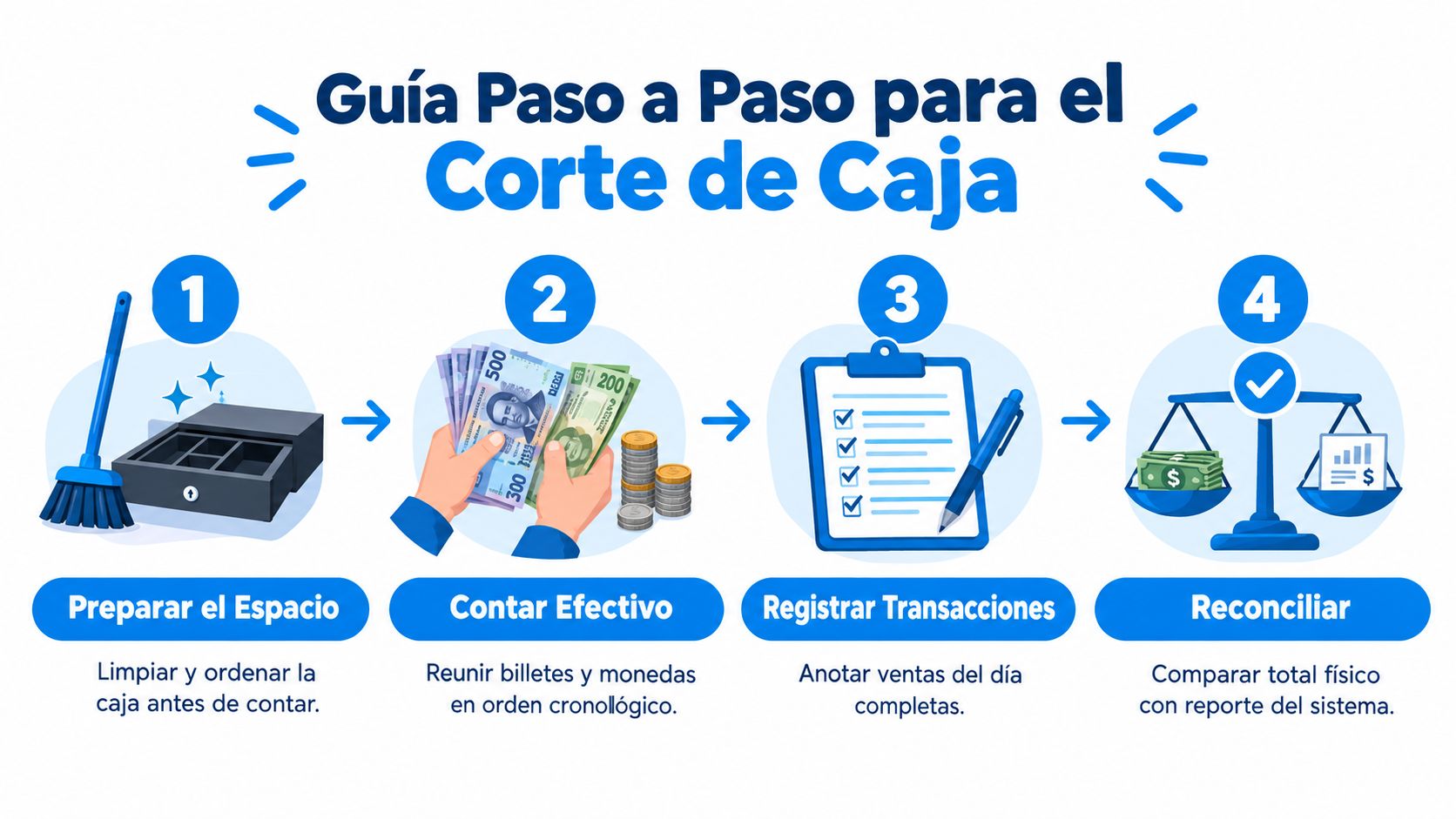
1. Stop Operations and Tidy the Workspace
First, halt new sales, print or export the system report, and clear the counter. If there are order tickets, loose receipts, WhatsApp notes, or card slips, everything should go into the same folder before counting.
In a coffee shop, this prevents confusing a coffee that has already been paid for with one that was prepared but is still pending. In a barbershop, it also helps separate an already completed service from an appointment that was scheduled but not attended.
2. Separate by Payment Method
Next, divide everything by payment method: cash, card, bank transfer, and other means. This step is critical because counted cash should not be compared against total sales.
The basic formula is simple: expected cash = starting cash float + cash collections − withdrawals − cash refunds. If the business accepted card payments or transfers, those amounts are validated against their own reports, as they do not reside in the physical drawer.
A proper closeout does not mix the card terminal with the cash drawer. Each payment method must balance on its own.
3. Count the Cash by Denomination
Then, count bill by bill and coin by coin, ideally in order. If the shift was busy, it's wise to perform a double check whenever recurring discrepancies appear or when multiple hands access the same register.
The count record must include date, time, cashier, branch, amount, and an explanation of any adjustment. For a restaurant with multiple servers, it is also useful to log authorized withdrawals and returns, as those transactions directly affect actual available cash.
4. Reconcile and Keep Documentation
Finally, compare the counted cash against the expected cash. If they match, sign off on the closeout and file the report alongside cancellations and receipts.
In businesses that handle deposits or partial payments, each transaction must retain its reference number to avoid mistaking a reservation for a regular sale. To keep daily sales organized, it also helps to review the logic of operational tracking in how to track daily sales, because a clean closeout begins long before closing the register.
Common Mistakes When Counting Cash
The most costly mistake is not always an obvious shortage. Often, the problem arises when someone lumps everything into a single mental bucket and assumes the total sold should match the physical cash on hand.
Confusing Total Sales with Available Cash
This error frequently occurs in businesses that accept card or bank transfer payments. If the system recorded a sale, but payment was not received in cash, the drawer will not reflect that amount, and the closeout will appear off even when it isn't.
It also happens with transfers shown on-screen or sent via text. A screenshot shared via WhatsApp does not prove that the money has already cleared into the account, so verification must be done against actual bank activity.
Failing to Record Small Adjustments
Another frequent failure is omitting cancellations, discounts, refunds, and emergency withdrawals. Every small adjustment impacts the final figure, even if the business seems "too small" for it to matter.
When this happens repeatedly, the register begins to look unreliable, and the manager ends up arguing over perceptions rather than hard data. A sales log template ensures that every transaction is tied to a specific sale, adjustment, or withdrawal.
Treating Every Discrepancy as the Cashier's Fault
Not every discrepancy implies bad faith. An error in the starting float, a misapplied return, a pending digital payment, or incorrectly given change can cause overages or shortages without any fraud involved.
First classify the discrepancy, then decide what action to take.
If the business experiences repeated discrepancies by shift or payment method, the issue is no longer simple math error—it's a pattern. That is when you should review the process, not just point fingers at the person who closed the drawer.
Modern Tools for Better Cash Management
The traditional way of handling closeouts—pen, paper, calculator, and memory—still works for very small businesses. The problem arises when the business sells across multiple channels or when the person closing the register changes.
Paper and Memory vs. Systems and Traceability
With paper, the owner relies on everything being written down at the exact right time. In a restaurant with open tabs, a coffee shop with tips, or a salon where an appointment changes several times a day, that quickly becomes fragile.
With a point-of-sale system like the one described in point-of-sale software, closing out is much more orderly because sales are tied to the shift, user, and payment method. A morning closeout can be generated with sales broken down by product and cash separated from transfers, while the afternoon shift is reviewed without mixing operations. The value does not lie in digitizing just for the sake of it, but in obtaining a segmented report that is ready to reconcile.
What to Look for in a Small Business
A practical system should let you view sales by product, by employee, and by time period. In a barbershop with two shifts, for example, the morning closeout shouldn't be mixed with the afternoon one, and each cashier should be able to review what they sold during their shift.
It should also track cash movements and simplify reconciliation across cash, card terminals, and the bank account. If there was a cash withdrawal to get change, a return, or a pending transfer, the system must keep it visible so that closing does not depend on the memory of whoever counted the money.
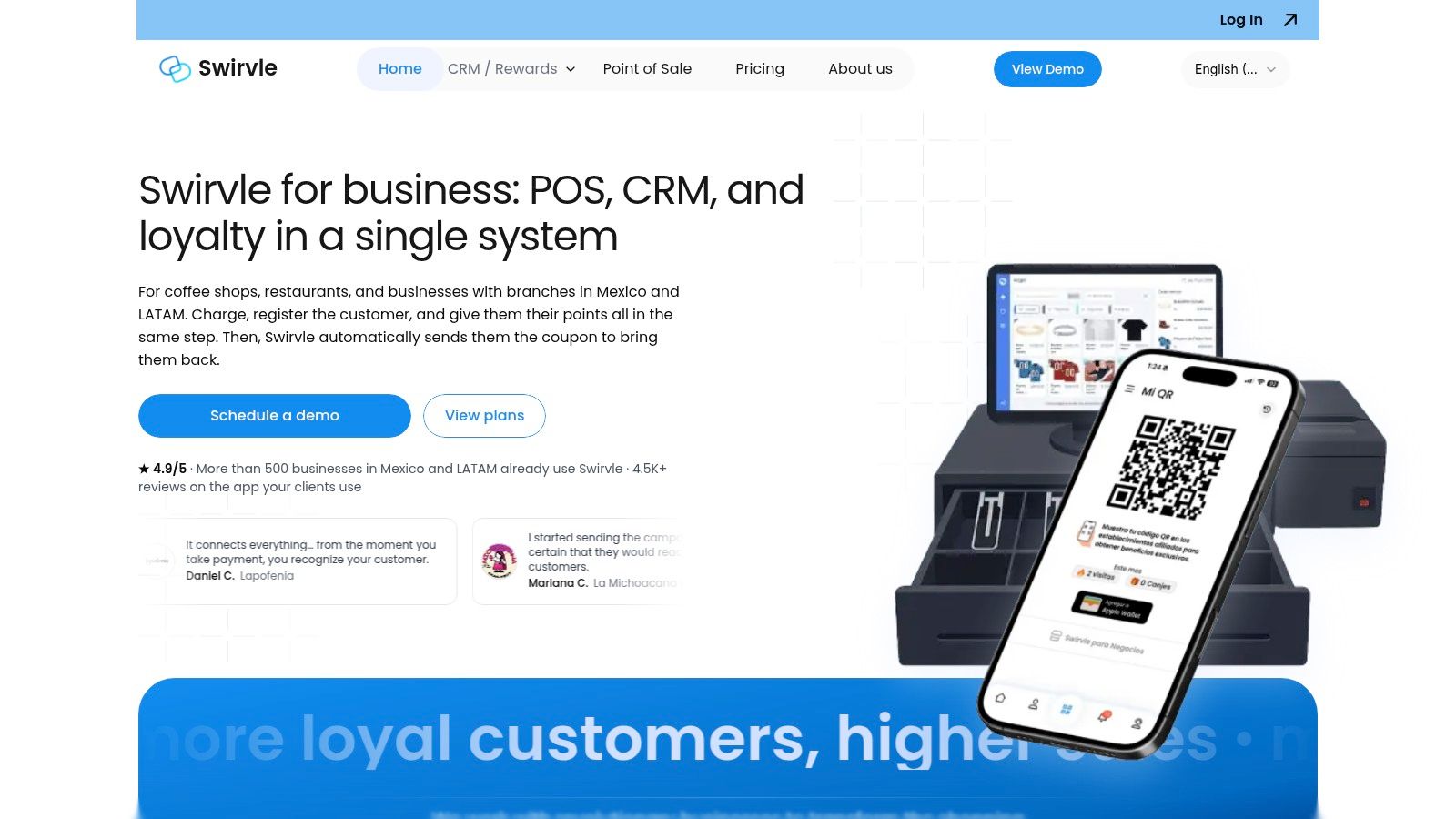
Swirvle centralizes sales, cash movements, and payments in the cloud, keeping information ready to review shifts and perform closeouts without relying on loose sheets of paper. In a coffee shop or barbershop, this structure helps when the business needs to see what happened during each shift, not just how much cash was left in the drawer.
When It's Really Worth Making the Switch
If you already have more than one cashier, multiple shifts, or advance bookings, manual tracking starts falling short. It also weakens when the business sells at the counter and via transfer simultaneously, because reconciliation becomes slow and more prone to error.
The goal is not to use more technology out of obligation. The goal is for every sale to be traceable with receipts, transfers, vouchers, and physical counts, without forcing the manager to recall the entire day from memory at closing time.
Key Takeaways for Better Cash Management
A cash register closeout exists to determine how much money is genuinely available, not to dress up the final numbers. In a small business, the value lies in the routine, because a repeatable process provides far better protection than an isolated, massive effort.
The most robust practice combines three things: separating payment methods, documenting every adjustment, and investigating discrepancies objectively. This prevents immediately penalizing the person who closed the drawer while providing enough evidence to uncover operational flaws.
It's also worth remembering that a small business doesn't need a complicated process, just one that is actually executed every single day. When the closeout is clear, the owner gets a better view of cash flow, the manager works with less stress, and the business stops relying on assumptions.
Swirvle centralizes sales, cash movements, and payments so that the daily closeout doesn't depend on loose paper or last-minute reconstructions. If your business needs to organize shifts, review reports, and connect every sale with its commercial follow-up, it is worth learning more about Swirvle and seeing how it fits into the register closeout of a coffee shop, restaurant, or barbershop.
Related Blogs

Oct 14, 2026
How to do a cash register closure step-by-step in a small business?

Oct 13, 2026
How to respond to a negative Google review without losing customers: The BLUF Guide

Oct 12, 2026
What birthday promotions can a restaurant offer to make customers come back?

Oct 11, 2026
How to set up a WhatsApp loyalty program for my business?

Oct 10, 2026
What Day of the Dead promotions work in coffee shops and restaurants?

Oct 9, 2026
How can I track my business's daily sales?