How to respond to a negative Google review without losing customers. Learn how to respond to a negative Google review without losing customers
At 8:30 a.m., a coffee shop owner opens Google Business Profile and finds a 1-star review. The comment accuses cold coffee and a long wait, right before the mid-morning rush. That moment is not resolved with pride or empty templates, it is resolved with operation, speed, and judgment.
The correct answer to How to respond to a negative review on Google without losing customers? starts with a simple idea, the review is not answered just for the upset person, it is answered for everyone who is going to read it. In Mexico, 83% of consumers take online reviews highly into account before buying according to Capterra, so every public response is a piece of sales, not a private discussion. Reading this guide leaves a clear method, BLUF, Bottom Line Up Front, to respond in less than 24 hours, classify the complaint, move the case to a private channel, automate follow-up, and not leak customer data.
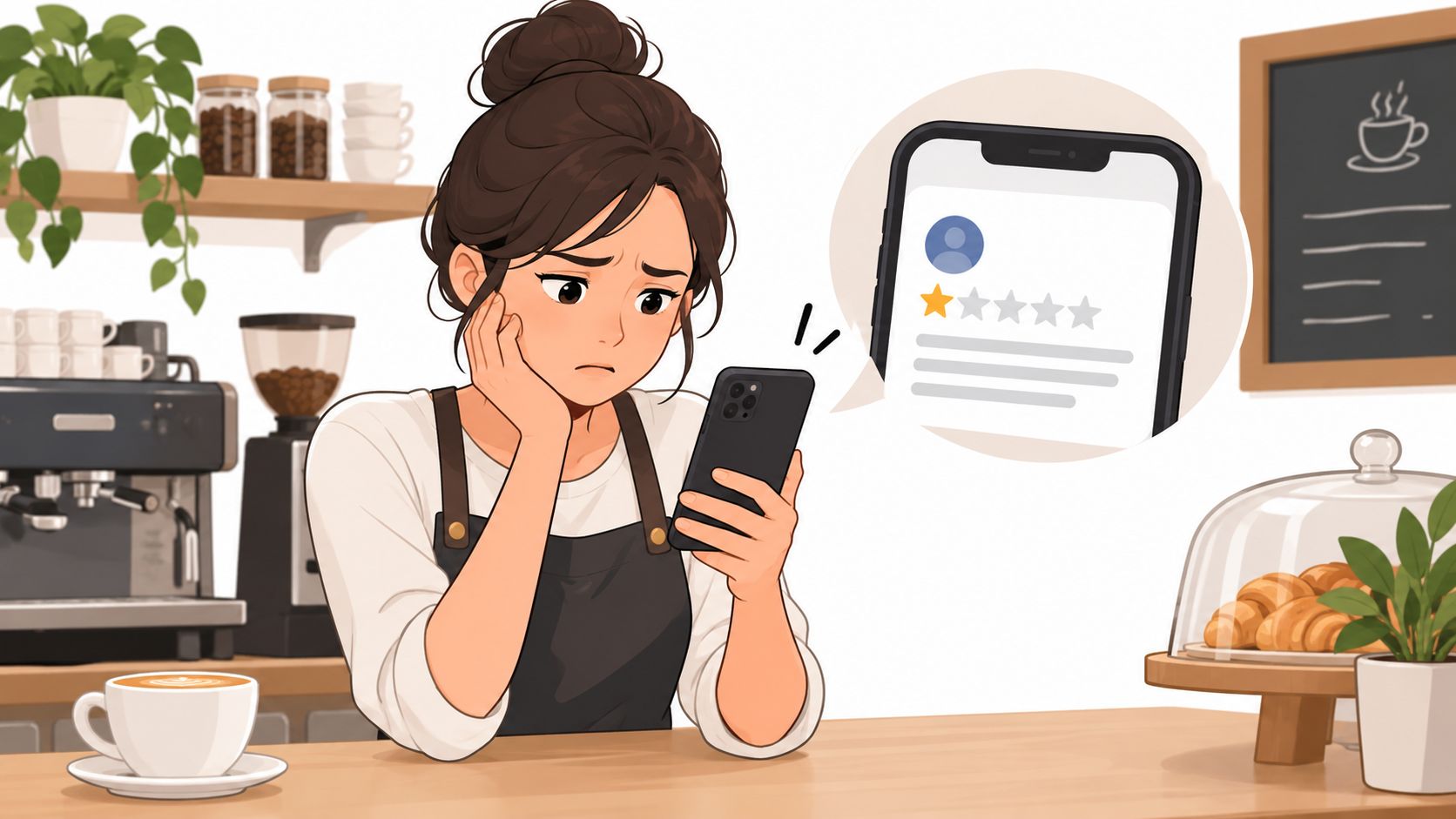
The logic is not romantic, it is commercial. If the profile shows disorder, defensiveness, or pride, the reader assumes the business treats them the same. If it shows control, empathy, and a concrete action, the business retains credibility. This guide to getting 5-star reviews serves as a complement, but here the focus is different, to regain trust when the blow has already appeared.
The critical review has already reached your listing
A negative review is not an isolated incident, it is a public message about the experience of the local. In coffee shops, restaurants, and barbershops, the problem is almost never just the comment, it is the effect of seeing that complaint pinned to the listing while other customers decide whether to enter or go with the competition.
What the customer is really seeing
Anyone reading a review is not looking for drama, they are looking for signs. They want to know if the business responds, if they correct, if they take responsibility, and if the problem happens again. That's why a generic answer sounds worse than silence, because it confirms that there is no control.
The useful response starts with the BLUF approach, first the conclusion, then the action. No need to write an essay, it is necessary to make clear that the business understood the failure, that they are going to review it, and that the case is not going to be left abandoned. When staff respond with cold or copied phrases, the reader perceives automation and is more suspicious.
Quick response, yes. Impulsive response, no. In a physical business, a bad public reply can cost more than the original review because it affects those who have not yet lived the experience. This is especially true in coffee shops and restaurants, where the purchase is immediate and comparison with other venues is a click away.
Operating rule: if the review is already visible, the team should not think about "beating" the customer, they should think about how to win back the next reader.
BLUF in one sentence
The structure is not complicated. First the fact is acknowledged, then the corrective measure is indicated, then the case is taken to a private channel, and at the end a follow-up timeframe is set. This avoids the trap of discussing in public and leaves a sign of order for everyone who reviews the listing.
Element | What it should achieve |
|---|---|
Acknowledgement | Admit that the comment exists and that it was read |
Action | Show that there is a real review, not just an apology |
Private channel | Move sensitive data out of public view |
Follow-up | Make clear that the business does not abandon the case |
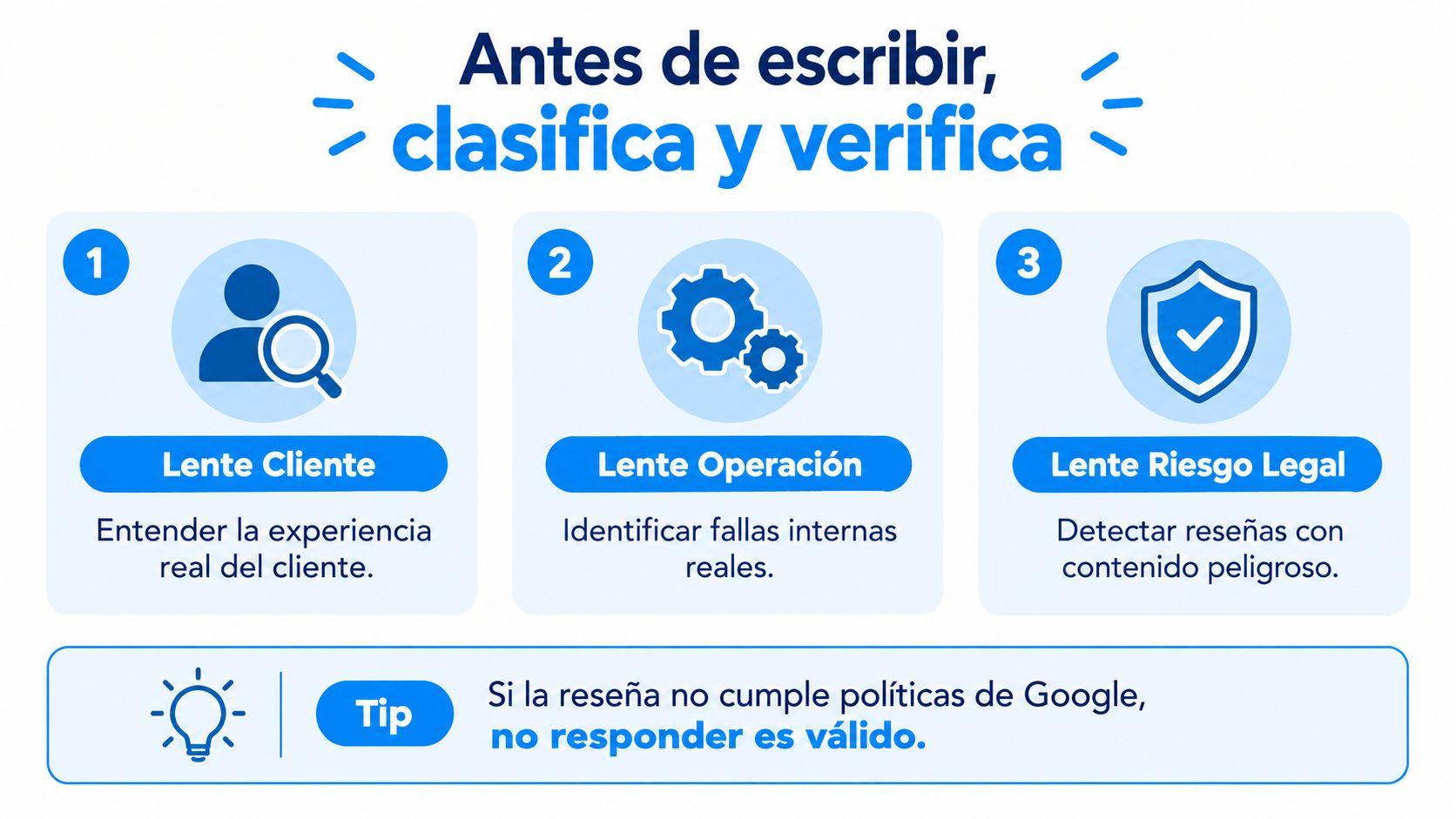
Before writing, classify and verify
Responding without classifying is what turns a bad review into a bigger problem. The team must read it through three lenses, customer, operation, and legal risk. If one of the three fails, the public reply can worsen the situation or open an unnecessary front.
How to distinguish what does deserve a response
The first question is simple, is there a verifiable consumption? If the review mentions ticket, shift, table, appointment, branch, or date, the case enters operational review. If it mentions a person by name or details private data, it also enters, but with extra care.
If there is no way to link the comment with a real visit, it is treated as a possible conflict of interest, duplicate review, or reportable publication. If the text mixes opinion with serious accusations, the business must not improvise. In those cases, it is best to separate the verifiable fact from what is only an assertion.
To this is added an uncomfortable detail, approximately 53% of Mexican readers only consider reviews published in the last three months according to Capterra. That means a recent critique weighs more than an old one, so verification must happen before replying, not after.
The quick review can be ordered like this:
Real problem: there is an order, appointment, or ticket and the complaint matches an operational failure.
Misunderstanding: the customer describes something that did not happen as they interpret it.
Duplicate: the text appears repeated or copied.
Legal risk: personal data, threats, or sensitive accusations appear.
Possible fraud: there is no verifiable relationship with the business.
Review type | Symptom in the text | Initial action | Most exposed shift/area |
|---|---|---|---|
Restaurant | Incorrect order, delay, cold product | Review ticket, shift, and branch | Kitchen and floor |
Coffee Shop | Poorly prepared drink, excessive wait | Verify time, bar, and flow | Barista and register |
Barbershop | Different haircut, altered appointment, barber's name | Cross-reference calendar and service | Calendar and service |
Five-minute checklist
Visible date: confirm when the case occurred.
Correct branch: validate if the critique does correspond to the local.
Concrete reason: summarize the problem without embellishments.
Internal responsible: assign who reviews.
Data risk: detect if there is sensitive information before responding.
Optimizing Google Business Profile for restaurants helps make that classification easier because it organizes the profile before the problem arrives.
The BLUF formula for public response
The public response should not sound like a legal department or a counter robot. It should sound like a manager who has already reviewed the case, knows what happened, and is moving a solution. The reader doesn't want poetry, they want evidence of control.
Template by business type
The correct version always starts with acknowledgement and ends with private channel. The business can adjust the tone, but not the structure. In coffee shops, restaurants, barbershops, and beauty salons, the base is the same because the customer seeks the same, to be heard and to see a correction.
Short template for coffee shop: “We are sorry that your visit was not as expected. We have already reviewed the service and are going to review the preparation and delivery process. Write to us via private message with the date and branch to follow up.”
Short template for restaurant: “Thanks for letting us know. We note what happened and are going to review the ticket, shift, and table service. If you share the date and order with us privately, we will follow up on the case with you.”
Short template for barbershop: “We are sorry for the experience. We are going to verify your appointment, the service, and what happened with the assigned barber. Send us the date of your visit privately to review it in detail.”
Short template for beauty salon: “Thanks for writing to us. We are already reviewing the indicated service and the team's attention. Share the date and branch with us privately to give it proper follow-up.”
In Mexico, 93% of consumers completely or partially agree that reviews from ordinary users are trustworthy, compared to 71% who distrust influencers according to Capterra 2024. That forces you to write like a real human, not like polished marketing text.
Phrases that are unnecessary
“It was not our fault.” Sounds defensive and doesn't resolve.
“Contact us if you like.” It is generic and lazy.
“Delete your review and we will help you.” It is a bad practice and can make everything worse.
“We will compensate you if you change your rating.” Crosses the line of improper incentive.
The most common mistake is to publish a template-like response without a single reference to the concrete case. The listing looks automatic, and an overly perfect response raises suspicion, especially when the problem was visible.
From public chat to private follow-up
The public conversation does not fix a poorly served order or a bad haircut. It serves to contain the damage, but real recovery occurs out of everyone's sight. That is where the business stops acting as a profile and starts acting as an operation.

What to ask for and what not to ask for
In public, it is only convenient to ask for minimal data to locate the case. Date, branch, and receipt are enough to start. Full name, phone, email, detailed consumption, or membership should not be published in the visible response.
In private, yes, you can ask for the necessary information to verify the visit and resolve it. The goal is to confirm the incident, review the ticket or appointment, and decide on a proportional measure. No need for interrogation, what is needed is traceability.
The first private message should be short and clean. Something like this works better than a long explanation:
“Thanks for writing. We want to review your case in detail. Please share the date, branch, and receipt, and the person in charge of the shift will review it with you.”
The compensation must correspond to the failure. If there was poor service, it may correspond to redoing the service, refunding a part, offering a correction, or giving a reasonable adjustment. What must not happen is conditioning that gesture on the customer changing the review.
In a restaurant, a complaint about delay is addressed by reviewing the order, shift, and kitchen dispatch. In a barbershop, calendar, haircut, and service are reviewed. In a coffee shop, preparation, times, and delivery are reviewed. Each business type needs its own reading because each breaks in a different way.
What is non-negotiable
Do not ask to delete the review in public.
Do not offer benefits in exchange for five stars.
Do not argue the case on the listing.
Do not move personal data in view of anyone.
In the daily operation of a restaurant or a coffee shop, complaints arrive sooner or later, especially during the busiest hours. That reality forces us to treat follow-up as routine, not as a dramatic exception.
Useful sequence: brief public response, private message, internal verification, concrete solution, and final update when the case has already been closed.
How to measure and build loyalty with a CRM like Swirvle
Recovery that is not measured becomes theater. A CRM with loyalty serves to know which branch fails, what reason is repeated, and which customer returned after a bad experience. Without that record, the business only collects pretty responses.
What to tag for each incident
The first thing is to classify each case by branch, reason, service stage, and outcome. This way you can see if the problem comes from a bar, a shift, a barber, or a cashier process. It is also useful to mark if the review ended in a solution, compensation, or recurrence.
The useful dashboard does not stop at stars. It measures time to first response, cases closed in 72 hours, repetition of the reason per quarter, and repurchase of recovered customers. That mix gives a real operational reading, not a decorative photo.
A practical way to activate it in an SMB is to use a CRM with automations, segmentation, and reminders. Swirvle can serve as one of those options because it centralizes customers, branch, and history, and allows automated campaigns via WhatsApp (Premium plan), email, or notification, as long as the business respects the policy of not conditioning benefits on a positive review.
Campaigns that do make sense
7-day reminder: only if the incident has already been closed.
Smart coupon at 14 days: as visit recovery, not as payment for a review.
Survey at 21 days: to validate if the problem reappeared.
Manual follow-up: when the case was sensitive or affected a frequent customer.
The hard rule is simple, the benefit does not buy the rating. Google prohibits offering incentives, such as payments, discounts, or free products and services, in exchange for posting reviews or having negative ones modified or removed, according to its content policy for Google Maps. That is why the incentive, if it exists, must be used to recover the visit, not to manipulate the listing.
A very clear example is a coffee shop that detects three reviews for the same poorly prepared shake. The CRM shows that all of them came from the same shift and the same branch. No more speech is needed there, the procedure is changed, the process is corrected, and then it is measured if the reason disappeared.
Seeing what a CRM looks like in a coffee shop or restaurant helps land this flow without turning it into theory.
What you should not publish and when Google can indeed remove the review
There are businesses that still respond as if the listing were their personal wall. That mistake is expensive. Never confirm in public that someone consumed, never publish their name, never expose phone, email, membership, nor medical or financial details.
In Mexico, the legal logic is clear, personal data is treated with lawfulness, purpose, proportionality, and responsibility. That means a public response that confirms a purchase or describes the case in too much detail can aggravate the risk instead of resolving it. The sensible way out is to separate opinion, insult, personal data, and factual accusation, and respond only with a general apology while verification occurs in private.
Google also does not delete a review just because the business does not agree. The platform removes content only when it violates its policies, such as spam, conflict of interest, personal data, threats, or deliberate harm according to Google Business Profile help. That forces you to distinguish between "I didn't like it" and "this violates rules."
What to do when the review does cross the line
Save screenshots: before reporting or asking for review.
Review policies: do not assume that every critique is removable.
Report with judgment: only if there is a clear breach.
Respond without revealing data: even if the case is annoying.
Avoid impulsive deletion: deleting legitimate critiques generates more suspicion.
Suspicion also goes the other way. When a response sounds too polished or when the business makes weird maneuvers to hide critiques, the reader thinks something doesn't add up. In a market where digital distrust is already high, the best defense is a consistent history of real responses, visible corrections, and verifiable evidence of improvement.
A useful metric in the end is not just the average rating. Reputational authenticity also counts, that is, response time, reincidence of the reason, clarity of the message, and verifiable testimonials inside and outside the listing. That is what ends up convincing whoever is about to buy.
Swirvle helps organize that flow with CRM, loyalty, automations, and segmentation by branch, reason, and customer history so that a negative review does not remain as noise. If the business needs to turn public responses, private follow-up, and measurable recovery into a single process, it is worth checking out Swirvle and seeing how it fits into daily operation.
Related Blogs

Oct 13, 2026
How to respond to a negative Google review without losing customers: The BLUF Guide

Oct 12, 2026
What birthday promotions can a restaurant offer to make customers come back?

Oct 11, 2026
How to set up a WhatsApp loyalty program for my business?

Oct 10, 2026
What Day of the Dead promotions work in coffee shops and restaurants?

Oct 9, 2026
How can I track my business's daily sales?

Oct 8, 2026
How to do a daily grocery store inventory without wasting time?