
How to prevent employee petty theft in my business? Learn to prevent and detect inventory shrinkage with practical controls for cafés, restaurants and shops.
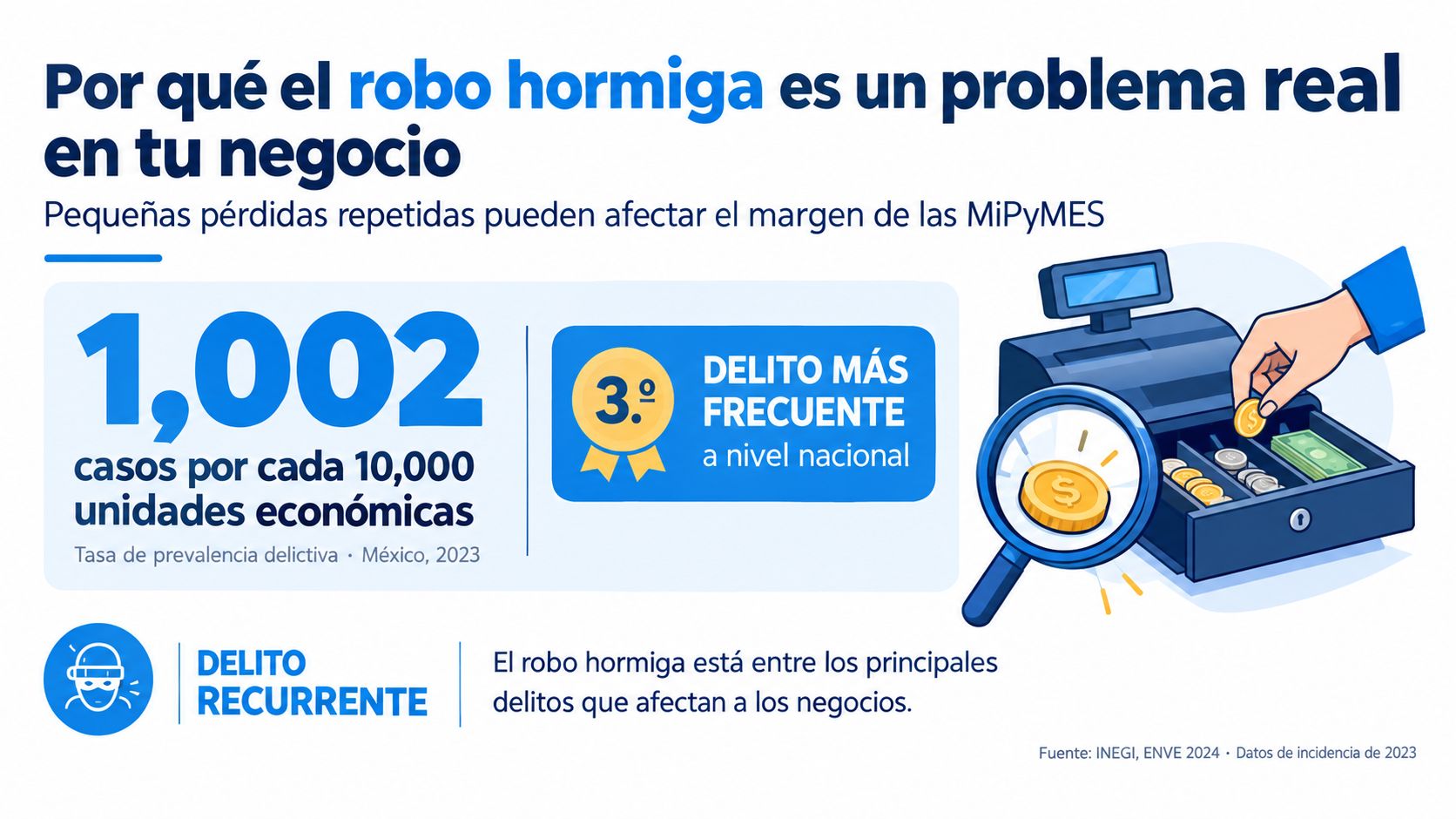
In Mexico, petty theft was the most frequent crime against businesses in the Commerce sector during 2023, according to INEGI’s ENVE 2024. For a café, a restaurant or a shop, that signal points to an operational problem that deserves constant controls, not just a reaction when a shortage shows up.
The question how do you prevent employee petty theft in a business? is not solved by starting with an accusation. First you need to determine whether the discrepancy comes from theft, a cash register error, a poorly portioned recipe, an unrecorded return or another process failure. With clear records and a step-by-step review, the business can fix operational causes and escalate an investigation when the evidence justifies it.
Why petty theft is a real problem in your business
Petty theft is no minor issue for brick-and-mortar retail. INEGI’s ENVE 2024 identified it as the most frequent crime against commercial businesses during 2023. The same survey estimated that, in 2023, 31.5% of businesses in the Commerce sector suffered some crime, compared with 21.6% of manufacturing businesses and 24.2% of those in services. The total cost of insecurity and crime for businesses reached 124.3 billion pesos that year.
In a café, closing time may reveal less cash than expected and a gap between the drinks sold and the milk, coffee or syrups used. In a shop, stock of small, high-value products may drop faster than recorded sales. None of these signals proves on its own that someone stole: it does show that the business needs to know what happened, when, and under what procedure.
The first alert is a repeated discrepancy
A one-off shortage can have different explanations. A miscounted delivery, an unrecorded courtesy item or spoilage due to expiration can change stock levels without any deliberate theft. When discrepancies keep appearing in the same product, shift or type of transaction, it is time to stop relying on memory and compare records.
Shrinkage should be treated as part of operational control. A basic plan combines frequent counts of sensitive products, cash register closings per shift, defined permissions for discounts and returns, and reconciliations between sales, stock and ingredient usage. The goal is to detect patterns with verifiable data, not to turn every discrepancy into a personal conflict.
Starting point: a shortage is a signal to review the process. It is not, by itself, proof of theft.
How to tell internal theft from operational shrinkage
The safest way to handle a discrepancy is to separate what you know from what you assume. It is often repeated that 40.7% of thefts are committed by employees or former employees, but the ENVE 2024 bulletin says something else: in 40.7% of crimes against businesses, employees or owners witnessed the event, not that they committed it. No national figure lets you conclude that an inventory discrepancy in a small business is employee theft; that is why it makes sense to review the records first.

The practical difficulty is that internal theft and operational shrinkage can produce the same symptom: shortages. In a restaurant, a generous portion or a recipe applied differently can explain the extra use of an ingredient. In a shop, an incomplete delivery, a damaged product or a return that never goes back into inventory can create a discrepancy that looks like theft.
Build evidence before assigning responsibility
The business can start by recording inventory by shift and location, and comparing what was sold with stock and expected usage. In cafés and restaurants, measuring ingredients by recipe and modifier is more useful than counting only finished products. If drinks were sold with size or ingredient changes, those details should be reflected in the record.
It also helps to document cancellations, returns, courtesy items and inventory adjustments with the reason and the corresponding authorization. Cycle counts of sensitive items let you review discrepancies without stopping the whole operation. To expand loss control in a restaurant, see this guide on how to control food waste in a restaurant.
A solid investigation looks for repetition and relationships between records. A shortage that appears after a poorly documented delivery calls for reviewing the receiving process. A discrepancy that persists after correcting the count could justify a more detailed review. Accusing someone before ruling out fixable errors can damage trust and leave the original cause of the shrinkage untouched.
Administrative and physical controls that actually work
The most helpful controls are the ones that reduce opportunities and leave a trail without slowing down operations. In a small business it may not be feasible to assign a different person to each task, but some authorizations can be separated: whoever runs the register should not approve their own discounts, cancellations or returns. If duties cannot be fully separated, the owner or manager can review the exceptions.
A security firm quoted in the Mexican press estimates that petty theft can reduce inventory by up to 15% and revenue by up to 30%, and affect 28% of small and medium-sized businesses; these are estimates from an industry company, not official data or a guaranteed outcome for every business. The source describes possible impacts in its coverage of petty theft.

Adapt the control to your type of business
Shops and convenience stores: each cashier should use their own user account and record every sale, even if the customer is a regular or pays in cash. The review can compare sales with payments, returns and movements of high-value or easy-to-hide products, such as cigarettes, liquor or personal care items.
Cafés and restaurants: cash register closings per shift and recording staff meals, courtesy items and adjustments help explain variations in cash and ingredients. The rules should specify who can authorize each exception.
Warehouses and storage areas: limiting access to inventory areas reduces unrecorded movements. Cameras can cover relevant operational points, always as a complement to records and procedures, not a substitute.
The staff consumption policy should be clear: what can be consumed, how it is recorded and who authorizes it. When the rules are ambiguous, the business loses the ability to tell an allowed courtesy from an undocumented outflow. A random process review can complement daily controls, as long as it is applied consistently and respectfully.
Cash and inventory audit and reconciliation processes
Reconciliation works when it is done regularly and compares records that should match. In a café, for example, the closing should tie together sales, payment methods, counted cash, card terminal transactions and ingredient usage. If each data point is linked to the corresponding shift and user, the manager can locate discrepancies without relying on memory or suspicion.
Mexican tax rules identify the payment method codes 01 for cash, 03 for transfer, 04 for credit card and 28 for debit card. Recording the payment method for each sale lets you compare declared cash with counted cash, card payments with the terminal report, and transfers with bank movements. To review which tax details, such as the payment method, each invoice must include, see this guide on tax requirements for an invoice.

A routine that leaves a trail
Close the shift with a breakdown. The person in charge records sales, cash, electronic payments, returns, discounts and withdrawals. Tips should be kept separate from the business’s sales so business money is not mixed with staff money.
Compare each payment method. Cash is checked against the register count; cards, against the terminal; and transfers, against the bank record.
Review sensitive items. Cycle counts focus on high-value, high-turnover products or those whose usage is hard to estimate. Discrepancies are noted with date, product, location and shift.
Review exceptions. Cancellations, returns, discounts and adjustments require a reason and authorization. A weekly review of these transactions helps detect concentrations or repetitions.
Document the explanation. If a discrepancy comes from an incomplete delivery, a recipe or a data entry error, the record should note the cause and the correction applied.
This routine lets you investigate without immediately pointing at a person. To organize a consistent closing, the business can rely on this guide to do a step-by-step cash register closing in a small business.
How to use technology to monitor without being invasive
Technology should help find patterns, not automatically label employees. A point of sale with individual users can record who processed a sale, applied a discount or canceled a transaction. An inventory system can update stock with each sale and let you compare shifts or locations. These tools provide operational evidence, but human review is still needed to understand the context.
Cameras can cover register areas, merchandise receiving or warehouse access where relevant. Their installation should come with a clear policy on their use and communication to the team. Watching every move, recording spaces without an operational reason or using footage out of context can damage trust without fixing process failures.
Analyze exceptions, not people
A CRM or loyalty system can complement control by linking coupons, promotions and rewards to identifiable tickets, locations, times and authorized users. This way, the business can check whether certain discounts are concentrated in specific shifts, whether a campaign is recorded differently across locations, or whether there are rewards that do not match identifiable sales. The signal justifies a process review, not an automatic conclusion about someone’s behavior.
Swirvle brings together CRM and loyalty features, and its point of sale system with inventory control lets you check stock and recorded sales. To understand how sales operations connect with inventory, see this guide on point of sale systems with inventory.
The right tool is the one the team can use consistently and whose records the manager actually reviews. Before adding technology, define which operational question it should answer: who authorized an adjustment, in which shift a discrepancy repeats, or which ingredient does not match sales. Without that question, piling up data can add work without clarifying the cause.
Training and clear policies for your team
A control works best when staff understand the rule and can apply it without guessing. Training should explain what counts as authorized shrinkage, how to record a damaged product or a courtesy item, who can approve discounts and what happens if someone alters a record. Policies should be written down and communicated the same way to the whole team.
The ENVE 2024 estimates that, in 2023, 27.2% of the country’s businesses were victims of some crime, about 1.3 million establishments, and places petty theft among the three most frequent crimes. In Mexico City, a video surveillance company quoted in Milenio’s coverage of petty theft in Mexico City small businesses estimated that 6 out of 10 small businesses had suffered petty theft by their employees. The figures are not directly comparable and do not represent a universal rate for all small businesses; they serve as signs of exposure.
Communicate controls without creating a culture of suspicion
The explanation should focus on the process: records protect the business and also help clear up errors without unfairly blaming anyone. In a café, each employee can learn to record a courtesy drink; in a restaurant, the team can agree on how to document prep waste; in a shop, each sale should be linked to the user who recorded it.
A confidential channel lets people report irregularities without making informal conversations the only way to raise a concern. The business should explain how a report is received and reviewed, and avoid retaliation against anyone who reports in good faith. Reports also require corroboration before any disciplinary action begins.
Training does not replace clear working conditions or respectful supervision. The business can check whether controls are affecting service times, team satisfaction or turnover. If a rule adds friction and does not help explain discrepancies, it is worth adjusting before staff stop following it.
Legal and disciplinary steps when you confirm theft
A repeated discrepancy can justify a formal review, but the threshold should be objective and defined before a conflict arises. For example, the business can establish that several documented discrepancies in the same shift trigger an investigation, as long as it has first ruled out register, receiving, recipe, expiration and return errors. That criterion is a suggested internal policy, not a legal figure or automatic proof of guilt.
The investigation should gather inventory records by shift, sales reconciliations, counts of sensitive items and cancellation or return transactions. The staff involved should be treated confidentially, and any formal conversation should focus on verifiable facts and allow the person to explain their side. A suspicion, a rumor or a single discrepancy is not enough to conclude that theft occurred.
Escalate with evidence and advice
When the records support misconduct, the business can move from fixing the process to a formal investigation and consider the applicable disciplinary measures. Before suspending or ending an employment relationship, it is advisable to consult a labor lawyer to review the evidence and the corresponding procedure. In Mexico, article 47 of the Federal Labor Law includes lack of probity or honesty among the grounds for termination without liability for the employer, and requires giving the worker a written notice stating the conduct that motivates the termination and the dates on which it occurred.
The final decision should rest on documented facts, not on labels or pressure to quickly resolve the shortage. It should also address the operational cause: if the process that allowed the discrepancy stays the same, another employee could face the same situation. Controlling shrinkage takes evidence, clear rules and a proportional response.
Swirvle offers CRM, loyalty, point of sale and inventory tools that help connect sales, customers and stock in brick-and-mortar businesses. To organize those records and strengthen the operation of a café, restaurant or shop, discover Swirvle.
Related Blogs

Nov 17, 2026
How to create a loyalty program for a clothing store or boutique?

Nov 16, 2026
How to manage a coffee shop's inventory day by day?

Nov 15, 2026
Clip vs Mercado Pago: Which terminal is best for your restaurant or coffee shop in 2026?

Nov 14, 2026
Checklist: Your Coffee Shop POS Features (9 Essentials)

Nov 13, 2026
What rewards should you offer in a restaurant loyalty program? 2026

Nov 12, 2026
How to manage clothing store inventory without losing sales? 2026 Guide