How to control waste in a restaurant? Learn diagnostics, FIFO, standardized recipes, technology, and corrective actions to reduce losses today.
Mexico loses around 20.4 million tons of food per year, equivalent to 34% of its national production, and controlling that waste in a restaurant begins by measuring shrinkage as a percentage of consumption, categorizing it by cause, and linking inventory to sales for each dish. Buying less without reviewing that data does not fix the problem: it can leave the business without product right when there is demand.
In a coffee shop, waste can hide in expired milk, unsold pastries, or incorrectly prepared drinks. In a restaurant, it can appear in poorly portioned proteins, overproduction, or plates sent back from tables. Operations must distinguish each loss and assign a cost to it. The goal is not zero shrinkage at any cost, but rather preventing avoidable losses and recovering value safely.
Why measure shrinkage before buying less
The FAO estimates that food loss in Mexico exceeds 400 billion pesos per year; it also generates close to 36 million tons of CO₂ equivalent and consumes around 40% of the water used by Mexican agriculture. The national scale does not automatically reflect what each individual location loses, but it makes clear why purchasing, storage, production, and sales must be managed using verifiable data. The FAO estimate on food loss and waste in Mexico

The first decision is to stop recording "shrinkage" as a single bag of discarded product. Overproduction, expiration, spoilage, preparation errors, returns, and plate waste occur at different stages and require different corrective actions. If they are lumped together, the manager cannot know whether to adjust the forecast, correct a kitchen technique, or review service.
Cause | Typical Example | Person Responsible | Data to Record |
|---|---|---|---|
Overproduction | Preparing more side dishes than are sold | Head chef | Dish, quantity prepared, and leftovers |
Expiration | Milk expiring before being used | Stockroom manager | Product, date, and cost |
Spoilage | Improperly stored vegetables | Receiving or kitchen | Ingredient, condition, and cause |
Preparation error | Drink made with incorrect recipe | Barista or cook | Product, error, and replacement |
Return | Dish sent back due to execution failure | Kitchen and service | Dish, reason, and destination |
Plate waste | Food left unconsumed by the customer | Service | Dish and approximate quantity |
For an initial diagnostic, the person in charge reviews inventory records across several days, compares sales per dish against what was prepared, and categorizes losses by cause. Each log entry must include the date, ingredient, quantity, unit cost, reason, and person responsible. Then, management calculates shrinkage as a percentage of consumption or purchases and compares shifts, locations, and days to detect patterns.
Operational rule: The metric is not just how much was thrown away. It also matters what product, still fit for consumption, was converted—with traceability—into a sale, a donation, or a secondary preparation.
Inventory control and FIFO that actually works in the kitchen
A lack of inventory tracking and FIFO control stands out as a source of shrinkage in a study on restaurant businesses in Mexico. The reason is simple: when no one knows what came in, what went out, and what remains in the walk-in, product can spoil before it ever reaches preparation. The research on inventory and FIFO control in restaurant businesses
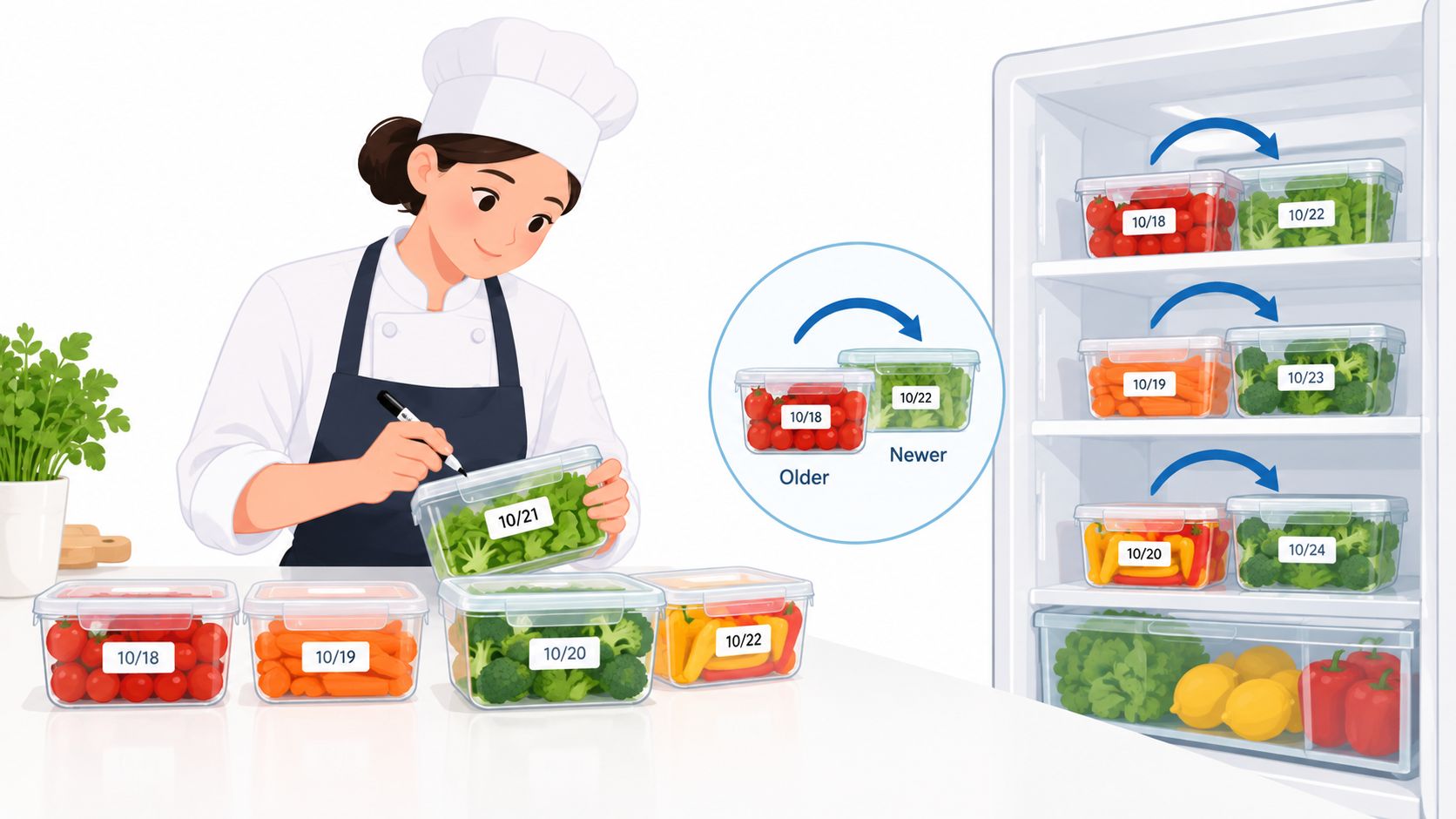
FIFO stands for first in, first out. The message to the team must be direct: "the first thing in is the first thing out." Receiving a product is not enough; someone must check its condition, log the arrival, label it, and store it behind the batch that was already open or available.
Labeling and rotating without slowing down service
A useful label displays the receiving date, opening date, product name, and person responsible. The team places the oldest batch at the front and checks that containers are sealed and stored according to kitchen procedures. In a coffee shop, this applies to milk, syrups, and pastries; in a full-service restaurant, to proteins, vegetables, and dairy.
Physical counts should be integrated into the daily routine, not turn into a chore that halts kitchen operations. The manager can rotate the categories being checked, compare the count with logged receipts and issues, and note any discrepancies for investigation. The review should clarify whether the issue was due to expiration, higher-than-expected consumption, a data-entry error, or an unrecorded issue.
Daily Log | Information to Record |
|---|---|
Receiving | Product, quantity, supplier, and condition |
Labeling | Receiving date, opening date, and person responsible |
Usage | Product, quantity, and destination |
Discrepancy | Physical inventory, recorded inventory, and explanation |
This procedure can go live starting on the next shift: one person receives and labels, another puts items away following FIFO, and the kitchen manager verifies stock levels and discrepancies. This way, the entire team speaks the same language and no one opens a new batch for convenience while the previous one is still usable.
Standardized recipes and portions that protect margins
Serving an extra 30 grams of a steak that costs 200 pesos per kilo across 25 dishes a day can add up to nearly 55,000 pesos per year in extra costs, according to an operational guide from Unilever Food Solutions Mexico. The cost example of extra portions in the waste guide This is no small detail: if every cook plates "by eye," the business pays for a larger portion even though the menu price remains unchanged.
The recipe spec sheet must state the weight of each ingredient, edible yield, unit cost, target weight, and expected margin. It is also wise to specify which trimmings can be repurposed, for which preparation, and under what conditions. A standardized recipe helps distinguish shrinkage inherent to cleaning an ingredient from an error in portioning or production.
From theoretical yield to actual consumption
Theoretical yield is based on the quantity that should be used according to the recipe and recorded sales. Actual consumption is calculated by comparing that figure with the ingredients that were actually drawn from storage. If actual consumption exceeds theoretical yield, the manager investigates before placing blame on the kitchen: it could be over-portioning, an inaccurate prep yield calculation, recipe errors, or incorrectly entered sales.
The corrective action depends on the root cause. If customers consistently leave food on their plates, the team reviews the portion size and dish composition before blindly cutting portions. If the issue lies in usable trimmings, the chef can design a secondary preparation, provided that traceability, food safety, and quality are maintained. Reusing does not mean salvaging any leftover scrap.
Before authorizing reuse, the chef verifies that the product was handled and stored safely, maintains its quality, has an identifiable source and date, and is designated for an approved preparation. If any condition is not met, it is discarded and the reason is recorded. To document recipes and their costs, the team can consult this guide to standardizing recipes in restaurants.
Purchasing and suppliers aligned with real demand
Each business should set its own food and beverage cost target as a percentage of the sales price, based on the real cost of its recipes. If a location shows a deviation of four percentage points from that target, the discrepancy warrants a review of shrinkage, recipes, portions, and sales, but it does not prove on its own that the entire variance comes from waste. To set that target with your own numbers, see this guide on how to calculate the cost of a dish.

Orders must align with probable sales, not habit. Management reviews historical data by day of the week and shift, adjusts the forecast if there is a special event, and translates it into quantities per ingredient. A coffee shop forecasts milk, pastries, and coffee beans separately; a full-menu restaurant orders proteins, produce, and dry goods based on the dishes that actually sell.
What every purchase order must cover
The purchase order template must include product, on-hand inventory, forecasted consumption, required quantity, delivery date, and the person responsible for approval. Before placing the order, the manager balances needs against physical inventory and items nearing expiration. This check avoids repurchasing items that are already in the walk-in.
Suppliers also impact shrinkage. The manager must demand clear expiration dates and agree on receiving conditions, lot tracking, and options for handling products with insufficient shelf life. If frequent deliveries are feasible for the business, they can help keep order quantities tighter, though the decision must factor in cost, availability, and storage capacity.
A low purchase price does not make up for a product that arrives late, in poor condition, or in quantities that the business cannot sell in time.
Management compares actual food costs against targets, but breaks down the analysis by product category and dish. This makes it possible to separate price fluctuations from over-purchasing or outdated recipes. The weekly order is adjusted based on actual sales, available inventory, and forecasted demand—not on recollections of what "usually sells."
The overlooked side of shrinkage comes from demand
In Mexico, approximately 13.4 million tons of food are discarded each year, with a significant portion tied to poorly managed surpluses during retail and consumption. The analysis on food waste in Mexico Because of this, not all shrinkage begins in the kitchen. A location can execute its recipes flawlessly and still overproduce if forecasts do not reflect what customers purchase at specific times of day.
The manager must cross-reference forecasted and actual sales by dish, along with cancellations and shift leftovers. This dashboard helps pinpoint whether waste stems from a preparation that sells less than expected, a shift in customer behavior, or prep work done too far in advance that no longer aligns with tickets.
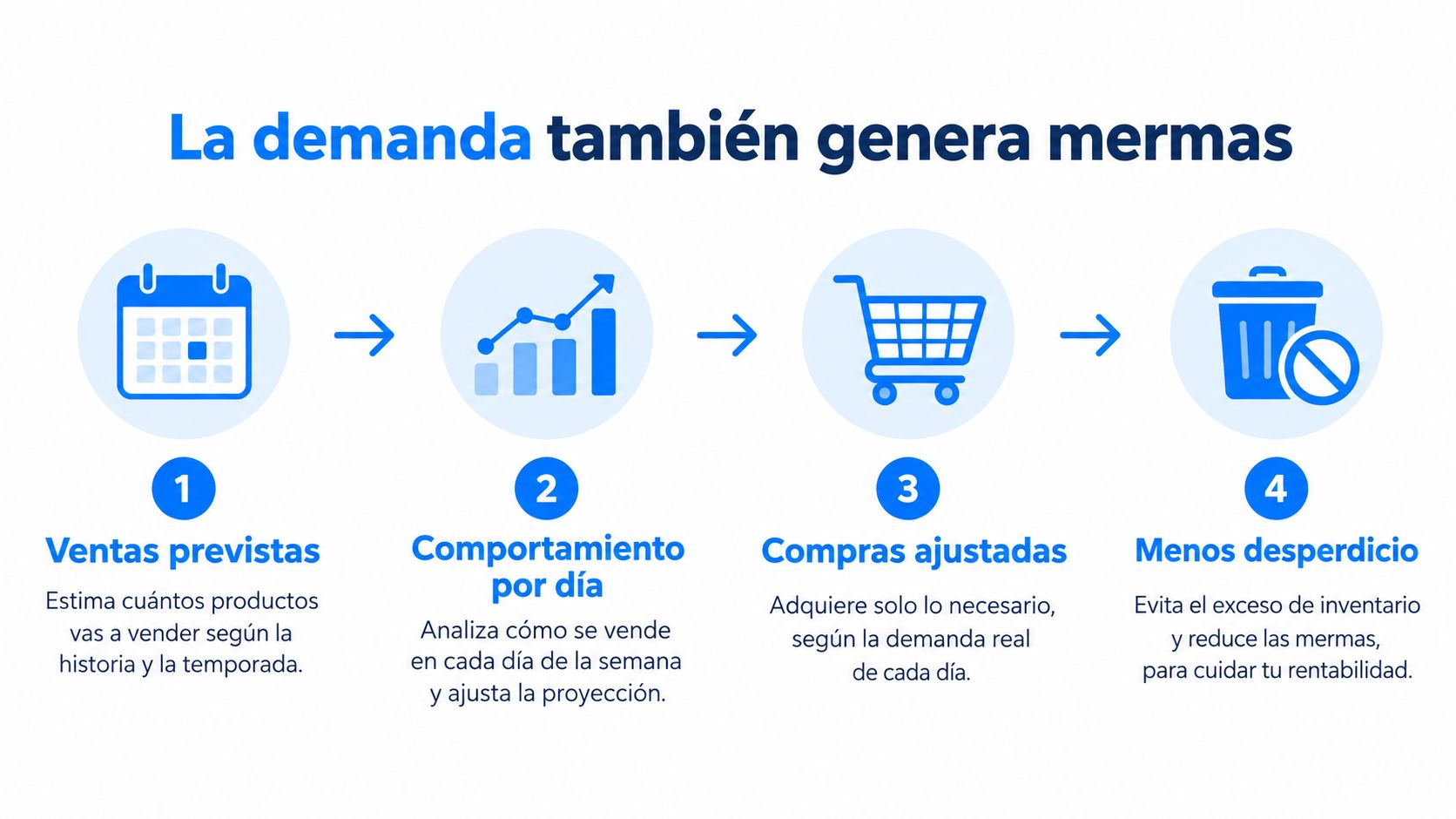
A promotion can recover margin
If a perishable ingredient is at risk of not selling in time, the business can feature a related dish or product for a segment that frequently purchases it. A coffee shop might promote a drink using ripe fruit, and a restaurant could run a special on a dish utilizing available ingredients. The promotion must respect the minimum profitable price and product quality standards, rather than turning into an across-the-board discount that erodes margins.
A targeted campaign via WhatsApp or push notifications can be effective if it reaches customers with relevant dining habits or a branch with surplus inventory. Evaluation does not end with how many kilos were kept out of the trash: the manager tracks attributable sales, the cost of ingredients used, and the marginal contribution gained. A promotion that saves product but sells below cost does not solve the problem.
To adjust production for seasons and fluctuations in demand, the team can rely on this guide on peak and off-peak seasons in restaurants. The priority is to anticipate surpluses and act before ingredients lose their value, rather than waiting until closing to count what was thrown away.
Logging, metrics, and technology to sustain control
A log is only useful if someone records it in real time and someone else reviews it. Every instance of waste must be linked to a date, location, shift, category, cause, quantity, cost, person responsible, and final disposition. Management reviews losses daily, compares trends in a weekly meeting, and adjusts recipes, purchasing, or production whenever a recurring discrepancy is identified.
Reported waste by category in restaurants highlights where to focus attention: 52% in fruits and vegetables, 50% in seafood, 38% in grains, 22% in meat, and 20% in dairy, according to a study published in SciELO Mexico. These rates reflect the cited study and should not be taken as an automatic outcome for every establishment; however, they can help prioritize the most vulnerable categories. The study on waste by food category in restaurants
Key metrics to review
Actual food cost: Cost of ingredients consumed relative to food and beverage sales.
Shrinkage by category: Quantity and cost associated with each product group and root cause.
Recovered shrinkage: Value of usable product converted into sales, donations, or documented secondary preparations.
Forecasted vs. actual sales: Comparison by dish, location, and shift.
Average check: Benchmark to evaluate whether a promotion also drives complementary purchases.
A point-of-sale system integrated with recipe costing can automatically deduct the specified ingredients for each dish and display theoretical usage against inventory. Swirvle, for example, combines POS capabilities with recipe-level inventory, stockroom receiving controls, and targeted marketing campaigns, making it possible to correlate consumption, sales, and actions to move stock.
Date | Location | Shift | Category | Cause | Weight (kg) | Cost ($) | Responsible | Destination |
|---|---|---|---|---|---|---|---|---|
Logs should be easily accessible without having to reconstruct history from memory. To organize receipts, issues, and on-hand inventory, the person in charge can consult this inventory tracking guide. The system can be digital or a shared spreadsheet, but every discrepancy must have an explanation and an assigned owner for follow-up.
Corrective actions and a 30-day plan for your business
Control is not established with a pep talk. It is built by assigning tasks, due dates, and owners, and verifying whether adjustments reduce the cost of waste. Management must designate who logs the data, who verifies it, and who authorizes any reuse of ingredients.
Implementation roadmap
Phase | Actions | Deliverable |
|---|---|---|
Assessment | Log waste by cause; compare sales to prep levels; identify the most costly categories | Shrinkage baseline and list of causes |
Inventory & Recipes | Implement FIFO; label products; standardize weights and yields | Labels, recipe spec sheets, and physical count routine |
Purchasing & Demand | Align orders with sales history; review leftovers and voids by shift | Order template and forecasted vs. actual sales dashboard |
Review | Compare costs, losses, and recovered product; assign corrective actions | Operational agreements with assigned owners |
In a coffee shop, the team prioritizes milk, pastries, and drinks prepared with errors; the manager aligns production with hourly sales patterns. In a full-service restaurant, the kitchen monitors proteins and produce, while the front of house tracks returned dishes and plate waste. In both cases, the weekly operational meeting reviews the data and documents the action items to be completed before the next review.
Meeting Checklist
Was every loss recorded with cause, quantity, and cost?
Does inventory follow FIFO, and are labels complete?
Do portions match the recipe spec sheet?
Do purchases reflect sales and on-hand inventory?
Did the team document the disposition of all recovered product?
Was an owner assigned to every corrective action?
Waste does not disappear by decree; it is managed. The result that matters is that every lost peso stops being invisible and turns into a concrete decision regarding purchasing, production, recipes, or demand.
Swirvle helps restaurants and coffee shops connect sales, recipe-level inventory, and targeted campaigns to move product based on their customers' habits. Visit Swirvle and discover how to turn each location's data into actionable steps to recover value and boost customer retention.
Related Blogs

Oct 21, 2026
How to Control Food Waste in a Restaurant: 2026 Guide

Oct 20, 2026
What is the global invoice for the general public and when is it issued? SAT Guide

Oct 19, 2026
How to take restaurant orders on WhatsApp without losing any?

Oct 18, 2026
How to Create a WhatsApp Business Catalog to Sell More: 2026 Guide

Oct 17, 2026
How to set up quick replies in WhatsApp Business?

Oct 16, 2026
Can fake Google reviews be removed and how do you request it?