What is the global invoice for the general public and when is it issued? Learn about CFDI 4.0 deadlines, official requirements, and examples for coffee shops and retail businesses.
The global invoice for the general public is a CFDI 4.0 that consolidates sales in which the customer did not request an itemized tax invoice and must be issued no later than 24 hours after the close of the chosen period—daily, weekly, or monthly—according to the current SAT guidelines.
When closing a coffee shop, the manager may have collected receipts, card payments, and invoice requests pending identification. The challenge isn't just adding up sales: they need to distinguish which ones correspond to the global invoice and verify that each amount is backed by documentation before issuing it.
Definition of a global invoice for the general public
A coffee shop finishes the day with sales of food and drinks whose buyers did not request an invoice with their tax details. Those transactions do not disappear from the tax record: the business consolidates them into a global invoice for the general public, preserving the details that allow them to be identified.
The question what is the global invoice for the general public and when is it issued? has an operational answer: it is the tax receipt documenting those sales at the end of the selected period, within the timeframe indicated at the beginning. It is not equivalent to a register closeout, nor does it replace the record of each individual receipt.
What it documents and who issues it
The mechanism applies to the taxpayer conducting transactions with the general public, such as an individual or legal entity managing a coffee shop, restaurant, or retail store. The benchmark is the business activity performed and the documentation of its sales, not just the commercial trade name of the establishment.
Under the CFDI 4.0 framework, the invoice identifies transactions with the general public and the period to which they correspond. This version came into use on January 1, 2022, and became the only valid version starting on April 1, 2023, in accordance with the documentation in SAT's Annex 20.

How to identify qualifying transactions
To prepare the batch of sales, the person in charge of the establishment needs to distinguish:
Sales without an itemized tax invoice. These are the transactions that will feed into the preparation of the global invoice.
Sales identified for individual invoicing. These must remain separate during the review.
Transactions pending clarification. A cash discrepancy requires investigation, not an improvised tally.
Operational criterion: grouping sales together does not mean losing the detail of the transactions that generated them.
In a retail store, the manager should be able to trace the amount prepared for invoicing back to the products sold and their receipt numbers. If they only keep a figure scribbled down at the end of the shift, they lack an adequate basis to explain how the total was compiled.
Technical requirements of CFDI 4.0 for the general public
The total amount collected is not enough to prepare the tax file. The system must retain information about the transactions and their taxes, in addition to the data identifying the invoiced period.
The SAT rule on receipts for transactions with the general public establishes the inclusion of amounts and folio or transaction numbers from simplified receipts, the use of the corresponding generic RFC, and the explicit separation of transferred VAT and IEPS. The XML must also incorporate the global information for the period.
Fields that must be reviewed before issuing
Element | Operational Review |
|---|---|
Generic RFC | Applies to transactions with the general public. |
Periodicity | Matches the frequency chosen for the invoice. |
Month or months and year | Identify the transactions actually included. |
Amounts and folio numbers | Allow matching the invoice back to the source sales. |
VAT and IEPS | Are presented separately when applicable. |
The global information node is the section of the XML where periodicity, month or months, and year are recorded. These fields should not be treated as simple data entry tags: they must match the selected set of transactions.
Why point-of-sale settings must be checked
In a restaurant, adding up everything collected without distinguishing the tax treatment of the products does not provide the necessary breakdown. The point of sale must allow sales to be accumulated by rate or tax; the accountant needs to review that configuration before relying on the report.
To help organize the documentary review, you can consult the explanation on tax requirements for an invoice. Mexican tax validation must remain grounded in the cited official documents, not in a generic list of fields.
Current periodicity and issuance deadlines
Choosing a periodicity does not change the deadline after closing. The SAT global CFDI completion guide provides for daily, weekly, or monthly issuance and a maximum of 24 hours following the close of operations; it also includes a bimonthly option for taxpayers under the Tax Incorporation Regime (RIF) within the corresponding tool.
Periodicity options for global invoices
Periodicity | Applies to | Maximum issuance deadline |
|---|---|---|
Daily | Transactions with the general public grouped by day | Within the timeframe following closing indicated by the cited guide |
Weekly | Transactions with the general public grouped by week | The same timeframe, counted from the weekly close |
Monthly | Transactions with the general public grouped by month | The same timeframe, counted from the monthly close |
Bimonthly | RIF taxpayers under the option provided by the SAT | The deadline applicable upon closing the period, according to the cited guide |
For example, if a coffee shop chooses daily invoicing and closes Monday's operations at 10:00 PM, the deadline will be Tuesday at 10:00 PM, applying the timeframe from the cited guide. That schedule illustrates counting from the close of the integrated operations, not permission to postpone reconciliation.
The difference compared to older documentation is significant: the historical CFDI 3.3 guide allowed 72 hours, whereas the cited CFDI 4.0 guide establishes 24 hours. An internal procedure based on the previous deadline must be updated.
Which frequency is manageable
Daily issuance allows for reviewing smaller batches, but it requires maintaining a daily preparation and validation routine. Weekly or monthly issuance consolidates the invoicing workload, although it does not eliminate the advantage of reviewing the cash register every day.
The period can be broad; the review of sales does not need to wait until its final day.
For a coffee shop with shift changes, it is worth evaluating who will hand over the information and who will issue the invoice. In a retail store managed directly by its owner, the decision may depend on the capacity to keep and review records without accumulating unresolved discrepancies.
Differences between a global invoice and an individual receipt
The global invoice does not replace the customer's right to request an individual CFDI. The difference lies in which transactions each invoice documents and how the recipient is identified, under the framework of Annex 20 cited above.
In a restaurant, tables where customers request an itemized tax invoice can coexist with orders that will be included in the global invoice. The manager needs to identify that difference right from the sales entry, rather than trying to reconstruct it when the accountant asks for the information.
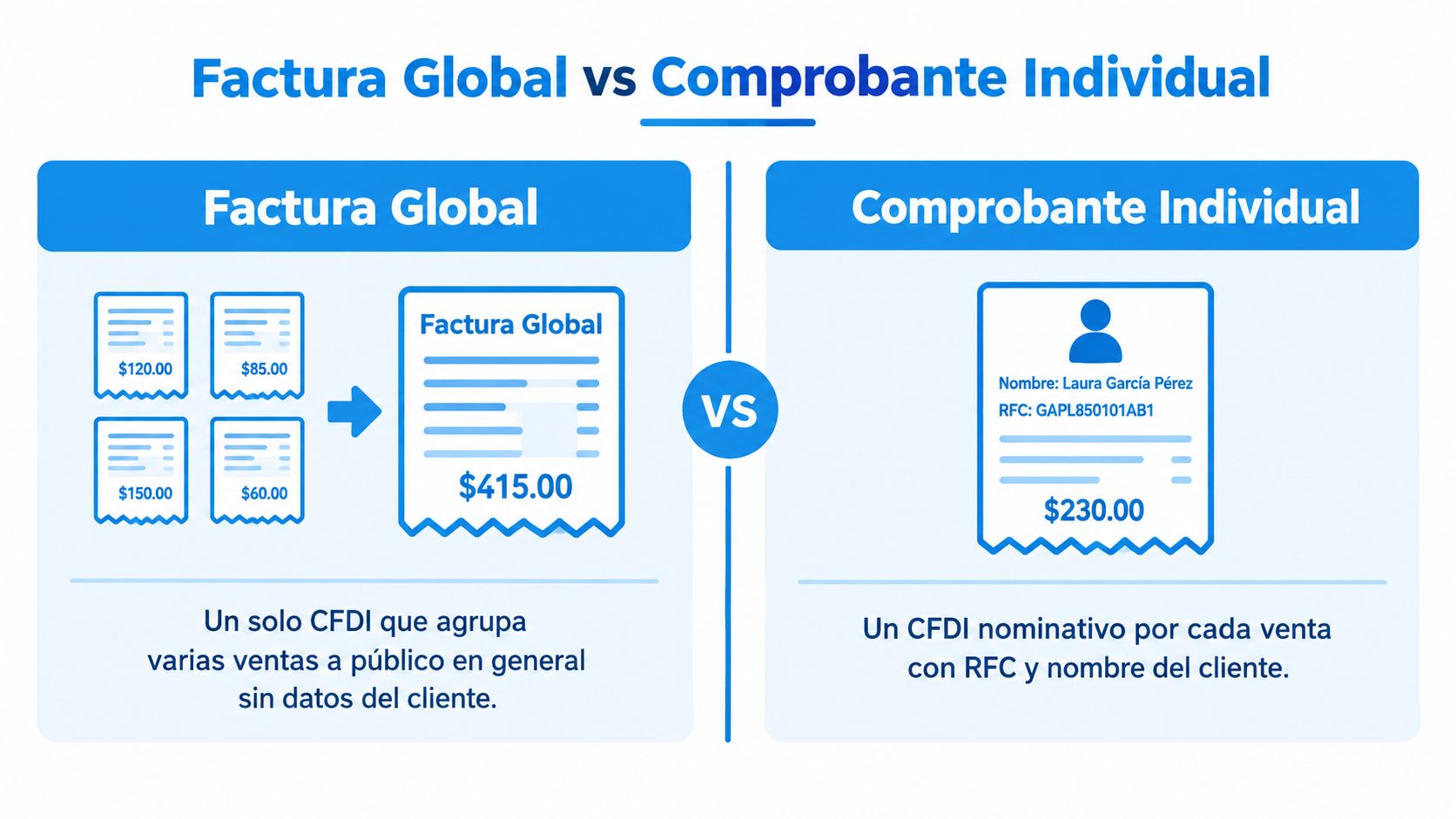
What changes in business operations
Aspect | Global invoice | Individual itemized receipt |
|---|---|---|
Documented transactions | Sales for the period without a request for an itemized invoice | The transaction invoiced to the identified customer |
Recipient identification | General public | Buyer's tax details |
Required internal control | List of integrated transactions | Link between sale and customer's CFDI |
In a retail store, one customer might request an invoice when paying, while another leaves without asking for one. Staff must record the destination of each transaction so the accounting manager isn't left working with an undifferentiated list of payments.
How to prevent duplicates
Internal controls can use an invoicing status linked to the sales receipt number. What matters is that the manager can distinguish a pending transaction from one that has already been documented, without relying on isolated messages or staff memory.
Identified request. Must be linked to the corresponding sale.
Issued invoice. An entry should be logged in the operational record.
Subsequent request. If the sale was already included in a global invoice, the accountant must review the applicable procedure before issuing another invoice.
Refusing an invoice because the business uses global invoices does not resolve the customer's request. Issuing it without checking past records is not sound control either.
Operational reconciliation between sales and the global CFDI
The reconciliation must account for the amount to be invoiced. Simply comparing the point-of-sale total with the cash in the drawer leaves out payments made through other methods, voided transactions, and entries that require review.
The requirement to integrate amounts and folio numbers, outlined in the previously cited SAT rule, provides the documentary foundation. From there, the business can establish an internal review routine without mistaking this administrative recommendation for an additional tax obligation.

A daily review that leaves an audit trail
Verify folio numbers. The manager identifies sales for the period and checks for gaps or unrecognized entries.
Separate transactions. Voids and returns are reviewed with supporting documentation, rather than adjusting the total without explanation.
Reconcile payments. Cash and electronic payments are compared against available records.
Review tax classification. Distinguish transactions meant for the global invoice from sales with an itemized invoice.
Deliver the breakdown. The person responsible for issuing receives reviewed information, not just a bare total.
A guide on sales recording can help structure this discipline. The core point is maintaining records that allow you to investigate discrepancies by transaction, shift, or branch.
What to do when the register doesn't balance
In a coffee shop, a discrepancy might require reviewing a payment entered under the wrong payment method or an undocumented void. These are examples of verifications, not reasons to arbitrarily alter the amount feeding into the invoice.
Closing control: a discrepancy needs explanation and supporting proof before becoming an adjustment.
For an SMB with multiple branches, it is best to keep the origin of the records identified during the review. This separation makes it easier for each manager to clarify their transactions and for the accountant to trace the path from the receipt to the amount prepared for the CFDI.
Practical recommendations for SMBs and closing
A retail store can close on time and still hand over incomplete information to the accountant. If the manager leaves loose notes, fails to track invoice requests, and modifies sales without documentation, the problem starts well before the invoice is issued.
A more structured operation assigns clear responsibilities: who records, who reviews, and who prepares the tax information. The owner doesn't need to perform every task personally, but they do need to ensure someone is accountable and that issues don't remain unresolved due to poor communication.
Turning closing into a verifiable routine
Define roles. One person's absence shouldn't leave the business without a handover procedure.
Set the schedule. Invoicing must be planned with a safety margin ahead of the SAT deadline.
Review configurations. Changes to products or taxes require attention before using the reports.
Keep supporting records. Receipts and clarifications must remain linked to the reviewed transactions.
The procedure for how to do a step-by-step register closeout in a small business helps organize shift handovers. The closeout is an administrative foundation, not a substitute for tax analysis.
Keeping compliance separate from the tool
A point of sale is useful when staff record transactions correctly and the accountant can review the data. No system can automatically fix an omitted sale, a misconfigured tax, or a discrepancy that no one investigated.
This article is for informational purposes and does not replace professional accounting advice. The taxpayer's regime, specific operations, and any corrections should be reviewed with professional advice and applicable official documentation.
For a business looking to organize its daily sales, Swirvle offers a point of sale that helps keep records organized and makes reconciliation prep easier. Managers can visit their site to learn how to incorporate it into register closeouts and handover data to their accountant.
Related Blogs

Oct 20, 2026
What is the global invoice for the general public and when is it issued? SAT Guide

Oct 19, 2026
How to take restaurant orders on WhatsApp without losing any?

Oct 18, 2026
How to Create a WhatsApp Business Catalog to Sell More: 2026 Guide

Oct 17, 2026
How to set up quick replies in WhatsApp Business?

Oct 16, 2026
Can fake Google reviews be removed and how do you request it?

Oct 15, 2026
What are WhatsApp Business labels used for and how do you use them?