
Learn what personalized notifications are, and how to segment and automate via WhatsApp, push, and email to retain customers and increase the average ticket size in your SMB.
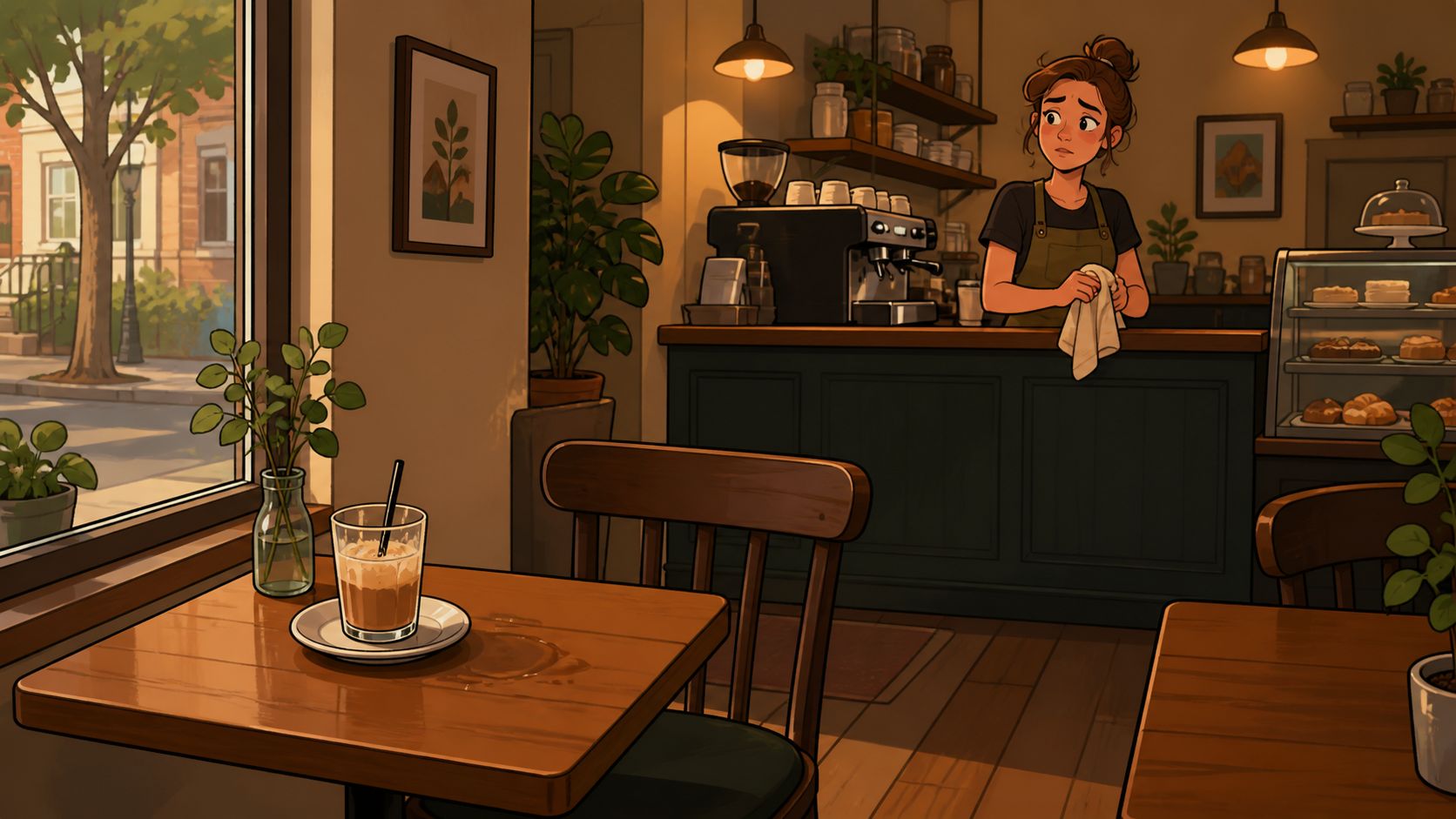
Carlos used to buy a cappuccino every Tuesday and Thursday at a neighborhood coffee shop. For six months, his routine was so consistent that the cashier could have the cup ready before he even arrived. Then he stopped showing up. The staff noticed on the third empty Tuesday, but they didn't have a direct channel to ask him what had happened.
Three weeks later, the owner sent a brief WhatsApp message: “We miss your 8 AM cappuccino. We look forward to seeing you this week with a free upgrade to a large size.” Carlos returned the next day and brought an office colleague with him. That visit recovered MXN $480 in sales that already seemed lost.
This scene is repeated in coffee shops, restaurants, barbershops, and beauty salons. The problem is not always the product or the price. Many times, the customer simply stops remembering the visit because no one offers them a useful reason to return. Personalized notifications close that gap between the counter ticket and the next purchase decision.
The scene you never want to repeat in your store
In a chain with several branches, the counter usually detects when something changes before the system does. A barista recognizes that a regular customer didn't arrive, a barber knows that a chair was left empty at the usual time, and a salon receptionist identifies that a client didn't book her next service. The problem appears when that knowledge stays in the team's memory and does not turn into a measurable action.
The right notification does not try to sell anything to the entire database. It stems from a concrete behavior, respects the context, and proposes a simple next step. For Carlos, the trigger was an absence from a very clear routine. The message did not offer a generic promotion, but rather an extension of something he already valued: his morning cappuccino.
The cost of not having a direct channel
The case also shows a common limitation: the business observes the loss, but reacts too late. When the customer stops visiting a branch, the team can log the absence, but cannot recover the relationship without contact information, history, and a follow-up rule.
In Mexico, messaging already plays a significant role in the relationship between consumers and companies. A study by BCG and Meta reports that more than two-thirds of consumers prefer to interact with companies via messaging, and highlights that the channel allows for building personalized journeys with first-party data. BCG and Meta's executive summary on business messaging in Mexico also links this personalization to 1P data integration and advanced analytics.
The operational rule is simple: every frequent visit must be able to turn into a signal. If a customer disappears, the system needs to know when to contact them, through which channel, and with what benefit. Without that connection, the counter will keep seeing lost sales after they have already occurred.
What personalized notifications are and why they drive the ticket
A personalized notification is a message sent to an identified customer, with their name, context, and a proposal related to their history. It differs from a mass message because it does not send the same text to the entire database. A customer who usually orders sugar-free coffee should receive a compatible recommendation, not an indifferent promotion for any random product.
The operation needs at least three pieces of data:
Verifiable identity: name and authorized contact method.
Trigger event: purchase, inactivity, birthday, visit, location, or reservation.
Exit rule: a condition that stops the flow after a purchase, response, or defined period.
A useful analogy is that of a barista who remembers a preference without the customer having to repeat it. That micro-attention can guide an add-on sale, but personalizing does not mean writing a name on a template. It means adjusting product, channel, and timing.
From data to margin
The impact appears when the message matches a real need. A restaurant can recommend a side dish related to the last order. A barbershop can remind of a booking when the usual interval approaches. A coffee shop can notify about a product available at the branch the customer visits, instead of sending a national offer that does not apply.
In Mexico, a market reference projected for 2026 reports that 78% of companies adopt personalized email content, with an average open rate of 38%, clicks of 7.5%, and an estimated ROI of 45 USD for every 1 USD invested. The same report points out that 65% of emails are opened on mobile devices, a data point that reinforces the need to write short messages adapted to the context of use. The market reference on email personalization in Mexico should be taken as market guidance, not as a guarantee for every business.
A mass message looks for reach. A personalized notification looks for margin per customer, and that is why it needs a clear relationship between the trigger, the offer, and the attributed sale.
Channels that matter in LATAM and when to use each one
At a branch, the wrong channel turns an easy sale into a missed conversation. If a customer is waiting to confirm a barber appointment, WhatsApp allows them to reply and book. If they just went through checkout and accepted alerts, a push notification can trigger their next visit. Email works best for explaining a promotion, summarizing points, or presenting an entire season.
The choice starts with the ticket and the timing. For a coffee shop, a push notification can remind of a beverage available while the customer is near the branch. For a barbershop, WhatsApp can confirm the time and open a direct response. For a loyalty campaign, email offers space to compare benefits and buy.
In Mexico, email is the preferred channel for 33% of consumers, followed by messaging apps like WhatsApp and Messenger with 28%. Only 6% prefer SMS, MMS, or RCS. Additionally, 43.3% value real-time price and availability updates, 34.7% prioritize relevant recommendations, and 24% appreciate a personalized and conversational experience. The analysis on communication and advertising preferences in Mexico helps to organize the channel according to the expected utility.
Criterion | Push | ||
|---|---|---|---|
Urgency | High, useful for appointments, orders, and replies | High, if the user has permissions | Medium, suitable for broad information |
Operating cost | Requires managing conversations and templates | Low per send, with consent | Low per send and easy to schedule |
Best use | Restaurant, barbershop, salon | Flash deals and branch visits | Coffee shop, points program, and seasons |
Expected action | Reply, book, or confirm | Open an offer or land on a screen | Read, compare, and buy |
Personalized push notifications already have a reported scale in Mexico: a reference estimates 85 million receiving users, an average opt-in rate of 65%, monthly engagement of 48%, and a CTR of 12.5%. The figure provides orientation, but the decision must come from permissions, proximity to the branch, and attributed sales.
To design operational responses via WhatsApp, you can review a top rated WhatsApp AI assistant. It is also useful to consult the types of communication channels to assign each message to a concrete action, from confirming an appointment to recovering a visit.
How to segment your customers with data you already have
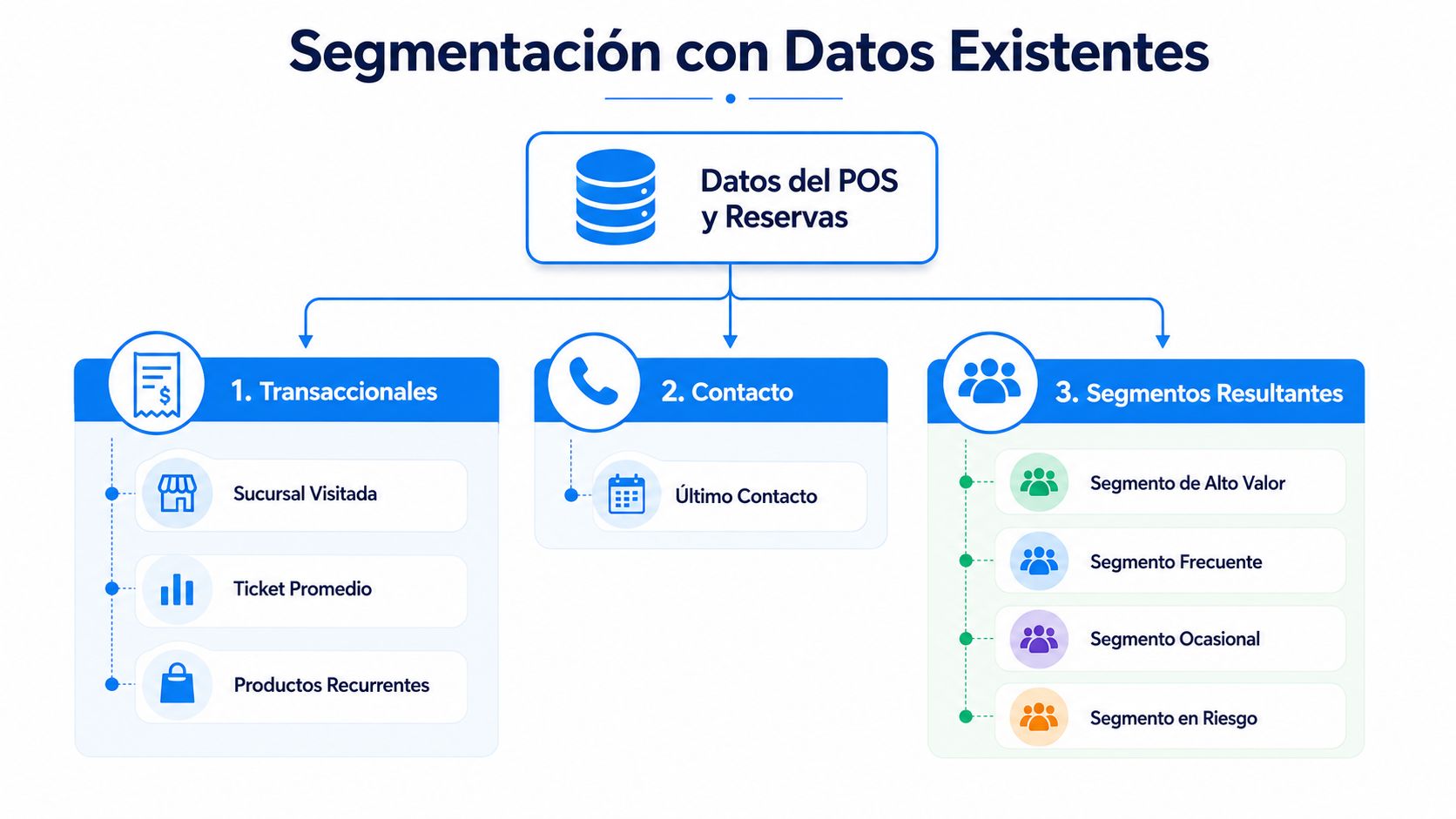
An SMB does not need to hire a data team to get started. The staff already has enough information in the POS, bookings, and contact logs. The task is to turn those records into actionable groups, with rules that a store employee can understand and execute.
Step one, organize what already exists
First, cross-reference four fields: branch visited, average ticket, recurring products, and last contact. A record like "latte customer on Mondays in Polanco" is more useful than a broad label like "coffee lover," because it allows you to choose an offer, a location, and a time.
At a barbershop, the record might show "beard trim and haircut every three weeks in Roma Norte." At a restaurant, it might show the category ordered most frequently, the chosen branch, and the last date of consumption. Precision does not depend on having hundreds of fields, but on keeping the ones that help make a decision.
Step two, group by habit and relationship
The database can be organized into four practical groups:
New: made their first purchase and still needs a reason to return.
Recurring: maintains a recognizable frequency.
Dormant: stopped buying during a relevant period for their pattern.
VIP: combines frequency, ticket, or a high lifetime value.
Step three, turn groups into rules
Each segment must have an action. "Ticket over MXN $300 dormant 60 days" can trigger an email with a recommendation based on the last category purchased. "Recurring at Roma Norte branch" can receive a WhatsApp reminder at their usual time. An all-in-one CRM like Swirvle allows you to create lists and triggers without code, connecting transactional data with WhatsApp, push, and email from a single console.
The customer segmentation guide helps to structure these groups before creating campaigns. The final criterion must be operational: if the counter team does not understand why someone received the message, the segmentation is not ready yet.
Examples by business type that you can copy today
Profitable personalization starts at a branch's ticket counter. At the counter, the typical mistake is sending a broad promotion because the team wants to fill the schedule or increase the day's traffic. The correct rule starts with a concrete signal and defines which contact can generate the next purchase.
At a coffee shop, a ticket can show a morning latte and food added only on some visits. The message should continue that habit:
“We'll be ready for your morning latte tomorrow. If you want to pair it, your usual option is available at the branch you visit.”
The automation is triggered before the usual time, recommends the related food item, and stops if there is already a purchase in the week. If the client never buys pastries in the morning, offering them reduces relevance and wastes the contact.
At a restaurant, the ticket can log the category ordered, the branch, and the day with the highest intent. A Friday push can say: “A new item has arrived in the category you usually order. Check it out at your usual branch.” The trigger combines those three pieces of data. The metric is the attributed sale and ticket value, not just the open rate.
A barbershop should work with the calendar and the interval between visits. If the customer usually returns after their haircut, WhatsApp can send: “Your next visit is approaching. There is availability at the time you normally choose. Would you like to book?”. The flow ends when the appointment is confirmed or when they reply that they do not want reminders. Sending the same message to someone who just got a haircut creates unnecessary pressure.
At a beauty salon, the completed service guides the subsequent recommendation. An email can present an add-on related to the treatment performed with a clear expiration date. The rule is triggered when closing the service and stops when it registers a purchase or a new booking.
Business | Trigger | Example Message | Expected Metric |
|---|---|---|---|
Coffee Shop | Visit routine and regular product | “Your morning coffee can wait until tomorrow. Add your usual pairing at your branch.” | Attributed visit during the week |
Restaurant | Last category ordered and high-intent day | “There's a new item in the category you usually order. Check it out this Friday.” | Cross-sell and ticket |
Barbershop | Time since last cut and preferred schedule | “Your usual time is available. Confirm your next appointment.” | Confirmed appointments |
Beauty Salon | Completed service and related recommendation | “Following your service, this complementary option can help you maintain the result.” | Repeat purchase or booking |
The message should sound like an extension of the counter. If it looks like a template sent to the whole city, the automation rule lost its value before even reaching the customer.
Key automations to activate and measure from day one
The first month should focus on automations that have a clear trigger, a mandatory exit, and a weekly KPI. The process automation in Mexico guide provides context to understand why repetitive tasks must move from the team's memory to verifiable rules.
Abandoned Cart
Expected result: recover orders that already showed purchase intent.
The flow is triggered when an order started via WhatsApp has been without payment for 30 minutes. It sends a brief reminder, stops communication when the purchase is registered or after 24 hours, and measures recovered revenue against the number of sends. If the customer responded with a question, the conversation should shift to support, not continue as an automatic promotion.
Inactivity
Expected result: reopen a relationship without giving away margin to customers who were still active.
The trigger can be an absence of 45 to 60 days, always compared to the habit of each segment. Push and email can remind of a relevant benefit, such as a new arrival in their favorite category or an available reward. The weekly KPI is the attributed return rate, along with the sale's margin.
Birthday and Reward
A birthday should trigger a benefit with an expiration date and a nearby branch. The message needs to state what the customer receives, where they can use it, and when it ends. The exit occurs after redemption, an opt-out, or expiration.
Loyalty Milestone
A third visit can trigger a reward redeemable at the counter. The POS registers the milestone, the CRM sends the message, and the branch validates the redemption. The primary indicator is the redemption rate and the subsequent visit, not the number of notifications sent.
Season Change
A new season can trigger an offer in each customer's preferred category. The system should exclude those who have already purchased the product or received a recent communication. The centralized dashboard allows comparing ROI by channel, branch, and segment, a practice also covered in the marketing automation guide.
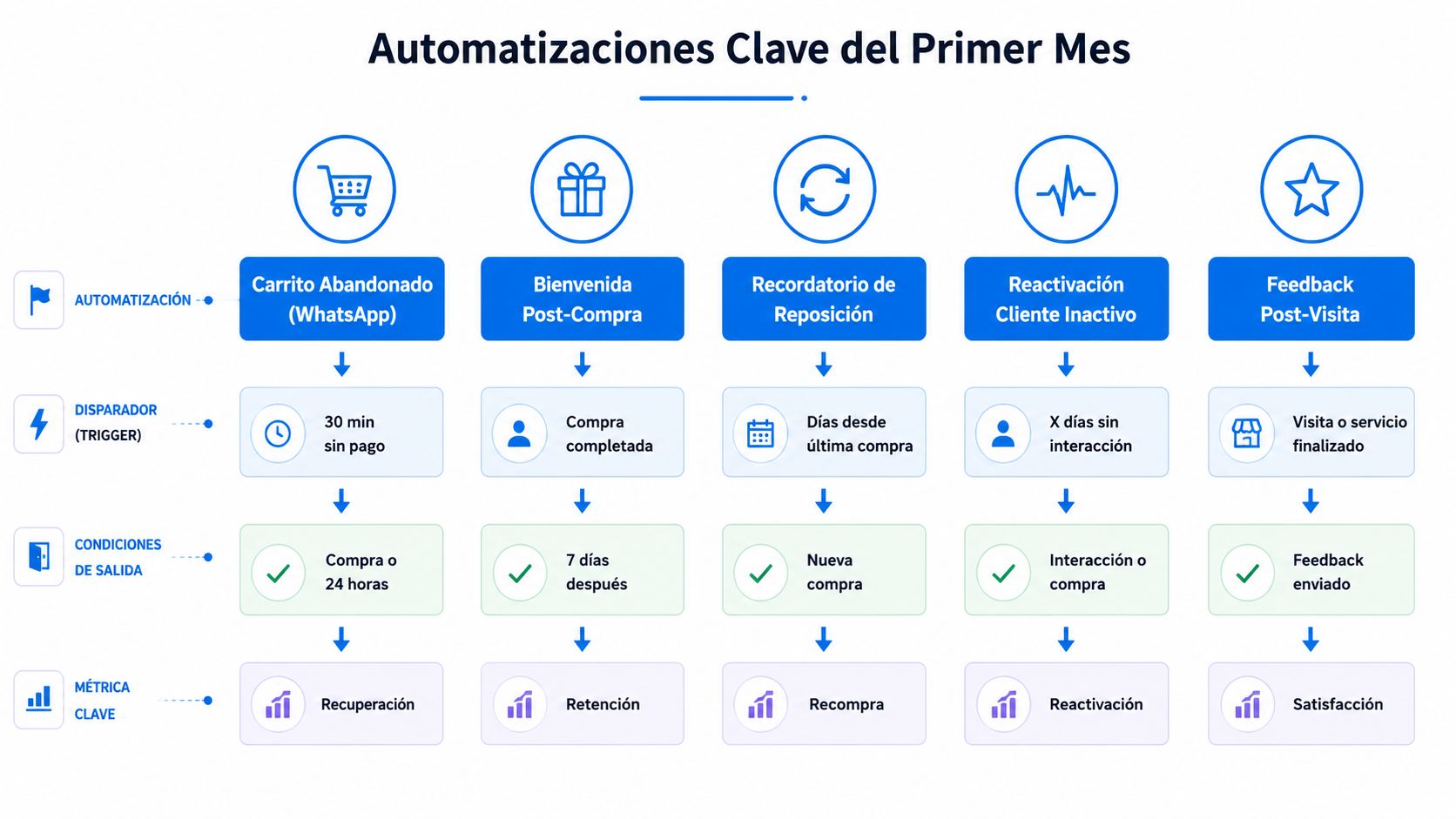
Operating Rule: no automation is complete until the team can explain what triggers it, when it stops, and what sale should appear in the report.
Personalization without spamming the customer
Sending more messages does not equate to selling more. In a neighborhood SMB, trust is lost when the customer receives irrelevant promotions, repeated messages, or reminders after having already bought.
The cadence must be established before activating campaigns. A practical framework limits commercial contacts to two per week, unless there is explicit consent for a different frequency. Each message needs a visible opt-out and a channel-attributed sale.
Messages/month | Maximum frequency | Expected opt-out | Impact on ticket |
|---|---|---|---|
Few and relevant | Based on buying habit | Low, if content is useful | Can sustain recurrence |
Moderate frequency | Up to two weekly contacts | Must be monitored by segment | Depends on relevance |
High frequency | Only with explicit consent | Increasing risk of opt-out | Can drop if message is perceived as noise |
The operational formula can be simple: allowed frequency = purchase recency, ticket value, and customer permission. A customer who visited yesterday does not need a return coupon, while one who stopped visiting a branch might need a contextual reminder. The team must weekly review opt-outs, negative responses, ignored messages, and attributed sales.
It is also useful to separate service from promotion. An appointment confirmation should not compete within the same limit as a commercial offer, even if both arrive via WhatsApp. The reference on WhatsApp Business usage by MSMEs in Mexico reports that 92% of MSMEs use WhatsApp Business to reach consumers and that 71% of online adults consider messaging the fastest and simplest way to deal with a company. That reach makes consent, opt-outs, and relevance even more critical.
Your seven-day plan to get started with personalized notifications
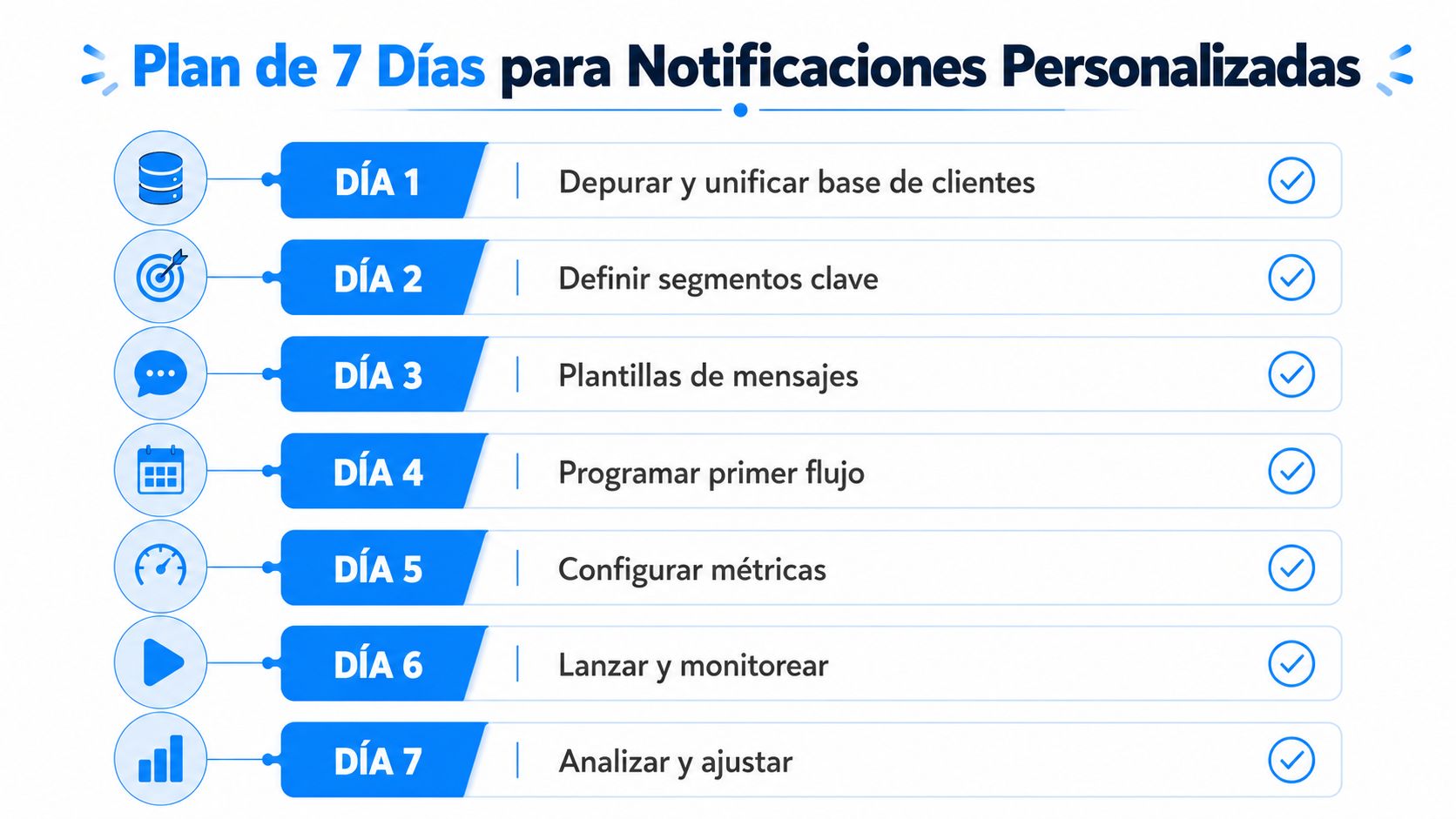
The deployment can start with one verifiable task per day. The priority is not to launch many campaigns, but to prove that a piece of counter data triggers a message and that a sale can be attributed.
Day 1, cleaned database. The person responsible for the CRM unifies phone numbers, removes duplicates, and delivers a usable list in the system. The branch manager validates that recognizable customers are associated with their purchases.
Day 2, three segments. Marketing defines VIP, recurring, and inactive. The deliverable is a list with written criteria, branch, and last interaction.
Day 3, triggers. The team configures birthday, reward, and inactivity. Each flow must have an exit condition before being activated.
Day 4, templates. One message is drafted for WhatsApp, one for push, and one for email using the same benefit, but adapted to the channel's length.
Day 5, isolated testing. Operations reviews deliverability, links, schedules, and purchase logs. No messages should reach real customers until this review is complete.
Day 6, controlled launch. Marketing activates the flows on 10% of the database and gives the counter a clear instruction to recognize the coupon or benefit.
Day 7, decision. The manager compares attributed sales, replies, opt-outs, and margin by channel. They then adjust the cadence and scale only the flows that the team can sustain.
In Mexico, A2P SMS still adds value in urgent events because it reaches users without internet and is useful for confirmations, OTPs, and reminders. Access Partnership estimated that this channel raised the national economy's productivity by almost MXN 42 billion. The reference on A2P SMS and the Mexican market supports its transactional use, though MSMEs must choose the medium based on consent, urgency, and interaction type.
WhatsApp also maintains a familiar base for the Mexican consumer. A source on Mexico reports that 87% of Mexican internet users use WhatsApp, that 29% of Mexican companies offered contact via WhatsApp, and that only 43.86% of those companies did so with WhatsApp Business. The academic analysis on business adoption of WhatsApp in Mexico points out an operational opportunity for local businesses that still reply in an improvised way.
Speed is also part of the experience. A source from 2026 reports that 65.1% of consumers expect a response in less than 5 minutes on WhatsApp, while only 4.1% consider waiting more than an hour acceptable. The reference on response expectations on WhatsApp Business reinforces a useful rule for coffee shops, barbershops, and salons: the message should first state the essential, offer a clear action, and leave details for later.
For a physical SMB, responsible personalization is not about filling the customer's inbox. It is about listening to what happens on the ticket, transforming that behavior into a rule, and returning a proposal that makes sense at the right branch. Swirvle centralizes customers, segments, loyalty, coupons, automations, and ROI measurement to connect WhatsApp, push, and email with counter sales.
Swirvle helps coffee shops, restaurants, barbershops, and beauty salons turn buying habits into personalized notifications, rewards, and measurable campaigns from a single place. Visit Swirvle to organize your data, activate your first triggers, and measure which messages drive actual visits and sales.
Related Blogs

Oct 22, 2026
How to prevent employee petty theft in my business?

Oct 21, 2026
How to Control Food Waste in a Restaurant: 2026 Guide

Oct 20, 2026
What is the global invoice for the general public and when is it issued? SAT Guide

Oct 19, 2026
How to take restaurant orders on WhatsApp without losing any?

Oct 18, 2026
How to Create a WhatsApp Business Catalog to Sell More: 2026 Guide

Oct 17, 2026
How to set up quick replies in WhatsApp Business?