
Learn how to calculate ROI step-by-step with formulas, examples for SMBs, and tips to measure the real return on your business.
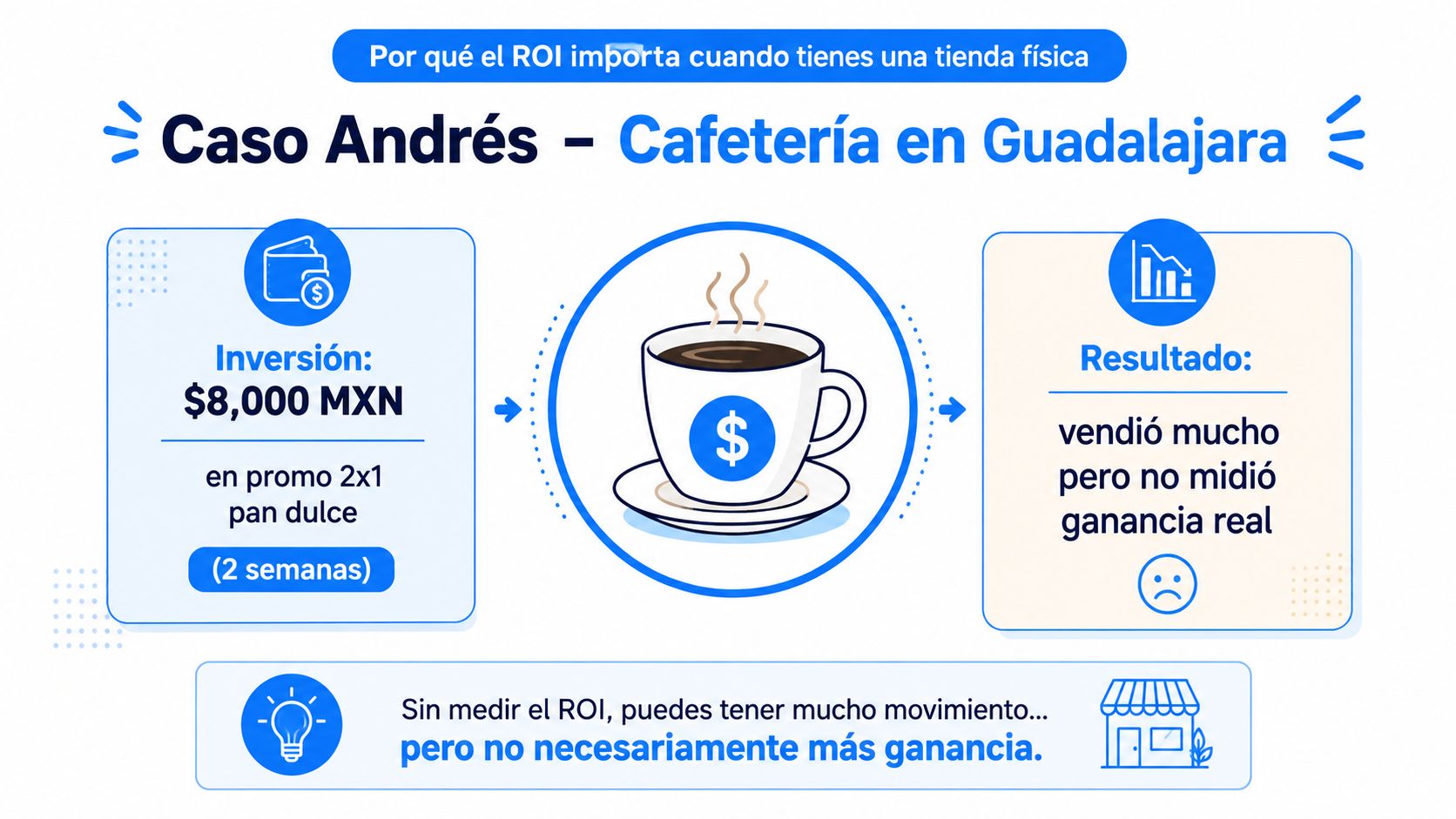
Andrés, a coffee shop owner in Guadalajara, ended a 2-for-1 promotion on sweet bread after two weeks with a common feeling: he had sold a lot, but didn't know if he had made money. He had allocated $8,000 MXN to the promotion and could see more tickets in the cash register, although he couldn't distinguish incremental sales from purchases that would have happened anyway.
The answer begins with a simple formula: ROI = (Net Benefit / Investment Cost) × 100. In an SMB, the challenge is not performing the mathematical operation. It is in identifying which revenues actually belong to the investment and subtracting all the costs that made it possible to obtain them.
Why ROI matters when you have a physical store
Without ROI, a WhatsApp campaign, a billboard ad, a remodel, or a promotion on a delivery app becomes an act of faith. The owner observes more movement, more messages, or more sales, but doesn't know if the action generated profit or simply shifted purchases that were already planned.
For Andrés, the right question was not how much he sold during the promotion. It was how much net benefit the promotion produced compared to the $8,000 MXN invested. The base formula converts that relationship into a comparable percentage across campaigns, locations, or periods, a particularly important utility for SMBs that need to decide where to put their next peso. BBVA México explains the ROI formula and its utility for comparing investments.
The difference between selling and winning
A physical store has costs that do not appear when looking at revenue: ingredients, consumed products, commissions, payroll, energy, discounts, and operating time. A promotion can increase the number of tickets and, at the same time, reduce the margin per ticket.
That is why it is convenient to separate three figures from the start:
Investment: everything allocated to activating the action.
Attributable revenue: additional sales that can be related to that action.
Net benefit: attributable revenue minus investment and direct costs.
The calculation doesn't require an MBA. It requires discipline to record inflows and outflows with the same measurement period. If an investment lasts less or more than a year, it is convenient to annualize the result before comparing it to another of a different duration, a practice contemplated in financial materials for Mexico. The BBVA México guide on investment performance addresses terms, rates, and annualization.
To organize campaigns, segmentation, and customer tracking, a resource on digital marketing for SMBs can complement financial control. But no tool corrects a calculation that mixes total sales with attributable sales.
Rule of thumb: if the owner cannot explain where each revenue included in the ROI came from, the percentage is not yet useful for making a decision.
The base formula and its real components
The operating formula for a campaign or commercial investment is:
ROI = [(Attributable Revenue − Total Investment − Direct Costs) / Total Investment] × 100
The general financial version is also expressed as [(Revenue − Costs) / Costs] × 100. The practical difference lies in precisely defining what goes into each component. An attractive figure loses value if the denominator omits labor, supplies, or expenses necessary to execute the action.
A barbershop with complete numbers
Suppose a barbershop in Puebla launches a promotion. The total investment includes $4,000 MXN in flyers and $2,000 MXN corresponding to the barber's time dedicated to promoting and operating the campaign. The denominator, therefore, is $6,000 MXN as activation investment.
During the campaign, $18,000 MXN in attributable new sales are recorded. That figure does not represent the total revenue for the month. It only includes sales linked to customers or codes identified during the promotion.
Then, the real costs of servicing those sales are subtracted: product consumed, barber's commission, and extraordinary electricity, totaling around $3,500 MXN. With those data, the attributable benefit is:
$18,000 − $6,000 − $3,500 = $8,500 MXN
The complete ROI looks like this:
($18,000 − $6,000 − $3,500) / $6,000 × 100 = 141.7%
The investment produced a benefit higher than the capital allocated to activate it. The most damaging error would have been to report 300%, calculating on gross sales and omitting supplies and commissions.
What should go into the investment
The total investment can cover the project cost, installation, training, external fees, valued own time, and opportunity cost. The guide on how to calculate ROI with real costs recommends considering these components before declaring a result.
It is also useful to separate profitability ROI from the break-even point. The break-even point formula helps to know how much the business must sell to cover costs, while ROI evaluates whether a specific investment generated value above what it cost.
In a barbershop or beauty salon, the cost of sales deserves an independent review. A useful reference for organizing that line item is how cost of sales is determined.
Which ROI variant is right for your business
There is no single formula suitable for all decisions. The owner of a coffee shop who wants to evaluate a campaign needs a different reading than an operator with several locations who must decide where to reallocate budget.
Variant | Objective | When to use it |
|---|---|---|
Marketing ROI | Measure the return on a commercial investment | When evaluating advertising, WhatsApp, flyers, or a promotion |
ROI by location | Compare the financial performance of each location | When there are multiple stores and capital must be allocated |
ROI by campaign | Isolate an action, creative, or audience | When testing different messages, coupons, or channels |
LTV vs CAC | Compare customer lifetime value with acquisition cost | When the business relies on repeat business, such as restaurants and coffee shops |
Marketing ROI
The marketing formula uses [(Attributable Revenue − Marketing Cost) / Marketing Cost] × 100. It is appropriate when a campaign has a defined date, budget, and attribution mechanism. An example published for Mexican SMBs uses an investment of $10,000 MXN and $32,000 MXN in attributed revenue, which produces an ROI of 220%, meaning an additional $2.20 for every peso invested. See the example of marketing ROI for SMBs in Mexico.
ROI by location
This calculation must include revenue, direct costs, and proportional expenses for each location. In restaurants, revenue from supplying goods and services represents the amount obtained from commercialization and service provision, a useful basis for ordering results by unit. INEGI's sectoral methodology identifies revenue, personnel, and economic unit variables.
LTV vs CAC
LTV, or customer lifetime value, estimates how much benefit a person brings during their relationship with the business. CAC represents the cost of acquiring them. For a coffee shop with a loyalty program, looking only at the first purchase can penalize a campaign that generates repeat business. The correct decision is to compare cohorts, frequency, average ticket, and margin, not just the revenue from the day of acquisition.
Numerical examples for coffee shops, restaurants, and barbershops
A restaurant with three locations needs to compare performance by location, not overall averages. Each industry has costs that can distort the percentage if they are not separated from the start. Use the same formula and the same period for all units.
Three readings for different decisions
A coffee shop invests $8,000 MXN in flyers and coupons. In 30 days, it attributes $32,000 MXN in additional sales and records $16,000 MXN in direct product and operating costs. The net attributable profit is $8,000 MXN, resulting in an ROI of 100%. Before expanding the promotion, review waste, product cost, and the ideal profit margin for a coffee shop.
A restaurant allocates $25,000 MXN to a WhatsApp campaign. The flagship location attributes $70,000 MXN in revenue and records $28,000 MXN in direct attributable costs. Its net profit is $17,000 MXN and the ROI reaches 68%. The correct decision requires comparing that unit with the lowest-responding location, using the same period and excluding sales that cannot be attributed to the campaign.
A bakery invests $12,000 MXN in a pre-order promotion. It obtains $36,000 MXN in attributable revenue and assumes $15,000 MXN in direct costs for ingredients, packaging, and operations. The net profit amounts to $9,000 MXN, with an ROI of 75%. The result justifies repeating the action only if the additional production does not increase waste or reduce the margin of regular orders.
Industry | Investment MXN | Attributable Revenue | Direct Costs | Net Profit | ROI % |
|---|---|---|---|---|---|
Coffee Shop | $8,000 | $32,000 | $16,000 | $8,000 | 100% |
Restaurant | $25,000 | $70,000 | $28,000 | $17,000 | 68% |
Bakery | $12,000 | $36,000 | $15,000 | $9,000 | 75% |
Choose the variant based on the decision. For a specific campaign, use marketing ROI with attributable revenue and costs. To compare locations, calculate each location separately. For promotions targeted at existing customers, observe performance by cohort and relate the result to retention and average ticket. This way, you will know if the investment produced real growth or just pulled forward a purchase that would have happened anyway.
Common mistakes that inflate or destroy your ROI
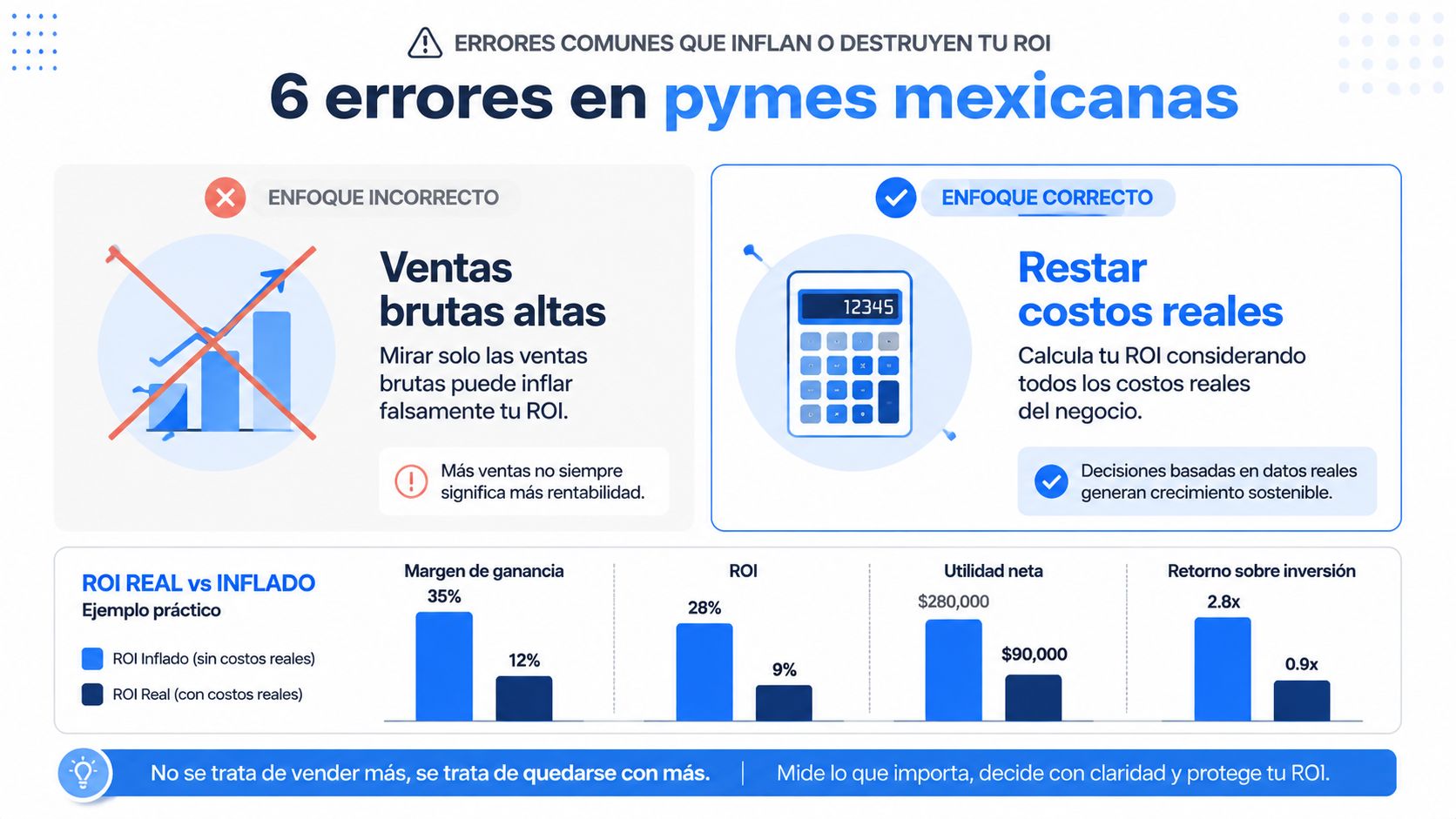
An inflated ROI almost always stems from an incomplete definition of costs or revenue. The mathematical operation can be correct and still lead to a wrong decision if the input data is misclassified.
Six flaws that require correction
Confusing revenue with profit. A barbershop might divide gross sales by investment and boast a 5x return. If it then subtracts supplies and payroll, the result could drop to 1.8x. The correct formula uses net profit, not revenue.
Forgetting hidden costs. Card commissions, extraordinary electricity, and the owner's time must be part of the calculation. If an action produces $18,000 MXN, but consumes $3,500 MXN in direct costs, declaring that the $18,000 MXN is profit overestimates the return by $3,500 MXN.
Attributing organic sales. If a customer was already coming every week, their ticket should not automatically be assigned to a campaign. The corrected calculation includes only the increase that can be linked to the code, link, tag, or trial period.
Not annualizing long-term investments. Equipment or a remodel produces benefits over a different horizon than a brief promotion. Comparing both returns without adjusting the period mixes investments that are not equivalent.
Mixing channels. An overall ROI can hide the fact that WhatsApp generated value while flyers produced no identifiable sales. Each channel needs its own investment, window, and attribution rule.
Using an incorrect window. A window that is too short excludes repeat purchases; one that is too long can attribute sales to the campaign that belong to another action. The date of first purchase and cohorts help order that reading.
The figure must withstand an audit
The owner must be able to reconstruct the percentage from tickets, expenses, and campaign tags. If a sheet only shows "marketing revenue" without identified customers, direct costs, or a period, the result works as an approximation, not as a solid financial indicator.
Reality check: every peso included in revenue must have a documented reason for belonging to the evaluated investment.
How a CRM facilitates measurement and attribution
Real attribution happens when point-of-sale data talks to customer information. A spreadsheet can serve for an occasional review, but it becomes fragile when the SMB needs to cross locations, campaigns, repeat business, and average ticket.
The correct data flow
Identify each sale. The record should associate the ticket with a customer when possible. Anonymous transactions make it difficult to distinguish a new purchase from a repeat purchase.
Tag the source. Each customer can be classified as a walk-in, WhatsApp campaign, referral, or flyer from registration. The tag must be maintained in the history to avoid improvised attributions.
Use unique codes. A coupon or link per campaign allows connecting the action with the purchase. The cashier team must apply the same rule at all locations.
Build cohorts. The CRM should allow exporting customers by date of first purchase and reviewing their behavior at 30, 60, and 90 days. Those periods help separate acquisition from retention and must be measured with the same criteria in each channel.
Compare LTV and CAC. The business calculates the average value generated by each channel and compares it with the acquisition cost. A coffee shop may discover that a channel brings fewer customers, but customers with higher frequency and ticket.
Automate the dashboard. The panel should show ROI by location and campaign, attributable revenue, costs, frequency, and average ticket. Automatic updates reduce transcription errors and allow reviewing decisions with recent data.

A platform like Swirvle can centralize customers, segment by consumption habits and location, connect campaigns with sales, and show ROI statistics. To organize reading criteria, a BI guide for founders offers context on how to turn operational data into decisions.
The owner looking to understand the architecture can review what is a CRM system. The recommendation is to connect CRM and point of sale before increasing the budget. More investment on a faulty attribution only produces a more expensive percentage.
Action plan to start measuring ROI this week
A functional system can be implemented in 30 days if the team limits the initial scope to three campaigns, one location, or a priority channel. The goal is not to build a perfect financial model from day one. It is to replace sensation-based decisions with a repeatable record.
Four-week roadmap
Week 1, define the baseline. The owner records each marketing expense, including production, discounts, fees, and valued own time. They also export daily sales, average ticket, and identified customers. The success indicator is having a verifiable total investment and a sales baseline.
Week 2, connect sources. Point of sale, WhatsApp Business, and the CRM are integrated. Each campaign receives a unique tag, code, or link, while staff learns to capture the customer's source at the register. The expected result is that each test sale has an assigned source.
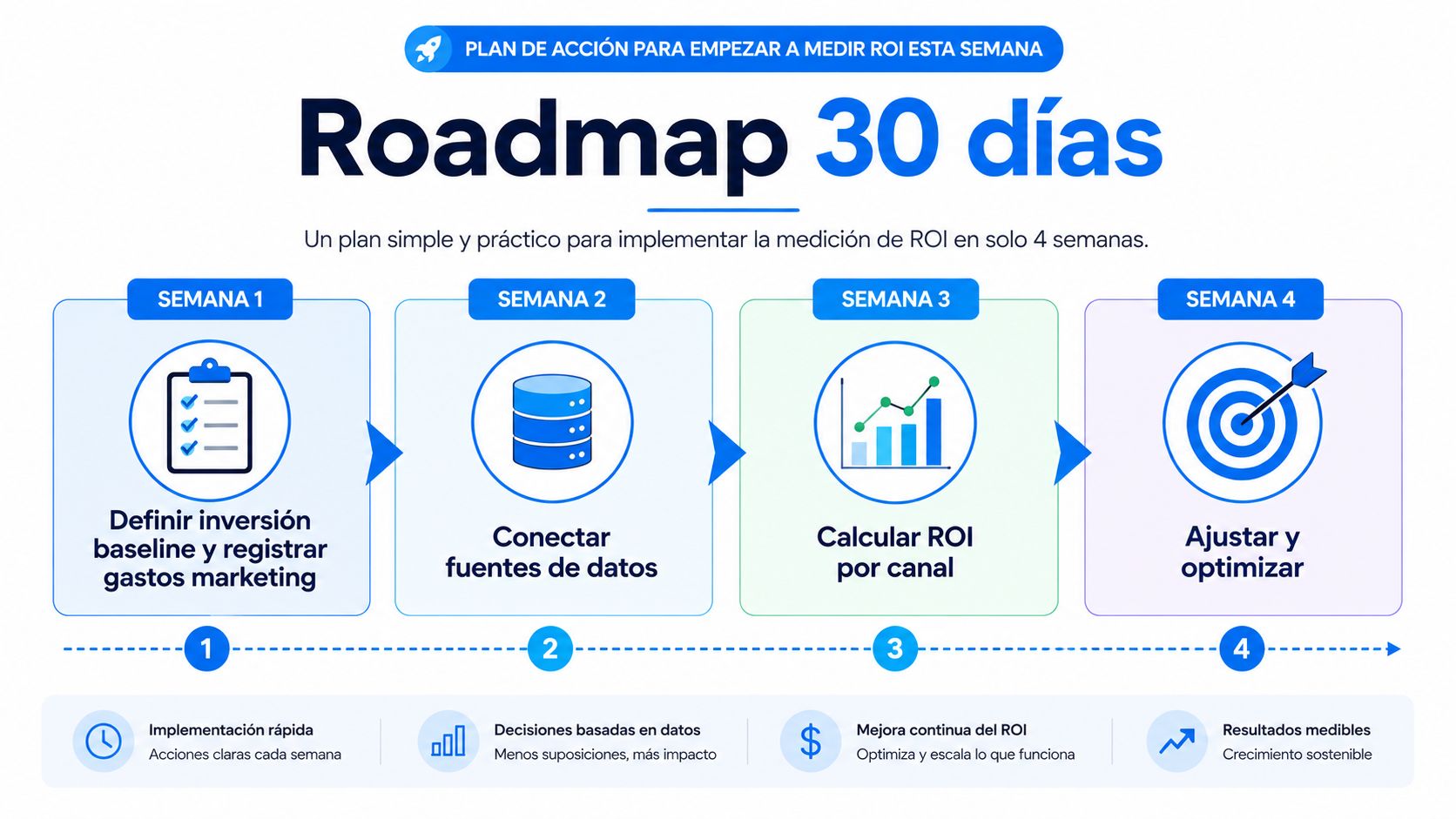
Week 3, calculate by channel and location. The team applies the net benefit formula over total investment, separates direct costs, and creates customer cohorts. They also compare LTV with CAC and review retention, average ticket, and repeat visits. The progress test consists of having calculated the ROI of at least three campaigns and having a comparison of LTV against the business's real CAC.
Week 4, review and adjust. The person in charge eliminates doubtful attributions, validates costs with accounting, and redistributes budget toward actions that generate utility. The review must include location, channel, campaign, and subsequent customer behavior.
Recommended rhythm: a monthly 30-minute meeting is enough to review the dashboard, question attributions, and decide which investment continues.
The owner of a coffee shop, restaurant, barbershop, or salon should schedule that review starting now. Swirvle centralizes CRM, loyalty, campaigns, and ROI panels to connect sales from the point of sale with retention, average ticket, and attributable results.
Related Blogs

Oct 21, 2026
How to Control Food Waste in a Restaurant: 2026 Guide

Oct 20, 2026
What is the global invoice for the general public and when is it issued? SAT Guide

Oct 19, 2026
How to take restaurant orders on WhatsApp without losing any?

Oct 18, 2026
How to Create a WhatsApp Business Catalog to Sell More: 2026 Guide

Oct 17, 2026
How to set up quick replies in WhatsApp Business?

Oct 16, 2026
Can fake Google reviews be removed and how do you request it?