How to attract more customers to my coffee shop? Prioritize frequency, average check, and margin with actionable steps, WhatsApp, and measurable loyalty.
27.9% of people surveyed in Mexico City buy prepared coffee outside the home, according to Profeco's 2025 survey on coffee buying and drinking habits. For a café, the opportunity lies in turning part of those regular visits into more frequent or higher-value purchases.
A blanket discount can fill a shift and shrink your margin. It's better to offer different incentives depending on the time of day, visit frequency and usual spend: that way, people who drop by occasionally get a reason to come back, and those who already buy often can add something to their order. The useful measure is incremental profit, not how many coupons get redeemed.
Which customer to attract first
A café with 100 customers a month can have two different opportunities: getting some of its occasional visitors to come back sooner, and increasing spend among those who already come every week. Choose the profile based on frequency, ticket size and the margin each offer leaves.
In that same survey, among those who do buy coffee outside the home, the most common frequency was weekly, at 26.4%, and 43% pay between 12 and 30 pesos per cup. At that price, a permanent 2-for-1 can cut into the margin of purchases that were already happening.
Competition also helps set priorities. Between 2018 and 2023, 17,050 cafés, soda fountains, ice cream parlors and similar businesses were added, with an average annual growth rate of 4.5%, according to INEGI's 2024 Economic Censuses. In 2018, this activity already had 69,599 establishments and 209,685 employed people, according to INEGI's compendium on the restaurant industry. Over the same period, antojitos restaurants added 30,861 establishments and 108,579 more employed people.
A one-size-fits-all promotion doesn't distinguish between slow and peak hours, or between someone who already buys and someone who needs a reason to come back. To decide which profile to serve first, cross frequency with ticket size, as explained in this guide on how to identify your best customers.
Profile | Signal | Offer that makes sense | What to measure |
|---|---|---|---|
Passing by in slow hours | One purchase, a 12 to 30 peso cup | Entry product or upgrade only during that hour | Ticket and margin in the slow hour |
Occasional | Comes now and then, with no fixed rhythm | Mission of 3 visits in 14 days | Repurchase within 30 days |
Frequent | Comes back every week or every 3 days | Reward on visit 6 or 7 | Frequency and redemption rate |
High ticket | Spends more than average per visit | Drink plus food combo | Average ticket for the segment |
Inactive | No visit in 30 days | Win-back coupon expiring in 7 to 14 days | Active customers at 60 days |
Pick one profile to work on for four weeks. That way you can compare the incremental profit of its offer, instead of treating redeemed coupons as enough proof of success.
How to make the menu justify another visit
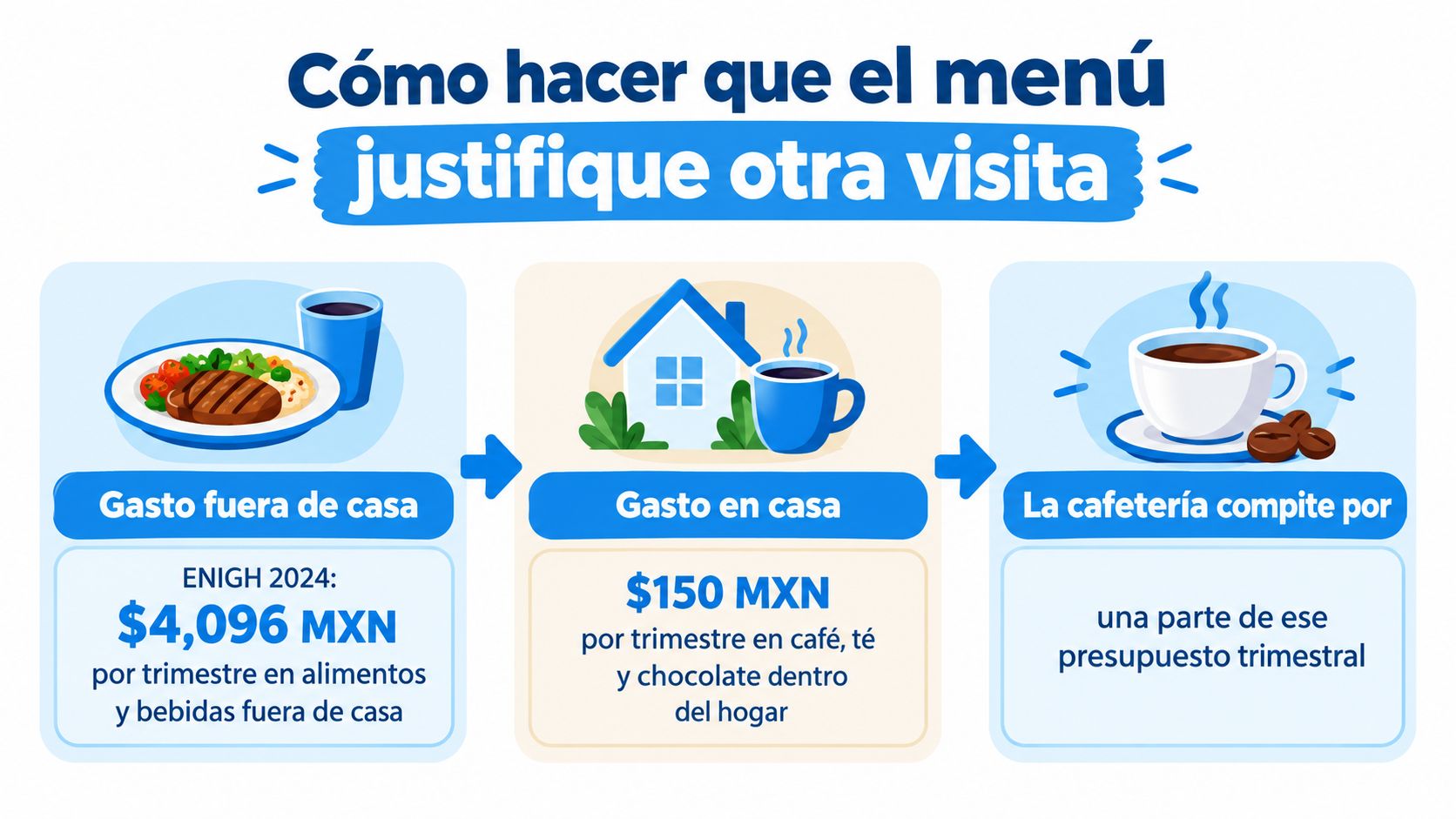
The consumption occasion should define the menu anchor: breakfast, lunch or afternoon. INEGI's ENIGH 2024 reports an average quarterly current monetary spend of 3,896 pesos on food and drinks consumed outside the home, compared with 150 pesos on coffee, tea and chocolate at home. The difference helps size out-of-home spending, although it doesn't correspond only to cafés.
Five steps to anchor the menu
For 14 days, record the time, the product and whether the ticket includes food. That log helps you identify which combinations already sell and at what times there's room to grow.
Define three anchors by occasion: coffee with pastries in the morning, a combo for people working nearby at lunchtime, and a cold drink in the afternoon. Keep each product's list price visible.
During slow hours, offer an entry product or a specific add-on. That way, the incentive is concentrated on the time slot you want to activate and doesn't lower prices across the whole menu.
Remove one specific friction, such as allowing pickup orders with no line between 8 and 10. For people who study or work nearby, speed can justify another visit.
At checkout, explain the benefit of coming back, along with the rule and the date. If you register the customer and their purchases, you can tell who responds to the incentive and which anchor generates an extra visit.
The same approach in other businesses
The occasion changes by business. A café can separate breakfast and afternoon according to the item that goes with the drink; a restaurant can focus its offer on the midday set menu, and a corner store can offer a benefit during its slowest hours.
A combo that already sells on its own doesn't need an incentive. Save the reward for a time slot or an add-on that still has room to grow.
At the end of the week, define one anchor per time slot and a single friction to remove. Review average ticket, visits per customer and sales tied to each anchor. Since occasions vary between office, residential and commercial areas, measure each location separately before replicating an offer.
How to grow your customer base with Google and WhatsApp
WhatsApp helps turn a search or a purchase into a relationship you can measure. Your Google profile helps people find the café; registration at checkout lets you follow up with those who already came in.

Seven-step funnel
Keep your Google profile up to date with real opening hours, photos of the anchor product, replies to reviews and the location's area. Follow this guide to optimizing Google Business Profile for cafés when reviewing that information.
Place a QR code at the register, on tables and on receipts to make registration easy.
Choose a first-purchase incentive with a low marginal cost, such as an extra or a small drink.
Ask only for the data you'll use to personalize follow-up: name, phone, location and what they usually order.
Classify each customer as new, occasional or returning.
Set up a welcome message and the interval for the next offer based on the café's visit cycle. The cadence and message limit are defined in this section.
Compare second visits and sales in the group that received the incentive with those of a group without a coupon.
In an academic study published in 2021 on 200 companies operating in Mexico and Spain, 27% allowed contact via WhatsApp and 85.71% of the Mexican companies that replied automated the first contact, according to the SciELO article on corporate digital communication. For a café, the opportunity is to reply with useful information and record what interest prompted the contact.
Segment the message by consumption and moment: a seasonal drink for those who usually order cold drinks, or a lunch option for nearby customers who visit at that time. In a corner store, the reminder can match the day the customer usually stocks up on groceries.
"I started sending campaigns and I was sure they would reach my real customers.", Mariana C., Michoacana Granjeros
Before sending the first message, ask for explicit consent and explain what you'll use the number for. The relevant metric is incremental profit per activated customer: a single redemption doesn't prove growth if that customer would have bought anyway.
Which numbers to review every Monday
Eating out is already the specific category with the highest household spending. INEGI's ENIGH 2024 reported a quarterly average of 3,896 pesos per household on food and drinks consumed outside the home, 19.2% more in real terms than in 2022.
To capture part of that spending, review results by segment and time slot. During slow hours, test an entry product; for those who already spend more, offer a combo or an upgrade. Measure whether each option changes visits and ticket size without reducing margin.
Metric | How to calculate it | Initial reading |
|---|---|---|
Visits per customer | Visits in the quarter divided by active customers | It should rise compared with your baseline frequency |
Ticket by segment | Sales divided by tickets, separated by profile | Compare profiles, not an overall average |
Margin after the reward | (Sales minus product and reward cost) divided by sales | Check how much margin each offer keeps |
Registration to second visit | New registrations who come back, compared with a group without a coupon | Compare the share that returns |
Incremental profit | Profit of the incentive group minus that of the control group | Review the result by segment |
Active at 60 days | Customers with a purchase in the 60 days after the reward | If it doesn't rise, turn off the promo |
Separate new, occasional and returning customers. That way you can tell whether an offer turns an occasional customer into a frequent one or only increases spending by those who were already visiting.
Three failure readings
Coupons go up, but visits don't. The reward may have reached customers who were already planning to buy. Adjust the offer or target a behavior that isn't happening yet.
Slow-hour traffic rises and margin falls. The entry product may be displacing higher-value purchases. Limit the offer to that time slot and review the cost of the reward.
The office-area location responds and the residential one doesn't. Analyze each location separately. Their hours and spending profiles may require different offers.
The ritual fits in 20 minutes: review one metric, choose one segment and decide whether to continue, adjust or turn off the offer.
How to reward frequency without eating into your margin
A profitable reward changes buying behavior: it brings the occasional customer's next visit closer and offers a different benefit to frequent customers. A card that gives away the tenth cup to someone who already comes daily may reward a purchase that would have happened anyway. That's why it pays to fit the mechanic to the profile and the habit you want to build.
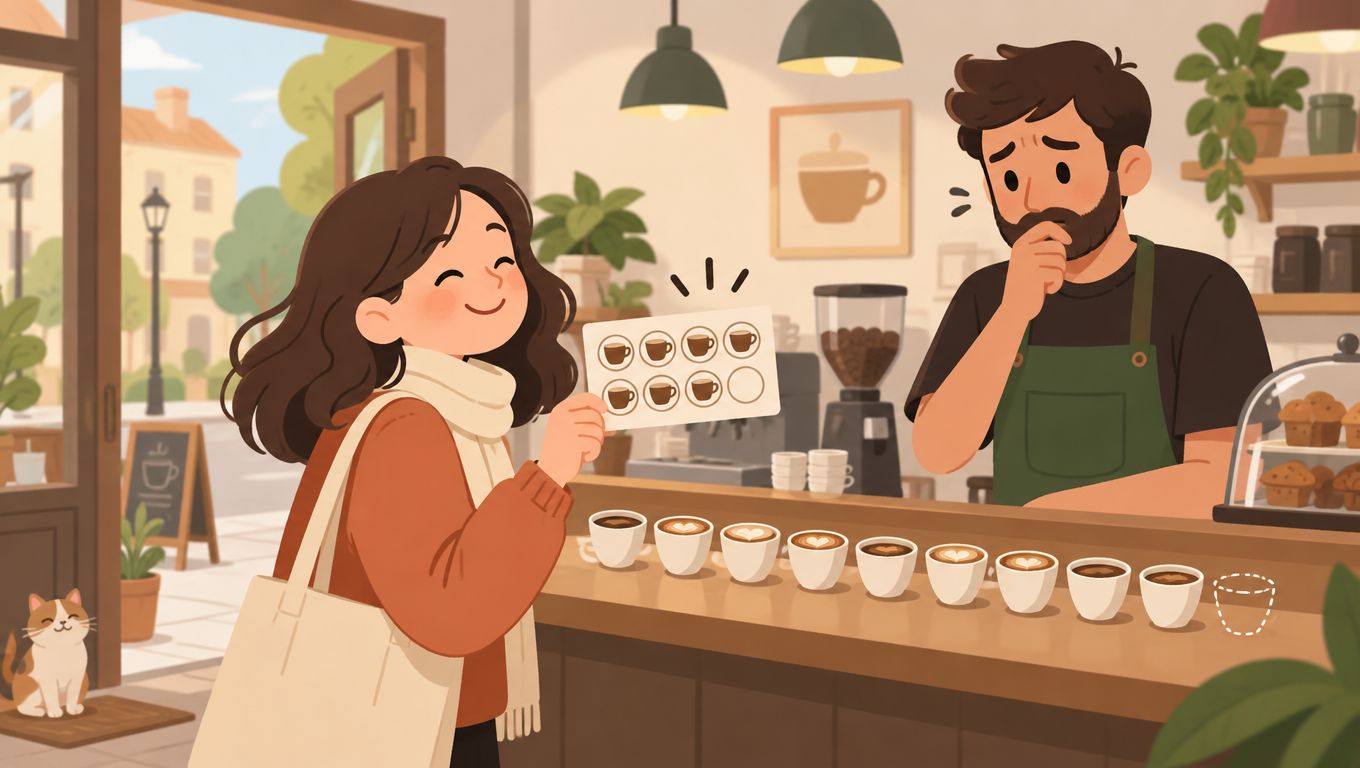
A loyalty card works better when it distinguishes between profiles. The occasional segment offers a clear opportunity: invite them to a second visit with an incentive tied to what they buy. For someone who usually orders just a drink, a small, frequent reward may be enough; for someone who usually spends more, a higher-value bundle can work, as long as its cost doesn't eat up the margin.
You'll find dynamic and reward alternatives in these examples of loyalty programs for cafés.
Six rules to make the reward pay off
Record your baseline frequency for 8 to 12 weeks. That way you can compare behavior before and after the incentive.
Separate new, occasional and high-frequency customers. Define a suitable reward for each group.
Tie the reward to a future behavior, such as completing a third visit within 30 days.
Choose rewards that expand consumption: for example, offering pastries with a morning purchase or a cold drink in the afternoon.
Schedule the reminder close to the interval at which each customer usually returns.
Review frequency, margin and redemptions by group. Set an expiration of 7 to 14 days and compare results with a group that gets no reward. If active customers at 60 days don't increase, adjust the rule.
The mechanic should feel achievable and simple for the customer. Jesús V., from Pollos Vidaurri, explains it this way: “A lot of people come to buy the same thing every week, which they didn't do before, because we're rewarding them: every six visits, on the seventh we give them a discount. People feel taken care of.” At Brunch Brunch, Mimi and Jaime describe a different frequency: “There are people who come every 3 days ... they ask us on their own to add their points in the app.”
In a bakery or a corner store, the same logic can apply with a benefit after a certain number of purchases. For a café, the key calculation is how much margin the extra visit leaves compared with the cost of the reward: if the reward costs more than that margin, the rule needs a different product, a different condition or a lower value.
What to activate at the register this week
This week's action is concrete: choose a profile, a slow hour and a reward tied to a future visit. That way, the register records a behavior you can evaluate later, instead of handing out discounts without knowing who needs them.
Day 1. Choose the profile and define which metric you'll review, such as repurchase or incremental profit.
Day 2. Select the product you want to push in that hour and calculate its cost. If the reward cuts too much into margin, change it.
Day 3. Make registration easy at checkout. Ask only for the data needed to recognize the customer and note their preference or location.
Day 4. Write a welcome message and another one inviting them back. Limit communication to once or twice a week.
Day 5. Set up the points, visits or purchases mechanic and define when the reward is delivered.
Day 6. Turn on the rule at the register and make sure staff can explain the benefit in one sentence.
Day 7. Review the result on Monday and decide whether to keep the rule or adjust the profile, time slot or reward.
With Swirvle, you charge, register the customer and give them their points in the same step. Afterward, the system can send them a coupon to bring them back; if they stop visiting the business for 30 days, it can also send them a message with an incentive. This week's priority is to record the chosen profile on every ticket and launch a single rule.
Swirvle brings together customer registration, the loyalty program and campaigns to follow up on visits. With segmentation by location and consumption habits, you can target each offer to the profile you chose. In Swirvle, WhatsApp campaigns are part of the Premium plan. Learn about the Swirvle platform at swirvlehub.com.
Related Blogs

Oct 30, 2026
How to Attract More Customers to My Coffee Shop: 2026 Guide

Oct 29, 2026
What holiday promotions work in a restaurant? 2026

Oct 28, 2026
How much does a grocery store make per month in Mexico? 2026

Oct 27, 2026
How to attract more customers to my grocery store in 2026?

Oct 26, 2026
8 ideas: What promotions can I run for Buen Fin if I have a small business?

Oct 25, 2026
What thank-you messages should I send to my customers?