How to attract more customers to my grocery store: A 12-week roadmap with POS, loyalty, WhatsApp, and ROI measurement for your small business.
It's 7 p.m., the store is fully stocked, but the same usual customers walk in and the average ticket doesn't budge. Lowering prices attracts a visit, but it also cuts into the margin of products that would already sell on their own. The answer to how to attract more customers to my grocery store? isn't giving away more, it's tracking every visit, rewarding the next one, and measuring which promotion actually generated a profit.
12-week roadmap to attract more customers
The roadmap is simple: measure for two weeks, organize the store for two weeks, test a loyalty program for two weeks, and segment with a control group for six weeks. Without baseline numbers, no discount can be evaluated. First you find out who is buying, then you decide who to incentivize.
Phase | Weeks | What you do | Metric to review |
|---|---|---|---|
1. Measure the baseline | Weeks 1-2 | Track which customers buy, how many visits they make per week, and their average ticket | Unique customers and average ticket |
2. Optimize the visit | Weeks 3-4 | Adjust displays, checkout, restocking, and visible store hours | Sales per hour and average basket size |
3. Activate loyalty | Weeks 5-6 | Launch a visit- or points-based program with a trial coupon | Registered customers and redemption rate |
4. Segment and measure | Weeks 7-12 | Send campaigns by group and compare against a control group | Frequency, incremental sales, and margin |
Why measuring comes first
Food, beverages, and tobacco represent the largest portion of household spending. According to INEGI's ENIGH 2024, they account for 37.7% of total monetary expenditure and average 5,994 pesos per month per household. That is steady replenishment shopping, not occasional foot traffic.
That is why it pays to track what each customer buys, how often, and in what combination. A combo of cereal with milk, coffee, or sugar increases visit value more than a storewide discount. The roadmap is on track when the registered customer base grows, the average ticket goes up, and frequency improves without relying on across-the-board markdowns.
How to organize the store to encourage repeat visits
Store organization makes an impact before promotions do. If the customer doesn't see your hours, can't find the staples, and isn't registered at checkout, the visit won't be repeated. These five adjustments are listed in order of impact.
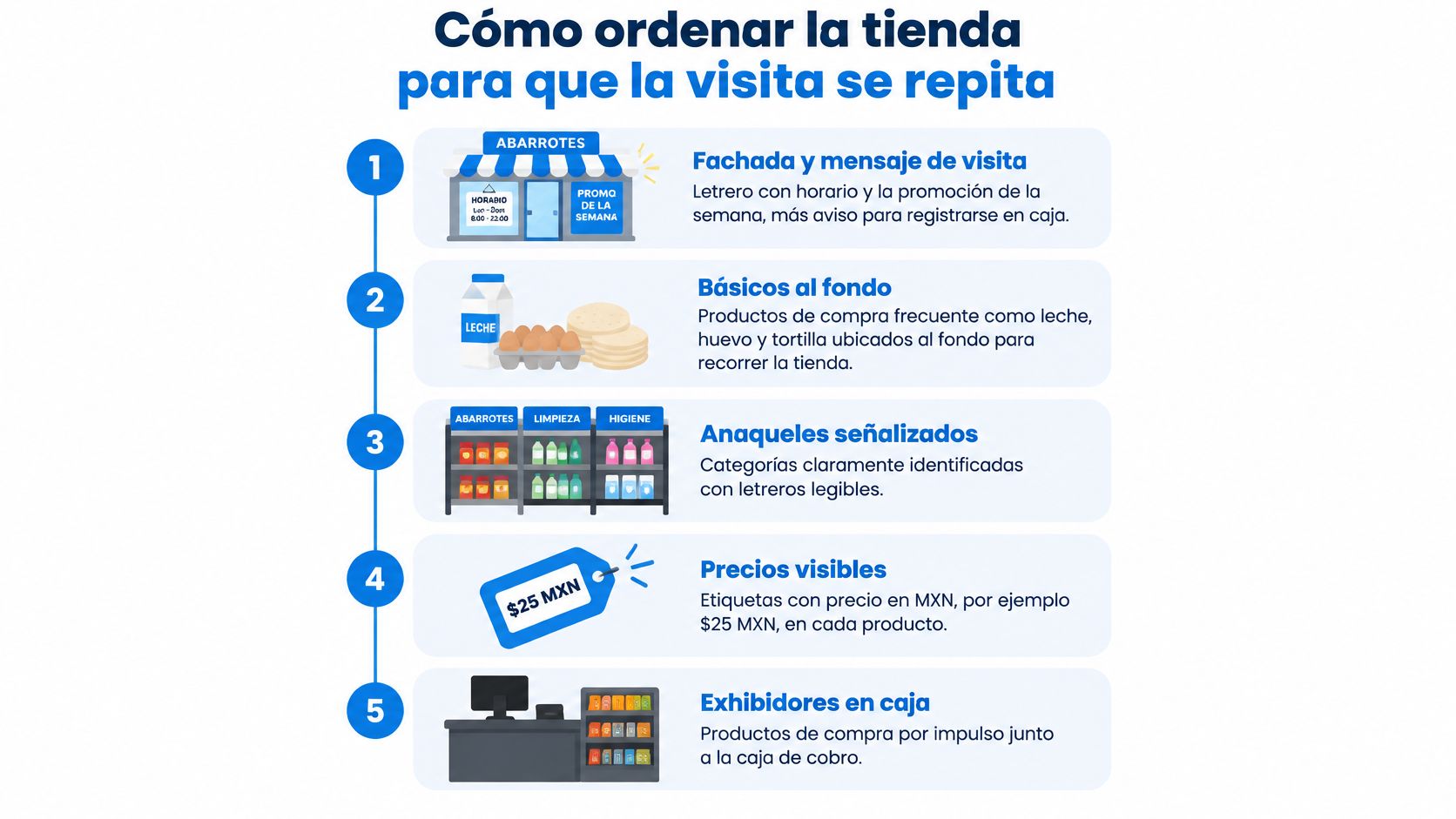
Storefront and visit messaging. Post your hours, the promotion of the week, and a sign-up notice at checkout. The common mistake is advertising a deal that doesn't match what's on the shelf. Check every Monday that signage, pricing, and inventory all align.
Checkout as a registration point. Ask for their phone number at checkout and offer points or a coupon before handing over change. That way, the sale is tied to the customer. The mistake is asking for their info afterward, as they are already walking out.
Restocking shelves. Place milk, cereal, coffee, and cleaning supplies at the back so customers walk through the store, and put high-turnover categories at eye level. The mistake is promoting a product without stock to replenish it. Check for out-of-stock items at closing.
Combos and target basket. Put together two or three complementary combos, like cereal with milk or soda with snacks, near the checkout counter. The combo should add an extra product, not just discount the one they were already buying.
Convenience without competing on price. Accept orders via WhatsApp, layaways, and in-store pickup. That reduces friction compared to supermarkets. According to INEGI's 2024 National Financial Inclusion Survey (ENIF), the share of people who paid by card at markets, corner stores, and similar shops rose from 7.0% in 2021 to 12.6% in 2024, although for 85.2% cash is still the most frequent payment method for purchases of 500 pesos or less.
Adjust by area
ENIGH 2024 reported an average quarterly monetary expenditure of 52,003 pesos in urban areas, compared to 30,858 pesos in rural areas. An urban store prioritizes frequency, convenience, and fast restocking. A rural store tailors package sizes, product mix, and promotions to a lower average budget.
Customers return to the store that serves them quickly and recognizes them at checkout, not to the one that just lowers a price.
A card terminal helps, but it doesn't replace trust or product availability. First, the basics need to be in stock, visible, and clearly priced.
How to choose a loyalty program structure that protects your margin
The defining question is which behavior to reward: the visit, the spend amount, or a full basket. The challenge isn't the first purchase. It's making the second and third purchases worth more than the first.
Program Structure | How it works | Ideal for | Risk to margin |
|---|---|---|---|
Punch card (7th visit free) | Reward after a set number of visits, regardless of spend | Rotisserie chicken shops, coffee shops, and brunch spots | Rewarding very low tickets with expensive items |
Points per spend | Points per peso spent, redeemable for staple products | Grocery stores and hardware stores | Points costing more than the margin they generate |
Scheduled recurring purchase | Perk for buying the replenishment basket every week | Grocery stores with weekly customers | Discounting those who were already buying without a promotion |
Third-visit reward | Reward only starting on the second or third purchase within 30 days | Restaurants and stores with frequent purchases | Quick redemption without repeat visits if the window is too long |
In a rotisserie chicken shop or a coffee shop, rewarding visits works because purchases are already routine. Jesús V., from Pollos Vidaurri, sums it up: "Many people come in to buy the same thing every week—something they didn't dare to do before—because we reward them: every six visits, we give them a discount on the seventh. People feel valued."
In a restaurant, on the other hand, a win-back coupon pays off better for customers who haven't visited in 30 days. That coupon brings them back without giving away free dishes to those who already return on their own. In grocery stores, points per spend work best when redeemable for staple products, because the reward drives another visit soon after.
Omar C., from Alfri Chapas y H., highlights the competitive edge: "If we have the same product at the same price, they prefer to buy from us because they're earning points and getting extra perks." Before setting the discount rate, it's worth reviewing how to offer a discount without losing margin and calculating the cost per additional visit.
According to INEGI's Monthly Survey on Commercial Enterprises, real retail revenues rose by just 0.1% month-over-month in July 2025, while total personnel employed decreased by 0.3%. With such tight margins, storewide discounts subsidize purchases that would happen anyway. Every program structure should be measured by margin after promotion, not by redemptions.
How to segment and engage customers via WhatsApp
WhatsApp works when you segment, not when you blast the same message to your entire list. A weekly shopper doesn't need a discount; someone who hasn't visited in 30 days does. The funnel has four steps, and each one prevents a different type of waste.

QR code opt-in. Place a visible QR code at checkout, on shelves, and on receipts to capture explicit consent. Without permission, there is no valid campaign. The mistake is jotting down phone numbers without explaining how they will be used.
Useful contact profiles. Save the phone number, store location, purchased categories, and last visit date. A name without purchase history doesn't allow for segmentation. Organizing contacts helps here, as explained in the guide on WhatsApp Business labels.
Actionable segmentation. Group buyers of beverages, snacks, or staples, and separate regulars from lapsed customers. If a customer hasn't visited the store in 30 days, the Swirvle platform can automatically send them a message with an incentive to return (WhatsApp sending is included in the Premium plan).
Time-sensitive offers. Send coupons with an expiration date, redemption limit, and clear purchase instructions. Messages without deadlines don't create urgency and make measuring return on investment difficult.
The opportunity is substantial. A Meta and Boston Consulting Group study on business messaging in Mexico, based on a survey of 400 Mexican businesses, reports that 7 out of 10 Mexican consumers find messaging a quicker and easier way to communicate with businesses.
As an initial test, a 10% to 15% discount on a high-turnover category, with a 48- to 72-hour window, lets you compare against similar customers who didn't receive a coupon. Track opt-in, delivery, redemption, and incremental sales every week.
Never buy contact databases. Consent and a clearly stated purpose protect your business as well as your delivery rates.
A restaurant can segment by day of the week and a coffee shop by morning hours. The underlying logic is the same; only the trigger changes.
Templates for campaigns, events, and local partnerships
Each template targets one segment, with one trigger, and one metric. Blasting it to your entire database dilutes the discount and ruins attribution. These six can be launched without building an elaborate campaign, and several pair well with other promotion ideas when tailored to your industry.
Campaign | Segment | Trigger | Sample Message | Metric |
|---|---|---|---|---|
Win-back | Customers with no visit in 30 days | Day 30 without a purchase | We miss you: get 10% off your favorite item this week | Customers returning within 72 hours |
Basket builder | Cereal buyers who didn't buy milk | Cereal purchase on last visit | Get your milk at 10% off today | Average ticket |
Replenishment repeat purchase | Weekly shoppers | Purchase every 7 days | Your groceries are ready: enjoy a 50-peso coupon on your next purchase | Visit frequency |
Birthday | Customers with birthday on file | Birthday date | Your birthday gift: enjoy a complimentary coffee this week | Redemption within the week |
Neighborhood event | All registered local customers | Saturday tasting or workshop | Coffee tasting this Saturday from 10 to 12, just show your phone | Attendees with redeemed coupon |
Local partnership | Customers of partner bakery or tortilla shop | Presenting receipt from partner business | Show your receipt from the bakery and get 15% off your coffee | Cross-promoted receipts per business |
How to adapt each template
Win-back and basket builder. The first re-engages lapsed customers; the second increases basket size. They should not be sent to the same customer in the same week.
Replenishment and birthday. Replenishment rewards a weekly habit with a coupon for the next purchase. A birthday promo works as a complimentary gift valid throughout the week—low cost with high recall.
Events. A Saturday morning coffee tasting or a sweet bread sampling with a partner bakery only delivers value if you collect phone numbers at the door. That way, attendance is directly tied to redemption.
Partnerships. With a local bakery or a tortilla shop, each business hands out the other's coupon upon showing a receipt. It's best to agree on a simple cost split, such as 50/50, and track cross-promoted receipts.
Every business model has its own prime moment. An ice cream shop triggers coupons on hot days, a restaurant encourages a second visit within the same week, and a grocery store sells everyday staples. Using a one-size-fits-all template wastes that natural advantage.
Measure ROI and launch your first experiment
Before rolling out any promotion, calculate the margin remaining after the discount and marketing costs. The formula is ROI = (incremental margin minus promotion cost minus marketing cost) divided by total cost. Total cost combines promotion and marketing; a redeemed coupon doesn't prove the sale was incremental, because the customer might have purchased anyway.
Worked example: 2,400 pesos in incremental margin, with 1,000 in discounts and 200 in marketing costs, yields (2,400 minus 1,200) divided by 1,200, which equals a 100% ROI.
Your tracking needs to connect digital engagement with what actually happens at checkout. Even when the promotion arrives via WhatsApp, the sale closes at the counter. For this reason, log every redeemed coupon at the register and connect that data to purchases, not just to sent messages.
The four-week test
Compare two groups of customers with similar profiles: a control group with no incentive and a treatment group with a targeted coupon. Define a target basket, record every reward at checkout, and review results by location, time of day, and product category. Measure shifts in ticket size, frequency, and margin; gross sales figures alone do not indicate whether the promotion was profitable.
Signal | What it means | What you should do |
|---|---|---|
Sales rise, margin falls | The discount may have funded purchases that would have happened anyway | Lower the percentage or switch to visit-frequency points |
High redemption, unchanged frequency | Customers use the coupon but don't come back more often | Switch to a reward unlocked on the second or third visit |
Frequency rises, ticket unchanged | More visits are happening, but without complementary items | Create combos or define a target basket |
Low WhatsApp delivery | Messages are being ignored, blocked, or poorly targeted | Review opt-in consent, sending times, and audience segmentation |
Control group buys at the same rate | The campaign is not proving incremental sales | Pause the offer and test a different mechanic |
Before sending, set a per-customer redemption limit, an expiration date, and verify sufficient inventory. Tie the reward to the second or third visit and avoid rewarding low-margin items. An impressive redemption rate can easily hide a promotion that delivers little profit.
To get started this week, select one segment, define a 48- to 72-hour offer with a per-customer limit, and compare treatment against control. Among businesses that have been on Swirvle for over seven months and actively register customers, comparing their initial months to their most recent ones shows increases of 65% in revenue, 15% in visit frequency, and 38% in average ticket. Use these figures as a benchmark, but guide decisions with your own data: assess every promotion by the incremental margin it delivers, not by how many coupons get redeemed.
Final takeaways
The challenge of bringing in customers is almost always an issue of margin, not advertising. Every incentive must justify its cost through visits that wouldn't have happened otherwise and through sales that generate real profit. That's why it's critical to track who buys and monitor if they return, rather than merely counting redeemed coupons.
The sequence is straightforward: make sign-up seamless at checkout, decide which customer behavior to reward, and deliver a targeted offer to a specific segment. Next, evaluate the outcome against customers who didn't receive the promotion. That's how you tell an incremental visit apart from a purchase that was going to happen regardless.
The costliest mistake
A broad discount can shrink margins without shifting customer behavior. Segmentation ensures incentives are reserved for customers who are genuinely likely to return, add to their basket, or renew their visit cycle. The true benchmark is never how many coupons are redeemed, but how much profit those visits leave behind once the reward is accounted for.
It is equally vital that your team can explain how the promotion works at checkout. If the mechanics require too much explanation, customer sign-ups become inconsistent and evaluating performance becomes difficult. Keep the reward simple and make sure every transaction can be linked back to the customer.
Establish exit criteria before launching: if the pilot ends and additional sales fail to cover the discount and the cost of servicing those visits, pause the campaign. If they do cover them, keep running it or test it with a different audience segment. Never extend a campaign simply because coupons were redeemed.
As a starting point, track how many unique customers you register per week and hold that baseline for a month. That will give every future promotion a clear cost and response rate to measure against. Swirvle combines POS, CRM, and loyalty features into a single platform to register customers and track their purchase history. Its goal is to connect checkout with rewards and targeted campaigns to encourage return visits. For any store, the ultimate decision remains grounded: keep only the promotions that generate profitable visits.
Related Blogs

Oct 27, 2026
How to attract more customers to my grocery store in 2026?

Oct 26, 2026
8 ideas: What promotions can I run for Buen Fin if I have a small business?

Oct 25, 2026
What thank-you messages should I send to my customers?

Oct 24, 2026
What questions should you ask in a restaurant satisfaction survey? 8 ideas

Oct 23, 2026
Is it legal to charge a card payment fee in Mexico?

Oct 22, 2026
How to prevent employee petty theft in my business?