
Learn how to differentiate a specialty coffee shop from the competition with real strategy: origin, experience, margin, and measurable retention in LATAM.
The coffee shop opens with an impeccable bar, earth tones, minimalist ceramics, and a seasonal drink that is already appearing all over social media. During the first few weeks, people walk in out of curiosity. Afterward, the flow cools down, the average ticket does not increase, and customers have no clear reason to return. The problem is usually not the coffee. It is that the experience ends up being interchangeable.
In Mexico, consumption remains dominated by soluble coffee. One market source places it at 57% of consumption, while another puts it at 60%, and the total projected consumption for 2025/26 reaches 3.15 million 60-kg bag equivalents according to Specialty Coffee Online. At the same time, the USDA projects a national production of 3.9 million 60-kg bags in 2025/26, with 663,070 hectares harvested, and raised its estimate for 2026/27 to 4.135 million bags, according to its annual report on Mexican coffee.
The answer to how to differentiate a specialty coffee shop from the competition is not in decorating more or adding drinks without control. It lies in crossing cup quality, operation, and measurable recurrence by branch. The coffee shop that wins is not the one that seems most special during a visit, but the one that gets the customer to repeat a consistent experience, understand its value, and incorporate it into their routine.
Why aesthetics and a long menu no longer differentiate
The Mexican coffee and tea shops market recorded sales of MXN 44.7 billion in 2024, but its compound growth was only 0.9% between 2019 and 2024, while the number of transactions fell at a negative rate of 2.1%, according to Datahooks. It is an uncomfortable contrast: there is money in the category, but opening another similar shop does not guarantee growth.
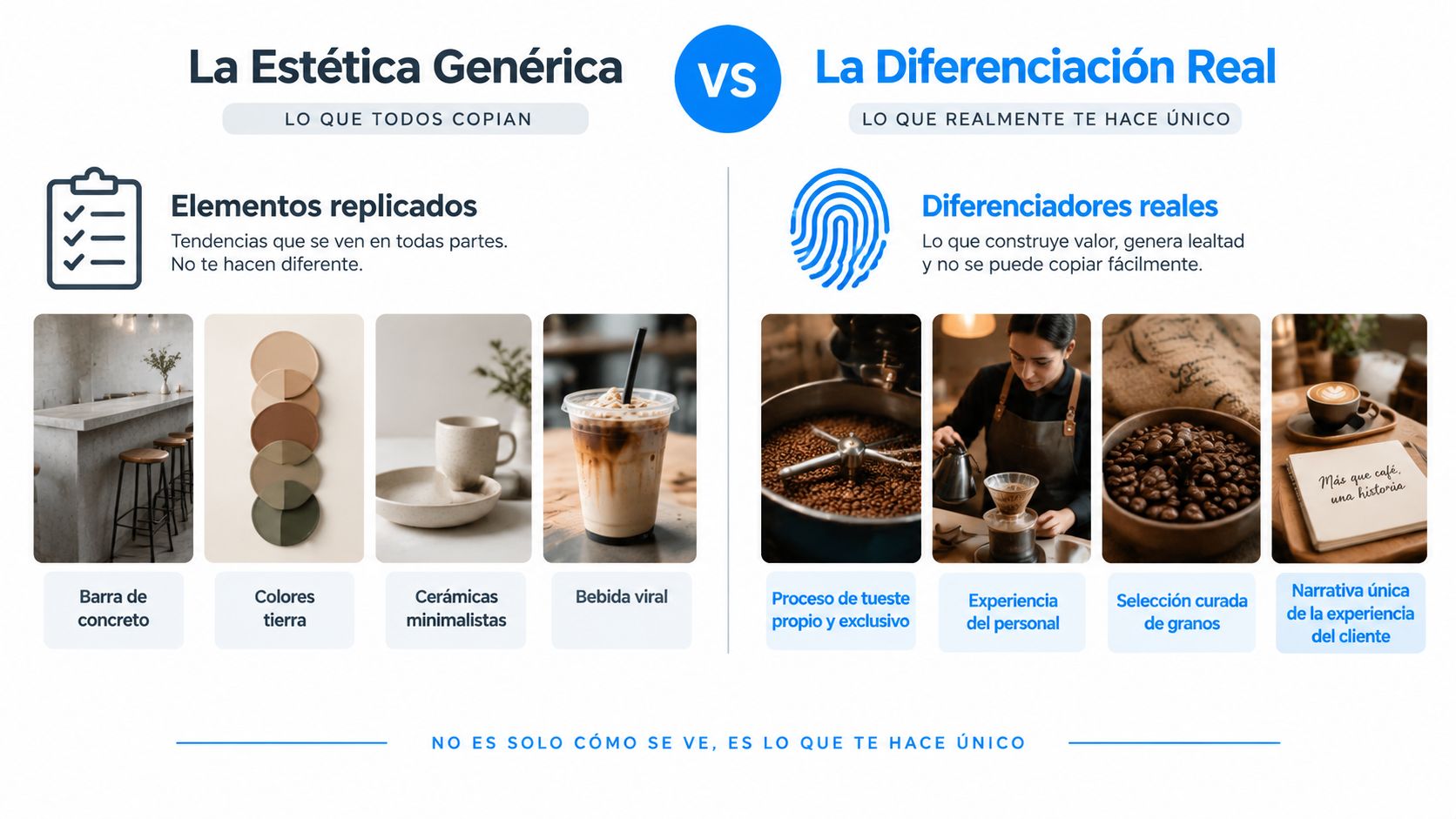
A concrete bar, an earth-tone color palette, or a viral drink are quickly copied. Decorated lattes, cold brews, and extensive menus are also copied. When several coffee shops offer the same thing, the customer decides based on location, price, or an attractive photo. None of those factors alone builds a stable relationship.
Turning identity into an operational promise
Profitable differentiation must be verifiable at the bar. A coffee shop can promise consistent espresso, documented origin, quick morning service, or a decaf alternative prepared with the same rigor. The promise has to change concrete decisions, from coffee bean sourcing to training, workflow, and the loyalty program.
Competitive analysis should start within a radius of one to three kilometers. The operator needs to record prices, hours, rotation, most ordered products, customer profiles, and what competitors actually do well. The question is not what looks pretty, but what is difficult to copy during all shifts.
It is advisable to choose only two or three defensible attributes:
Cup quality: documented recipes, controlled extraction, and understandable sensory profiles.
Service: helpful recommendations, predictable speed, and recognition of frequent customers.
Convenience: clear ordering, hours aligned with the area, and products ready for peak demand times.
Education: brief explanations that turn origin and method into an accessible experience.
Community: activities and rituals that make the visit valuable beyond the beverage itself.
A dashboard of differentiation metrics for trainers can help organize this diagnosis, provided its indicators translate into purchasing, service, and retention decisions.
Operational rule: if the promise cannot be explained in one sentence, measured, and repeated with every visit, it is probably decoration, not differentiation.
Origin, traceability, and cup standards as an anchor
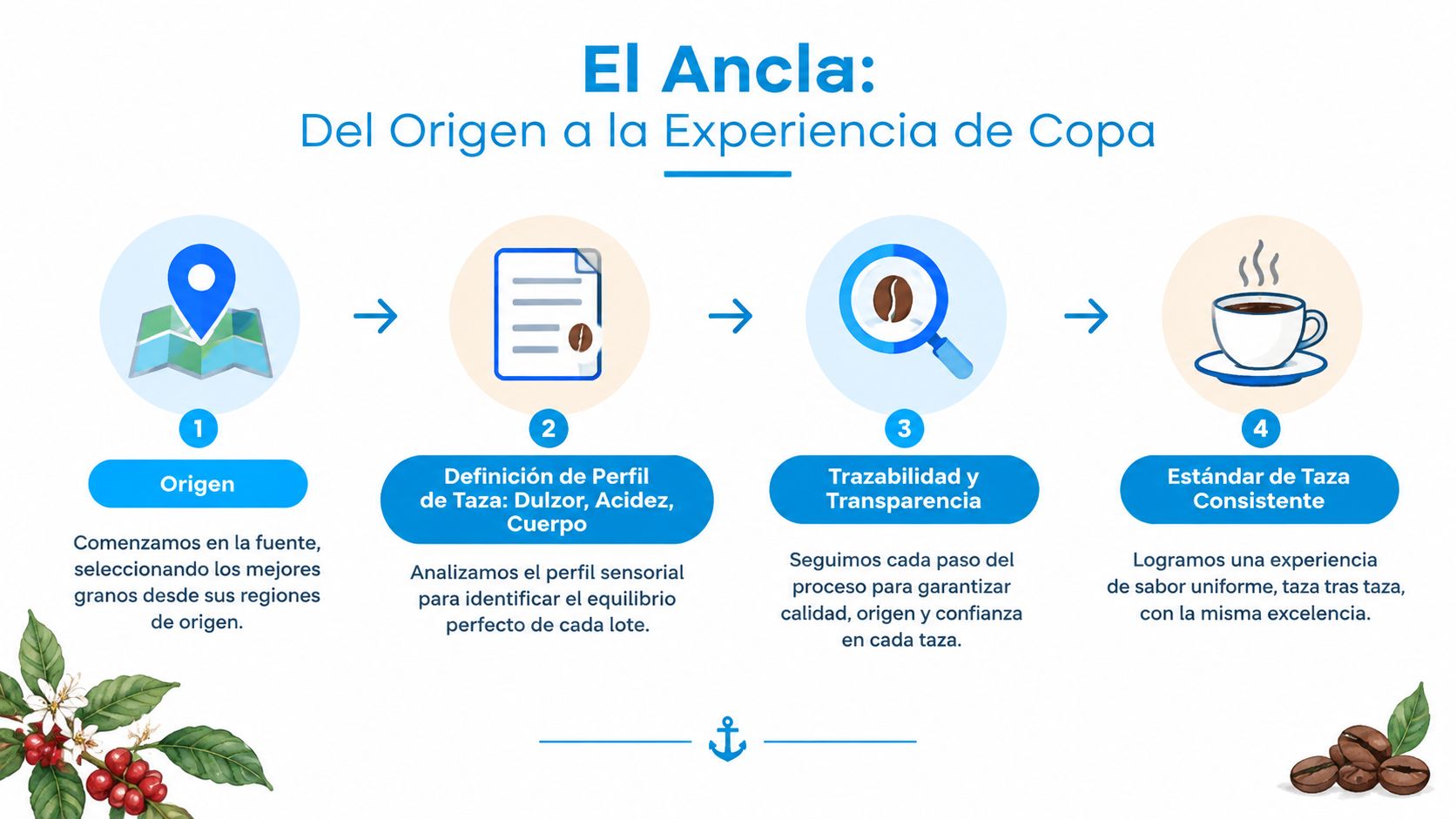
Origin should not function as an ornamental label. Beans from Chiapas, Veracruz, Oaxaca, or Puebla do not sell better just by mentioning the state. The value appears when the customer understands what is in the cup, who produced the coffee, how it was processed, and why that batch deserves a different price.
The SCA scale offers a technical starting point. In Mexico, a coffee scoring 80 to 84 points is classified as premium, and one scoring over 85 points as specialty, according to the study published in Sustainability by MDPI. The score does not substitute for experience, but it helps establish an internal standard that does not rely on adjectives like "artisanal," "premium," or "exclusive."
Building a chain of evidence
The operator must first define which profile they want to defend: high sweetness, bright acidity, silky body, or a seasonal combination. Then they must buy beans with verifiable information about country, region, farm or cooperative, producer, variety, process, altitude, and harvest. If there is information about the price paid to the producer, it is best to keep it and communicate it accurately.
Documentation must also include invoices, contracts, roasting sheets, roast curves, resting times, and espresso and filter recipes. At the bar, the team has to standardize doses, yield, temperature, water, extraction time, milk, and allowed tolerances.
For espresso, a weekly review with refractometry allows relating the measurement to flavor, body, sweetness, and defects. The barista must know when to adjust the grind and when to investigate another variable, such as water, temperature, or rest. Quality control is not about filling out forms. It is about preventing the customer from receiving a different cup every time.
Communicating without exaggeration
The coffee card should show the producer's name, process, sensory profile, and recommended preparation. If it is a blend, say so. If the bean went through several intermediaries, it should not be presented as "direct from the producer." Transparency protects trust and prevents the origin story from becoming an impossible-to-defend promise.
For those looking for price and availability references without losing sight of traceability, a discount alert for organic coffee can serve as a point of comparison, not a substitute for quality analysis. The operation must document every batch and explain what changes between coffees.
Information about processes and controls can be organized with a quality control guide. The customer does not need a technical class with every order. They need a brief, honest explanation connected to what they are drinking.
Menu and recipes designed by habits and time slots
A specialized menu begins by observing the day, not by writing a list of drinks. Analysis of Mexican coffee shops indicates that Friday concentrates more than 315,000 orders and that the actual peak hour is 10:00 AM, with nearly 500,000 orders, according to Parrot Software. The same analysis identifies the latte as the most ordered beverage and on-site consumption as the dominant channel.
This forces the separation of offerings by occasion. The early rush needs speed. The work break needs clarity. The after-meal needs complements. The afternoon allows for filter drinks, pastries, and products that justify a longer stay.
Time slot | Customer need | Menu candidate | Target time | Margin |
|---|---|---|---|---|
Early arrival | Speed and consistency | Espresso, Americano, or preconfigured latte | Less than 90 seconds | High |
Work break | Energy and food | Latte with short-preparation breakfast | Controlled by recipe | Medium-high |
After-meal | Leisure and flavor | Filter coffee with pastry | According to method | High |
Afternoon | Craving and gathering | Signature drink with complement | Stable per batch | Medium-high |
Closing | Light option | Decaf or caffeine-free beverage | Simple flow | Medium |
Designing recipes that the bar can repeat
Every drink needs a reproducible specification: grams of coffee, amount of water or milk, temperature, extraction, cup, toppings, and price. Ingredients should share functions where possible. A syrup that only serves one drink can complicate inventory, training, and waste.
The proprietary recipe can use a seasonal syrup, a fermentation technique, or a filtering method, but it must maintain stable quality. The operator must calculate the full variable cost, including cup, lid, milk, syrup, jam, and preparation loss.
The menu does not need to be long. It needs to resolve consumption moments well and offer sensible add-ons. Compatible pastries, a caffeine-free beverage, and retail bean sales can elevate the visit value without turning the bar into a slow laboratory.
The menu structure should be tested with controlled changes. One week the combo can be modified, another the size, another the price or the position of a drink. To deepen the relationship between profitability and menu design, it is useful to review this guide on how to design the menu to sell the most profitable dishes.
Prices, margins, and average ticket without giving away the shop
The price should not come from looking at the shop across the street. A specialty coffee shop can compare three models, but must decide based on real cost and the value it manages to demonstrate.
Pricing model | Espresso price | Real margin | Estimated average ticket | Risk |
|---|---|---|---|---|
Anchored to green coffee cost | Variable according to batch | Depends on full structure | Low to medium | Passing on volatility without explaining value |
Commercial chain benchmark | Equal or slightly lower | Pressured by discounts | Medium | Competing on price and eroding utility |
Proprietary blend with target margin | Defined by recipe and operation | Target of 65% to 70% in espresso | Medium to high | Requires waste control and execution |
The real margin subtracts coffee, milk, cup, lid, syrups, waste, and labor. An espresso with cheap raw material may have an attractive apparent margin and lose profitability when the recipe generates long times, remakes, or waste. The cost sheet must reflect what happens at the bar, not just the purchase price.
A signature drink at $48 can function as an entry point, while a more complex version at $58 can be defended if it offers a clear difference in origin, preparation, or pairing. A latte with oat milk can carry an additional $10 charge when the cost is calculated and communication is transparent. A proprietary 250 g bean combo can have a fixed price to convert the experience into home consumption.
The mistake is lowering $5 compared to the shop across the street hoping to double customers. That discount usually compresses utility without changing frequency. The ticket grows better with relevant add-ons, such as retail beans, proprietary syrups, or breakfasts, than with permanent discounts.
Two rules prevent impulsive decisions:
Do not lower prices out of anxiety: first review conversion, product mix, and value perception.
Test with discipline: every menu change should run in an A/B test for a minimum of 14 days.
Bar experience, atmosphere, and customer education
The bar becomes a differentiator when staff know how to explain and execute. A barista can tell the origin of the batch of the day, justify why a Geisha costs $5 more, and reject a bad practice, like preparing an iced caramel macchiato using the same spoon as the V60. That decision communicates technical care without needing to turn the service into a lecture.
Education works when it translates. "Bright acidity" should become "a sensation similar to fresh citrus." "Silky body" can be explained as a rounder and more lingering texture. The customer does not need to memorize vocabulary. They need to identify what profile they enjoy and receive an accurate recommendation.
Two businesses, same pattern
A coffee shop in Coyoacán went from 18% to 41% repeat customers in six months by training the team to narrate the coffee card of the day. The takeaway was not that all customers wanted a long explanation. It was that a brief, repeatable conversation linked to the beverage helped turn an occasional purchase into a meaningful visit.
A barbershop in Condesa applies the same principle with a three-question script about style, frequency, and service preference. The product changes, but the mechanism is similar: the business gathers useful information, personalizes the recommendation, and creates continuity between visits. Restaurants, beauty salons, and barbershops can use this approach because loyalty depends on recognizing habits, not on filling the venue with decorations.
Functional atmosphere, not stage design
The atmosphere should support the behavior the coffee shop wants to provoke. An operation can work with a temperature of 21 °C, noise controlled below 65 dB, lighting of 3000 K, and playlists curated by time slot. These parameters do not replace a good drink, but they reduce friction for those working, conversing, or staying in the shop.
The education protocol should be simple:
Explain without jargon: every technical term receives an immediate translation.
Recommend with criteria: the barista asks about sweetness, intensity, milk, or temperature.
Close with a habit question: "Do you usually come in before work or in the afternoon?"
Record the preference: the data should feed the CRM and the next contact.
A memorable experience is not one that surprises once. It is the one that the customer recognizes and finds intact on the next visit.
Local, digital marketing and CRM to trigger repeat business
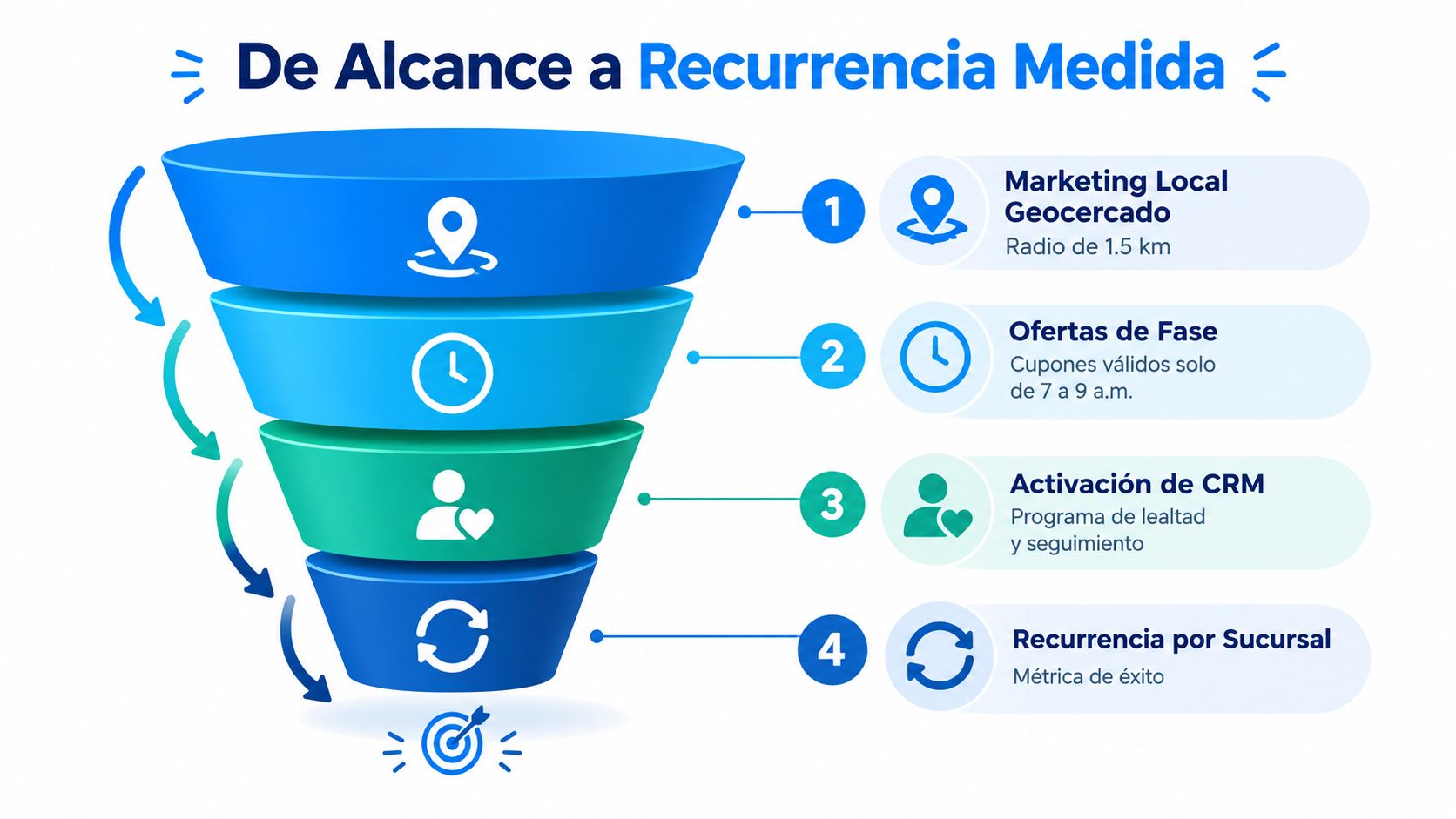
Reach attracts. Repeat business pays for the operation. In Mexico, projected domestic consumption for MY 2025/26 reaches 3.15 million GBE, driven by urbanization, expansion of restaurants and coffee shops, and growing interest in premium and specialty coffee, according to Deep Market Insights. The opportunity is not in chasing the whole city, but in building a habit around each branch.
Working the immediate radius
Local marketing should start within a 1.5 km radius. Coupons can be valid only from 7 to 9 a.m. to train the morning visit, while partnerships with neighboring yoga studios or coworkings connect the coffee shop with existing routines.
The offer must have a purpose. A coupon can attract the first visit, but the second needs a consistent experience and the third a reason of habit. The shop must know if the customer arrives before work, during a break, or as a meeting point.
Maintaining a minimal digital system
Instagram can operate with three weekly formats:
Origin: producer, region, variety, or process.
Process: roasting, calibration, preparation, or mise en place.
Real customer: consumption stories with authorization.
The Google Business Profile must be kept updated with 15 proprietary photos of the bar and dish of the day. WhatsApp Business must have quick replies for hours, menu, location, and availability. Technology only works if the information matches the reality of the venue.
An omnichannel marketing strategy helps coordinate those touchpoints, but the criterion remains operational: each channel must lead to a measurable visit, purchase, or repurchase.
Measuring visits, not vanity
The CRM must record name and email in 100% of transactions, always with consent and a clear explanation of data usage. The minimal segmentation separates visit 1, visits 2 to 5, and visit 6 or higher. Then milestone messages can be activated:
Welcome: incentive to complete the second visit.
Reactivation at 21 days: reminder tailored to the observed habit.
Benefit for 10 visits: reward that protects margin and reinforces frequency.
A study on Mexican consumers reports that 91% participate in at least one loyalty program, but 82% are willing to switch brands for the right incentive, according to Comarch. This data forces the design of relevant benefits, not handing out discounts without strategy.
The weekly metric is visits per customer and branch. If recurrence does not improve between 3 and 6 months, first review product, service, and atmosphere before increasing ad spend. The owner's financial management also deserves order, and a reference to pension plans for freelancers can be part of a broader business health review, without confusing it with a retention tactic.
KPIs and A/B testing to decide with data
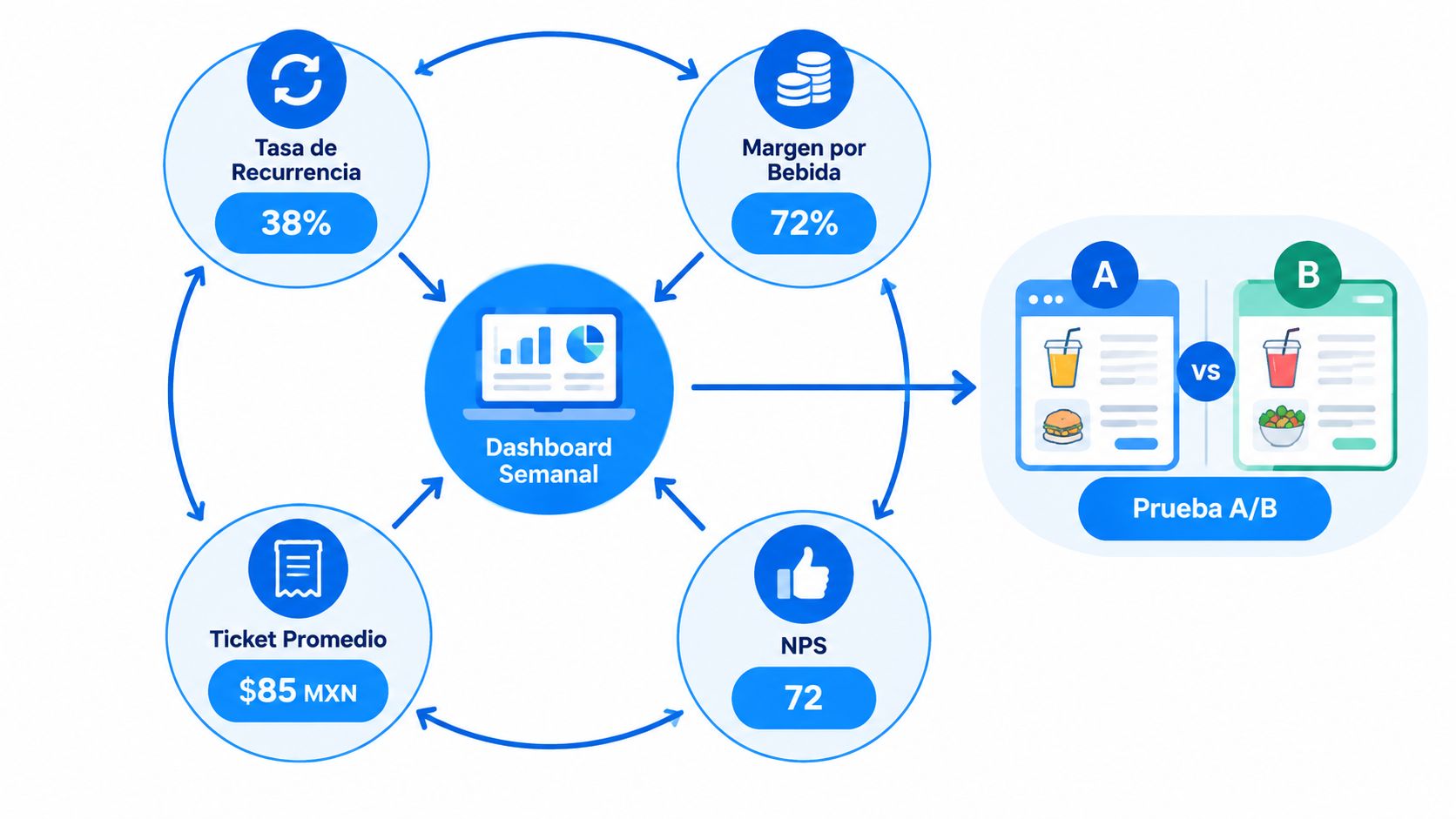
A coffee shop does not need a hundred indicators. It needs a weekly dashboard that connects what the customer perceives with what the business earns. The foundation must include recurrence rate, margin per beverage, average ticket, NPS, and service time, separated by branch and time slot.
Choosing a single hypothesis
A useful A/B test changes one variable and keeps the others stable. The team can compare a bean description, the timing of a morning combo, two barista recommendation scripts, or two house blends for 14 days.
Each test should be written like this:
Hypothesis: a clearer sensory description will increase filter coffee selection.
Primary metric: proportion of tickets that include that product.
Control metric: margin per ticket and service time.
Unit of analysis: daily tickets, not impressions or general visits.
Decision: scale, iterate, or discard.
The sample size should be based on available daily tickets. If a branch has low volume, the test needs more time to avoid concluding from noise. Making decisions after one week often confuses an atypical day with a trend.
Reading the dashboard like an operator
If recurrence goes up and the margin holds, the proposal deserves to be scaled. If the ticket goes up but service time drops, the recipe needs simplification. If the NPS improves but customers do not return, the business must review the benefits program, contact frequency, or convenience of the offer.
A practical decision tree looks like this:
Did the primary metric improve? If not, discard or reformulate the hypothesis.
Was the margin preserved? If not, adjust price, portion, or ingredients.
Did the operation support the change? If not, redesign recipe or workflow.
Does the improvement appear by branch and slot? If yes, scale where it works.
Does the customer repeat? If not, connect the offer with CRM and habits.
The common mistake in LATAM is measuring likes while recurrence falls. Another is celebrating a viral drink without knowing its margin. The specialty coffee shop differentiates itself when its data allows repeating what works and eliminating what only looks good.
Swirvle offers a CRM with a loyalty program, segmentation by habits and branch, automated campaigns via WhatsApp, push notifications, and email, plus dashboards to measure sales attributed to campaigns. Those who want to turn their coffee shop's recurrence into a measurable process can visit Swirvle and see how to organize customers, rewards, and operational decisions from a single place.
Related Blogs

Oct 22, 2026
How to prevent employee petty theft in my business?

Oct 21, 2026
How to Control Food Waste in a Restaurant: 2026 Guide

Oct 20, 2026
What is the global invoice for the general public and when is it issued? SAT Guide

Oct 19, 2026
How to take restaurant orders on WhatsApp without losing any?

Oct 18, 2026
How to Create a WhatsApp Business Catalog to Sell More: 2026 Guide

Oct 17, 2026
How to set up quick replies in WhatsApp Business?