
How to increase recurring sales? A practical guide for physical SMEs using loyalty programs, WhatsApp, and coupons to boost frequency and average ticket.
Only 22% of Mexicans consider themselves loyal to a specific brand, while 78% are willing to switch if they find a better price, experience, or value, according to an analysis cited in local media on consumer trust in Mexico. That completely changes the question of How to increase recurring sales?. The answer is not in "bringing in more people," but in building a system that makes the customer return for a specific, measurable, and repeatable reason.
In physical SMBs, recurrence does not happen on its own. It is designed using purchase data, behavioral segmentation, tangible rewards, and channel tracking. Whether the business is a coffee shop, a barbershop, or a restaurant, proximity helps, but it does not replace a system that records who came back, when they came back, and why they came back. Recurring sales begin when the store stops looking only at traffic and starts measuring frequency, average ticket, and retention by branch and cohort.
Why recurring sales don't grow on their own in physical SMBs
BLUF: recurrence is designed, not improvised, because in Mexico loyalty is fragile and customers switch if they don't see a clear reason to stay.
The majority of businesses in Mexico are SMBs. A source summarizing INEGI data indicates that 99.8% of the companies in the country are MSMEs. That explains why the challenge is not theoretical, it is operational. Most of the business landscape operates with small teams, limited budgets, and a need to see results by branch, not in nice averages.
In this context, a coffee shop cannot rely on "neighborhood locals" returning on their own. A barbershop cannot assume either that the last visit solved everything. If there is no specific reason to return, the customer moves on. And they don't need to be unhappy; it is enough for them to find less friction, more value, or a better offer.
Rule of thumb: if the business cannot say why the customer should return this week, it cannot expect stable recurrence either.

The difference between an isolated promotion and a measurable loyalty system is simple. The promotion drives a purchase. The system captures behavior, records the visit, triggers a follow-up, and learns what incentive works by branch. In Mexico, loyalty program members are also up to 4 times more likely to consider the store their regular place of purchase compared to non-members, according to loyalty studies cited in the reference on consumer trust in Mexico. This does not happen by chance, it happens when the store turns repurchase into a routine.
The Mexico RPI 2023 by dunnhumby found that 7 out of 10 Mexicans use at least one loyalty program and that 43% of those who use these programs participate in 2 or more. This signal is key for physical SMBs because it confirms that recurrence does not rely on a single discount, but on systems that the customer understands, uses, and remembers. The internal link why customers do not return even if they left happy helps read this symptom more clearly.
Initial diagnosis and data you must capture in your store
BLUF: before automating, the store must capture a minimum baseline of useful data, or all recurrence will be intuition disguised as strategy.
The diagnosis starts at the checkout. There is no need to turn the operation into bureaucracy, you just need to record what allows for segmentation later. A coffee shop can collect contact info and branch, a restaurant can add the main product and last visit, and a barbershop can add the reason for consumption, haircut, styling, or touch-up. The key is not to slow down checkout.
The store needs to know what to measure by branch and by cohort. If a location attracts frequent visits but low tickets, the strategy is not the same as in another where the ticket is high but the return takes too long. Without that insight, the business ends up rewarding everyone equally and penalizing personalization. The internal link customer database fits here because a useful database is not the largest, but the most organized.
Good operational criteria: data that does not allow you to decide on a campaign should not be requested at checkout.
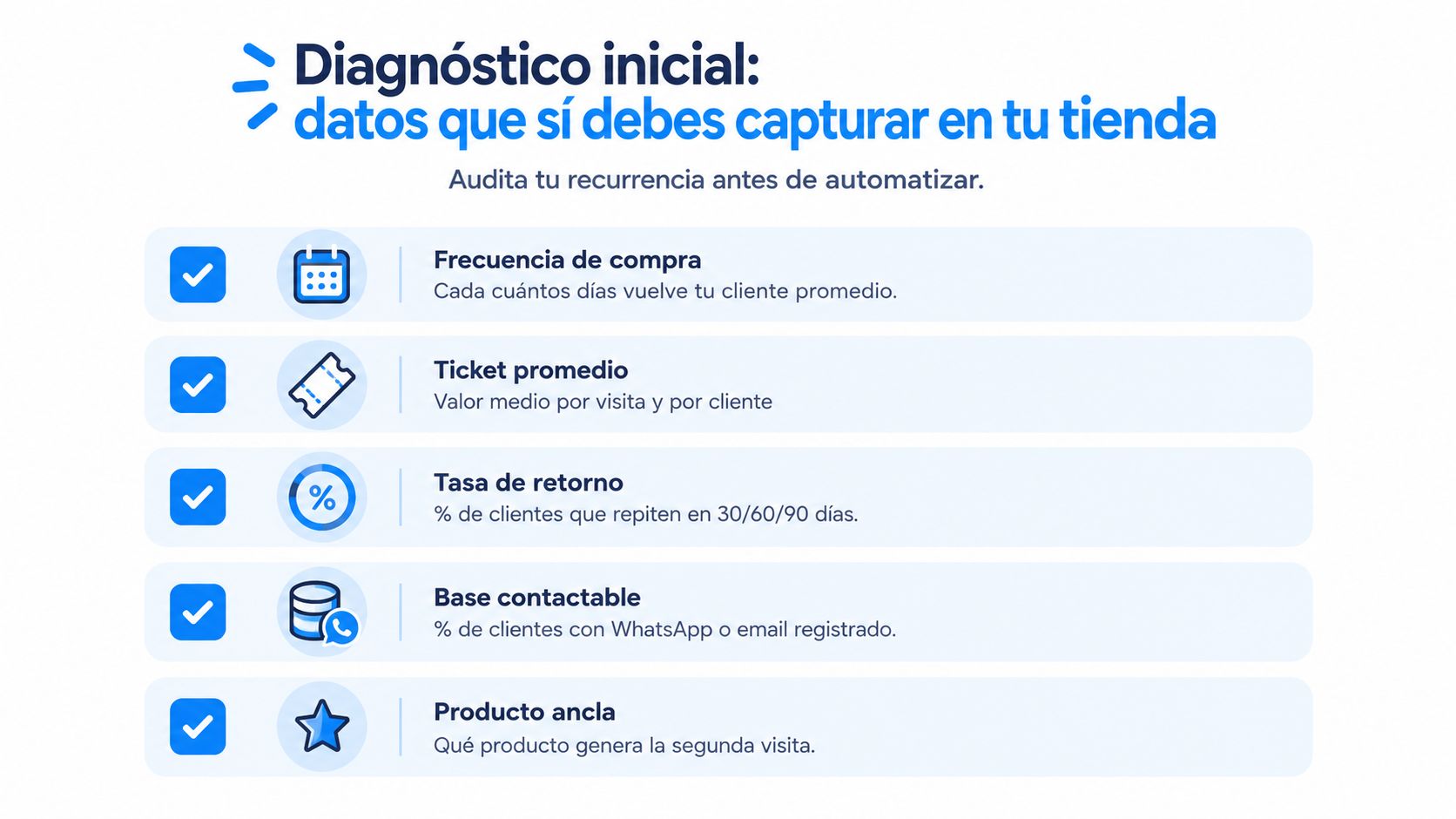
The essential fields are few, but they must remain consistent. Consented contact, last visit, main product, branch, and purchase frequency are enough to trigger real segmentation. If the business manages multiple channels, it is best to unify scattered contacts into a single record, because there is little use in having several phone numbers, emails, or loose tags if the campaign does not know who it is addressing.
What should be captured without creating friction
Consented contact: allows reactivation by channel without depending on new traffic.
Purchase branch: avoids sending the same message to everyone when each location has different rhythms.
Last visit: signals who is active and who already needs a reminder.
Main product: helps send a useful, not generic, offer.
Reason for purchase: useful for barbershops, beauty salons, and restaurants with repeated consumption.
In a restaurant, for example, it is not advisable to ask the customer ten things. It is better to record the bare minimum and use it well. In a beauty salon, a note about the main service and branch already allows designing the next communication. Operational precision is worth more than a huge, messy database.
Designing your loyalty program and rewards that make them come back
BLUF: loyalty works when the mechanics match the real motive for purchase, not when the store hands out generic discounts.
A study with 2,039 Mexican consumers segmented the base into four profiles, Monetary, Habit, Status and Reciprocity, and found that 91% participate in at least one loyalty program, but 82% are willing to switch brands if they receive the right incentive. The message is clear. Having a program does not guarantee retention. Having a poorly designed program only creates opportunistic customers.
The useful takeaway for a physical SMB is this. If the customer responds to price, the reward must be visible and simple. If they respond to habit, the program must reward consistency. If they value status, the store needs exclusive benefits. If they buy for the relationship, communication and treatment weigh more than the discount. Treating everyone the same is the classic mistake.
Matrix of rewards by business type and archetype
Archetype | Ideal reward | Example coffee shop / restaurant / barbershop |
|---|---|---|
Monetary | Direct and simple savings | Coffee shop, free drink through accumulation. Restaurant, controlled discount on a large bill. Barbershop, clear benefit on the next visit. |
Habit | Routine reward | Coffee shop, frequency prize. Restaurant, stamp or recurring visit. Barbershop, reminder and benefit for continuity. |
Status | Exclusive benefit | Coffee shop, early access to new items. Restaurant, priority attention. Barbershop, preferred booking or differentiated service. |
Reciprocity | Relational detail | Coffee shop, small and frequent courtesy. Restaurant, personalized gesture. Barbershop, upgrade or special treatment for loyalty. |
The mechanics must also be manageable. In Mexico, a clear rule for points is to define from the start the accumulation unit, redemption threshold, and expiration. A practical scheme is 1 point for every 10 pesos, redemption at 100 points, and expiration after 90 or 180 days of inactivity, with automatic deduction if there are returns or cancellations, according to the reference on how loyalty programs work. That logic reduces friction and prevents the customer from not understanding when they earn and when they redeem.
For food and physical services, the reward has to be tangible and cost-controlled. A free coffee in a coffee shop works because the customer understands it quickly. In a restaurant, a discount on a large bill can drive the next visit without destroying margin. In a barbershop, a small but frequent benefit can sustain the flow better than a massive promotion.
Automated campaigns that generate visits without chasing customers
BLUF: recurring visits are triggered with useful and segmented messages, not by chasing or mass-mailing the entire base.
To scale recurrence in Mexico, WhatsApp has the lowest friction between cost and response. In Mexico, its reported penetration is around 94.3% and the channel shows a 98% open rate, while optimized campaigns can drive conversions from 5% to 15%, well above the traditional email rate of 1% to 3%, according to the guide on sales via WhatsApp in LATAM. In direct messages initiated by the customer, conversion can exceed 45%, and in some channel benchmarks, optimized campaigns reach 45% to 60%. The lesson is not to "use WhatsApp just because," but to use it with discipline.
A coffee shop can trigger a reminder when a customer has gone a certain amount of time without buying their anchor product. A barbershop can trigger an alert when it detects inactivity since the last visit. A restaurant can send a reminder about expiring balances or available rewards, always with a single offer and a single CTA. The internal link marketing automation fits because automation without segmentation only accelerates mistakes.

Flows that actually drive repurchasing
Repurchase by history: if a customer usually buys specialty coffee, the message should remind them of that category, not the whole menu.
Inactive visit: if the barbershop does not see the customer, the message should make booking useful, not sound like an ad.
Balance or reward expiring: if there is a benefit available, the alert must arrive before it is lost.
Recovery by branch: if a location is performing below its rhythm, the campaign should target its cohort, not the entire base.
Each flow needs a single offer, a single action, and a single measurement. Everything else is a distraction.
Mass messaging decreases performance. When the store sends the same text to everyone, recurrence is eroded because the customer stops perceiving relevance. Conversely, a short message with purchase context and a clear benefit feels useful. That difference is what separates a campaign that reactivates from a campaign that annoys.
Measuring recurrence and ROI without getting lost in metrics
BLUF: if the store does not measure by branch and cohort, it does not know if it is growing or just shifting sales between periods.
The useful metric is not total isolated sales, but the combination of purchase frequency, average ticket, redemption rate, and 90-day retention. In physical SMBs, this must be read by branch, because two locations of the same brand can behave entirely differently. A centralized CRM with dashboards allows you to compare cohorts and see which campaign generated real visits, not just clicks.
Digital programs connected to a CRM report average increases of 15% in purchase frequency and up to 38% in average ticket, according to the reference on frequent customer cards. This type of improvement does not happen by accident; it happens when every redemption, visit, and response is recorded in a single place. This is where a solution like Swirvle can come in as an operational choice, because it centralizes customers, behavioral segmentation, and branch-specific insights, automations via WhatsApp, push and email, and dashboards to measure ROI and attribution.
Measurement must also serve to decide which campaign to turn off. If a barbershop sees that a reminder works in one branch but not another, the problem is not the channel, it is the segment or the offer. If a restaurant achieves high redemption but a weak ticket, the reward is attracting visits without raising value. If a coffee shop converts well but does not repeat, the follow-up frequency is poorly designed.
What to review every week
Frequency by branch: confirms whether behavior is repeating or dropping off.
Average ticket by cohort: detects if the reward is driving value or just volume.
Benefit redemption: shows if the offer is understood and desired.
90-day retention: separates active customers from those who only showed up once.
Measuring only total sales hides the problem. Measuring by cohort makes it visible.
A store that reviews this data every week can adjust messages, thresholds, and rewards without waiting for the end of the month. That rhythm is what turns recurrence into profitability, not just another seasonal campaign.
Operational checklist to implement your plan in 30 days
BLUF: in 30 days, you can go from a messy database to a functional system, as long as the store does not try to do everything at once.
The first seven days should focus on capturing and organizing. Checkout needs a simple script to request consented contact, branch, last visit, and main product. If the business is a coffee shop, staff should only record the minimum without slowing down the line. If it is a barbershop, the same criteria apply, a short capture and immediate use.
Between days 8 and 15, the brand must segment. There is no need to create ten groups, it is enough to separate by branch, frequency, and type of purchase. From there, the first campaign must target a single segment with a single offer. The most expensive mistake is launching to the entire database and then blaming the channel for the poor result.
Days 16 to 23 should be dedicated to automating the trigger. If a customer does not return, the system sends a useful reminder. If a reward is close to expiring, the alert goes out without manual intervention. If the business uses a unified platform, like Swirvle, the operation stops depending on loose sheets and improvised messages.
Priorities that should not be moved
Organizing the database: unify scattered contacts and label by branch.
Activate a pilot segment: a small, clear, and measurable cohort.
Define a tangible reward: no abstract mechanics.
Review results by location: each branch learns differently.
In the final days of the month, the brand must compare which flow generated visits, which message was ignored, and which reward was actually redeemed. That is where operational truth appears. If the business sees consistent signals, it can now extend the system to more branches. If there are no signals, it is not wise to scale chaos.
Recurrence grows when the store stops improvising and starts operating with discipline. Anyone who wants to turn visits into repeat sales can organize their database, automate communication, and measure the return from a single place. To do it with a logic designed for physical SMBs, it is worth visiting Swirvle and checking how it centralizes customers, loyalty, and campaigns to transform data into profitability.
Related Blogs

Oct 22, 2026
How to prevent employee petty theft in my business?

Oct 21, 2026
How to Control Food Waste in a Restaurant: 2026 Guide

Oct 20, 2026
What is the global invoice for the general public and when is it issued? SAT Guide

Oct 19, 2026
How to take restaurant orders on WhatsApp without losing any?

Oct 18, 2026
How to Create a WhatsApp Business Catalog to Sell More: 2026 Guide

Oct 17, 2026
How to set up quick replies in WhatsApp Business?