
Installed capacity is the maximum you can produce or serve with your resources. Utilization formula and an example in a coffee shop.
What is installed capacity? It is the maximum number of products or services that a business can produce or handle in a given period with the resources it already has: space, equipment, staff, and operating hours. It is compared with actual production to know what percentage of that potential you are currently using.
Formula: % utilization = actual production ÷ installed capacity × 100
Example in a coffee shop: with 2 baristas and an espresso machine you can prepare 60 drinks per hour; in 10 hours of service, your installed capacity is 600 drinks per day. If yesterday you sold 390, your utilization was 390 ÷ 600 × 100 = 65%. That free 35% is capacity you are already paying for in rent and payroll.
Installed capacity vs. actual capacity
Installed capacity is what your business could do under ideal conditions. Actual capacity (or effective capacity) is what it can truly do after subtracting cleaning, breaks, maintenance, shift changes, and breakdowns. And actual production is what you actually sold. In the coffee shop example, if the machine stops for one hour a day for cleaning, the actual capacity drops to 540 drinks even though the installed capacity remains at 600. Planning based on installed capacity rather than actual capacity leads to promising more than the team can deliver.
The coffee shop in Mexico City is packed at 8:30. The car wash in Monterrey has a queue on Saturday. The gas station with a convenience store in Yucatán sells non-stop during rush hour. And yet, at the end of the month, the profit feels thin. The problem is almost never a "lack of movement." The problem is that the business works hard but uses its capacity poorly.
This happens every day in Mexican SMBs. A store may look busy and still lose margin due to downtime, poorly assigned staff, underutilized equipment, poorly rotated tables, or campaigns that attract customers right when there is no more room for them. Having demand is not enough. You need to convert that demand into a profitable operation.
Installed capacity serves to give a name to that reality. It is not a concept reserved only for factories or power plants. It also applies to a coffee shop in Puebla, a grocery store in the State of Mexico, a car wash in Nuevo León, or a service station in Baja California. In simple terms, it answers a crucial question: how much can a business handle or produce with what it already has?
When an owner understands that figure, they stop making decisions based on intuition. They no longer hire "because they feel overwhelmed," nor do they launch promotions without knowing if the problem lies in demand or in an internal bottleneck. They begin to see which resource is limiting growth, which hours are being wasted, and where money is being thrown away.
A business can be full and still operate below its true potential.
The good news is that this can be measured, corrected, and improved. And it does not always require buying more equipment or opening another branch. Many times, the biggest breakthrough comes from making better use of the space, time, staff, and data that already exist.
Table of Contents
Installed capacity vs. actual capacity
Introduction: Full of customers but low on profit?
The typical symptom
What is actually failing
What is installed capacity in a business?
The definition that actually works for an SMB
Three levels worth separating
The error of confusing installed capacity with actual capacity
Key formulas and metrics to measure your capacity
Utilization rate
OEE adapted to services
Product hours
Essential capacity metrics
Practical examples by business type
Car wash in Monterrey
Coffee shops in Mexico City and Baja California
Gas station with a store in Yucatán
How to improve your installed capacity with data and campaigns
First, identify off-peak hours and bottlenecks
Then, shift demand instead of suffering from it
Digital capacity counts too
From measurement to profit: The continuous improvement cycle
A simple cycle that actually works
Profitable improvement usually starts small
Frequently asked questions
What is installed capacity?
How is installed capacity calculated?
Introduction: Full of customers but low on profit?
A business with a constant flow can be mismanaging its installed capacity. That is why a coffee shop with occupied tables does not always make more than another with less traffic but better operational control. The same goes for a car wash in Puebla that has a queue at noon and empty bays on weekdays, or a bakery in the State of Mexico that sells a lot on weekends and wastes staff and production during the rest of the week.
The confusion arises because many owners look at activity, not performance. They see people walking in, receipts printing out, and staff running around. That gives a false sense of health. But profitability does not come from noise. It comes from how much the business produces with what it already pays for each month.
The typical symptom
A neighborhood café can have three problems at the same time: morning queues, empty tables in the afternoon, and baristas overwhelmed only at certain times. From the outside, it looks like a lively operation. From the inside, payroll, rent, utilities, and equipment are working at half-capacity.
In competitive markets like Mexico's large cities, operating without measuring capacity is not a minor omission. It is a disadvantage.
What is actually failing
The problem is usually not "selling more." It is typically one of these three:
Miscalculated capacity: the owner does not know how many customers they can serve well per hour.
Poorly distributed capacity: demand arrives all at once and leaves dead times.
Poorly activated capacity: the business does not use data to fill slow hours or to protect peak hours.
Rule of thumb: if a business does not know where its bottleneck is, it is making expensive decisions based on incomplete information.
Those who correct this gain control. They start pricing better, scheduling better, selling better, and growing with less friction. That is when installed capacity stops being a theory and turns into money.
What is installed capacity in a business?
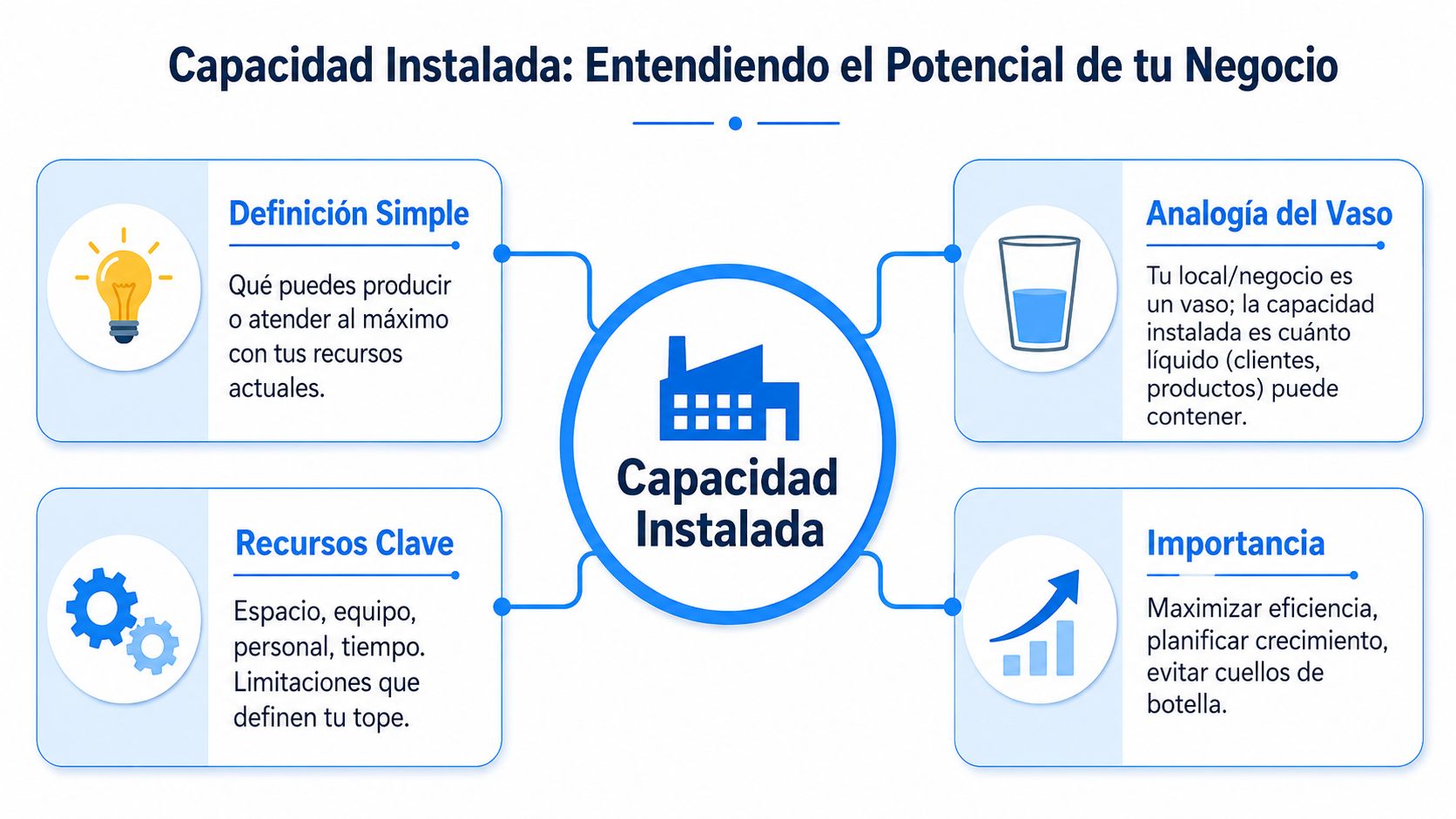
Installed capacity is the maximum a business can serve or produce with its current resources. Resources mean space, equipment, staff, and time. There is no need for a complicated industrial definition. A coffee shop has installed capacity in tables, baristas, the espresso machine, and operating hours. A car wash has it in bays, staff, supplies, and service time per vehicle.
The definition that actually works for an SMB
The most useful analogy is that of a glass. If the business were a glass, installed capacity would be how much it can hold. In a brick-and-mortar business, that translates into customers served, services completed, or tickets processed within a period.
Being compliant with local regulations also shapes that capacity. Schedules, occupancy limits, land use, and establishment conditions can define how much an SMB can actually operate. That is why it is highly recommended to review these permits with your local municipality when planning to open, expand, or reconfigure a point of sale.
Three levels worth separating
Many businesses mix up three different things, and that is why they make mistakes when measuring.
Design capacity: the ideal maximum. Example: a coffee shop with 20 tables of 4 chairs each.
Effective capacity: what it can actually handle considering cleaning, breaks, preparation times, and shift changes.
Actual production: what happened today, this week, or this month.
A restaurant in Puebla may have a kitchen designed to produce a certain volume of orders per hour. But if an oven goes into maintenance, if a cashier takes too long, or if the delivery of ingredients is delayed, the actual operation drops. The installed capacity remains on paper. The usable capacity drops in practice.
The error of confusing installed capacity with actual capacity
This error is costly. Breakdowns, maintenance, and schedule or occupancy restrictions mean that part of what is installed is not available when you need it. For a car wash or a coffee shop, the lesson is the same: owning the asset does not mean having full availability.
Theoretical capacity reassures. Actual capacity pays the bills.
That is why the right question is not "what does the business have?". The right question is "what can it reliably and profitably use each day?". When that answer becomes clear, much smarter decisions appear.
Key formulas and metrics to measure your capacity
Most SMBs do not need a sophisticated model. They need three simple metrics and the discipline to review them. That is enough to detect waste, saturation, and opportunities.
Utilization rate
The utilization rate shows what percentage of the available capacity is being used.
Simple formula:
Operation | Calculation |
|---|---|
Utilization rate | Actual production / Effective capacity x 100 |
Simple example: If a car wash can handle 10 cars per hour under normal conditions and today handled 7, its utilization was 70%. If a coffee shop in Mexico City can serve 80 drinks per shift and only served 50, the utilization was 62.5%.
This metric serves two purposes: identifying dead times and confirming saturated hours. If utilization is low during several blocks of the day, the business does not need more equipment. It needs to shift demand.
OEE adapted to services
In manufacturing, OEE is used. In services, it is also useful if translated with common sense. Here it can be read as a combination of availability, pace, and quality.
Simple formula:
Component | Calculation |
|---|---|
Availability | Operating time / Scheduled time |
Performance | Actual production / Possible production in operating time |
Quality | Error-free services / Total services |
Service OEE | Availability x Performance x Quality |
A coffee shop in Baja California can have its bar open for the entire shift, but lose productivity if equipment breaks down, baristas take too long, or drinks have to be remade. A car wash can open on time and still lose money if the drying area delays delivery and forces workers to redo details due to poor quality.
Product hours
This metric translates capacity into sellable units per hour. It is useful for brick-and-mortar businesses because it connects operations and the cash register.
Simple formula:
Operation | Calculation |
|---|---|
Product hours | Sellable units / Operating or working hours |
In a gas station with a store, it can be measured by transactions at the register per hour. In a restaurant, by dishes served by the kitchen per hour. In a bakery, by decorated pieces or orders dispatched per block of time.
Operational tip: a mediocre metric measured every week is worth more than a perfect metric that is never reviewed.
Essential capacity metrics
Metric | Simple Formula | What does it tell you? |
|---|---|---|
Utilization rate | Actual production / Effective capacity x 100 | How much of the available potential is actually being used |
OEE adapted to services | Availability x Performance x Quality | How well the business operates once it is open |
Product hours | Sellable units / Operating hours | How much time translates into actual sales |
It is highly recommended to record these metrics by location, shift, and day. That is where patterns emerge. A clear dashboard prevents the owner from relying on isolated impressions. To organize this reading, it helps to review a practical approach on how to use a sales dashboard.
Anyone who measures capacity stops managing by fatigue and starts managing by evidence.
Practical examples by business type
Concepts are best understood when they hit the floor of the business. Not the Excel sheet. The floor.

Car wash in Monterrey
A car wash in Nuevo León might believe that its capacity depends on the tunnel or the bays. Sometimes it doesn't. Many times the bottleneck is at the end, in drying, detailing, or payment.
If the business measures cars received per hour, cars delivered per hour, and average time per stage, it quickly finds the real constraint. It may discover that the incoming queue does not mean high capacity, but rather slow output. Therefore, the right decision is not to attract more cars with a general promo. It is to speed up the final phase, adjust roles, or redesign the flow.
Coffee shops in Mexico City and Baja California
A small chain can have an office-oriented branch in Mexico City and another in a tourist area of Baja California. Having the same menu does not imply the same capacity. In one, the peak might be concentrated in the morning. In the other, it might be spread more towards the afternoon or the weekend.
Here it helps to measure two things: customers served per shift and cups prepared per barista. If a branch has tables available but the bar collapses, the bottleneck is in preparation. If the bar is doing well but the tables are not rotating, the problem lies in occupancy, table service, or order mix. To decide on promotions or staffing, it also helps to analyze behaviors by high and low season.
Gas station with a store in Yucatán
In a service station, capacity is not a single element. There are at least two layers: fuel pumps and the store cash register. One can be free while the other is saturated.
The convenience store can process a certain number of transactions per hour, but if the queue grows at the register, impulse sales drop. The customer buys less because they want to leave quickly. At that point, the store's installed capacity is limited by checkout, not by inventory.
Installed capacity is not only measured in customer service. It is also measured in infrastructure (refrigeration, energy, shelf space) that sustains profitability.
A physical business earns more when it identifies which part of its operation limits all the others.
How to improve your installed capacity with data and campaigns
Measuring is good. Staying only at the measurement phase is useless. Installed capacity improves when the business uses data to shift demand, adjust operations, and fill profitable gaps.
First, identify off-peak hours and bottlenecks
Most owners already know when the business "gets good." This informal knowledge is of little help if it is not converted into concrete decisions. The useful thing is to map three bands: saturation, normal operation, and off-peak hours.
With that reading, direct actions appear:
Move staff with precision: not by habit, but based on the actual workload per hour block.
Separate demand problems from process problems: if there is a queue with idle staff, the flow is poorly designed.
Avoid clumsy promotions: promoting during peak hours only compresses margins and worsens service.
A café in Puebla does not need a discount at 8:00 AM if it is already full. It needs it mid-afternoon, when tables, bar, and rent still cost money, but demand drops.
Then, shift demand instead of suffering from it
This is where the intersection of operations and marketing comes in. A smart business does not wait for the customer to arrive whenever they want. It gives them reasons to arrive when it is most convenient.
Some tactics work very well in SMBs with physical stores:
Promotions for dead hours
A car wash can offer benefits on weekdays, not on Saturday at noon. This converts empty capacity into additional revenue.Campaigns segmented by proximity or habit
A coffee shop can trigger a message to frequent customers who live or work nearby, inviting them during low-occupancy hours. A useful framework for structuring this is in this digital marketing campaign guide.Loyalty with an operational goal
It is not just about rewarding purchases. It is about rewarding purchases at the right time. If the business wants to push Monday afternoon or Wednesday before lunch, it must design the incentive for that.
Marketing stops being an expense when it helps fill idle capacity without putting pressure on saturated operations.
Digital capacity counts too
Many brick-and-mortar businesses already have physical assets. What they lack is the digital infrastructure to govern them well. That gap matters more than many owners think.
The lesson for an SMB is simple: having physical capacity without the digital capacity to manage it leaves money on the table.
A car wash in Monterrey may have bays, staff, and vehicle flow. If it does not capture data on visits, frequency, hours, and response to promotions, it continues to operate blindly. A gas station in Baja California can sell thousands of products in-store over time and still not know which customer responds to which message, nor when it is best to activate it.
Actual improvement appears when capacity data triggers specific actions:
Adjust shifts to protect service at peaks.
Launch campaigns to fill slow hours.
Change incentives to better distribute demand.
Measure return by schedule, branch, and segment, not just total sales.
This turns installed capacity into a commercial lever, not just an operational one.
From measurement to profit: The continuous improvement cycle
Installed capacity is not optimized just once. It is managed all the time. Those who review it only when there is a crisis are always too late. Those who turn it into a routine find margins before anyone else.
A simple cycle that actually works
The useful cycle has four steps:
Measure: choose a basic metric per business unit.
Detect: locate the bottleneck or underutilized range.
Act: move staff, adjust the process, or activate demand.
Repeat: compare the result and correct.
There is no need to overcomplicate it. A coffee shop can start with drinks per hour and table occupancy. A car wash, with cars delivered per block. A gas station, with in-store transactions per shift. The important thing is that the metric connects to money.
Profitable improvement usually starts small
A small change can have a powerful effect if it makes better use of already committed costs. One more customer per hour, a better-rotated table, or a better-managed dead zone increases revenue without touching rent, a large part of the payroll, or other fixed costs.
The opportunity to apply capacity and efficiency criteria is huge, especially in coffee shops, restaurants, and retail, where rent and payroll are paid the same whether the place is full or empty.
What is not measured is debated. What is measured is improved.
The next step should not be huge. It should be clear. Choose a single metric. Measure it for a week. Make a concrete decision based on that data. Then repeat. This is how you build a more orderly, more profitable, and much more stable operation.
Frequently asked questions
What is installed capacity?
It is the maximum volume that a business can produce or handle in a period with its current resources: space, equipment, staff, and operating hours. In a coffee shop, for example, it is measured in drinks or customers served per hour or per day.
How is installed capacity calculated?
Multiply what your most limited resource can produce per hour by the hours of operation (for example, 60 drinks per hour × 10 hours = 600 drinks per day). To know how much you are taking advantage of it, use: % utilization = actual production ÷ installed capacity × 100.
What is the difference between installed capacity and utilized capacity?
Installed capacity is the maximum you can produce or handle with your current resources. Utilized capacity is what you actually produce or handle in that same period.
How do I make better use of my business's installed capacity?
Identify your off-peak hours and drive demand to those times with promotions targeted at customers who already know you, rather than investing in more equipment or more space.
Swirvle helps translate that logic into daily execution. For SMBs with physical stores, it centralizes customer data, automates push and email campaigns (and WhatsApp in the Premium plan), activates loyalty, and allows measuring ROI to fill off-peak hours, increase repeat visits, and sell more with already installed capacity. Anyone who wants to operate with more control and less intuition can discover Swirvle.
Related Blogs

Oct 21, 2026
How to Control Food Waste in a Restaurant: 2026 Guide

Oct 20, 2026
What is the global invoice for the general public and when is it issued? SAT Guide

Oct 19, 2026
How to take restaurant orders on WhatsApp without losing any?

Oct 18, 2026
How to Create a WhatsApp Business Catalog to Sell More: 2026 Guide

Oct 17, 2026
How to set up quick replies in WhatsApp Business?

Oct 16, 2026
Can fake Google reviews be removed and how do you request it?