
Practical guide to omnichannel marketing strategy for SMBs with physical stores. Diagnosis, channels, automations, and KPIs to measure ROI with Swirvle.
In Mexico, 83% of consumers combine online and in-store shopping, while 54% adopt an omnichannel behavior, above regional and global averages, according to Mexico Business News on Mexican omnichannel behavior. For a coffee shop, restaurant, barbershop, or beauty salon, this data changes the priority: the customer no longer decides at a single counter. They discover digitally, ask via WhatsApp, visit a branch, compare, buy, and expect a concrete reason to return.
An omnichannel marketing strategy is not about opening more profiles or posting the same promotion everywhere. It consists of coordinating branch data, consumption habits, inventory, conversations, and rewards so that each interaction helps the next sale. A business that connects these dots stops chasing isolated transactions and starts managing recurrence.
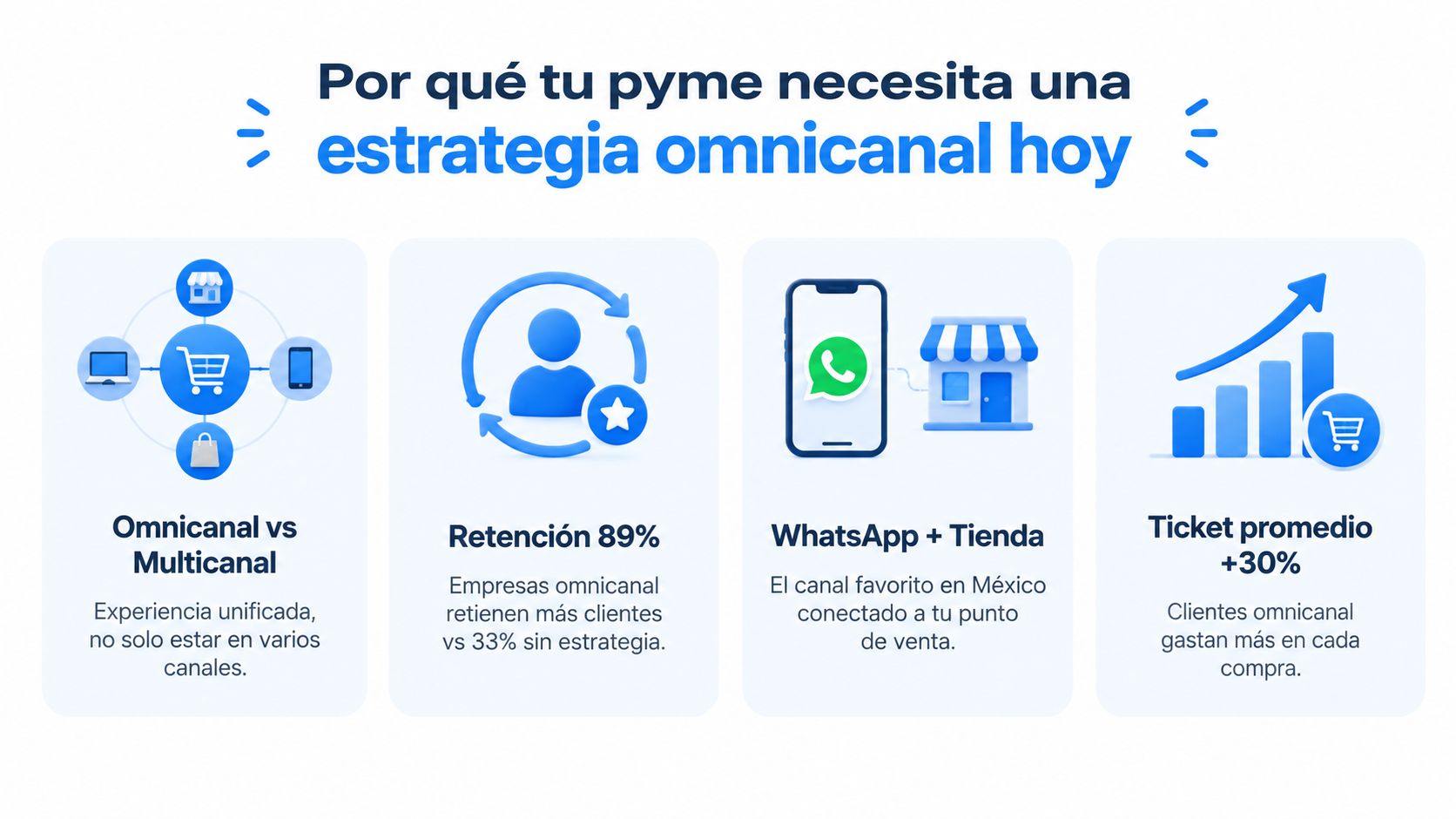
Why your SMB needs an omnichannel strategy today
The difference between multichannel and omnichannel is operational. A multichannel SMB may have a store, social networks, email, and WhatsApp, but each space works separately. An omnichannel strategy turns those points into a continuous experience: the coupon received by message can be redeemed at the right branch, the appointment confirmed via WhatsApp is registered, and the physical purchase feeds the next communication.
The Mexican market already operates this way. The same report indicates that consumers visit e-commerce platforms approximately once every two months and spend an average of MX$441 per visit. This frequency does not imply that the physical store has lost relevance. On the contrary, web, messaging, and branch participate in a hybrid journey where each channel fulfills a distinct function.
The purchase begins before the visit
A coffee shop can capture a person through a local post, guide them to a digital menu, and close the order via WhatsApp. If the purchase is associated with a branch, the next message can highlight a habitual drink, a convenient time, or a reward for returning. Without that connection, the business only knows that someone asked. With it, it learns what they consume and how to turn an occasional visit into a habit.
In a restaurant, the customer can check the menu from their phone, save a promotion, ask about ingredients, and visit the venue over the weekend. In a barbershop, the search can begin with a recommendation on social media, continue with a conversation about availability, and end with an in-person appointment. The path changes, but the expectation is the same: consistent information and zero friction.
The digital channel does not replace the branch
The Mexican e-commerce market reached MX$941 billion and 77.2 million active buyers, according to the analysis of e-commerce statistics in Mexico. That same source reports that only 17.7% of sales revenue is channeled through digital media, while 71% of consumers buy services online, compared to 62% who buy products.
The reading for an SMB is clear. The digital channel serves as a bridge for discovery, comparison, booking, and loyalty, but the physical experience still closes many decisions. A CRM like Swirvle can centralize the history by customer and branch, so the team does not depend on separate spreadsheets, scattered chats, or the manager's memory.
Strategic rule: do not add channels until you connect the data that allows you to recognize the customer across all of them.
Quick diagnosis of your omnichannel maturity by branch
Before launching campaigns, each branch needs to answer five concrete questions. The diagnosis can be made in a 30-minute session, separating what the business knows from what it assumes. If an answer depends on reviewing conversations manually or asking the team, there is a data gap.
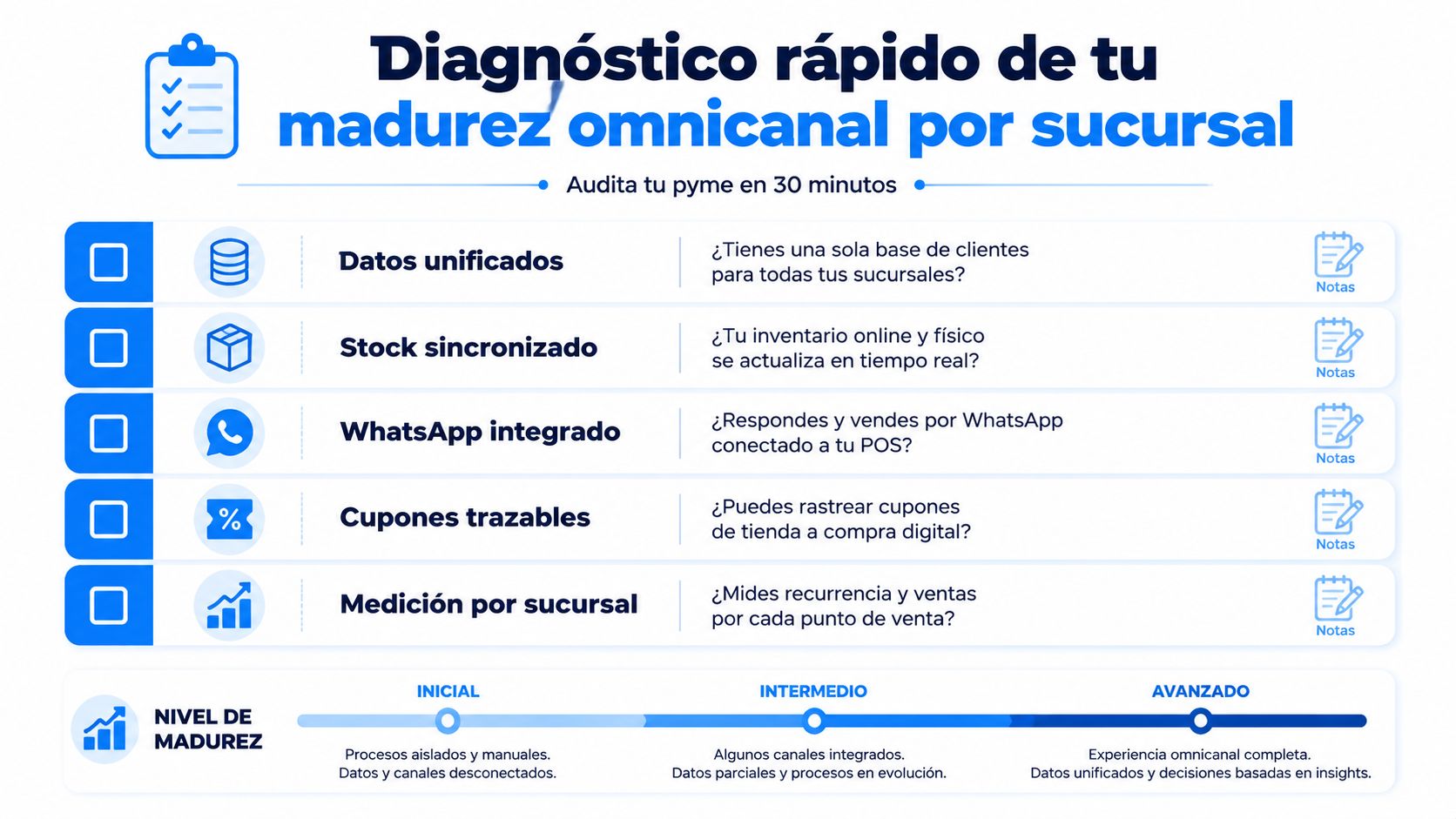
Audit in five questions
Unified data: does each customer have a single record even if they buy at different branches or write from various channels?
Synchronized stock: does the inventory showing as available match what the team can sell or deliver?
Integrated WhatsApp: are conversations about orders, reservations, and follow-ups linked to the purchase?
Traceable coupons: can the business know which campaign generated a coupon and at what point it was redeemed?
Measurement by branch: does management distinguish recurrence, sales, and rewards by location?
The operation must be audited alongside communication. In Mexico, the most common online shopping issues include damaged, late, and incomplete deliveries, with 45%, 38%, and 33% respectively, according to the analysis on RFID technology and omnichannel. Although a coffee shop or barbershop does not operate as a pure e-commerce, the principle applies: a digital promise that fails in availability, delivery, or redemption erodes trust.
Practical classification
A branch is at an Initial level if it keeps data in separate systems, does not identify the source of sales, and sends identical promotions to everyone. It is at an Intermediate level if it already captures customers, registers purchases, and uses some coordinated channels, but differences still exist between branches or coupons remain impossible to attribute.
The Advanced level requires a shared database, reliable stock, behavioral automations, and comparable reports across locations. The priority is not to buy more technology. First, the point that most breaks the journey must be fixed. If inventory is outdated, an acquisition campaign will only lead more people to a poor experience.
Map of channels and touchpoints that actually generate recurrence
The correct map starts with the objective of each contact, not with a list of platforms. The physical store creates trust and experience, WhatsApp resolves doubts and closes conversations, push notifications remind of a timely action, email nurtures the relationship, and coupons connect a promise with a verifiable purchase. Integration prevents two channels from sending contradictory messages.
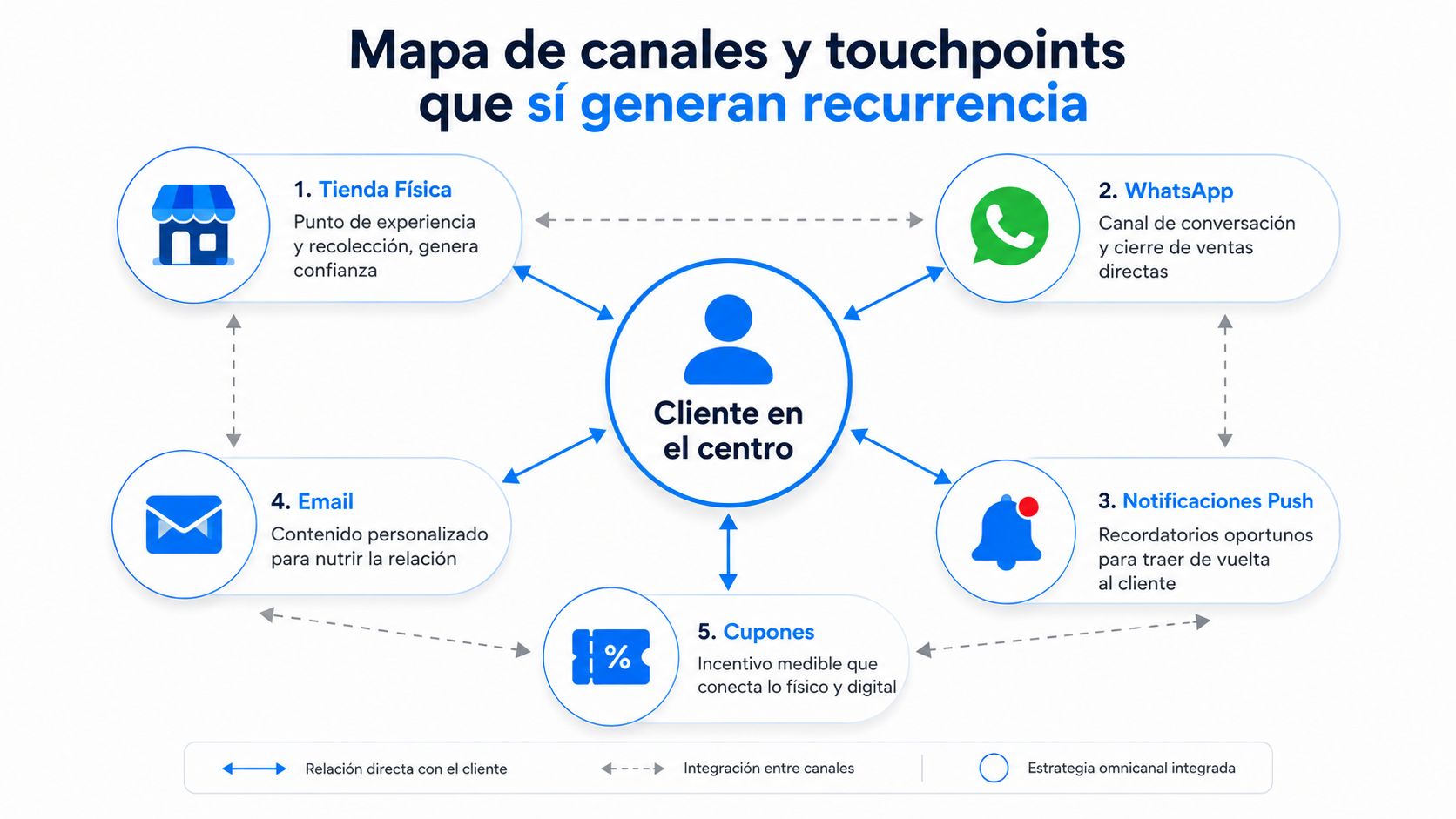
The journey must have an owner
In a coffee shop, the QR on the counter can lead to the menu and request consent to receive updates. The purchase identifies the branch and the chosen product. Afterwards, a reward for visits can arrive through the channel the customer uses most frequently, without forcing them to repeat information.
In a barbershop, the decisive touchpoint is not a generic post. It is scheduling availability. WhatsApp can confirm the appointment, send instructions, and activate a reminder. After the service, a message can propose a new reservation or a complementary service, provided the history justifies it.
In a restaurant, the sequence can start with a visit to the menu, follow with a notification about a pending order, and end with a coupon conditioned on a next purchase. The map must record what happens if the customer responds, ignores, buys, or complains.
Decision matrix by objective
Objective | Priority channel | Coordinated action |
|---|---|---|
Resolve a doubt or close a reservation | Personalized response and record in profile | |
Remind of an appointment or visit | Push or WhatsApp | Message linked to time and branch |
Develop relationship | Content segmented by habits | |
Measure a promotion | Coupon | Code associated with campaign and point of sale |
Reinforce the experience | Physical store | QR, trained staff, and visible reward |
To delve deeper into media selection, it is useful to review this guide on types of communication channels. The decision should depend on urgency, consent, context, and operational capacity. An appointment reminder does not need the same treatment as a brand story.
The system must maintain the history by branch and update the status after each interaction. Thus, a person who has already purchased does not receive a first-visit invitation, and someone who redeemed a coupon does not receive the same offer again.
Segmentation and automations that turn data into sales
Useful segmentation answers three questions: who buys, what they buy, and where they buy. With those answers, an SMB can separate new, occasional, and frequent customers; group by average ticket; identify the favorite branch; and distinguish between products, services, or moments of consumption.
Four segments that actually work
Frequency: new customers need trust and a first reward; occasional ones require a reason to return; frequent ones respond best to recognition, access, or benefits.
Average ticket: an offer to increase a small purchase should not be the same as a proposal for someone who already consumes higher-value services.
Branch: a promotion valid at one location should not reach customers who live or shop far from it.
Service or product: a barbershop can separate haircut, beard, and packages; a salon can distinguish coloring, manicure, and treatments; a coffee shop can separate recurring consumption from seasonal products.
Automation should be written as an if-then rule. If a person registers their first purchase, then they receive a welcome and a clear reward. If they schedule an appointment, then they receive a confirmation and a reminder. If they spend a period without buying, then they receive a reactivation communication different from that of an active customer.
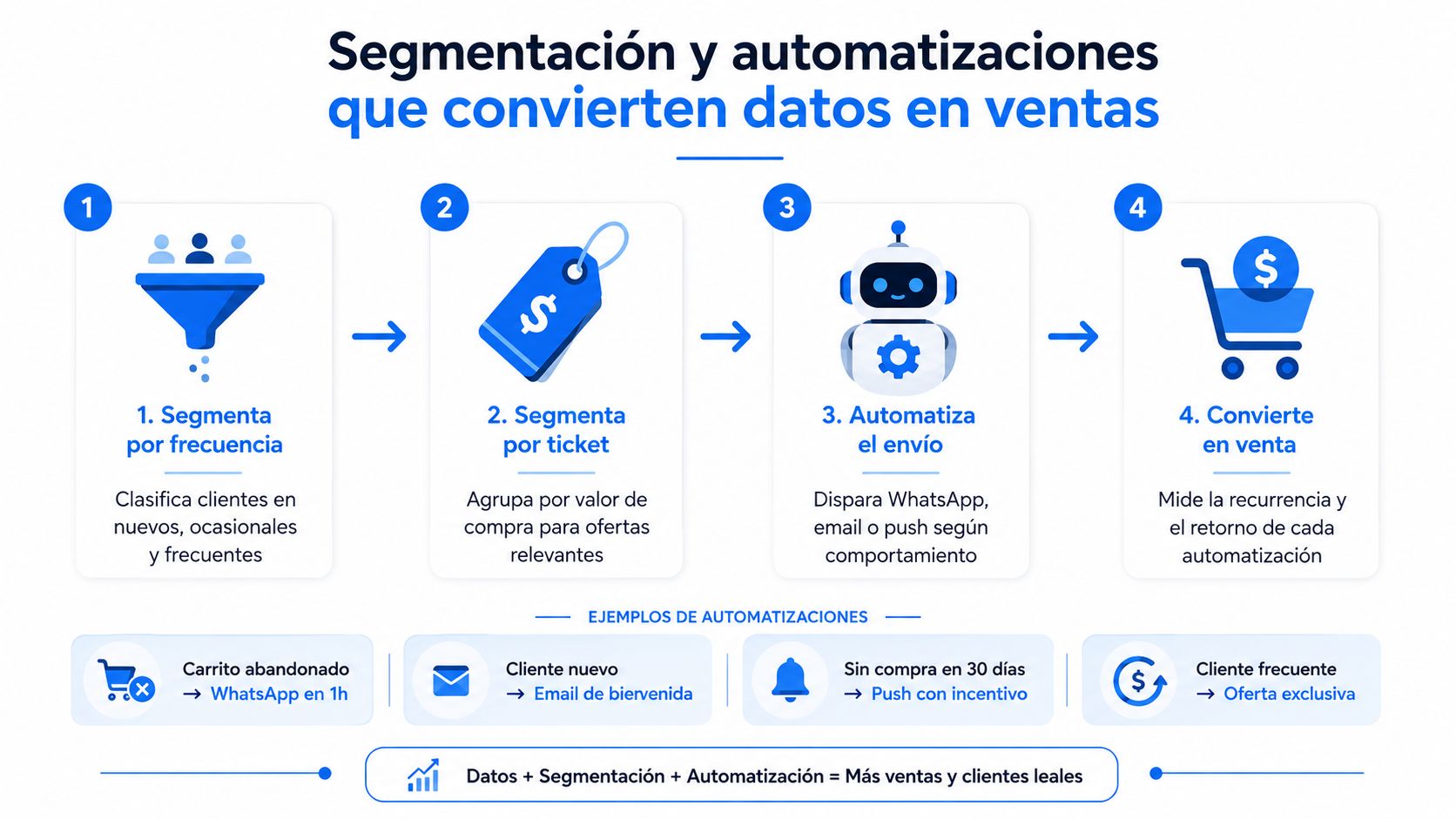
Initial flow library
Welcome: trigger, first purchase or registration. Message, thank you, and coupon for next visit. Measurement, redemption, and second purchase.
Appointment reminder: trigger, confirmed reservation. Message, date, time, branch, and option to reschedule. Measurement, attendance, and new reservation.
Reactivation: trigger, absence of purchase during the period defined by the business. Message, product or service related to history. Measurement, return, and margin.
Reward: trigger, accumulation of points, visits, or purchases. Message, available benefit, and expiration date. Measurement, redemption, and subsequent frequency.
A platform like Swirvle can centralize segmentation by behavior and branch, in addition to triggering WhatsApp, push, and email with automated campaigns. The criteria for use must be simple: each flow needs a verifiable event, an exit if the customer buys, and a rule to avoid oversaturating them.
Automation does not replace the team. Complex answers, complaints, and service changes require human attention. Technology should remove repetitive tasks so that staff can resolve cases where context matters. To organize flows, you can consult this guide on marketing automation.
Examples of omnichannel campaigns for coffee shops, restaurants, and barbershops
A profitable omnichannel campaign coordinates three pieces of data: branch, habit, and reward. Adding WhatsApp, push, and email is not enough. The flow must recognize what the person buys, where they do it, and what the next behavior is that the business wants to trigger. In coffee shops, restaurants, and barbershops, this coordination increases recurrence and can improve the average ticket without offering discounts to the entire customer base.
Coffee shop with visit rewards
Objective: increase the frequency of customers who already know a branch, without reducing the margin on each purchase.
Segmentation: customers who bought coffee at a specific location and have not yet met the condition defined to receive a reward.
Message: “Your next visit to [branch] can bring you closer to a complimentary drink. Show this coupon when ordering and accumulate your visit.”
Channel: WhatsApp for those who converse or respond through that medium, push for those who accepted notifications, and email for those who prefer more detailed information. Swirvle can coordinate the segment, branch, coupon, and flow exit once the purchase has occurred.
Attribution: the coupon identifies the campaign and branch. The sale is registered when staff redeem it at the point of sale. If the customer adds an extra or food item, compare the campaign ticket with their previous behavior. This evaluates recurrence and order value, not just redemptions.
In Mexico, 51.72% of companies using WhatsApp have implemented it, compared to 43.86% of the general average, according to the study available on SciELO Mexico. For a coffee shop, this context supports using WhatsApp for reservations, orders, and follow-ups, always connected to the in-store purchase.
Restaurant with recovery and complementary sales
Objective: recover an order intent and increase order value without sending an indiscriminate promotion.
Trigger: the person views the menu, starts an order, and does not finish it.
Sequence: WhatsApp asks if they need help. If they do not respond, a push notification reminds them of the item they viewed. After the purchase, the next contact recommends a related add-on, not a general discount. The segment must be excluded as soon as the sale is registered.
Reward: a benefit conditioned on the next purchase, with visible validity and branch.
Suggested message: “The dish you reviewed is still available at [branch]. If you want to finish your order, reply here.” Attribution connects inquiry, response, and final sale. If there is no order, the flow can stop or move to a reactivation audience defined by the business.
Barbershop or salon with service continuity
Objective: reduce missed appointments and trigger the next visit before the habit cools off.
Segmentation: customers by service, preferred professional, and branch. Someone who schedules a haircut needs a different proposal than someone booking coloring or a treatment.
Flow: immediate confirmation via WhatsApp, reminder before the appointment, and post-service message with a related recommendation. The incentive can reward booking the next service, instead of discounting the current service. It also stores the usual interval between visits to send the message when it makes sense for each customer.
For neighborhood promotions and reminders, a guide focused on Mexico reports a 98% open rate on WhatsApp compared to 21.5% on email, in addition to read times under three minutes on WhatsApp compared to over six hours on email, according to WhatsApp Business statistics. The practical recommendation is to reserve each channel for the context where it performs best, without abandoning email when the customer prefers it.
In beauty and aesthetics, the same reference reports WhatsApp conversions of 20% to 28%, and in restaurants 18% to 25%, with estimated average tickets of US$50 and US$25, respectively, according to the Spanish version of those statistics. Use them as a reference to design your test, not as a guarantee of results. Verify each campaign with real sales, branch, reward, and subsequent frequency.
How to measure ROI, attribute sales, and improve with practical templates
The omnichannel dashboard must answer whether campaigns generate returning customers, not just if someone opened a message. The unit of analysis is customer, campaign, and branch. Without this combination, a promotion may seem profitable while merely concentrating sales that would have happened anyway.
Minimum control panel
Recurrence: customers who return after an interaction or purchase.
Average ticket: purchase value associated with the campaign, compared to the available baseline behavior.
Redemption: coupons used versus coupons issued, always with campaign and location.
Attributed sales: revenue linked to an identifiable code, event, booking, or response.
ROI: attributable margin or revenue minus campaign cost, divided by the campaign cost.
Attribution must follow a single rule. You can assign the sale to the last measurable contact, the redeemed coupon, or a defined distribution among interactions. The important thing is not to change the rule after seeing the result. To organize the calculation, you can consult how ROI is calculated.
Three operational templates
Weekly dashboard: branch, segment, campaign, channel, messages sent, responses, redemptions, attributed sales, ticket, and cost.
Monthly calendar: date, objective, audience, trigger, message, reward, channel, owner, and exit condition.
Attribution matrix: customer identifier, first contact, last contact, coupon or reservation, branch, purchase, and attribution criteria.
A 30-60-90 day plan keeps the work controlled. During the first 30 days, the SMB cleans data and audits each branch. In the next 30, it activates welcome, appointments, reactivation, and rewards with simple rules. In the last 30, it compares results by segment, eliminates campaigns with no return, and reallocates budget toward the journeys that produce recurrence.
Statistical dashboards, automations, and AI agents can speed up analysis, but the decision still belongs to the team. The monthly question should be direct: what behavior changed, which branch captured value, and what part of the operation prevented repeating the sale.
Swirvle centralizes CRM, loyalty, coupons, habits-based segmentation, and branch, as well as campaigns via WhatsApp, push, and email with sales measurement. Visit Swirvle to turn that omnichannel strategy into concrete automations for coffee shops, restaurants, barbershops, and salons.
Related Blogs

Oct 22, 2026
How to prevent employee petty theft in my business?

Oct 21, 2026
How to Control Food Waste in a Restaurant: 2026 Guide

Oct 20, 2026
What is the global invoice for the general public and when is it issued? SAT Guide

Oct 19, 2026
How to take restaurant orders on WhatsApp without losing any?

Oct 18, 2026
How to Create a WhatsApp Business Catalog to Sell More: 2026 Guide

Oct 17, 2026
How to set up quick replies in WhatsApp Business?