Discover what the average ticket is, how to calculate it, and key strategies to increase it in your SME or franchise in Mexico. Turn data into profit!
Many business owners in Mexico close their day looking at a single figure: total sales. If the number looks good, they breathe a sigh of relief. If it looks weak, they push promotions the next day. The problem is that this reading is almost always late and almost never explains what actually happened.
A coffee shop in Mexico City might do well on a Tuesday morning because more office workers came in. A car wash in Monterrey might see its cash register rise on a Saturday because it sold more full services. A small store in Puebla might grow its sales because it moved a lot of cheap product, but without improving the value of each purchase. In all three cases, the daily cutoff may look similar. The story behind it does not.
That is where a metric comes in that does clear up the picture: average ticket value. It is not just useful for knowing how much a customer spends per purchase. It serves to detect if the business is selling better, if the team is recommending add-ons, if a promotion is leaving more money per visit, or if it is just pushing volume without sales quality.
When a physical business understands what average ticket is, it stops operating blindly. It no longer depends solely on bringing in more foot traffic. It starts working on something more controllable: the value of each transaction.
Table of Contents
Introduction: Why Your Total Sales Do Not Tell the Whole Story
The Impact of the Average Ticket on Your SMB's Profitability
Strategies to Increase Your Average Ticket with Real Examples
Frequent Mistakes When Measuring Average Ticket and How to Avoid Them
How to Measure and Optimize Your Average Ticket with a CRM Platform
Introduction: Why Your Total Sales Do Not Tell the Whole Story
A car wash owner checks his cutoff in Nuevo León and sees a good day. A coffee shop in Mérida also reports a healthy register at the end of the day. A small retail chain in the State of Mexico closes with more sales than last week. Everything seems positive, but the useful question still needs to be answered: what did people buy and how much did each visit, on average, leave behind.
Total sales only show the final result. They do not show if growth came from more customers, better product combinations, or higher-value purchases. Nor do they show if one branch is selling premium services while another relies on discounts to reach its goal.
When a business only looks at the total register, it mixes very different customers, very different hours, and business decisions that do not have the same effect.
In physical businesses, this carries a lot of weight. A car wash can fill bays with basic washes and feel busy, but still leave money on the table if almost no one adds waxing, vacuuming, or interior cleaning. A coffee shop can sell many small drinks and think it is doing well, even if the counter is not pushing bakery items, refills, or morning combos. A convenience store can have constant traffic and still operate with tickets that are too low.
The average ticket structures that conversation. It helps separate volume from sales quality. And that changes how promotions are managed, how the team is trained, and how to decide what is actually worth pushing on the sales floor.
What Average Ticket is and the Formula to Calculate It
The average ticket is the mean value of each transaction. In simple terms, it answers how much a customer spends each time they make a purchase. In Mexico, it is used as a basic KPI to measure spending per purchase and compare performance between periods, branches, or campaigns. A frequently cited example is that if a business records $10,000 MXN in 50 sales, its average ticket is $200 MXN, as explained in this reference on average ticket.
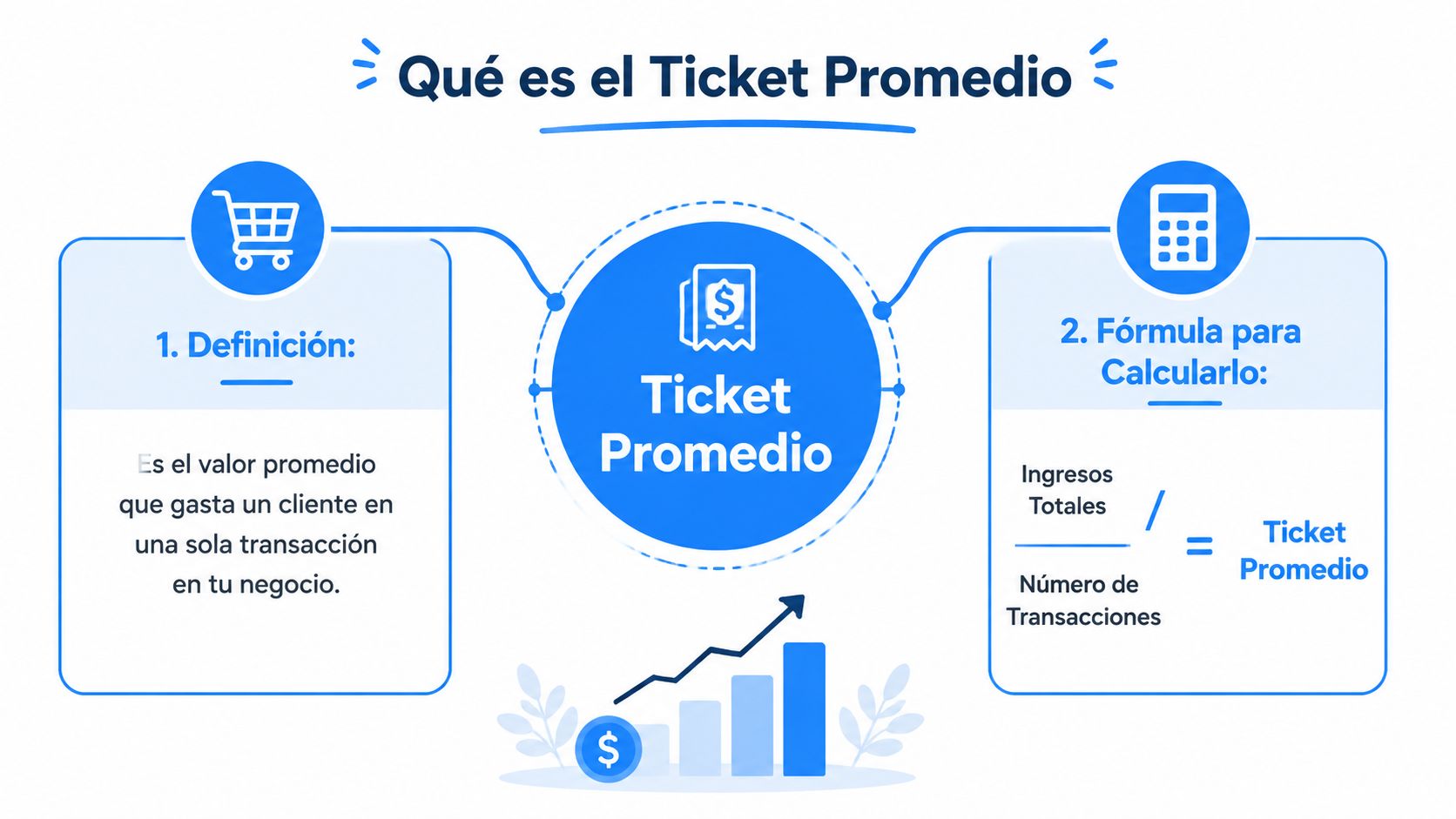
The formula is uncomplicated, but it does require discipline to read it correctly.
Basic Formula
Total revenue ÷ number of transactions = average ticket
How to apply it to a physical business
Think of a car wash in Monterrey. During the day, customers come in for quick service, wash and vacuum, and more complete packages. If at the end you only check how much money came in, you are missing half the picture. The key data point is how much, on average, each serviced car left behind.
That number serves several practical decisions:
Detect sales mix: if the ticket drops, it could be because more basic services were sold.
Measure commercial execution: if it rises, it could indicate that staff are recommending add-ons with better timing.
Compare similar days: a high-traffic Saturday was not necessarily better than another with fewer cars but more complete purchases.
What this metric does and does not say
The average ticket does not replace total sales, margin, or recurrence. It accompanies them. Its value is that it summarizes purchasing behavior in a single operational indicator, easy to track and easy to compare.
A common mistake is believing that raising it means forcing the sale of more items. Not necessarily. Sometimes it improves because the business presents its services better, designs its menu better, or places its impulse products better.
A healthy average ticket does not come from pressuring the customer. It comes from facilitating a more complete purchase.
The Impact of the Average Ticket on Your SMB's Profitability
Many businesses seek to grow by bringing in more people. That route works, but it is usually more expensive, slower, and more uncertain. Instead, working on the average ticket targets a lever that is inside the point of sale. The customer has already walked in. The challenge is to sell to them better.
At the regional reference level, average ticket is presented as a KPI comparable across periods and channels, with an example of $50,000 MXN in 100 orders, equivalent to $500 MXN per transaction. The practical value of that logic is that small changes in the transaction can move revenue without depending on increasing traffic, as explained in this note on average ticket as a management KPI.
Not all additional sales are worth the same
A coffee shop can bring in more customers with an aggressive promo. It sounds good, but if most buy the cheapest item on the menu and add nothing, the operation is strained. There is a line, there is more work, but there is not necessarily better profitability.
In contrast, when the business raises the value per visit with better combinations, suggestive selling, and complementary products, revenue grows on a healthier foundation. That logic also helps to better read the real state of the business along with other financial indicators, as reviewed in this guide on profit and loss for businesses.
More traffic without strategy: can raise operational costs and overwhelm the team.
Higher average ticket: makes better use of each visit already secured.
Poorly designed discounts: move volume, but can lower the average value per transaction.
Comparing branches changes decisions
A small chain with a branch in an office zone in Mexico City and another in a residential area of the State of Mexico rarely sells the same way. The first might rely on quick weekday purchases. The second might depend more on family consumption or replenishment purchases.
If both report similar sales, it is still not clear which one is executing better. The average ticket helps to see it. It also prevents wrong decisions, such as copying promotions from one store to another without considering different purchasing habits.
Two branches with the same total sales can have completely different problems.
In operational consulting, this finding appears often. One point of sale needs more traffic. Another needs staff to stop selling only the basic option. Without the average ticket, both look the same. With the average ticket, they no longer do.
Why the Average Ticket is a Key KPI in Mexico
In Mexico, this metric carries more weight than many owners realize because a large portion of daily spending occurs in high-frequency purchase categories. When the visit is repeated several times a month, any improvement in the transaction amount has a cumulative effect for the business.
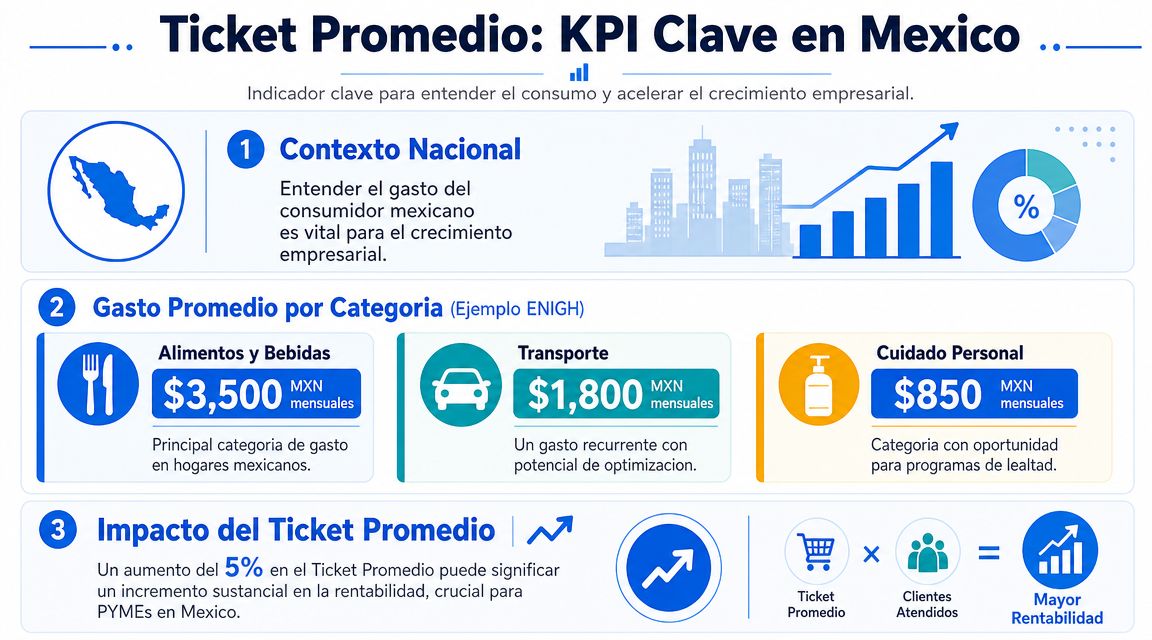
The ENIGH 2022 from INEGI reported that the average quarterly monetary current expenditure per household in Mexico was $16,541 MXN, and that food, beverages, and tobacco represented 37.7% of total expenditure, according to the ENIGH 2022 results. That does not measure average ticket per purchase, but it does make clear why optimizing each transaction matters so much in recurring consumption businesses.
What household spending says
When a significant portion of household spending is concentrated in daily consumption, businesses that thrive on repeat visits cannot rely solely on attracting new customers. They need to better capture each purchase that is already happening.
This clearly applies to:
Coffee shops and bakeries: where a drink can turn into a drink plus food.
Convenience stores and small retail: where a quick purchase can be expanded with useful add-ons.
Frequent services: such as car washes or light maintenance businesses, where the customer is already on-site and it is easier to present a premium package.
Why it matters more in high-frequency businesses
In a coffee shop in Puebla, a corner store in Ecatepec, or a service station in Baja California, visit frequency changes the commercial logic. It is not always wise to push heavy discounts. Often it is better to design more complete and consistent purchases.
The average ticket becomes key because it forces you to look at the business from the quality of the transaction. It is not just about selling. It is about selling with a better structure: a better product mix, better add-ons, and better execution at the counter.
In frequent consumption businesses, a sustained improvement in each purchase usually carries more weight than an isolated campaign to bring in additional visits.
Strategies to Increase Your Average Ticket with Real Examples
Raising the average ticket does not mean raising prices automatically. On the sales floor, organizing the offer, training the team, and designing the right moments to suggest something additional almost always works best. For an SMB with branches, this metric should also be measured by period and by point of sale. It is also beneficial to elevate the value per purchase with complementary products, bundles, and discount thresholds, as summarized in this guide on average ticket in SMBs.
Before applying any tactic, there is an important warning. There is no universal chart that says how much each business type in Mexico should sell. Therefore, instead of inventing benchmarks, it is better to build an internal table with the actual historical data of the business by branch, hour, and category.
Business Type | Estimated Average Ticket (MXN) |
|---|---|
Car Wash | Define it with your history by service and branch |
Coffee Shop | Define it with your mix of drinks, food, and hours |
Gas Station with Store | Define it by separating fuel and store |
Small Retail | Define it by category, channel, and point of sale |
Well-executed upselling
Upselling works when the customer has already decided to buy and it only remains to help them choose a higher-value version. It does not work when the team does it as an empty script.
In a gas station in Baja California, for example, it makes sense to offer a premium service or product related to the fuel purchase already decided. If the customer is focused on leaving quickly, the proposal must be brief and clear. If the cashier takes too long or pushes something out of context, it will likely be rejected.
Best practices:
Offer a concrete upgrade: a superior version with a visible benefit.
Use the right moment: when the customer has already accepted the base purchase.
Avoid overwhelming options: too many alternatives slow down the decision.
To better implement this tactic, it is useful to review what upselling is and how to apply it in sales.
Cross-selling that actually feels natural
Cross-selling works when the additional product complements the main purchase. If it seems improvised, the customer detects it quickly.
A coffee shop in Yucatán can suggest a local bread or dessert along with a hot drink. The key is not to say "add something else" without direction. The key is to recommend a logical combination that better resolves the visit. In a small store, this also applies to related-use items placed near the register or the main category.
What usually works best is this:
Immediate-use add-ons: what the customer can consume or use at that moment.
Well-displayed impulse products: visible, simple, and with an easy-to-understand price.
Specific recommendation from staff: not generic.
Bundles and thresholds that drive purchases
In physical services, well-assembled packages are among the cleanest tactics to raise average ticket. A car wash in Puebla can group washing, waxing, and vacuuming into a single commercial proposal. The customer perceives convenience and the business structures its sale better.
Thresholds also help. There is no need to inflate the pitch. It is enough for the offer to clearly state what amount or condition triggers a benefit. That structure drives the completion of the purchase at that exact moment.
The right bundle does not sell more through pressure. It sells more because it simplifies the decision.
In small retail chains, another useful lever is reviewing which promotions actually raise the ticket value and which ones only move cheap items. If a campaign increases the volume of tickets but lowers the purchase per transaction, it is not correcting the core problem.
Frequent Mistakes When Measuring Average Ticket and How to Avoid Them
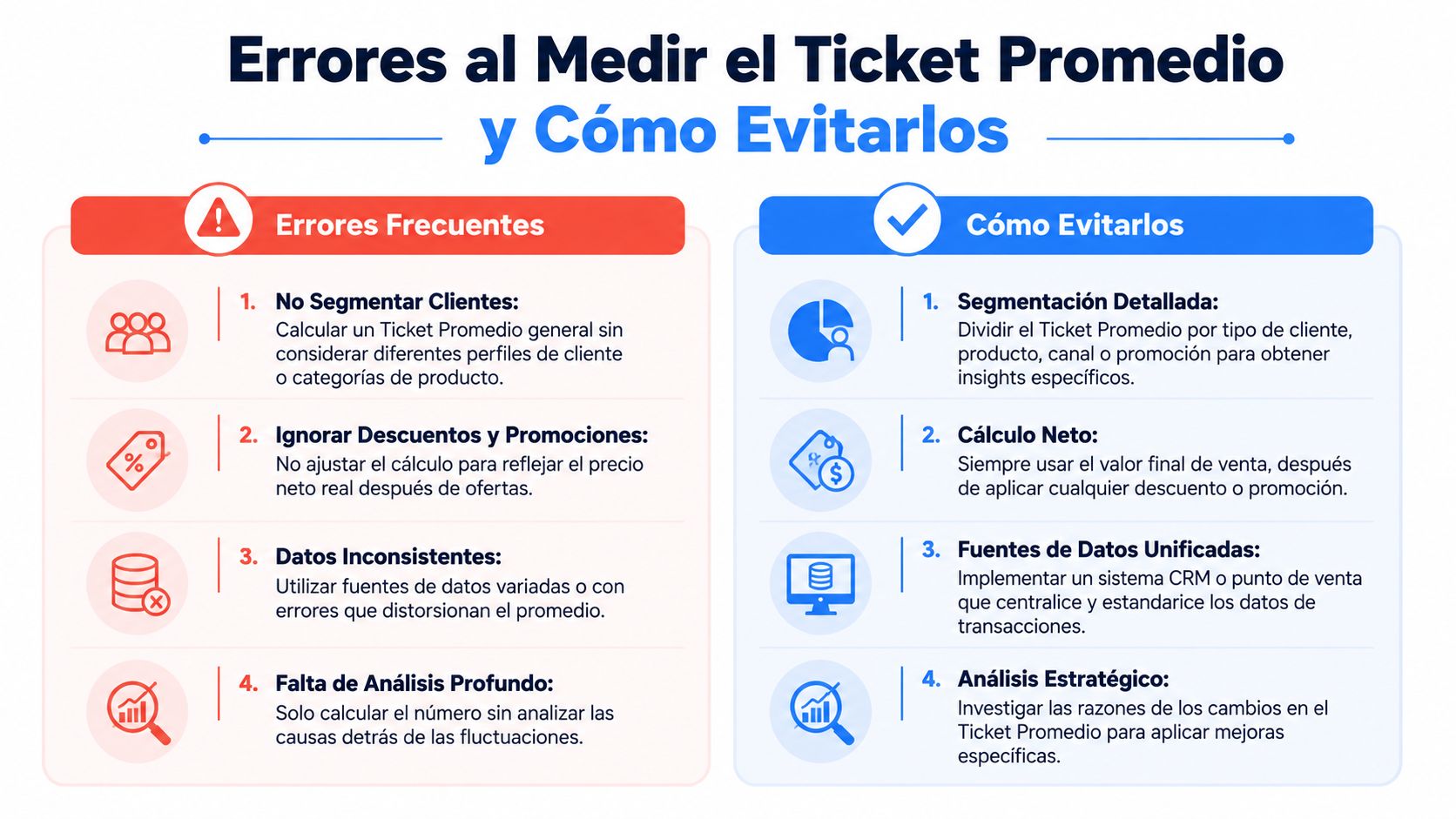
The most common mistake is not in the formula. It is in the interpretation. Many businesses calculate a single average for the entire operation and make decisions based on that for all branches, all hours, and all customer types. That mixed average almost always hides more than it reveals.
A frequent problem in physical businesses in Mexico is precisely not measuring the average ticket by branch, channel, or unique customer. The indicator changes significantly between stores, categories, and times, which can hide real opportunities for upselling or cross-selling, as pointed out in this explanation on average ticket and segmentation.
The overall average is misleading
A chain with branches in CDMX, Puebla, and Nuevo León might report a single average ticket for general management. As aggregated data, it is useful. As a tool for daily operations, it falls short.
It is convenient to break down the metric by layers:
By branch: to detect actual differences in execution.
By time: morning, lunch, afternoon, or closing do not behave the same way.
By category or service: the ticket changes depending on what is being pushed on the floor.
By customer type: new, recurring, or identified frequent customer.
Measuring without context leads to bad conclusions
Another mistake is looking at the number without reviewing promotions, discounts, and mix changes. If the ticket went up, it is not always good news. It may have gone up because fewer, but more expensive, transactions were sold. If it went down, it is also not always bad. It could be the result of a useful campaign to drive visits that later convert into more complete purchases.
The important thing is to avoid three traps:
Making decisions with an isolated average. The data needs operational context.
Not reviewing who sold what. There are strong differences between shifts and teams.
Not connecting the ticket with concrete actions. If execution does not change, the number becomes decorative.
The average ticket is useful when it guides decisions. If it is only reported in a meeting, nothing changes.
How to Measure and Optimize Your Average Ticket with a CRM Platform
Once the business understands the metric, the next challenge is to operate it without depending on loose spreadsheets, late reports, and the team's memory. That is where a CRM platform helps because it centralizes purchases, identifies customers, and allows viewing the transaction in greater detail.
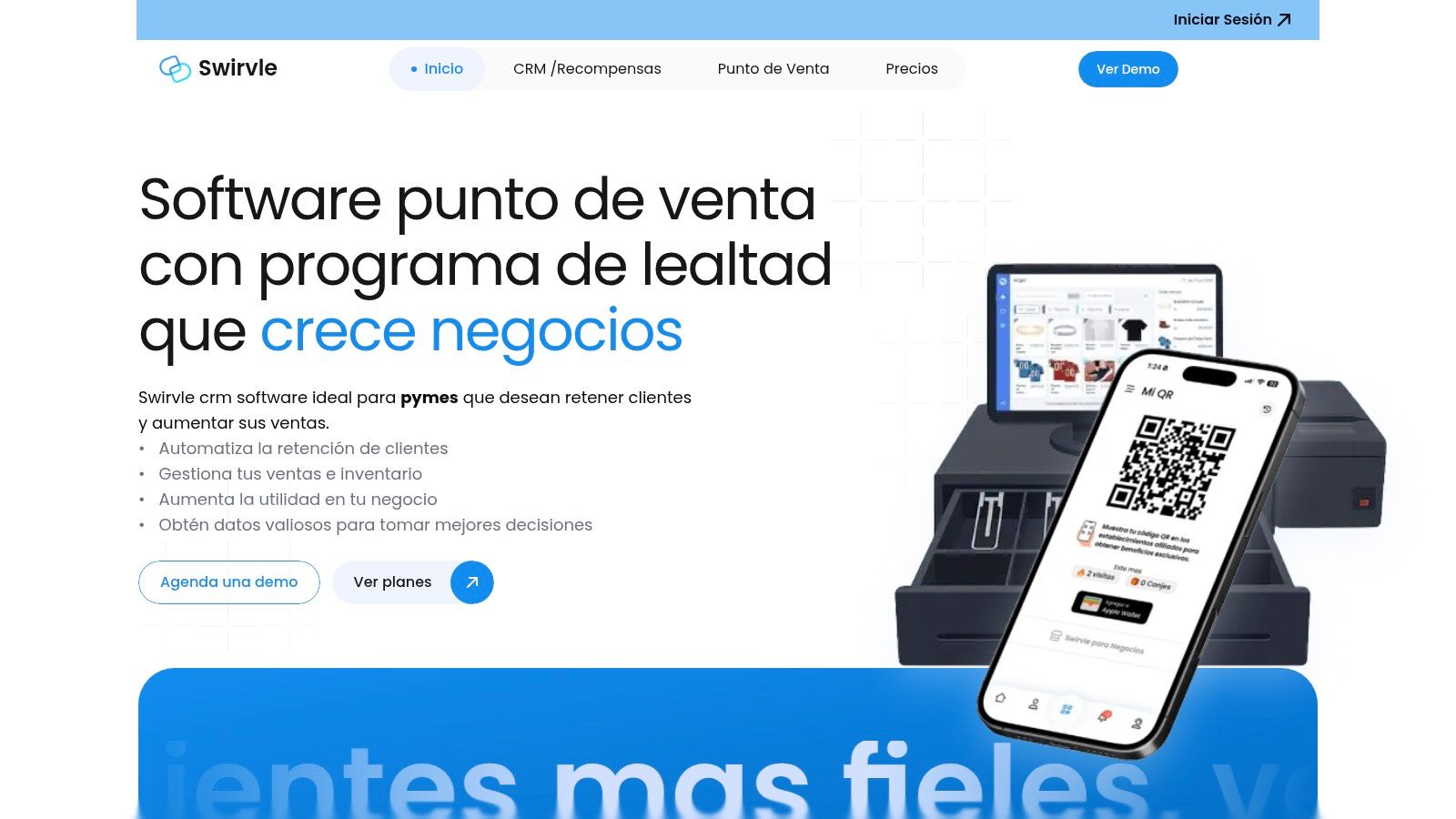
With a CRM, the business can segment by branch, buying habits, recent campaigns, and high-value customers. This allows you to stop launching blanket promotions for everyone. It also makes it easier to trigger messages via WhatsApp, push, or email based on actual buying behavior, rather than operating on intuition.
One option in this category is Swirvle, which combines CRM, loyalty program, segmentation, and automated campaigns for physical businesses. This type of platform is useful when trying to connect the average ticket with repeatable and measurable actions, not just reports. To better understand this approach, it is useful to review what a CRM system is and how it is used in a physical business.
The most valuable part is not the automatic calculation. It is the ability to answer operational questions. Which branch sells add-ons better? Which customers accept more packages? Which campaign lifted more complete purchases? Which schedule best converts an additional suggestion into an actual sale? When those answers appear on a dashboard and not in assumptions, the average ticket stops being a static figure and becomes a growth tool.
Swirvle helps physical businesses turn purchases, visits, and campaigns into clearer decisions. If an SMB wants to better measure its average ticket, segment by branch, and activate loyalty or repurchase actions with centralized data, it can learn more at Swirvle.
Related Blogs

Sep 30, 2026
7 sales report templates for SMBs

Sep 29, 2026
Business POS and payment system: complete guide 2026

Sep 28, 2026
Selling price: what it is and how to set it in your business

Sep 27, 2026
10 CRM best practices for SMEs in LATAM

Sep 26, 2026
8 grab-and-go coffee shop snacks in 2026

Sep 25, 2026
How to standardize operations in branch offices
Try Swirvle for free
No card required · 30 days free
Start your free trial