Discover how a restaurant point of sale system optimizes operations and customer service. Choose the best solution and digitalize your business.
A restaurant point of sale system is much more than a cash register with a touchscreen. It is the true center of operations, the nervous system that connects every part of your business so that it functions as a unified and efficient whole.
Think of it as the brain of your restaurant: it coordinates what happens in the dining room with the kitchen, manages payments, monitors inventory, and even nurtures relationships with your customers. All from a single platform that seeks perfect harmony in service.
What a point of sale system is and why it is the brain of your restaurant
Imagine a point of sale (POS) system as the conductor of an orchestra. Each member of the team —servers, cooks, the bartender, the cashier— has a key role. But without someone to direct and synchronize them, the result would be a disaster. The POS is that director: it ensures that each area works together to create a memorable experience, both for your team and for your customers.
This tool goes far beyond simply collecting payments. It is the bridge that connects the customer experience at their table with the speed of the kitchen and the strategic decisions you make in the back office. Trying to manage rush hour without a good POS system is like directing service blindfolded; you leave the profitability of your business and the satisfaction of those who visit you to chance.
The central role of the POS in different businesses
The great advantage of a good POS system is its ability to adapt to the specific needs of each type of business, demonstrating incredible versatility.
For a specialty coffee shop: The POS is key to managing complex orders instantly. A customer orders an "oat milk latte, with an extra shot of espresso and sugar-free hazelnut syrup." The system not only sends the order clearly and error-free to the barista, but also deducts the milk, coffee, and syrup from inventory, and can save that preference in the customer profile for future visits.
For a barbershop or a beauty salon: Although they do not sell food, the principle is identical. The POS organizes appointments, assigns services to specific stylists, controls the inventory of products such as waxes or dyes, and processes the final payment. All from the same interface.
For a car wash: Here, the system allows selling different wash packages (basic, premium, with wax), managing wait times, and even selling additional products like air fresheners, maintaining precise inventory control of each item.
A modern POS system does not just record transactions; it transforms raw data into smart decisions. It tells you what you sold, who bought it, when, and why, giving you the power to anticipate your customers' needs and optimize your resources to the fullest.
The Mexican market is waking up to this need at an accelerated pace. The POS systems sector in Mexico is projected to reach a value of 1.57 billion dollars. However, the gap is huge: only 35% of SMEs use POS software, and more than 576,000 food and beverage establishments operate without any type of automated technology.
This situation represents both a challenge and a giant opportunity for businesses that decide to make the leap to modernization.
Essential features in a food and beverage POS
If you think a restaurant point of sale system is only for collecting payments, you are missing half the story. A generic system records sales, yes, but one designed for the food and beverage sector must be the co-pilot of your operation, the brain that connects every movement, from the smallest ingredient to the most complex order.
The right tools are what separate a chaotic service from a smooth and, above all, profitable operation. It is not just about recording transactions, but about solving the daily headaches of the industry: communication between the dining room and the kitchen, minute-by-minute inventory control, and the customization of each order so that the customer always leaves happy.
Imagine the POS as the central nervous system of your restaurant. Just like this:
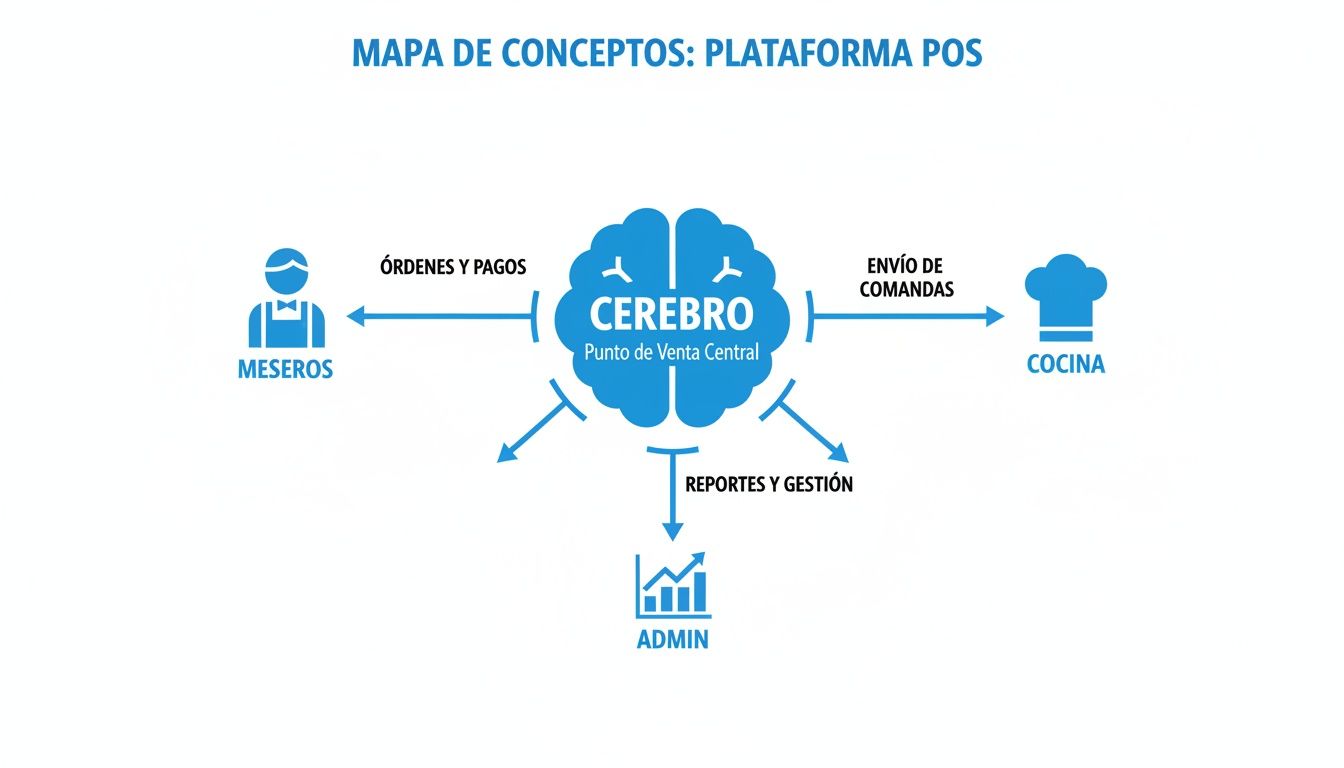
As you can see, it is not an isolated tool. It is the point of union that allows servers, kitchen, and administration to work in perfect synchrony.
Menu management and order modifiers
Flexibility is key in gastronomy. A good POS system must allow you to update prices, add the daily special, or remove a dish that ran out in seconds. This digital menu management capability is a lifesaver. You forget about reprinting paper menus and ensure that your team always has the correct information, avoiding those uncomfortable "we don't have it anymore" moments after taking the order.
Equally fundamental is the order modifiers function. It is the tool that translates the customer's wishes into clear instructions for the kitchen.
Think of these day-to-day situations:
In a coffee shop: The order arrives: "a lactose-free latte with an extra shot of espresso and vanilla syrup." The POS sends it to the order ticket just as clearly, without confusion. The customer gets exactly what they asked for.
In a burger joint: The classic "no pickles, extra bacon." The modifier on the POS ensures that the kitchen sees it instantly, reducing errors that cost time, ingredients, and, worst of all, customer trust.
In a steakhouse: Specifying the doneness of the meat —"medium rare," "medium well"— is sacred. Modifiers ensure that each cut comes out perfect, completely elevating the experience.
Precise control of recipes and inventory
The profitability of your restaurant lives or dies on inventory control. A top-tier restaurant point of sale system is not limited to counting bottles or boxes; it gets right into the kitchen, managing ingredients at the recipe level.
What does this mean? That when you sell a dish, the system automatically deducts each ingredient from your warehouse. If you sell a margherita pizza, the POS subtracts the exact portion of dough, tomato sauce, cheese, and basil. This precision is pure gold: it tells you what to buy, when to buy it, and how to stop waste.
A system with recipe control gives you a microscopic view of your costs. You know exactly how much each dish costs you, allowing you to set prices that protect your profit margin and instantly detect any shrinkage or leakage.
A taco shop, for example, can use this function to control the grams of meat, onion, and cilantro in each taco. A bar can measure liquor inventory by the ounce, immediately identifying if too much is being poured or if there is any loss. It is total control over the profitability of each drink.
Integrated electronic invoicing
In Mexico, electronic invoicing (CFDI) is not optional, it is a tax obligation. A POS that integrates this function natively takes a huge load off your shoulders, simplifying administration and ensuring you are always compliant with the SAT.
A real integration means you can generate the invoice from the same screen where you closed the sale. No more external platforms and manual data re-entry. This not only saves you extremely valuable time, but also eliminates the human errors that always appear when passing information from one system to another.
To go a step further, many modern systems offer self-invoicing portals. The customer only has to scan a QR code on their ticket to generate their own invoice. This level of autonomy improves the customer experience and frees your team from administrative tasks so they can focus on what truly matters: service.
Below is a table summarizing how important each feature is depending on the type of business. This will help you identify your priorities when choosing a POS system.
Comparison of POS features for different food businesses
Key Feature | Importance for coffee shop | Importance for 'fine dining' restaurant | Importance for 'food truck' or 'dark kitchen' |
|---|---|---|---|
Menu management and modifiers | High. Key to customizing drinks and managing fast product changes. | Critical. Fundamental for customizing dishes, cooking temperatures, and allergies. | High. Essential to adapt to rapid menu changes and manage complex orders. |
Recipe and inventory control | Medium. Useful to control key supplies (coffee, milk), but not as granular as in a restaurant. | Critical. Indispensable to control costs of complex dishes and high-value products. | Critical. Maximum control of costs and ingredients to optimize profitability in a small space. |
Electronic invoicing (CFDI) | High. Mandatory for all formal businesses serving customers who request an invoice. | High. Indispensable requirement for corporate clients and to comply with tax regulations. | High. Necessary to professionalize the business and comply with tax obligations. |
As you can see, although all features are important, their level of priority changes depending on your business model. A fine dining restaurant cannot live without detailed recipe control, while for a coffee shop, agility in modifiers is king.
How to turn customers into fans with an integrated CRM
A sale should not be the end point with a customer, but the beginning of a relationship. In a world as competitive as gastronomy, the true profit is not in the single visit, but in making people return. Right there is where a restaurant point of sale system that includes an integrated CRM (Customer Relationship Management) becomes your secret weapon.
Tools like Swirvle make it clear: every transaction is a gold mine. They do not limit themselves to processing a payment; they convert each purchase into a detailed customer profile. Little by little, you build a database that becomes the most valuable asset of your business.

Think for a moment about what you could do if you knew instantly who your most loyal customers are, what dishes they love, how often they visit you, and how much they spend on average. With that information, you stop launching marketing blindly and start building real, personal connections.
From anonymous transactions to profiles with first and last names
A traditional point of sale tells you what you sold. One with an integrated CRM tells you who you sold it to. It is a massive difference. Every time a customer makes a purchase and identifies themselves (perhaps to earn points in a loyalty program), the system nurtures their profile.
This capability converts cold data into deep knowledge about your clientele, allowing you to detect patterns that, otherwise, you would miss completely.
A coffee shop might notice that a group of customers always orders an Americano in the morning, but after 3 p.m. they lean towards cold drinks.
An auto repair shop (because this applies beyond food) can keep a service history per vehicle, anticipating when a customer will need an oil change to send them a useful reminder.
A barbershop would know which stylist each customer prefers and how often they schedule, so they can offer a slot with their favorite barber before they even ask for it.
This level of detail is what allows you to go from a generic service to a personalized experience. You make your customers feel seen, understood and, above all, valued. If you want to dive deeper into how this technology works, here you can better understand the role of a CRM for restaurants and its impact on loyalty.
Marketing that truly connects with people
Okay, you have all that valuable information. Now what? The next step is to use it to communicate intelligently. A POS system with CRM allows you to segment your customer base and launch automated, highly personal marketing campaigns through direct channels like WhatsApp or email.
This translates into sending the right message, to the right person, at the precise moment.
Instead of bombarding your entire list with the same promotion, you can design offers that resonate with the habits and tastes of each group. This not only skyrockets the effectiveness of your campaigns, but also prevents you from tiring your customers with messages that do not interest them.
Let's see what this looks like in practice:
Pizzeria: Detects customers who have not purchased in the last 30 days and sends them an automatic coupon via WhatsApp that says "We miss you," with a 2-for-1 on their favorite pizza.
Coffee shop: Notifies its most loyal customers about the launch of a new seasonal drink and offers them a free tasting on their next visit.
Restaurant: Sends an email to customers who usually order salads to tell them about a new line of healthy dishes that has just launched.
This precision marketing approach is incredibly powerful. In Mexico, where the restaurant industry has more than 640,000 establishments but faces a noticeable technological lag, these tools make a world of difference. Advanced POS systems do not just help you with inventory; they can increase the average ticket by up to 24% simply because of the ability to analyze data to adjust menus and promotions.
With 73% of Mexicans planning to spend more on dining out, segmenting your customers based on their habits gives you an almost immediate return on investment.
In short, a POS system with a good CRM gives you the tools to stop endlessly searching for new customers and, instead, focus on building a strong community. You go from having buyers to having fans who choose your business time and time again.
Factors to choose the right point of sale system
Selecting a restaurant point of sale system is one of the most critical decisions you will make for your business. You are not simply buying a program; you are choosing a technology partner that will dictate the pace of your daily operation, your growth potential, and, above all, your relationship with your customers. A poor choice here quickly translates into frustration, operational bottlenecks, and missed opportunities.
The key is to engrave this in your mind: there is no magic solution that works for everyone. Your business needs must define the tool, and never the other way around. What is perfect for a large restaurant chain can be a white elephant, expensive and complicated, for a business just starting out.
Adaptability to the size and type of your business
The first filter, the most important, is your business model. The tool has to feel like a tailor-made glove, not a borrowed suit that is too big or too small. The daily differences between one type of venue and another are huge.
For a food truck or a neighborhood coffee shop: Here, agility is everything. You need a lightweight system, probably on a tablet, that is lightning-fast for taking orders and processing payments. Ideally, it should be able to work even if the internet connection fails. The absolute priority is speed and simplicity.
For a barbershop: Although you do not sell food, the logic is very similar. Your POS must be able to schedule appointments, assign services to specific barbers, keep control of product inventory such as waxes or oils, and manage loyalty programs so that your customers always return.
For a chain with multiple locations: The key word is centralization. Here you are looking for a robust system that gives you the power to manage menus, prices, inventories, and promotions for all your locations from a single place. Consolidated reports and the ability to compare performance across locations are not a luxury, they are a necessity.
The importance of an intuitive interface and real support
A system can boast of having a thousand functions, but if your team cannot use them quickly and naturally, they are useless. Ease of use is not a whim; it is a factor that directly impacts your operation and, therefore, your costs.
A clean and intuitive interface drastically reduces training time for new employees, which is vital in an industry with high staff turnover. A server, even on their first day, should be able to take a complicated order, send modifiers to the kitchen, and split a bill in seconds without breaking a sweat.
A good POS system is one that becomes invisible during rush hour. Your team should not be thinking about how to use the software, but how to better serve the customer. If the technology becomes a hindrance, it is the wrong technology.
Equally crucial is technical support. Problems do not keep office hours. Imagine your system goes down on a Saturday night, in the middle of service. You need a provider who responds in Spanish and is available when you are operating, not when it is convenient for them. Slow or inaccessible support can end up costing you much more than the system itself.
Scalability and pricing models
Your business today will not be the same in two years. A good point of sale system must be able to grow with you. This scalability means that the system will be able to handle more transactions, more locations, or new features (like online ordering or more sophisticated loyalty programs) as you need them.
Finally, analyze pricing models under a microscope. Do not be swayed by the first impression.
Monthly subscription (SaaS): It is the most common model today. You pay a recurring fee that usually includes software, updates, and support. The barrier to entry is much lower.
One-time payment (Perpetual license): You buy the software once. The initial investment is heavy, but in the long run, it could be cheaper. Watch out, because support and updates are almost always charged separately.
The market trend clearly points to "all-in-one" solutions like Swirvle, which integrate POS, CRM, inventory, and marketing into a single platform. This approach removes headaches, avoids the nightmare of integrating multiple systems, and gives you a 360° view of your business. If you want to better understand how these plans are structured, I recommend checking out different pricing options for integrated systems to see what fits your budget and the stage your business is in.
How to implement your new POS without interrupting your business
The mere idea of changing the system that is the heart of your restaurant can sound terrifying. It is almost like trying to change a car's engine while driving. But the reality is that, with a good action plan, implementing a new restaurant point of sale system is a much more controlled and manageable process than it seems. You do not have to stop your operation.
The secret, as in almost everything, lies in organization. If you divide the project into logical phases and make sure each step is solid before taking the next, the transition will be a success.
The preparation phase: work behind the scenes
Before any customer sees the new system, there is a fundamental job to do behind the scenes. This is the stage where you build the foundations of your new digital operation. Here is where all the information the system needs to run like a Swiss watch from day one is loaded.
The focus is on three key areas:
Menu and recipe loading: The basics are registering each dish and drink with its price. But if you really want to have control, the trick is to input the recipes, detailing ingredient by ingredient. This is what allows the inventory to automatically deduct with each sale, giving you a real view of your stock.
Initial inventory: There is no other way around it; you must do a physical count of everything you have in the warehouse and storage room to load it into the system. This number is your starting point, the basis for the POS to maintain precise control of stock in real time.
Staff setup: You need to create profiles for each member of your team (servers, cashiers, managers) and give them the right permissions for their role. This ensures that everyone can only access what they need to do their job, and nothing more.
A good provider, like Swirvle, does not leave you alone in this. They usually have a support team that accompanies and guides you through every step of the setup. This is gold, because a well-made foundation from the start saves you a lot of headaches later.
Hands-on training for your entire team
There is no use in having the most powerful system if your people do not know how to take advantage of it. And watch out, training cannot be a boring manual. It has to be hands-on, with the system in hand, and designed for everyone's tasks.
The best technology is the one that feels invisible during service. The goal of training is for your team to master the tool to the point that its use is instinctive. That way, they can focus on what truly matters: serving the customer.
To make the transition smooth, divide training by roles. Servers must become experts in taking orders and handling modifiers. Cashiers, in closing bills and processing different payment types. And managers need to know reports and settings inside out.
A strategy that works wonderfully is to appoint a "system champion" within your own staff. This person becomes the house expert, the first contact to resolve quick doubts. This takes a load off management and makes everyone learn faster.
The final transition: a controlled launch
D-day does not have to be a leap into the void. The key to a smooth transition is to test in a safe environment before officially launching. Simply set up a "test table" and ask your team to simulate the most complicated orders they can think of: splitting bills, applying discounts, canceling dishes, closing the day.
This "dress rehearsal" is your best weapon to catch any configuration error or staff doubt before it affects a real customer.
Think about the specific scenarios of your type of business and put them to the test:
A barbershop could simulate appointment scheduling, collecting payment for a service along with a product sale, and closing the cash drawer of a stylist.
A car wash could test selling different packages, registering tips for employees, and how the queue of cars is managed.
When launch day finally arrives, choose a quiet day, like a Tuesday or Wednesday. This takes pressure off your team and gives you room to resolve any unexpected issues without the stress of a Friday night. With good planning and the right support, you will see that your restaurant will be running smoothly and seamlessly with its new tool.
Metrics that prove your POS return on investment
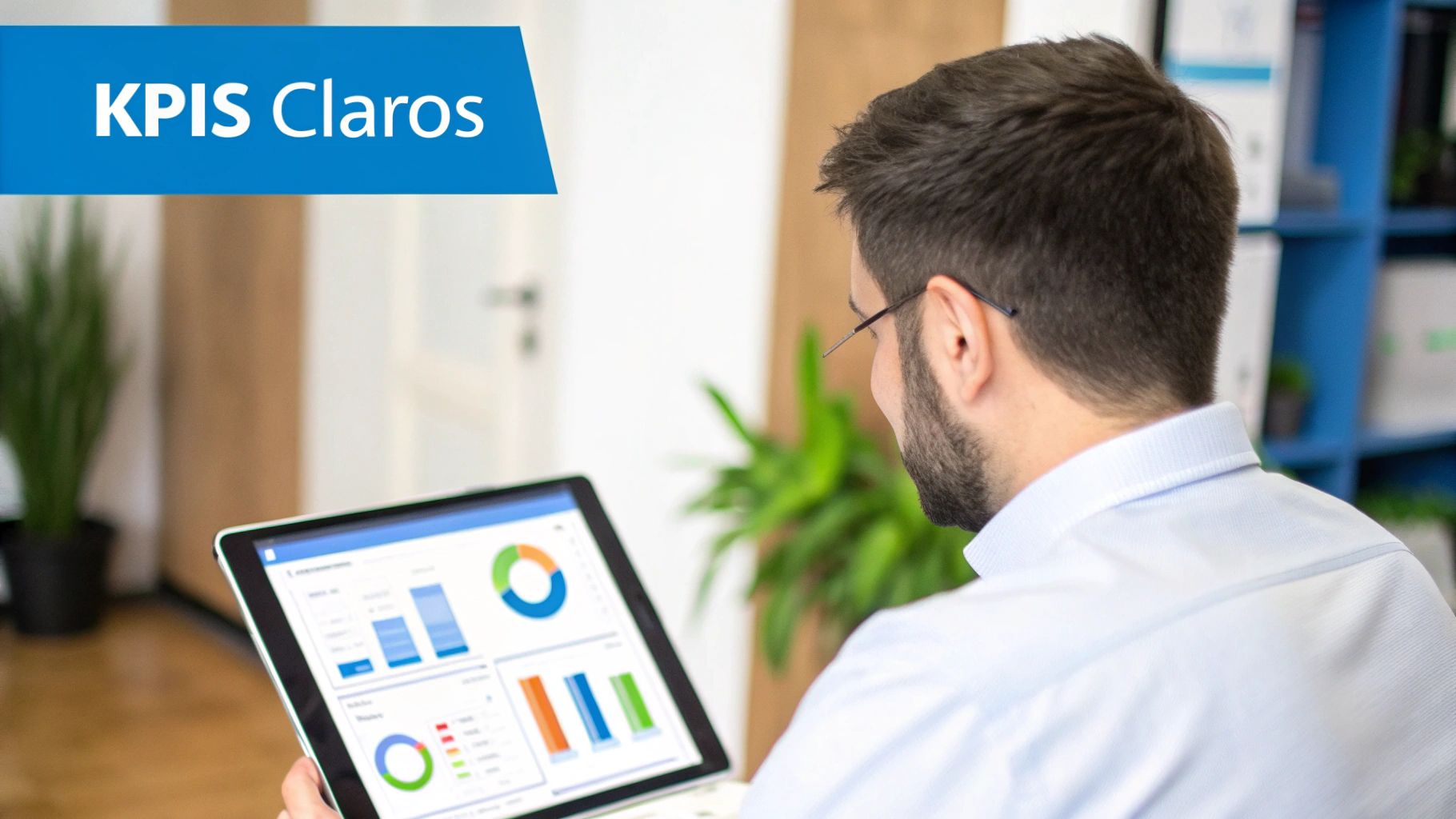
Viewing a restaurant point of sale system as a simple expense is a perspective error. In reality, it is one of the smartest investments you can make, but like any good investment, you have to know how to measure its impact to confirm it is bearing fruit. The key is to stop operating on hunches and start monitoring the business indicators (KPIs) that truly matter for the health and growth of your restaurant.
The objective is very clear: that every piece of data your POS generates becomes an informed decision that drives your profitability. With the right reports and dashboards, every sale, every order ticket, and every ingredient tells you a story that you can use to fine-tune everything from your menu to your marketing campaigns.
Reduction of shrinkage and cost optimization
One of the most immediate and tangible benefits of a well-implemented POS is in inventory control. Shrinkage, that silent waste of ingredients, eats away at your profit margins day by day. A system that automatically deducts inventory with each dish sold gives you total clarity on what you have in the warehouse.
Thanks to precise inventory control, you stop guessing what to buy and when. The system alerts you when a critical supply is running low, preventing you from running out of your most popular dish and, at the same time, stopping those impulse purchases that end up in the trash.
Think of it this way: a barbershop can use its POS to manage inventory of premium products like waxes or oils, ensuring that every gram is charged in a service or sold directly. Similarly, a coffee shop can record the exact consumption of its specialty beans to fine-tune orders to the supplier, minimizing waste and getting the most out of every purchase.
Increase in average ticket and visit frequency
We already know: it is much more expensive to get a new customer than to get one who already knows you to return. A POS with an integrated CRM is your best ally to measure and strengthen your customer base loyalty.
With this tool, you can closely track metrics like visit frequency and the average ticket per customer. By knowing who your most loyal customers are, you can design personalized promotions that motivate them to return more often or spend a little more each time they visit you.
To increase the average ticket: Why not send a "free fries with the purchase of any burger" coupon to customers who normally only order the main dish?
To increase frequency: Launch a loyalty program like "collect 5 visits and the sixth drink is on us" to reward their consistency.
A car wash, for example, could offer a discounted premium wash to customers who have purchased the basic package in their last three visits—a simple way to increase their average spend. The system shows you instantly if these strategies are working. If you want to explore this concept further, here you can learn what ROI in marketing is and how to calculate it correctly.
At the end of the day, these metrics are irrefutable proof that your POS system is working for you, converting cold data into smart decisions and, of course, into more money in your pocket.
Want to see this working in your restaurant? With Swirvle, each order ticket is printed for the kitchen, each dish deducts its ingredients from inventory, tips and split bills are clear at the daily close, and you register your customer in the same payment process so they return. Get to know Swirvle's restaurant point of sale →
Frequently asked questions about point of sale systems
Clearing up the most common doubts is essential to making a good decision. Let's answer those practical questions that always arise when thinking about a restaurant point of sale system, so you truly understand how this technology works.
Do I need to be a technology expert to use it?
Not at all. Today's POS systems are designed to be used by anyone, not by engineers. They have visual interfaces, with large buttons and clear menus.
Taking an order, applying a discount, or doing the daily cash close are actions that are learned in minutes. A good provider will also give you initial training and will have a support team ready to help, so both you and your team feel comfortable from the very first moment.
Is my information really safe in the cloud?
Yes, and in fact, it is much safer there than on a computer at your local venue. Serious POS system providers invest fortunes in security: data encryption, 24/7 monitored servers, and protocols that a business on its own could never afford.
In addition, it gives you huge peace of mind to know that everything is backed up automatically. If a tablet breaks or gets stolen, nothing serious happens. Your sales, your customer list, and your inventory are safe in the cloud, ready for you to access from any other device.
Cloud security not only protects you from hacks, but also from day-to-day accidents. It is like having double insurance for the data that keeps your business running.
What happens if the internet goes down in my restaurant?
It is the million-dollar question, and the answer is simple: good systems are ready for that. Most include an "offline mode."
This means you can keep taking orders, taking payments, and operating as if nothing happened. The system saves everything locally on the device. As soon as the internet connection returns, it automatically synchronizes with the cloud without you having to do anything and without losing a single cent of information.
Can I use this same POS in another type of business?
Of course! Although we have focused on restaurants, the structure of a good POS is very versatile. A system that allows you to customize products and services works wonderfully in other business lines.
A barbershop: Can schedule appointments, keep track of which barber served whom, and manage inventory of waxes, gels, and shampoos.
A car wash: Ideal for selling wash packages, controlling service times, and offering extra products like air fresheners or headlight restoration.
Flexibility is key. If the system lets you adapt the catalog to your needs, you can use it for practically anything.
It is time to change how you manage your business and connect with your people. With Swirvle, you don't just have a point of sale, but also an integrated CRM, all on a single platform designed to help you sell more and keep your customers returning time and time again.
Related Blogs

Oct 22, 2026
How to prevent employee petty theft in my business?

Oct 21, 2026
How to Control Food Waste in a Restaurant: 2026 Guide

Oct 20, 2026
What is the global invoice for the general public and when is it issued? SAT Guide

Oct 19, 2026
How to take restaurant orders on WhatsApp without losing any?

Oct 18, 2026
How to Create a WhatsApp Business Catalog to Sell More: 2026 Guide

Oct 17, 2026
How to set up quick replies in WhatsApp Business?