Discover what a cluster means and how to use clustering to segment customers, build loyalty, and increase sales in your SMB. Examples for Mexico.
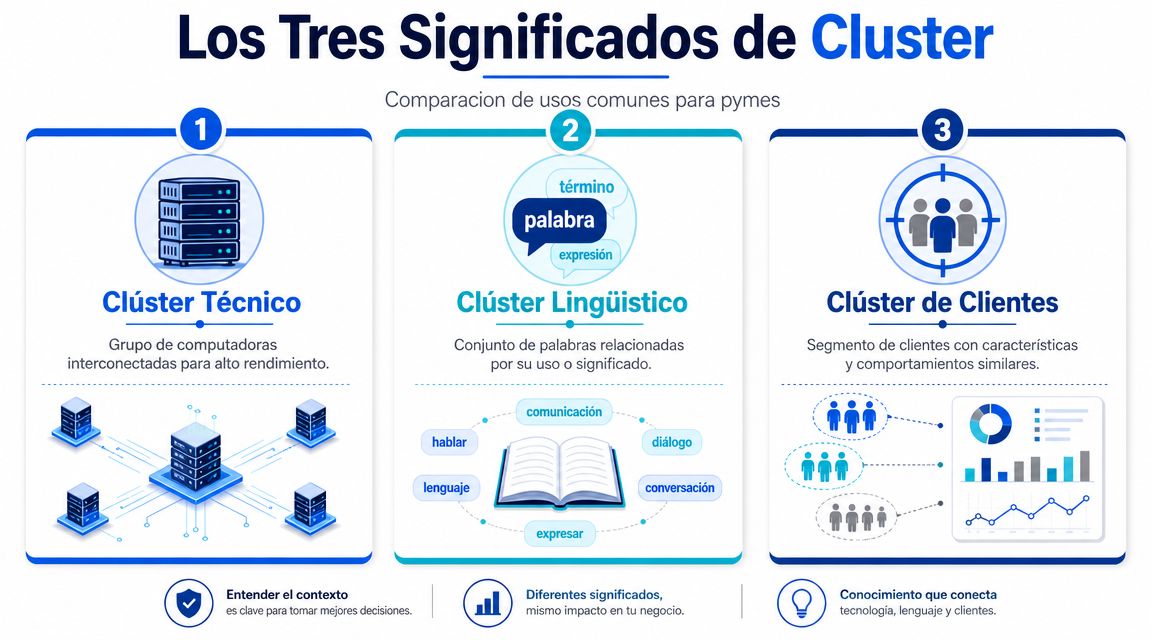
Cluster means "group" or "grouping": a set of similar elements that are analyzed or worked on together. Depending on the context, it has three meanings:
Economic: a group of related companies and institutions concentrated in a region, such as industrial clusters.
IT/Computing: several computers or servers that work in coordination as if they were a single one.
Marketing: a group of customers who buy in a similar way (same frequency, same schedule, same type of product).
For a business with a physical store, the third one is the one that matters. Below, you will see how it differs from a segment, what customer clusters are typical in a coffee shop or restaurant, and how to build them using purchase data from your CRM.
Table of Contents
The Three Meanings of Cluster You Need to Know
One single word in three contexts
Types of clusters and their application
Cluster vs. segment: they are not the same
Typical customer clusters in a coffee shop or restaurant
How to build them with purchase data in a CRM
How to Apply Clustering with a CRM like Swirvle
First organize, then group
After the cluster comes the action
Frequently asked questions about what cluster means
Is it written "cluster" or "clúster"?
What is a customer cluster?
Do I need a lot of information to make clusters?
How often should I review the clusters?
The Three Meanings of Cluster You Need to Know
The word “cluster” causes confusion because it is used for different things. Something very common can happen to an SMB owner: they hear the term in a tech conversation, then see it in an article about the automotive industry, and later it appears in a marketing platform. It seems like the same idea, but it doesn't always refer to the same object.
One single word in three contexts
The most technical meaning appears in systems. IBM defines server clusters as “groups of servers that are managed together” to distribute loads, while in business it is understood as a grouping that seeks to increase competitive strength, as explained in the IBM server clusters description. In both cases, the logic is similar: several coordinated units function better than a single isolated one.
That helps to understand the second use, the business or industrial one. In this case, a cluster is a concentration of related companies in an area or sector. It is similar to what happens when several companies, suppliers, universities, and public actors connect around a productive activity.
The third meaning is the one that is most useful for marketing. Here, cluster is not a group of servers or a network of companies, but a group of customers who share similar behaviors. That customer might buy in the morning, respond to coupons, visit a specific branch, or spend more when buying combos.
Grouping does not always mean bringing together physically. In CRM, it means detecting useful similarities to make better decisions.
Types of clusters and their application
Type of Cluster | What it refers to | Practical Example |
|---|---|---|
Technical cluster | Coordinated systems or servers | Several machines back up an operation so it doesn't fail |
Business cluster | Related companies and institutions in a region or sector | An industrial corridor in the State of Mexico with nearby suppliers and manufacturers |
Customer cluster | People grouped by habits and consumption signals | A coffee shop detects morning customers, dessert customers, and weekend customers |
The best analogy is to think of the word "group". A group can be a musical group, a school group, or a group of VIP customers. The base word is the same. The meaning changes depending on the context.
For an SMB, the confusion is resolved with a single question: are we grouping machines, companies, or buyers? If the answer is buyers, then you are already talking about customer clustering.
Cluster vs. segment: they are not the same
A segment is defined by you before looking at the data: "women aged 25 to 40", "downtown branch customers", "over 60s". A cluster comes from the data: you group customers by how they behave (when they come, how much they spend, what they order) and you discover groups you hadn't imagined. As Cyberclick explains, clustering uses algorithms to find those patterns in a more objective way than traditional segmentation.
In practice, they complement each other: the segment tells you who your customer is, and the cluster tells you how they buy. If you want the basis of segmentation, check out what customer segmentation is and, for an example of a demographic segment, segmentation by age.
Segment | Cluster | |
|---|---|---|
How it is defined | With criteria you choose beforehand | With patterns that appear in the purchase data |
Example | Customers aged 18 to 25 | Customers who come only in the afternoon and order frappé with dessert |
What it is for | Identifying who you are speaking to | Deciding what message and what reward to send them |
Typical customer clusters in a coffee shop or restaurant
These are groups that typically appear when a coffee shop or restaurant reviews its purchase history. Not all of them will exist in your business, and the size of each depends on your data, but they serve as a starting point.
Cluster | How it is recognized in your data | What action corresponds to it |
|---|---|---|
Weekday early birds | They buy early on weekdays, low ticket, almost always the same order | Fast "usual" order, reward for accumulated visits during the week |
Weekend families | They visit Saturday or Sunday, high ticket, several products per bill | Family combo or complimentary dessert on the next visit |
Afternoon customers | They arrive after lunch, order a cold drink or dessert | Afternoon promotion to fill slow hours |
Promo customers | They only buy when there is a coupon or a buy-one-get-one-free offer | Coupons with a deadline; do not send them discounts all the time |
VIP customers | High frequency and good ticket for months | Exclusive benefits and being the first to try the seasonal menu |
Inactive/Sleeping customers | They used to come often and have not returned for weeks | Welcome back message with a small, personal incentive |
How to build them with purchase data in a CRM
Register the customer on every purchase. Without a customer profile, you only have anonymous tickets. Asking for the phone number when checking out at the POS terminal or when adding points is enough.
Choose a few variables. To start, four are enough: frequency (how often they come), recency (how long ago they came), average ticket, and time or day of the visit.
Group and name them. Sort your customers by those variables and look for repeating groups. A clear name ("early birds", "sleeping") helps the whole team understand them.
Assign an action to each group. If a cluster doesn't lead you to do something different, it is not useful to you.
Automate and measure. With Swirvle automations, you can send the right message when a customer enters a group (for example, when they reach a certain time without coming) and check if they returned.
The best cluster is not the most sophisticated, but the one your team understands and can address with a concrete action.
To see how to activate groups based on interest and behavior, also check out the types of audiences.
How to Apply Clustering with a CRM like Swirvle
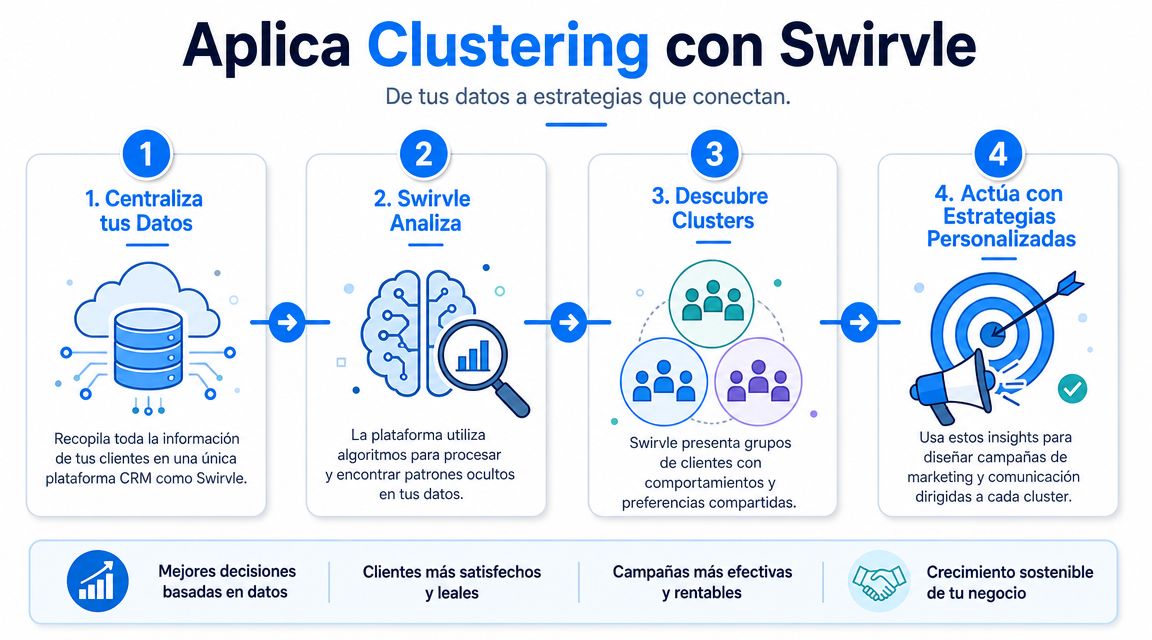
Clustering doesn't start with algorithms. It starts with organization. If a business has sales in one register, coupons in another system, and messages in another channel, there is no complete view of the customer. The first step is to gather those signals into a single view.
First organize, then group
For an SMB with physical stores, the practical sequence usually looks like this:
Centralize customer information
Every visit, purchase, redemption, branch, and channel must be associated with the same profile whenever possible.Review useful variables
Not all data is equally useful. To cluster better, frequency, ticket, time, branch, purchased categories, and campaign response are what matter.Detect actionable groups
The value is not in creating complex groups, but in forming sets that allow for deciding promotions, automations, or loyalty benefits.Assign an action to each cluster
If a group does not trigger anything different, then it brings no operational utility.
Practical evidence in Mexico regarding the impact of clusters on sales for SMBs remains a poorly covered angle, and that is why it is best to focus on measurable operational decisions, joining data from branches, inventory, and customer behavior, as proposed in the analysis on cluster societies in Mexico.
After the cluster comes the action
The most common mistake is staying in the analysis phase. You see the group, name the group, talk about it in a meeting, and that's where it ends. The real value appears when the business translates that finding into a repeatable action.
A simple outline can include:
High-value frequent customers: special reward or early access to benefits.
Customers at risk of churn: reactivation message with a relevant incentive.
Single-category customers: cross-selling with complementary products.
Customers by specific branch: local campaigns with hours and products from that location.
For small or medium-sized businesses, a platform focused on organization, segmentation, and tracking makes this work much easier. This guide on CRM for small businesses helps ground how an SMB can move from scattered lists to decisions based on real habits.
A useful cluster is not an elegant label. It is a group that triggers a concrete marketing, loyalty, or operational action.
Frequently asked questions about what cluster means
Is it written "cluster" or "clúster"?
In Spanish, the adapted form is clúster, with an accent, and its plural is clústeres. "Cluster" without an accent is the original English word; in marketing and technology, both are used.
What is a customer cluster?
It is a group of customers who buy in a similar way: same frequency, same schedule, same type of product, or same ticket. It is used to send each group a different message or reward instead of treating everyone the same.
Do I need a lot of information to make clusters?
No. With the purchase history linked to each customer (who bought, when, and how much) you can already build your first groups. The important thing is to register customers on every visit.
How often should I review the clusters?
Customers change groups: a frequent customer can become inactive. Review your groups regularly, for example every month or when seasons change, and adjust your actions.
Swirvle gathers the POS terminal, CRM, and loyalty program in one single place, so you can group your customers by how they buy and activate coupons and automations for each group. Discover Swirvle.
Related Blogs

Oct 22, 2026
How to prevent employee petty theft in my business?

Oct 21, 2026
How to Control Food Waste in a Restaurant: 2026 Guide

Oct 20, 2026
What is the global invoice for the general public and when is it issued? SAT Guide

Oct 19, 2026
How to take restaurant orders on WhatsApp without losing any?

Oct 18, 2026
How to Create a WhatsApp Business Catalog to Sell More: 2026 Guide

Oct 17, 2026
How to set up quick replies in WhatsApp Business?